Thursday, April 28, 2011


One crest, labeled Henry Rough Junior


A second crest, drawn in 1790

In some cases a picture is worth a thousand words! These two drawings were among the Hanson collection papers, mixed in with legal documents and personal letters. They seem to have the same artist, a Caggarus J Rough. They probably come from the Montgomery or Tryon county area.

Tuesday, April 26, 2011

Volunteer one on one: Ann Aronson

Ann Aronson has been a Grems-Doolittle Library volunteer since January 2006, when Carol Lewis suggested she might enjoy working here. Within a year Ann was also a trustee of the Society and she is currently on the buildings and grounds committee and the Mabee farm committee, as well as a co-editor of the Society Newsletter.
But when Ann is in the library, her main focus is working with our many photograph collections. The first project she worked on was the Laura Brown slide collection, which she organized and boxed.  Since then Ann has been involved in scanning numerous film negatives, glass plate negatives, slides and photographs. She was also involved in the production of Images of America: Niskayuna, a book of pictures relating to Niskayuna, which is for sale in the museum shop.  
Ann’s current project has not only been scanning the photograph collection, but also adding the information to PastPerfect, our digital cataloging system. And when she isn’t sitting the back of the library scanning pictures, Ann is often taking photos at Society events, either at 32 Washington Ave. or at the Mabee Farm. Ann says she continues to volunteer because she loves working with the photograph collection.  She enjoys the Society because of the atmosphere of camaraderie, friendship and fun, which exists here.

Thursday, April 21, 2011

An Interesting Discovery about Old Documents

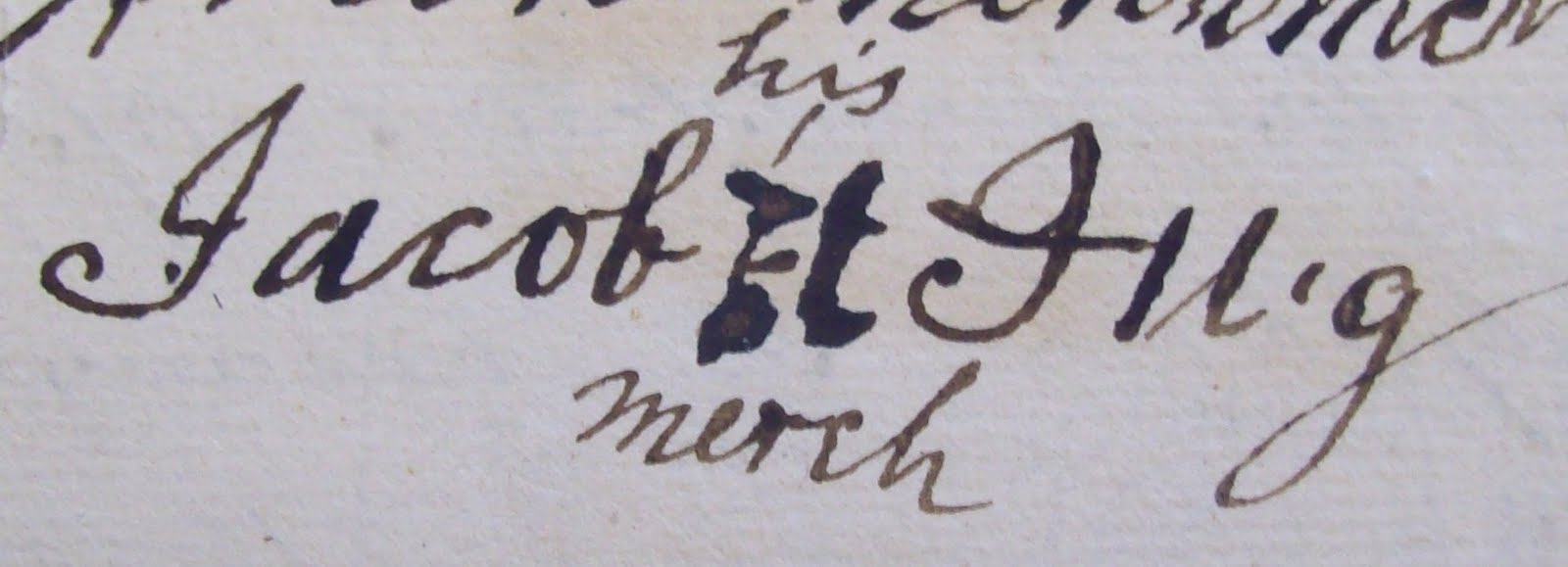
One example of someone using initals as their mark
While working with a collection of legal documents from the 1730s to the 1820s I discovered something interesting about signatures in early America. Previously I had been familiar with the idea of someone making a mark when they are unable to write their name. However, I had always assumed that these marks are almost always simple x’s . Working with the Hanson collection, my assumption has been proved over-simplistic. While it seems that many people chose to make their mark with an X, others were able to sign their initials.
A woman was asked to witness,
despite her inability to write
Additionally, the way that marks were presented is different than I expected. I had thought that people made a mark on a document and that was that. However, when given more thought, how would anyone know to whom the mark belonged? Well it turns out that when someone signed a document with a mark, the scribe or court official would write that person’s name around the mark and indicate that the mark was indeed his or her mark. This practice may have created some confusion, because often beside the signatures of those who had signed for themselves was a bubble with the letters LS inside. After some musing I decided LS most likely stood for Legal Signature, as a way of distinguishing between those who could sign their own names and those who could only make a mark.
L S, most likely meaning Legal Signature


It would be interesting to make a closer study of these marks, to see if any patterns emerge, in terms of who can sign their names and who cannot. I think that such a study might provide interesting insight into literacy in Early America.

Monday, April 18, 2011

Researching your Home


The Mabee Farm, Rotterdam

Everyone’s home has a history, are you interested in learning more about yours? Have you been remodeling or cleaning out and found something belonging to a past resident that made you curious? Did someone famous live in your house, was someone murdered in your house? Do you want to decorate the walls of your house or business with images from the past? We can help you answer these queries!
 Here at the Schenectady Historical Society we have resources which can help you learn about your house, whether it is located in the Stockade or Mont Pleasant. We have many files and photographs about streets in the city of Schenectady, if you want to see what your house looked like in the past, and how your street has changed with time. We have some files dedicated to specific houses, and who knows, one of those houses could be your home!
The Ingersoll Home, Niskayuna
 We also have city directories if you are interested in knowing more about past residents of your house. Were the past residents doctors, butchers, GE workers? Did a family live in your house, did they take in boarders?  If your house has an historic marker we have some original application forms, which may provide you with more information about the origins of your house. We also have scrapbooks on several of Schenectady’s oldest streets, assembled by Jonathan Pearson, a nineteenth century historian. Pearson collected maps, mortgage information and lots of other information and assembled it house by house, street by street. These scrapbooks, known as the street books, can provide a vast amount of information about a property.
The possibilities are vast, so drop by the library and learn more about your house and its past!


Friday, April 15, 2011

Katherine’s Goodbye

Katherine opening her farewell gift

Yesterday was Librarian Katherine Chansky’s last day with the Schenectady County Historical Society. Katherine has been an amazing asset to the Society over the past four years and the next librarian has very large shoes to fill. One volunteer, Elsie Maddaus described Katherine as “organized, knowledgeable and pleasant” and the other library volunteers are in agreement with her. Some words most often used to describe Katherine were friendly, eager, enthusiastic, helpful, dedicated, cheerful and persistent.
There are many projects that Katherine should take credit for including updating the Stockade Booklet, which was first published in the early 60s. She was also the originator of genealogy day here at the Society, a day of workshops and speakers discussing genealogical topics and research. Having historical fiction book discussions, like the program in March on My Name is Mary Sutter was another one of her brainchildren. Katherine has always been anxious to do what was best for the library. Bill Buell told me “when I asked her to be the subject of one of my Gazette QNA's, she agreed, not because she enjoyed the spotlight, but because she knew it would be good publicity for the library.”
Katherine has gone out of her way to teach the volunteers how to handle the library collections with care and how to manage a collection of this size. She has been a great person to work with, and she helped the volunteers to form a cohesive and content group. She has worked hard to make the atmosphere in the library friendly and welcoming, from her smile when you first walk through the door, to her garden of fake flowers plotted around the library.
Katherine posing for one last picture with library volunteers
and staff.
Overall, it is Katherine’s vision for the collection that has set her apart from many of the librarians before her. She has always had, and probably still does have, a to-do list for the library that is a mile long. But that list grows because Katherine is always anxious to take the collection one step further, making it easier to use, and manageable for the researchers and volunteers alike. I know she has left her mark here in the Grems-Doolittle Library and I would like to end by saying that Katherine will be missed as a colleague and a friend and we all wish her much success in her future endeavors.

Monday, April 11, 2011

Treasures of the Hanson Collection

More work has been done with the Hanson collection and it is time for an update. The collection seems to include many documents from the late 18th and early 19th century and some interesting documents have surfaced. I have selected a few that I found particularly interesting or unique within the collection to highlight now.
The first interesting document was Samuel Jackson’s application to be a citizen of the US “that the said Samuel Jackson is as this deponent verily believes attached to the Constitution of the United States, and well disposed to the good order and happiness of the same; and that he has ever since he has known him behaved as a man of good moral character.” I thought this document was particularly interesting because of the way it is worded. I cannot image anyone today considering themselves “attached to the Constitution.”
The second document that I want to mention made me laugh a bit. It was a letter to Brigadier general Henry Fonda from a court-martialed soldier. This soldier is writing to convince Fonda that he was unjustly charged because the order that he ignored was given to him on the Sabbath, the day of rest for all Christians. He even goes so far as to quote a specific law to the general. Someday I would like to see if I could find out more about this particular soldier and what became of his case.
The  last interesting document from the collection is a letter written in 1812 by a federalist. He spends the whole three pages of his letter writing philosophically about American politics, about the two different parties and about the future of politics in the State of New York. I think this letter would prove an amazing source for historians interested in early American politics.
I am sure to come across more interesting pieces to his immense collection, so I will provide you with another update soon!
Library Assistant Heather Cunningham, reading through the Hanson Collection to create a detailed listing of the materials

Friday, April 8, 2011

Archives in the Modern World- Going Digital

I recently attended a training session with CDLC, to learn how to use CONTENTdm, software that enables the management and uploading of digital archives to the internet. Previously, the Grems-Doolittle library, in partnership with the Schenectady Museum, had added some images and documents related to Charles Steinmetz to the CDLC digital collection. Now we are being encouraged to add still more digital records to CDLC’s growing database of images. 
There is some debate as to what collections we shall select to upload, and to what extent we are going to share our collections online, but we will definitely post something in the near future. Keep an eye out for our digital collections at CDLC’s website,  http://contentdm.cdlc.org/browse_collections.php and while we are in the process of uploading images, have a look at the Steinmetz collection.