Tuesday, May 31, 2011

Joseph Fazzone in World War II


Joseph Fazzone with
wife Bertha in 1943.


Joseph J. Fazzone (1911-2010) was a long-time area resident and a Navy veteran of World War II. After the war, Fazzone worked as a warehouse supervisor for the Army Depot until his retirement in 1967.


The Joseph Fazzone Collection chiefly pertains to Fazzone's military service during World War II in the Pacific theater. The collection includes a journal kept by Fazzone from August 1943 through December 1944 which records daily events and observations while he was in the Pacific. The journal details Fazzone's time on board the USS Chauncey, a U.S. Navy destroyer. Entries are comprised of brief descriptions of the day's travel or activity, such as the entry below, which mentions Chauncey's role in air strikes on Wake Island on October 5 and 6, 1943:


In addition to the journal, the Fazzone Collection includes photographs and military memorabilia. A finding aid for the collection can be found here.


Wednesday, May 25, 2011

Sanborn Maps


Portion of map of State Street and S. Center Street.
Image from 1914 Sanborn Map, updated through 1929.
Fire insurance maps were originally created as a means for insurance companies to underwrite policies for buildings that could not be inspected first-hand. Such maps are often referred to as "Sanborn maps" in reference to the Sanborn Company, based in New York City, that was responsible for producing the majority of fire insurance maps. Today, these maps are a useful resource for researching history, genealogy, preservation, urban geography and planning, and sociology.

Sanborn maps are bound in large volumes of numbered sheets. Each begins an index of streets and addresses, an additional index that includes the names of churches, businesses, and schools, and a map of the overall metropolitan area that indicates on which sheet to find certain blocks or areas. Each map sheet includes outlines of each building and outbuilding, the location of windows and doors, street names, street and sidewalk widths, property boundaries, building use, and house and block number. The maps also indicate information about each structure's building materials including framing and roofing, as well as locations of fire hydrants, water mains, gas mains, and often names of public buildings, businesses, and churches.

Portion of skeleton map showing lots
and buildings on Liberty Street
between Seward and Nott Terrace.
From 1914 Sanborn map.


To maintain accuracy and reduce production costs, updated drawings of new or altered buildings or lots were pasted on top of the old maps until a new volume was published. Occasionally, maps of some blocks include a base "skeleton" map outlining lots and properties.


Editions of Sanborn Maps in our library: City of Schenectady – 1884, 1889, 1892, 1894, 1900 (updated to 1912), 1914 (updated to 1924 and 1929), 1930 (updated to 1949/1961). Rotterdam Junction – 1913. To assist researchers in fully utilizing these maps, we also have information located nearby that explains abbreviations and notations used on the maps and offers suggested uses for Sanborn maps by genealogical researchers.

Monday, May 16, 2011

Helen Quirini and the Brother and Sister Cash Market

Many people in Schectady know of Helen Quirini for her work as a union organizer and community activist, but as a young woman, Quirini was also an entrepreneur.

Helen Quirini, late 1930s. Photograph from the Helen Quirini Collection.

In Quirini's memoir, Helen Quirini and General Electric: A Personal Memoir of World War II, she talks about her earliest work and entrepreneurship experiences following her graduation from Mont Pleasant High School in 1937:

"My brother had worked in a grocery store in the vegetable department and had than moved up to renting a concession in a meat market. I worked part time for him and then the store owner who ran the meat and grocery sections needed a 'delivery man' who also worked in the store. I applied for the job and with some apprehension, he hired me. Some of his customers did not like the idea because I wore slacks and besides this was not the traditional 'womens' job. The job was tiring because it seemed that all the customers lived on the second or third floors of the houses. After a while, they accepted me and even asked me to have a cup of coffee which I refused because I had other deliveries to make.

My brother and I then decided to become entrepreneurs and opened the "Brother and Sister Cash Market". We sold bakery, vegetables, and groceries. My brother's job was to get up at the crack of dawn and go to the farmer's market to buy vegetables and my job was to pick up delicious bakery from Scotia and bring it to the store for sale.

Brother and Sister Cash Market, 1279 Rugby Road, Schenectady, circa 1940.
Photograph from the Helen Quirini Collection.

I remembered with a smile about our first day of operation. The bakery was hesitant to sell to us because we were so young. So to prove to them that we were reliable we decided to get orders for over 25 pies. We ended up with four times that amount. The bakery had to hire extra people to bake these pies and we worked overtime to deliver them. We didn't make any money on this deal, but we did prove that we were 'reliable'. We worked 7 days a week about 10 hours a day. I made $12 a week and gave home $10 for room and board. It was hard work, but we liked the idea that we were our own bosses. We were forced to close our store because of the difficulty of getting supplies because of shortages and the war clouds over Europe."

The Quirini Collection includes awards, biographical information, material related to the Schenectady County Department of Senior and Long Term Care Services Advisory Council, a copy of the memoir quoted here, and numerous family photographs. A finding aid for the Quirini Collection can be found here.

Wednesday, May 4, 2011

Greetings from Melissa Tacke, Grems-Doolittle Library's new Librarian

I'm excited to come on board as Librarian at the Grems-Doolittle Library. During my first few days here, I have been warmly welcomed and helped enormously by our wonderful volunteers. I have also had the opportunity to meet several researchers and members of the Society, and I look forward to meeting more.

In my most recent experience before coming to the Library, I worked as a Library Assistant at Albany Public Library's Main Library. I have also worked as Project Archivist for the Adirondack Museum, where I processed and cataloged a number of collections, including the personal papers of Clarence Petty and Richard Lawrence, two of the “founding fathers” of the Adirondack Park Agency. Additionally, I served as Project Archivist at Bennington College, where I arranged, described, and preserved college records relevant to the documentation of the campus’ historic buildings. My appointment coincided with Bennington’s 75th anniversary, which provided me with opportunities to field numerous queries and create exhibits about the college’s history. I have also volunteered at the Efner City History Center and served as an intern at the College of Saint Rose Archives and Northeast Parent and Child Society. I have also earned my degrees in the area, from the University at Albany. There, I earned a Bachelor’s degree in Women’s Studies and Africana Studies in 2003, a Master’s degree in Women’s Studies in 2005, and a Master’s degree in Information Science in 2007.

I'm beginning to get to know the Library's collections, and I look forward to sharing some of the highlights of our collections here on this blog. Please feel free to contact me with any suggestions or comments, or simply come in and say hello!

Thursday, April 28, 2011


One crest, labeled Henry Rough Junior


A second crest, drawn in 1790

In some cases a picture is worth a thousand words! These two drawings were among the Hanson collection papers, mixed in with legal documents and personal letters. They seem to have the same artist, a Caggarus J Rough. They probably come from the Montgomery or Tryon county area.

Tuesday, April 26, 2011

Volunteer one on one: Ann Aronson

Ann Aronson has been a Grems-Doolittle Library volunteer since January 2006, when Carol Lewis suggested she might enjoy working here. Within a year Ann was also a trustee of the Society and she is currently on the buildings and grounds committee and the Mabee farm committee, as well as a co-editor of the Society Newsletter.
But when Ann is in the library, her main focus is working with our many photograph collections. The first project she worked on was the Laura Brown slide collection, which she organized and boxed.  Since then Ann has been involved in scanning numerous film negatives, glass plate negatives, slides and photographs. She was also involved in the production of Images of America: Niskayuna, a book of pictures relating to Niskayuna, which is for sale in the museum shop.  
Ann’s current project has not only been scanning the photograph collection, but also adding the information to PastPerfect, our digital cataloging system. And when she isn’t sitting the back of the library scanning pictures, Ann is often taking photos at Society events, either at 32 Washington Ave. or at the Mabee Farm. Ann says she continues to volunteer because she loves working with the photograph collection.  She enjoys the Society because of the atmosphere of camaraderie, friendship and fun, which exists here.

Thursday, April 21, 2011

An Interesting Discovery about Old Documents

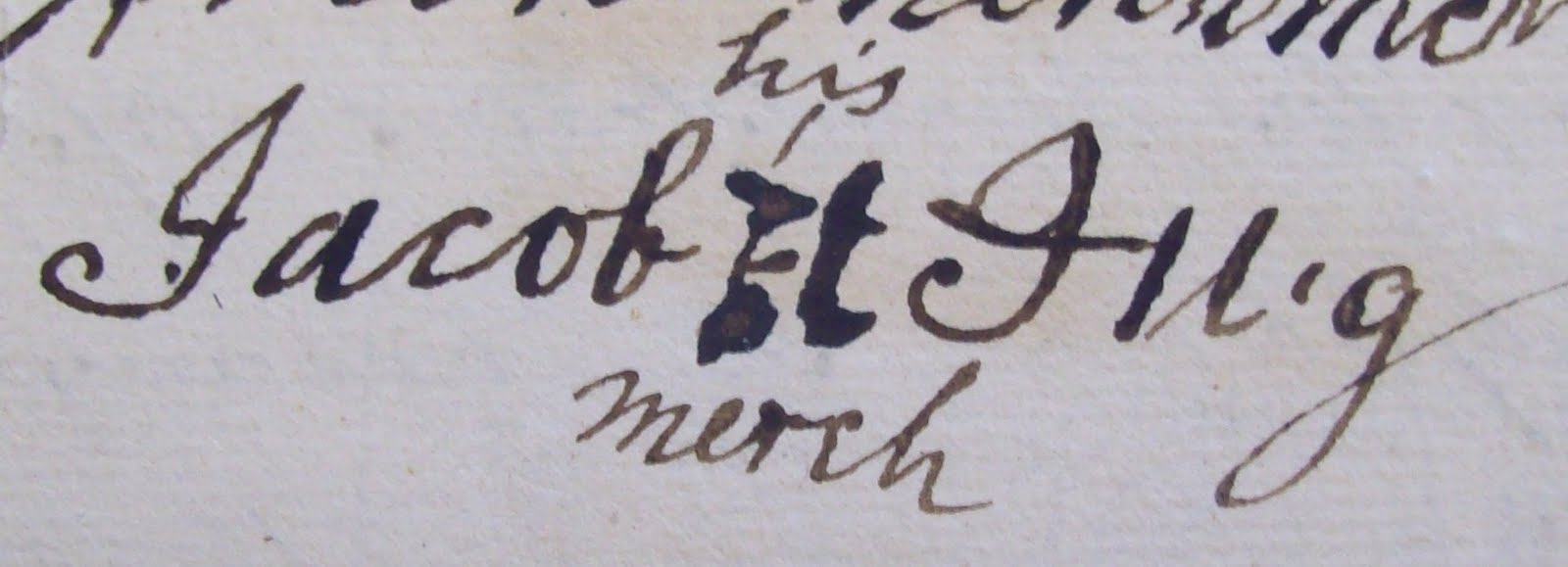
One example of someone using initals as their mark
While working with a collection of legal documents from the 1730s to the 1820s I discovered something interesting about signatures in early America. Previously I had been familiar with the idea of someone making a mark when they are unable to write their name. However, I had always assumed that these marks are almost always simple x’s . Working with the Hanson collection, my assumption has been proved over-simplistic. While it seems that many people chose to make their mark with an X, others were able to sign their initials.
A woman was asked to witness,
despite her inability to write
Additionally, the way that marks were presented is different than I expected. I had thought that people made a mark on a document and that was that. However, when given more thought, how would anyone know to whom the mark belonged? Well it turns out that when someone signed a document with a mark, the scribe or court official would write that person’s name around the mark and indicate that the mark was indeed his or her mark. This practice may have created some confusion, because often beside the signatures of those who had signed for themselves was a bubble with the letters LS inside. After some musing I decided LS most likely stood for Legal Signature, as a way of distinguishing between those who could sign their own names and those who could only make a mark.
L S, most likely meaning Legal Signature


It would be interesting to make a closer study of these marks, to see if any patterns emerge, in terms of who can sign their names and who cannot. I think that such a study might provide interesting insight into literacy in Early America.