Wednesday, March 28, 2012

Woman's Club of Schenectady


The Woman's Club of Schenectady drama department during a 1948 parade in Schenectady.
Photograph from the Grems-Doolittle Library Photograph Collection.
The Woman’s Club of Schenectady was organized after a discussion between two local university women seeking to form a woman’s club for “mutual improvement.” The first meeting was held at the home of Rebecca Hoffman on the grounds of Union College in 1900. The organization joined the state federation and general federation of women’s clubs that year. The first president of the club was Mrs. Louise H. Westover. The club was incorporated in 1908 and joined the Schenectady City Federation in 1915. 

56 Washington Avenue, the location of the
Woman's Club from 1920-1977. Photo taken 1962.
The club had its home at 238 State Street for many years before purchasing the house at 56 Washington Avenue in 1920. In 1930, under the presidency of Jessie T. Zoller, over $4,000 was raised to pay off the mortgage on the building. The club would remain at 56 Washington Avenue until 1977. Meetings were then briefly moved to the fellowship hall of the Eastern Parkway Methodist Church. The club had moved to its new home at 1309 Rugby Road by 1981, where it would remain until the meeting place was moved to Wynwood Commons, 1786 Union Street. The Woman’s Club celebrated its 200th anniversary in 2000.

From its earliest inception, the Woman’s Club focused on the cultural development of its members as well as projects supporting civic and philanthropic activity in the area. The club organized a number of departments over the years to oversee the group’s activities. Departments have included art, civics, drama, first aid, gardening, history, home economics, junior, music, parliamentary law, philanthropy, physical culture, public health, three S (service, success, and satisfaction), and tourism.

Sheet music for the Woman's Club of Schenectady song, composed by Clara Loyd Jones of Scotia. From the Woman's Club of Schenectady records.  
 In addition to holding frequent social and enrichment activities for its membership, the Woman’s Club of Schenectady also engaged in many charitable and community-improvement projects. The Woman’s Club raised funds for a number of local, national, and international charitable organizations over the years, founded the first supervised children’s playground in the city and advocated for the establishment of night schools. During World War I and World War II, the Woman’s Club raised funds for soldier care packages and war bonds. In 1925, the organization created a scholarship for local girls, which would come to be known as the Jessie T. Zoller Scholarship in later years.

Charter member Josephine Rickard, 
ca. 1920. Photo from Grems-
Doolittle Library Collection.
The Woman’s Club of Schenectady also worked to establish organizations that would be active in the community in their own right. In 1901, the Woman’s Club was instrumental in the formation of the Humane Society for Neglected Children, which would later become part of Northeast Parent and Child Society. The Public Health Association, a city organization, was first formed within the Woman’s Club in 1910. In 1916, the local branch of the Travelers Aid Society was formed under the auspices of the Woman’s Club. 

Woman’s Club mottoes over the years have included: “Service;” “Juncta Juvant” (Joined in fellowship and united in purpose); “To serve the present age;” “Let us therefore follow after the things which make for peace, and things wherewith one may edify another” (Romans 14:19); “So long as we love, we serve” (Stevenson);  “Let us be such as help the life of the future;” “Here’s to the greater to-morrow that is born of a great to-day;” “In essentials, unity; in doubtful matters, liberty; in all things, charity;” “Others;” “Coming together means beginning, bringing together means progress; keeping together means success;” “Together let us beat this ample field, try what the open, what the covert yield” (Pope). A song for the Woman’s Club of Schenectady was written by Clara Loyd Jones.

50-year-member Marjorie
Marco, ca. 1998.
From Woman's Club of
Schenectady records.
The records of the Woman’s Club of Schenectady consist of meeting minutes, year books, scrapbooks, and miscellaneous material including photographs, certificates, and written histories of the club. Ledgers in the collection include meeting minutes and other information pertaining to the club’s drama, home economics, and music departments. Scrapbooks contain newspaper clippings. A finding aid for the records of the Woman's Club of Schenectady can be found here.

Additionally, the library has clippings, documents, and photographs related to the Woman's Club of Schenectady and its members in our general holdings.

Thursday, March 22, 2012

Yearbooks

Yearbooks are a great source of information for genealogy researchers, as well as for people that are interested in the history of education, social life and customs, graphic design, and local history. Photographs of individual students, administrators, and faculty members and information about student clubs and achievements provide researchers a look into the lives of local people as individuals and as a group.
The student drawings and other design components show us the aesthetics of the period during which they were created. Yearbooks also offer valuable information about local businesses through the advertisements printed in them.

A complete list of our collection of yearbooks can be found here (updated September 2013). Our yearbook collection is slowly growing! We're always looking for more yearbooks from Schenectady County public and private schools, from elementary school through college. Please contact the Librarian, Melissa Tacke, by phone at 518-374-0263, option 3, or by email at librarian@schenectadyhistorical.org, if you are interested in donating yearbooks.

Below are just a few images from yearbooks in our collection.


Central Park Intermediate School yearbook Scrip, January 1925.
The school also published a literary magazine of the same name.
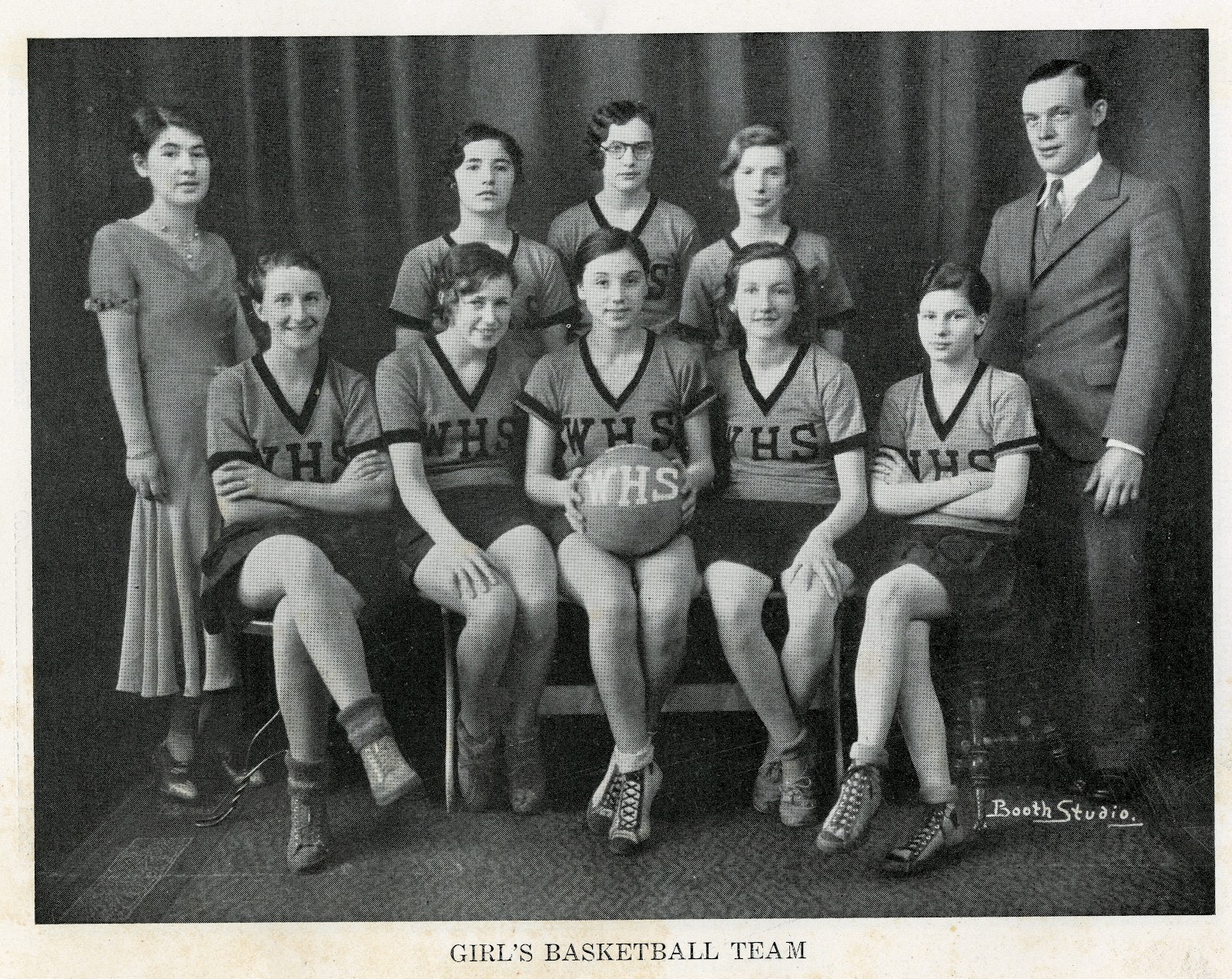
Photograph of the girls' basketball team at Woestina High School in Rotterdam Junction from The Woestinian, 1931.

The Japanese theme of the June 1917 Schenectady High School yearbook (SHUCIS)
differs from the standard cover for other years of the era; covers usually featured a simple
design and image of the school seal. SHUCIS was also the school literary magazine.

Advertisements from the Schenectady Savings Bank, Walker's Pharmacy, Tilly, and the Alling
Rubber Company from the 1911 Schenectady High School SHUCIS. Both the literary magazine
and the yearbook contain several pages of advertisements.
Whimsical drawings related to students at Schenectady Vocational High School printed in The Anvo, 1938.
These drawings, attributed to "JL," were drawn by James Lemmie, a student in the commercial art course of the school.
Photograph of the editorial staff of the 1905 SHUCIS.

Wednesday, March 14, 2012

Celebrating St. Patrick's Day and Irish-American Heritage in Schenectady


Happy St. Patrick's Day!
Postcard from Larry Hart Collection.

Over the years, St. Patrick's Day has been celebrated in Schenectady in a variety of ways. Newspaper clippings of the 1860s mention special church services and parades. In the early days of the 20th century, dinners, dances, and parties were held, and local merchants such as Barney's sold green carnations. Newspapers of the 1950s featured St. Patrick's Day recipes for home entertaining, and St. Patrick's Day sales were promoted by local businesses.

The celebration of St. Patrick's Day this Saturday also offers an opportunity to highlight the history of Irish-Americans in the city and county. Schenectady's division of the Ancient Order of Hibernians (AOH), a Catholic, Irish-American organization, was founded in 1880. The organization first met at the Center Street Opera House; the organization first appears in the 1882 city directory, listing Bernard Whyte as President and Martin Kelly as Secretary. The Hibernians met at a number of locations over the years, including the Van Curler Opera House, 729-733 State Street, and their current location at 1746 State Street, where the organization moved in 2000. The Schenectady Ancient Order of Hibernians have been active in promoting the culture, music, and language of Ireland, and have also been an important part of Schenectady's Irish-American community over the years, holding numerous social events including dances, variety shows, parties, communion breakfasts, Celtic Faire, and cocktail parties. As a group, the Schenectady AOH has also donated money to local causes, including scholarships for local high school students and funds for St. Clare's Hospital. The Hibernians have also organized and/or marched in St. Patrick's Day parades in Schenectady and in Albany.

A notice regarding the celebration of St. Patrick's Day in Schenectady in the March 19, 1866 Evening Star shows that imbibing on the holiday is nothing new. Image of newspaper retrieved via http://www.fultonhistory.com/.

Another organization that was active in annual St. Patrick's Day festivities was the Schenectady chapter of the Society of Friendly Sons of Saint Patrick. During the 1910s, the Friendly Sons hosted large dinners in celebration of the holiday, featuring speakers, songs, and fellowship. A 1911 newspaper clipping describes the celebration at the Vendome Hotel: "Sprigs of genuine shamrock were worn by many of the guests. The menu cards and favors were printed in green and tied with green ribbons and even the menu was tinged with the same color wherever possible, as in the ices, ice cream and punches, which were flavored and colored with pistachio and creme de menthe. Then there were green lights and the green ribbon insignia was displayed across the shirtfront of every guest, running from the northwest to the southeast."

Monsignor John L. Reilly, 1940.
Photograph from Grems-Doolittle
Library Photograph Collection.
One of the speakers who consistently addressed the annual St. Patrick's Day festivities of the Ancient Order of Hibernians and the Friendly Sons of Saint Patrick was the Monsignor John L. Reilly. The Rt. Rev. Msgr. John Liguori Reilly was born in 1853 in Albany. He attended Niagara University, where he earned his Bachelor's and Master's degrees. After completing his studies at St. Joseph Provincial Seminary in Troy, he became an ordained priest in 1876. He served as pastor for a few churches in New York State before coming to Schenectady in 1886. He was appointed a Monsignor by Pope Pius in 1904. He served the churches of St. John the Evangelist and St. John the Baptist for nearly 60 years. He often spoke before various organizations on behalf of the welfare of the city, and was recognized for his service in the fight against tuberculosis in the 1920s. He was a chaplain of the Schenectady council Knights of Columbus since its organization and was a charter member of the Schenectady Hospital Association and the Board of Managers of Ellis Hospital, member of the Friendly Sons of St. Patrick, the Schenectady County Historical Society, the Ingersoll Home, the Rotary Club, and the Schenectady County Humane Society. He received an honorary doctorate degree from Union College in 1943. He died at the age of 91 in 1945; at the time of his death, he was the oldest active priest in the United States. His obituary in the Schenectady Gazette stated that Reilly was "the symbol of Catholicism in Schenectady." He is buried at St. Agnes' Cemetery in Albany.

A ledger book of John Piper shows money sent to people in Ireland. The first page of the ledger reads, "John Piper is my name. Ireland is my nation - John Piper, Schenectady, New York." Image from Alonzo P. Strong Ledgers.

Schenectady Hibernians raise the Irish flag at the
corner of State and Jay Streets on March 17, 1986.
Photograph from Larry Hart Collection.
Monsignor Reilly and other prominent local Irish-Americans were highlighted in a clipping dated March 17, 1906, which included photographs of "Schenectady Irishmen typical of the race." Many of the men were prominent members of the community as well as men who were involved in Irish-American organizations such as the Ancient Order of Hibernians and the Friendly Songs of Saint Patrick. The men featured are: James Devine, Thomas M. Gleason, Patrick B. Kearney, John McDermott, Patrick H. McDermott, James C. McDonald, P.H. McDonough, John McEnroe, Daniel Naylon Sr. and Jr., Michael Nolan, William P. Nolan, and Monsignor John L. Reilly.

Many resources are available in the library to help researchers explore the history of St. Patrick's Day celebrations in Schenectady, as well as to trace the history of thr Irish-American community in Schenectady and Irish genealogy. Some materials include clipping files, family files, naturalization records, church records, original documents, books on Irish and Irish-American genealogy, and photographs.

Thursday, March 8, 2012

Lucia Newell Oliviere

Lucia Newell Oliviere, ca. 1920. Photograph
from Grems-Doolittle Library Collection.
Oliviere was born and named Lucinda Newell in North River, New York, around March 1855. After her father died, she was taken into the home of Rev. Enos Putnam in Johnsburg, an abolitionist who is said to have helped escaped enslaved people on their way to freedom in Canada. She was trained as a teacher at Albany Normal School and went on to teach for twelve years in Peekskill, Elmira, and Chestertown. She married Frank Oliver, and the couple had their first child, Julia, in 1879. Julia went on to be known as Jeanne Robert Foster, a noted poet, model, and journalist. Lucinda and her husband moved to Glens Falls during the 1890s and were living in Schenectady by 1900. Oliviere would continue to live in Schenectady until her death in 1927. After moving to Schenectady, Lucinda changed her name to "Lucia" and the family altered its last name to "Oliviere." In Schenectady, Oliviere became active in the Socialist party and local politics, writing in newspapers such as the Knickerbocker Press and George Lunn's newspaper, The Citizen. She wrote and lectured about a number of topics related to politics and social justice, advocating anti-militarism, socialism, suffrage for women, women's rights, labor rights, education, birth control, and the abolition of child labor and capital punishment.
Election ephemera from Lucia Oliviere Scrapbook. A hand-
written note beneath the card reads: "This card was used on
election day in Schenectady on November 6, 1917 - when
 equal suffrage was won."
Soon after suffrage for women was granted, Oliviere began making appeals to women voters, urging them to support Socialist candidates. In a November 1919 article titled "Women of Schenectady - How Will You Vote?" Oliviere addresses the working-class women of Schenectady, writing "the Democrat and Republican parties having each fought your right to political equality are now persistently seeking to secure your vote in their behalf. They have not changed their ideals - they still believe woman's place is in the home - but they remember that the women of the west turned the scales and elected Woodrow Wilson on the slogan 'he kept us out of war.' . . . You are willing to go out on a strike at much loss to yourself and your family, but you strike against the very conditions which you vote to maintain in November of every year. An ape should have more sense than that."  Throughout her articles, Oliviere addressed the concerns of working women, whether in an article highlighting the story of a female union organizer laid off by General Electric or an article aimed at wealthy families suggesting reforms that might make domestic work more attractive to young women than factory work.

Card promoting Lucia Oliviere, Socialist
Candidate for Supervisor of 8th Ward (1919).
From Lucia Oliviere Scrapbook.
Oliviere commented favorably on the "flapper" phenomenon of the 1920s, observing in a railroad station a young woman in flapper attire, unconcernedly crossing her bared legs while munching on a piece of fruit and reading "A Treatise on Political Economy for Women." Oliviere writes: "the coming woman of which a flapper is the advance guard are determined to have liberty and equality, to wear what they choose, to work at any trade or profession they desire, and the old fogies err if they think this will have any bad effect on public morals . . . the flappers will not forget mother today. They may feel a little sorry for our Victorian ideas." Oliviere also used her poked fun at charity-minded wealthy society ladies, employing a fictional "Mrs. Vanderburger" who offers skim milk to poor women an children as charity while advocating that "rich, creamy milk" be fed to pigs and calves to produce the finest meat for her family.

In addition to her work as a journalist, Oliviere also wrote poetry and fiction, which would occasionally appear printed in the newspaper. Her poem "Steinmetz" was published in the New York Times on January 30, 1923, after Charles' Steinmetz's death on January 26. The Anthology of Modern Poetry included Oliviere's poems "Carillo" and "She Will Go Out and Close the Door." A volume of Oliviere's poetry, titled Old Houses, was edited by Jeanne Robert Foster and published in 1928.

Oliviere was also active in local politics and civic activity. She was active in the fight for women's suffrage, organizing the Schenectady Industrial Suffrage Association and serving as its secretary. Under the Socialist ticket, she ran for the position of Schenectady County clerk in 1918, supervisor of the eighth ward in 1919, and ran twice for state senator, in 1922 and 1926. She was also a member of the Women's International League, the Consumers League, and the Woman's Club of Schenectady.

For those interested in finding out more about Oliviere's life in Schenectady, the Grems-Doolittle Library has a clipping file and photograph file for the surname Oliviere. We also have in our holdings a scrapbook compiled by Oliviere that includes clippings of her articles, poems, and short fiction, family photographs, and election-related ephemera.

Wednesday, February 29, 2012

Schenectady's Nineteenth-Century Black Barbers and the Anti-Slavery Movement

Tom Calarco, who has written many books about the Underground Railroad, writes in his book The Underground Railroad in the Adirondack Region that "census records generally show that the majority of free blacks in upstate New York who had attained some level of prosperity were barbers. But more significant to a study of the underground Railroad is the inordinate number who were agents or active in organizations that intersected with the Underground Railroad." This certainly seems to hold true in Schenectady, where at least three nineteenth-century black barbers appeared to have been connected to Underground Railroad activity or to the movement for the abolition of slavery. More information and research needs to be done in this area; for now, here are a few brief biographies of these men:


Newspaper advertisement for Francis Dana's barber shop
Francis Dana (ca. 1811–d. ca. 1875?)
Francis Dana was born in the British West Indies sometime between 1808 and 1811. There is a Francis Dana listed as a passenger on the ship George, which arrived in New York City from Frederickstaat, St. Croix, in 1826. Dana applied for naturalization in Schenectady in 1840. He is listed in the 1841 city directory as a barber working out of 146 State Street, on the canal. In 1842, Dana was listed as one of Stephen Myers’ North Star Association agents for the distribution of the Northern Star and Freeman’s Advocate. He continued to live and work in Schenectady until about 1865. A Francis Dana last appeared in the 1870 Federal census in Saratoga Springs, Saratoga County, and in Oriskany Falls, Oneida County (both locations show a man of similar age listed as being "mulatto" or "colored" and working as a barber).


Newspaper notice announcing the shop of John Wendell moving
from State Street to Ferry Street.
John Wendell (ca. 1801-d. 1875)
John Wendell (sometimes spelled Wendall, Wandell, or Wandle) was a barber. He was active in the Duryee Memorial AME Zion Church, serving as one of the church’s first trustees. He served as the first president of a local African-American temperance society in 1836. He was chosen to serve as secretary at a meeting of African-American citizens about the elective process (See The Colored American 28 December 1840). Articles in The Cabinet on March 18, 1845 and June 13, 1848 mention Wendell applying to the Common Council for aid to the school for African-American children in the city. Wendell died in 1875.


Advertisement for Stillman's razors endorsed by Richard P.G.
Wright. These types of advertisements were common in the
mid-nineteenth century.
Richard P.G. Wright (ca. 1778–1847)
Wright is perhaps the best known and most well-documented person in Schenectady connected to Underground Railroad and anti-slavery activity. He was born in Swansey, Massachusetts, and lived in Rhode Island for several years. In earlier years, he went by the name “Prince G. Wright.” By around 1811, Wright had moved to Schenectady, where he would continue to live until his death in 1847. Wright was a barber and both his business at 2 Canal Street and his home at 84 Ferry Street were close by the Erie Canal. Wright was deeply involved with local and regional anti-slavery activities; he was an early member of the American Anti-Slavery Society and a founding member of the Anti-Slavery Society of the City of Schenectady in 1838, and attended many anti-slavery conventions and gatherings in the region. Along with his son, the abolitionist and pastor Theodore Sedgwick Wright, he was a member of the New York Vigilance Committee. Wright and his son were also the only African-American members of the St. George’s Masonic Lodge in Schenectady. An Eastern New York Anti-Slavery Society 1843 annual report mentions 3 freedom seekers and notes that the agent who helped them “gave letter to Emp. Wright and Ellis Clizbe [of Montgomery County].” According to an article in the Emancipator and Weekly Chronicle (Boston) 16 April 1845, Wright assisted Charles Nelson in escaping slavery to freedom in Canada. Wright died in 1847; he is buried at Vale Cemetery in Schenectady.


Page from the 1841 Schenectady City
Directory. Black heads of household are
listed in italics.
 It is also worthwhile to investigate the lives of other free blacks who may have been active in anti-slavery efforts. Among other sources, the 1841 city directory is helpful here. The directory lists in italics all of the heads of households who are black, and in some cases professions are noted. Francis Thomas is another black barber listed at that time. The directory also includes names of prominent black citizens, such as Jacob Douw and Richard Sampson, who we find in a 1836 Schenectady Cabinet article as being involved in a black temperance society that had invited abolitionist Gerrit Smith to speak. Additionally, significant events, such as a national black conference held in Schenectady on September 16, 1844, deserve further inquiry. The library's collections of church records, cemetery records, family files, census records, newspapers on microfilm, clipping files, historic manuscripts, and other sources can help researchers learn about the lives of the city's black residents at that time period and about the contours of anti-slavery activity in the region.

Tuesday, February 21, 2012

Early Days of Union College


West College at corner of Union Street and College Street, looking north down College Street.
Photograph from the Grems-Doolittle Library Photograph Collection.
This blog entry was written by Frank Taormina, one of the Society's trustees and a frequent researcher here in the library.

We learned recently that Liberty Street was named after a Liberty Pole which had been erected in 1771 at the point where it was destined to make its eastward trek in 1802. Union Street, parallel to Liberty, got its name 4 years earlier in 1798 when it was changed from the Road to Niskayuna to Union by Schenectady’s first mayor, Joseph C. Yates. Yates was among the several citizens of Schenectady at this time who played a role in obtaining a charter from the New York State Regents for what was to be the second college in New York State, following Kings College, which came into existence in 1754 (Kings College was renamed Columbia University after the American Revolution). The process of obtaining a charter from the New York State Regents to permit the erection of a college in Schenectady took from 1779 to 1795.

Union College seal, which
features an image of Minerva.  
In 1795, Union became the first college founded in the United States that did not have a link to a specific religious sect.  Its name signifies that it was the “union” of several different religious sects then in existence in Schenectady that shared an interest in the creation of an institution of higher learning. Its symbol, a depiction of the Roman Goddess Minerva (who is usually also designated as the Greek Goddess Athena) and its motto, in French, “Under the Laws of Minerva, we all become brothers” was not associated with any religious sect.

Union’s first domicile was at the northwest corner of Union Street and Ferry Street, in a building erected in 1785, which had served as the “Schenectady Academy” until until Union occupied thie building in 1795.
Nine years later, Union moved to a location one block west, at the corner of Union Street and what became College Street, into a structure built especially for it which was called “West College.” That site today is the parking lot for the Van Dyck Restaurant.

From 1804 to 1814, this site, before the Erie Canal was dug along its eastern edge, was the location of Union College. In 1814, the college moved again, eastward, following the street which bore its name, Union, to the top of a hill generally called “Prospect Heights.” There, after erecting the stone wall we have since called “the Terrace”, were erected the two buildings, still very much like they were in 1814, and still called “South College” and North College.” 

Postcard depicting North College on Union College campus. From Grems-Doolittle Library Postcard Collection.
These buildings formed the beginning of the first planned college campus in America, still bearing witness, after nearly two hundred years, to the imagination and architectural skill of Jacques Ramee, and to the wisdom of Eliphalet Nott, the President of Union from 1804 to 1866, in hiring Ramee to plan the campus. 

The purpose of this blog is to introduce you to your surroundings on Union Street and to provide a brief account of Union’s existence in this neighborhood. There is so much more history of Union College – and much of it, for any one interested, on the net, accessible through a Google search.  In the meantime, as we walk down Union Street, let us listen - can we can hear the voices of all those associated with Union College as they strolled up and down the street named after their college between Ferry Street and Nott Terrace during the last two hundred years and seventeen years?

Tuesday, February 14, 2012

The Love Letters of Joseph Clements, Jr. and Bertha Platt


Happy Valentine's Day! This valentine comes from the newly-acquired Mynderse Collection.
"Never have I been so perfectly contented as I have been in your society. You have even caused me to turn from the ever practicable and dream of seeing new faces and new sights to-gether . . . So often have I wished for your companionship when I have heard splendid things said or seen funny things occur when others were there to see but who could not see." - Joseph Clements, Jr. to Bertha Platt, January 2, 1906.

In an apartment building at 22 Washington Avenue in 2005, building owner Marty Colangelo found two black tin cash boxes full of letters. The letters - approximately 250 - were written during the courtship of Bertha Platt and Joseph Clements, Jr. The two met in October of 1905 and soon began corresponding by mail. The first letter, dated November 24, 1905 and written from Joseph to "Miss Platt," was warm and polite. A month later, his letters had become lightly and humorously flirtatious; he drafted a mock contract regarding their plans to attend a New Year's dance. Very quickly, Bertha and Joe began to write each other almost daily, and the content of the letters rapidly shifted from flirtation to earnest declarations of caring. By spring, the couple was engaged.

Bertha was from a wealthy family, and Joseph was concerned that he would be able to provide a lifestyle for her that was was accustomed to. Bertha, on her part, reassured Joe of her love and her desire to be with him above all else. "I think I have seen the serious and all possible bad signs to getting married quickly," Joe writes on November 4, 1906. "And now, I don't see that anything could make me look terribly serious again. You see what annoyed me was that I could not give you all you had. Now I know and have known ever since your declaration that you'd go South with me that it was just me you wanted." As the year 1906 began to draw to a close, the letters made more frequent mention of the couple's impending marriage. "You and I, together!" Bertha wrote in mid-November. "Can you realize how fine it will be? I do want to help you, I do want to be everything to you - I do want that you may never be disappointed when you look to me."

After over a year of long-distance courtship, Bertha and Joe were married on January 12, 1907, in New Britain, Connecticut. They went on to live in Schenectady, where they had a son, McMillan, in 1909, and a daughter, Diantha, in 1918. The couple moved into 22 Washington Avenue, a property that Clements had purchased in 1909, in 1937. Joe died there in 1945; Bertha sold the property to Nicolas Colangelo in 1956. Bertha continued to live in the apartment until her death in 1960. The couple is buried at Fairview Cemetery in Princetown, their graves marked by a single stone, linked for eternity.

The letters that are left behind from their courtship serve not only as a rich document of their developing romance and commitment to one another, but also record Bertha and Joe's thoughts about events, document their activities, record impressions of the people in their lives, and serve as a window into social life and customs in the area at the turn of the century. The original letters are in the possession of Marty Colangelo. Elinore Schumacher, who lives in the building where the letters were found, worked to transcribe the letters and to conduct research about the couple. The transcribed letters and supporting information are available in the library.