Wednesday, April 25, 2012

Eleanor Jaeger School Photograph Collection


Unidentified girls put on a puppet show at Grout Park School in the 1950s.

Halloween parade at Euclid Elementary School, 1967.

The Eleanor Jaeger School Photograph Collection comprises photographs collected by Jaeger, an elementary school principal. The photographs depict the Euclid, Grout Park, and Halsey elementary schools in Schenectady during the 1950s and 1960s. Many of the photographs are professional photographs taken by Banrock Studio of Pearl River, New York; the collection also contains many informal snapshots. The collection also includes a publicity scrapbook for Euclid Elementary School and a scrapbook of material related to Hazel Graham of Grout Park Elementary School. The photographs depict a range of school functions and activities, including school events, building interiors, classroom and activity photographs, and group photographs of classes. A complete finding aid for the collection can be found here.

Class photograph from Euclid School, 1959.

Milk monitors pick up milk at Grout Park Elementary School, ca. 1954.

Classroom scene at Halsey Elementary School, ca. 1950s.
 
Eleanor Jaeger was a teacher and principal in a number of elementary schools in the Schenectady City School District. Jaeger was born in 1920, the daughter of Alfonse and Anna (Pilarski) Jaeger. She graduated from Mont Pleasant High School, earned her teaching degree at Oneonta State Teacher’s College, and took graduate courses at New York University. Jaeger worked as a first-grade teacher at Cobleskill Central School from 1942 until 1944. By 1947 she was serving as a special teacher for primary grades for the Schenectady City School District. In 1950, Jaeger became the first teacher in the district to be appointed as a school principal through the district’s apprentice system. She became principal of Halsey School that year, where she would serve through 1952. She went on to work as principal for a number of other local elementary schools, including Grout Park Elementary School (1953-1958), Woodlawn Elementary School (1958-1970), and Euclid Elementary School (1970-1973). After Euclid closed in 1973, Jaeger returned to the position of principal at Grout Park. She had retired by 1980.

Unidentified children involved in the Science Club at Euclid Elementary School, ca. 1950s. 

Children using the library at Halsey Elementary School, ca. 1950s.

Wednesday, April 18, 2012

Commissions in the Grems-Doolittle Library

Commissions grant authority to a person to perform particular duties or tasks. Many of the commissions pertain to positions related to legal functions or the law, including justice of the peace, commissioner of deeds, and public notary. Other local government positions documented include auctioneer and vendue master, inspector, coroner, master in chancery, undersheriff, and member of the city fire department. A few certificates confirming military service are also included in this collection.

Commission showing the appointment of William A.S. North and James Gale of Duanesburg and George McQueen of Schenectady as Inspectors of Turnpike Roads for Schenectady County, 1832 (Com 18).

Those commissioned for a most positions - even for local positions such as auctioneer or leather inspector - were appointed by the governor. The form for commissions of various types use preprinted boilerplate language, with only the position, locality, and date varying.

Occasionally, in looking through the collection, one can find commissions created entirely locally. One such example is this commission, created 1841, affirming the appointment Ralph Ostrum as a member of the fire department for the city of Schenectady in 1834. Ostrum (also spelled Ostrom), originally from Amsterdam, was a silver smith. In addition to being a member of the fire department, he served the city as an election inspector and as regulator of the city clock. This commission shows an aspect of Ostrom's civic involvement that a researcher might not otherwise come across using other resources.

Certificate verifying that Ralph Ostrum is a member of the fire department for the city of Schenectady, 1841. (Com 42)
The commissions in this collection range in date from 1783 through 1897. Most of the commissions date between 1809-1833. A complete list of commissions from our historic manuscripts collection can be found here.

Thursday, April 12, 2012

The Dialogue Coffee House

Leonard Miller asks a question during a session of the Dialogue Coffee House about a series of tape recordings written and produced by Rev. Malcolm Boyd about civil rights. This dialogue was held January 14, 1966, at the First Methodist Church in Schenectady. Photograph from the Dialogue Coffee House Records.

“Political protagonists seem to lay down their arms when they go to the house. Persons from all major political parties gather at this Schenectady night spot to talk and listen. Those of opposite political camps – liberals and conservatives – find they can hold dialogue with each other with feelings of tolerance and understanding.”
- Paul Dubner, in a 1967 Schenectady Gazette article, writing about the Dialogue Coffee House.

“We are convinced that dialogue is the ground out of which responsible community grows.”
- Grover E. Criswell, Chairman of the Board of Directors of Dialogue of Schenectady, Inc., 1966.

Dialogue of Schenectady, Inc., also known as the Dialogue Coffee House, was a non-profit organization aimed at creating dialogue among members of the local community. The organization’s coffee house hosted presentations and open dialogues about a number of topics, including social, economic, and political issues, local politics and government, civil rights, the war in Vietnam, visual and performing arts, health, religion and spirituality, psychology, labor issues, education, morality, and the nature of dialogue. While controversial topics were often featured at the Dialogue Coffee House, the atmosphere tended toward conversation rather than debate. In addition to open discussions and presentations, the coffee house also provided a space for underground films, musical performances, and plays as an impetus for dialogue. 

Newspaper advertisement for the
Dialogue Coffee House. 
The Dialogue Coffee House was organized by Rev. Grover Criswell of the Union Street Christian Church, Terry Hewitt, a lay Catholic, and Rev. Donald Stake of Union Presbyterian Church. The origins of the organization were inspired by the nascent “coffee house ministry” movement and by the progressive and ecumenical spirit of the Vatican II.  An initial organizing meeting for the coffee house was held in January 1965 at the First Methodist Church in Schenectady. By the following month, a statement of purpose had been written, which outlined the purpose of the coffee house as “to provide for the Schenectady area a place dedicated to the fostering of dialogue between persons. By dialogue we mean: the experience of significant conversation where the barriers between persons can be dropped because there is an atmosphere of trust . . . where the personal in our mass society is discovered.” The organization chose “The Dialogue” as a name and “a setting for significant conversation” as its motto. After several months of planning and organizing, The Dialogue held its opening session on September 12, 1965, at the First Methodist Church in Schenectady. Its first topic of discussion was United States foreign policy in Vietnam. The Dialogue continued its series of 54 programs at the First Methodist Church through June 1966.

The Dialogue operated in program years which ran from October through June, with a break from July through September. After ending the 1965-1966 season at the First Methodist Church, the Dialogue’s next season began in its own location at the second floor of 121 South Ferry Street in Schenectady. Interest and attendance at the Dialogue grew during the organization’s next year of operation; a 1968 report indicates that attendance at the Dialogue reached its peak around March 1967. Nearly 1,300 were in attendance at the coffeehouse during that month, in comparison to just over 400 in March 1966. At its busiest, the Dialogue Coffee House was open four evenings a week, Thursday through Sunday, with two days featuring speakers or other programming and two days based solely in fostering free-form discussion.  

This photograph shows the second location of the Dialogue Coffee House at 121 S. Ferry Street. The Dialogue was located on the second floor. Photograph from the Dialogue Coffee House Records.

As the popularity of The Dialogue grew, it encountered a few growing pains. Managing director Terry Hewitt wrote in March 1967, at the height of the Dialogue’s popularity, that “unfortunately . . . the program is now generally viewed as the end rather than the means . . . thus, it appears to me, that we are guilty of overemphasizing both the physical existence of the coffee house and the programming within it and have increasingly overlooked the very essence of this endeavor which is that of promoting personal interrelations among members and between the members and the public who come into the coffee house . . . We are quite rapidly becoming a commercial coffee house and losing the very spirit and motivation which brought this endeavor into existence.”

The coffee house also experienced changes in the ages of its participants as its popularity grew. Teenagers began to make up more and more of the crowd. Terry Hewitt recalls in his memoir that “the increasing number of young people was tending to keep some of the adults from attending.” A letter from Miss G. Kaminski written in 1967 addresses her reluctance to visit the Dialogue with its increased numbers of teenage attendees: “my first encounter with The Dialogue over a year ago was very stimulating, and I seriously considered becoming a member of your group . . . now, after my second encounter two months ago, I regretfully find The Dialogue is no longer appealing or inviting . . . at the last meeting, I was most disappointed to see the preponderance of teen-agers in attendance. Being well past the adolescent years, I do not actively seek the social company of adolescents, especially those Bohemian types to whom ‘coffee house’ spells Greenwich Village.” Perhaps in response, The Dialogue soon after helped to subsidize a teenage coffee house group, The Id, which met at the YWCA. In 1968, The Dialogue temporarily limited visitors to those 18 and older, and during 1969 opened up its doors one night a week to teenagers only. 

The cover of Vol. 1, No. 1 of The
Dialogue Journal.

In addition to activities at the Dialogue Coffee House, the Dialogue also published a journal, The Dialogue Journal, in spring 1967. John J. Waggy, Jr. served as the journal’s editor. Three issues were published from 1967-1968, featuring editorials and articles written by local people about a number of topics. Articles printed in the journal include “Alarming Problems Face the Schenectady Public Schools,” “Vatican II and the Albany Diocese,” and “Terminal Cancer and the State of the Theatre in Schenectady.”

The collection of Dialogue Coffee House records comprises the records of the organization from 1965 through March 1968, when Terry Hewitt served as managing director. The Dialogue Coffee House continued to operate at least through September 1969; it is unclear when the organization ceased operation. The records include correspondence, meeting minutes, newspaper clippings, publications and ephemera, photographs, financial information, and reports. The collection also includes a memoir written by Terry Hewitt, the organization’s first managing director, regarding his memories of the Dialogue Coffee House that includes a complete list of programs from 1965 through March 1968. A complete finding aid for the collection can be found here.

Wednesday, April 4, 2012

Historic Manuscripts Collection - Politics


Announcement of meeting of Republican electors of the first ward, city of Schenectady, 1828. (Pol 53)

Our collection of historic manuscripts comprises a number of categories, from broadsides to commissions to deeds to wills. One of the categories of historic manuscripts that is less often consulted is our collection of documents related to politics. Most of the documents pertain to local, regional, and New York State politics, and most date from the nineteenth century. The collection includes voter lists, election results, political ephemera, and correspondence and notes regarding politics.


The collection includes several undated notes written by E.Z. Carpenter,
including this note written about Yates (first name not given). (Pol 74)

This collection of documents amply illustrates the contentious nature of politics. The collection includes a number of undated, informal notes written by E.Z. Carpenter (1835-1917), a Glenville historian and genealogist, that are at times incendiary in tone. He refers to two local political figures, Hill and O'Dell, as "demagogues," and writes that another man, Yates, "prides himself on his own unbelief, but no one ever gave him credit for exceptional reason and all admit his shaky balance."

Carpenter is typically known as a gossipy source of information -- historian Neil Reynolds noted that Carpenter "chose to specialize in the seamy side of life" -- but the critical, satirical tone that runs through this collection is by no means confined to the content Carpenter created. An unattributed parody of New York State Governor William C. Bouck, written in a "German accent" English (Bouck was known for his heavy German accent), is entitled "Sour Krout Messitch."  The message addresses abolitionism, the enlargement of the Erie Canal, and other topics. The ersatz Bouck is agreeable to railroads "so lonk as der suddern peebles pe willing to kif us der fodes, watefer we to." Another unattributed piece, "Those Sheriff Bills," insinuates that the county sheriff's deputies "siez[e] as tramps every stranger they can catch" to enrich the sheriff himself, who received 17 cents for each vagrant housed in the jail.

List of voters in School District 10, Glenville, 1865. (Pol 57)
Other documents in the collection are less editorial in content and are more a recording of the processes of political activity, such as voter lists, election results, and the like. Other sources document local political activity outside of traditional electoral politics. A 1915 certificate admitting the Schenectady Economics Club, a local organization that hosted speakers and discussions about socialism, to the Intercollegiate Socialist Society (ISS) features the names of some of the ISS Schenectady chapter, including George Lunn and Charles Steinmetz.

A complete listing of the documents in the Historic Manuscripts Collection - Politics category can be found here. Library holdings of local government records, organizational records, clipping files, voter registration lists, scrapbooks, local histories, and other sources are available for researchers interested in local politics.

Wednesday, March 28, 2012

Woman's Club of Schenectady


The Woman's Club of Schenectady drama department during a 1948 parade in Schenectady.
Photograph from the Grems-Doolittle Library Photograph Collection.
The Woman’s Club of Schenectady was organized after a discussion between two local university women seeking to form a woman’s club for “mutual improvement.” The first meeting was held at the home of Rebecca Hoffman on the grounds of Union College in 1900. The organization joined the state federation and general federation of women’s clubs that year. The first president of the club was Mrs. Louise H. Westover. The club was incorporated in 1908 and joined the Schenectady City Federation in 1915. 

56 Washington Avenue, the location of the
Woman's Club from 1920-1977. Photo taken 1962.
The club had its home at 238 State Street for many years before purchasing the house at 56 Washington Avenue in 1920. In 1930, under the presidency of Jessie T. Zoller, over $4,000 was raised to pay off the mortgage on the building. The club would remain at 56 Washington Avenue until 1977. Meetings were then briefly moved to the fellowship hall of the Eastern Parkway Methodist Church. The club had moved to its new home at 1309 Rugby Road by 1981, where it would remain until the meeting place was moved to Wynwood Commons, 1786 Union Street. The Woman’s Club celebrated its 200th anniversary in 2000.

From its earliest inception, the Woman’s Club focused on the cultural development of its members as well as projects supporting civic and philanthropic activity in the area. The club organized a number of departments over the years to oversee the group’s activities. Departments have included art, civics, drama, first aid, gardening, history, home economics, junior, music, parliamentary law, philanthropy, physical culture, public health, three S (service, success, and satisfaction), and tourism.

Sheet music for the Woman's Club of Schenectady song, composed by Clara Loyd Jones of Scotia. From the Woman's Club of Schenectady records.  
 In addition to holding frequent social and enrichment activities for its membership, the Woman’s Club of Schenectady also engaged in many charitable and community-improvement projects. The Woman’s Club raised funds for a number of local, national, and international charitable organizations over the years, founded the first supervised children’s playground in the city and advocated for the establishment of night schools. During World War I and World War II, the Woman’s Club raised funds for soldier care packages and war bonds. In 1925, the organization created a scholarship for local girls, which would come to be known as the Jessie T. Zoller Scholarship in later years.

Charter member Josephine Rickard, 
ca. 1920. Photo from Grems-
Doolittle Library Collection.
The Woman’s Club of Schenectady also worked to establish organizations that would be active in the community in their own right. In 1901, the Woman’s Club was instrumental in the formation of the Humane Society for Neglected Children, which would later become part of Northeast Parent and Child Society. The Public Health Association, a city organization, was first formed within the Woman’s Club in 1910. In 1916, the local branch of the Travelers Aid Society was formed under the auspices of the Woman’s Club. 

Woman’s Club mottoes over the years have included: “Service;” “Juncta Juvant” (Joined in fellowship and united in purpose); “To serve the present age;” “Let us therefore follow after the things which make for peace, and things wherewith one may edify another” (Romans 14:19); “So long as we love, we serve” (Stevenson);  “Let us be such as help the life of the future;” “Here’s to the greater to-morrow that is born of a great to-day;” “In essentials, unity; in doubtful matters, liberty; in all things, charity;” “Others;” “Coming together means beginning, bringing together means progress; keeping together means success;” “Together let us beat this ample field, try what the open, what the covert yield” (Pope). A song for the Woman’s Club of Schenectady was written by Clara Loyd Jones.

50-year-member Marjorie
Marco, ca. 1998.
From Woman's Club of
Schenectady records.
The records of the Woman’s Club of Schenectady consist of meeting minutes, year books, scrapbooks, and miscellaneous material including photographs, certificates, and written histories of the club. Ledgers in the collection include meeting minutes and other information pertaining to the club’s drama, home economics, and music departments. Scrapbooks contain newspaper clippings. A finding aid for the records of the Woman's Club of Schenectady can be found here.

Additionally, the library has clippings, documents, and photographs related to the Woman's Club of Schenectady and its members in our general holdings.

Thursday, March 22, 2012

Yearbooks

Yearbooks are a great source of information for genealogy researchers, as well as for people that are interested in the history of education, social life and customs, graphic design, and local history. Photographs of individual students, administrators, and faculty members and information about student clubs and achievements provide researchers a look into the lives of local people as individuals and as a group.
The student drawings and other design components show us the aesthetics of the period during which they were created. Yearbooks also offer valuable information about local businesses through the advertisements printed in them.

A complete list of our collection of yearbooks can be found here (updated September 2013). Our yearbook collection is slowly growing! We're always looking for more yearbooks from Schenectady County public and private schools, from elementary school through college. Please contact the Librarian, Melissa Tacke, by phone at 518-374-0263, option 3, or by email at librarian@schenectadyhistorical.org, if you are interested in donating yearbooks.

Below are just a few images from yearbooks in our collection.


Central Park Intermediate School yearbook Scrip, January 1925.
The school also published a literary magazine of the same name.
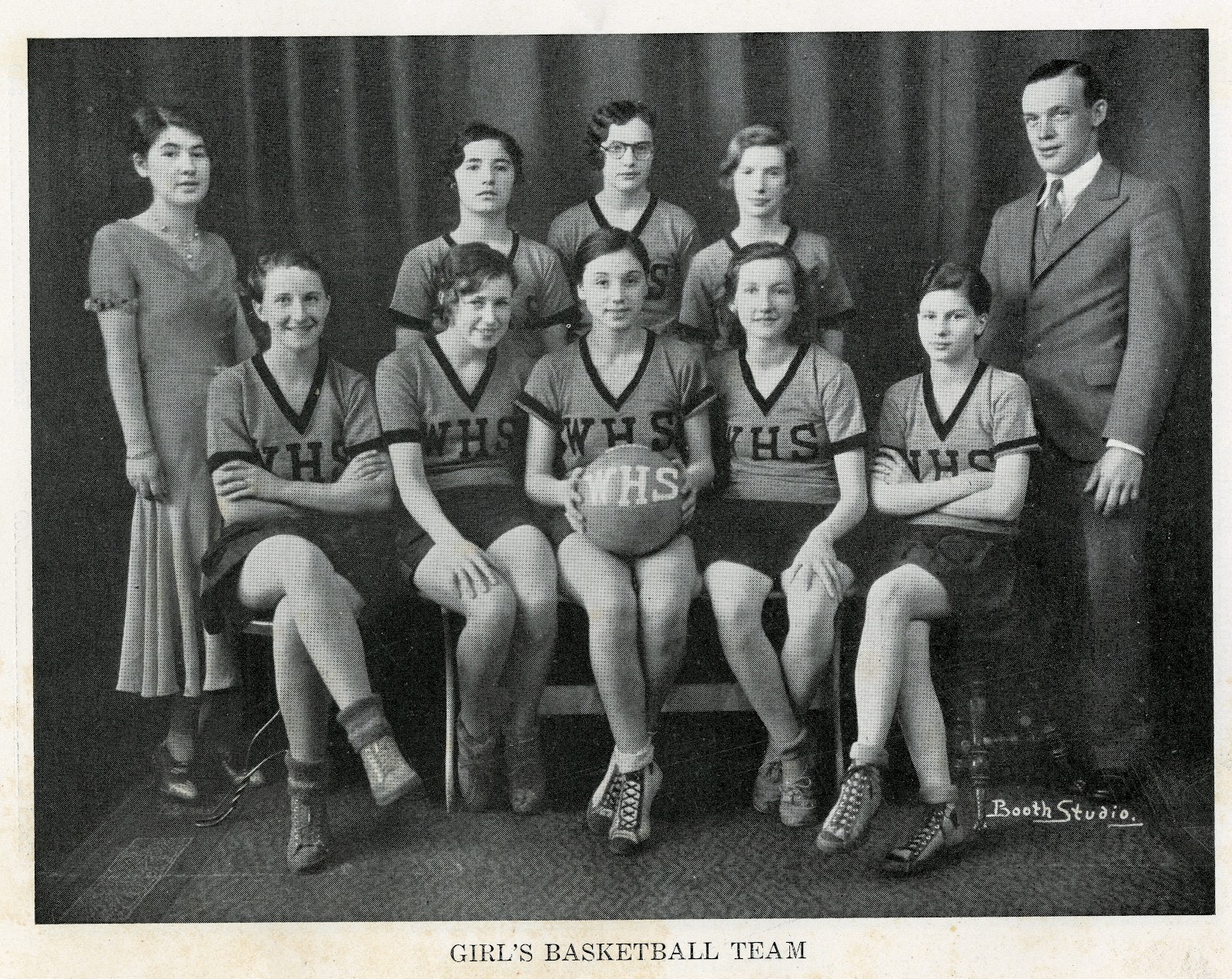
Photograph of the girls' basketball team at Woestina High School in Rotterdam Junction from The Woestinian, 1931.

The Japanese theme of the June 1917 Schenectady High School yearbook (SHUCIS)
differs from the standard cover for other years of the era; covers usually featured a simple
design and image of the school seal. SHUCIS was also the school literary magazine.

Advertisements from the Schenectady Savings Bank, Walker's Pharmacy, Tilly, and the Alling
Rubber Company from the 1911 Schenectady High School SHUCIS. Both the literary magazine
and the yearbook contain several pages of advertisements.
Whimsical drawings related to students at Schenectady Vocational High School printed in The Anvo, 1938.
These drawings, attributed to "JL," were drawn by James Lemmie, a student in the commercial art course of the school.
Photograph of the editorial staff of the 1905 SHUCIS.

Wednesday, March 14, 2012

Celebrating St. Patrick's Day and Irish-American Heritage in Schenectady


Happy St. Patrick's Day!
Postcard from Larry Hart Collection.

Over the years, St. Patrick's Day has been celebrated in Schenectady in a variety of ways. Newspaper clippings of the 1860s mention special church services and parades. In the early days of the 20th century, dinners, dances, and parties were held, and local merchants such as Barney's sold green carnations. Newspapers of the 1950s featured St. Patrick's Day recipes for home entertaining, and St. Patrick's Day sales were promoted by local businesses.

The celebration of St. Patrick's Day this Saturday also offers an opportunity to highlight the history of Irish-Americans in the city and county. Schenectady's division of the Ancient Order of Hibernians (AOH), a Catholic, Irish-American organization, was founded in 1880. The organization first met at the Center Street Opera House; the organization first appears in the 1882 city directory, listing Bernard Whyte as President and Martin Kelly as Secretary. The Hibernians met at a number of locations over the years, including the Van Curler Opera House, 729-733 State Street, and their current location at 1746 State Street, where the organization moved in 2000. The Schenectady Ancient Order of Hibernians have been active in promoting the culture, music, and language of Ireland, and have also been an important part of Schenectady's Irish-American community over the years, holding numerous social events including dances, variety shows, parties, communion breakfasts, Celtic Faire, and cocktail parties. As a group, the Schenectady AOH has also donated money to local causes, including scholarships for local high school students and funds for St. Clare's Hospital. The Hibernians have also organized and/or marched in St. Patrick's Day parades in Schenectady and in Albany.

A notice regarding the celebration of St. Patrick's Day in Schenectady in the March 19, 1866 Evening Star shows that imbibing on the holiday is nothing new. Image of newspaper retrieved via http://www.fultonhistory.com/.

Another organization that was active in annual St. Patrick's Day festivities was the Schenectady chapter of the Society of Friendly Sons of Saint Patrick. During the 1910s, the Friendly Sons hosted large dinners in celebration of the holiday, featuring speakers, songs, and fellowship. A 1911 newspaper clipping describes the celebration at the Vendome Hotel: "Sprigs of genuine shamrock were worn by many of the guests. The menu cards and favors were printed in green and tied with green ribbons and even the menu was tinged with the same color wherever possible, as in the ices, ice cream and punches, which were flavored and colored with pistachio and creme de menthe. Then there were green lights and the green ribbon insignia was displayed across the shirtfront of every guest, running from the northwest to the southeast."

Monsignor John L. Reilly, 1940.
Photograph from Grems-Doolittle
Library Photograph Collection.
One of the speakers who consistently addressed the annual St. Patrick's Day festivities of the Ancient Order of Hibernians and the Friendly Sons of Saint Patrick was the Monsignor John L. Reilly. The Rt. Rev. Msgr. John Liguori Reilly was born in 1853 in Albany. He attended Niagara University, where he earned his Bachelor's and Master's degrees. After completing his studies at St. Joseph Provincial Seminary in Troy, he became an ordained priest in 1876. He served as pastor for a few churches in New York State before coming to Schenectady in 1886. He was appointed a Monsignor by Pope Pius in 1904. He served the churches of St. John the Evangelist and St. John the Baptist for nearly 60 years. He often spoke before various organizations on behalf of the welfare of the city, and was recognized for his service in the fight against tuberculosis in the 1920s. He was a chaplain of the Schenectady council Knights of Columbus since its organization and was a charter member of the Schenectady Hospital Association and the Board of Managers of Ellis Hospital, member of the Friendly Sons of St. Patrick, the Schenectady County Historical Society, the Ingersoll Home, the Rotary Club, and the Schenectady County Humane Society. He received an honorary doctorate degree from Union College in 1943. He died at the age of 91 in 1945; at the time of his death, he was the oldest active priest in the United States. His obituary in the Schenectady Gazette stated that Reilly was "the symbol of Catholicism in Schenectady." He is buried at St. Agnes' Cemetery in Albany.

A ledger book of John Piper shows money sent to people in Ireland. The first page of the ledger reads, "John Piper is my name. Ireland is my nation - John Piper, Schenectady, New York." Image from Alonzo P. Strong Ledgers.

Schenectady Hibernians raise the Irish flag at the
corner of State and Jay Streets on March 17, 1986.
Photograph from Larry Hart Collection.
Monsignor Reilly and other prominent local Irish-Americans were highlighted in a clipping dated March 17, 1906, which included photographs of "Schenectady Irishmen typical of the race." Many of the men were prominent members of the community as well as men who were involved in Irish-American organizations such as the Ancient Order of Hibernians and the Friendly Songs of Saint Patrick. The men featured are: James Devine, Thomas M. Gleason, Patrick B. Kearney, John McDermott, Patrick H. McDermott, James C. McDonald, P.H. McDonough, John McEnroe, Daniel Naylon Sr. and Jr., Michael Nolan, William P. Nolan, and Monsignor John L. Reilly.

Many resources are available in the library to help researchers explore the history of St. Patrick's Day celebrations in Schenectady, as well as to trace the history of thr Irish-American community in Schenectady and Irish genealogy. Some materials include clipping files, family files, naturalization records, church records, original documents, books on Irish and Irish-American genealogy, and photographs.