Monday, August 27, 2012

The Mabee Family Papers

The original 1705 deed for what is now know as the Mabee Farm. In this deed, dated Jan. 22, 1705, Daniel Johnson conveys to John Pieterse Mebie a certain piece of land eight miles above the town of Schenectady on the South side of the Mohawk River containing 63 acres and 79 rood. This document is number M-Deed-06 in the Mabee Family Papers.

The Mabee Family Papers, a gift of George Franchere of Dunedin, Florida, consists of almost 600 items, including deeds, wills, correspondence, inventories, legal documents of many kinds, bills of sale for slaves, student exercises, and receipts for a wide variety of purchases. As a part of Mr. Franchere’s larger gift of the Mabee Farm, the Mabee Family Papers provide a wealth of information about the Mabee Farm and family. The wide breadth of materials in the collection are of interest to genealogy researchers as well as researchers interested in the history of the area. The documents in the collection give researchers a lot of information; not only about the Mabee family specifically, but also more broadly about commerce, farming, education, slavery, colonial Dutch language, cookery, war, and many other aspects of life and community. The personal correspondence, handwritten poems, and the elaborate calligraphy included in the student exercises provide a unique look into the personal lives, aesthetics, and personality of the people who created them.

The Mabee Family Papers are arranged and numbered by categories, in a style that parallels the system used for the Library's main Historic Manuscripts Collection. This introductory notebook begins with a listing of the categories used, followed by a categorized numerical list of the documents with an abstract summary of the contents of each item. See a complete finding aid for the collection here.

Below are just a few examples of some of the interesting documents included in the Mabee Family Papers.

This sketch map of an unidentified piece of land includes an interesting representation of scale information. “For Jacob Mabee, Esq.” is written on back of the map. Document number M-Misc-25 in the Mabee Family Papers.

Order by Col. John Bradstreet dated May 1, 1760, for “Jacob Mabie or a Sufficient Driver with a span of Horses, Harness and Waggon” to be “employed in his Majesty’s Service.” Document number M-Mil-05 in the Mabee Family Papers.


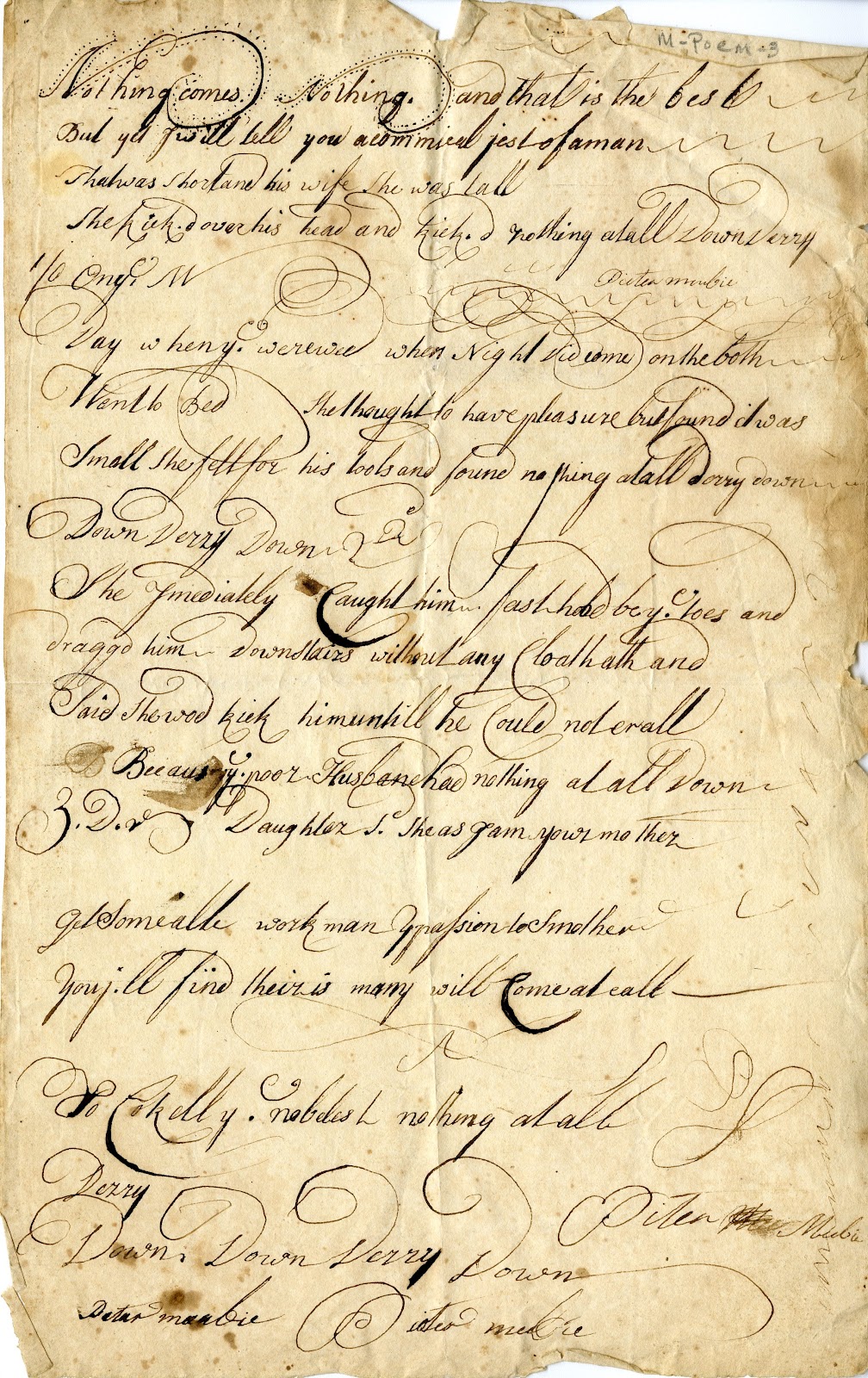
This slightly bawdy poem appears to have been written out by Pieter Mabee. “She thought to have pleasure but found it was small, she fell for his looks but found nothing at all.” M-Poem-03 from Mabee Family Papers.


Portion of a letter written by John V.P. Mabee to his cousin, Jacob Mabee, written while John was at Camp Vogdes, Fort Ringgold, Virginia in 1864 during the Civil War. John Mabee writes to his cousin for honey and beeswax and details the hardships of camp life. "I hope and pray I will see the day that I can meet Lieutenant Edward Smith in the streets of Schenectady when my term of service expires," he writes. "you can bet high he will either whip me or I will him[.] he is a very over bearing officer indeed." M-Letters-32 from Mabee Family Papers.


Bill of sale for a male slave named Cato, dated January 27, 1800. He was sold by Peter Conyne, Henry Funda, Peter Mabee & Simon Mabee to Jacob Mabee, for the sum of eighty-five pounds. M-Slaves-3 from the Mabee Family Papers.


Thursday, August 16, 2012

A First Look at the Dick Whalen Collection

Photograph of the interior of a barber shop operated by Benedetto "Benny" Zegarelli near the intersection of Main Street and Market Street in Rotterdam Junction. Photograph from Dick Whalen Collection.

Nearly one year ago, the Rotterdam Junction home of former Rotterdam town historian Dick Whalen was severely damaged by flooding caused by Hurricane Irene. The first floor of his property flooded with four feet of water, and the basement and garage, where Whalen's collection of historical materials were stored, was completely filled with water for at least three days.


This photo, taken a few days after the 2011 flood, shows standing water in the back of Dick Whalen's home and garage on Main Street in Rotterdam Junction. Photograph courtesy of Dick Whalen.  
 One week after the flood, after obtaining permission from Whalen to try to salvage some of the materials, we quickly moved to recover as many original photographs and documents as we could. Whalen had organized the historical materials he had compiled into themed binders. We moved nearly fifty wet, mud-covered binders out of his home and into frozen storage, in order to prevent mold growth and further deterioration of documents and photographs.

In 2004, Dick Whalen stands alongside one of the historical information boards he created. Photograph from Dick Whalen Collection.

Over the course of the next several months, I worked on thawing and drying out the materials from Whalen's collection binder by binder and rehousing them in folders and boxes. Many of the photographs and documents survived remarkably well. In June, volunteers and I began working on creating high-quality scanned images of the photographs and documents from Whalen's collection so that the historical information he compiled over the years would remain available to researchers in our library for years to come.

Many of the photographic prints in the Whalen Collection were in relatively good shape despite having contact with water. However, some photographs became so waterlogged that the emulsion lifted from the surface of the page. An example of this type of damage can be seen on this drawing of a Schenectady Savings Bank branch, although much of the image is still intact. Photograph from Dick Whalen Collection.


Woestina High School students on set of operetta "Green Cheese," performed in 1937. Photograph from Dick Whalen Collection.

The images you see here are just a few photographs and documents from the collection. The collection is a valuable resource about the history of Rotterdam and particularly of Rotterdam Junction, where Dick Whalen made his home for most of his life. Subjects documented in the collection include Rotterdam's town government, police, and fire departments, local schools and athletics, local industries, controversy surrounding the construction of the Rotterdam Square Mall, Rotterdam parades and historical celebrations, and historic houses in Rotterdam. Rotterdam Junction is particularly well-documented, from the Woestina School to local businesses to the people and families who lived there. For those interested in local history, the collection is truly a treasure. We're grateful for Whalen's diligence in compiling this material and his generosity in allowing us to record it and share it with others.


Rotterdam Town Supervisor John Kirvin marches in a parade in May 1978. Photograph from Dick Whalen Collection.

Carman Fire Department and members of the fire department, 1940s. Photograph from Dick Whalen Collection.
Mrs. Madison of Lower Rotterdam Junction. Photograph from Dick Whalen Collection.

Page from a 1898 diary of Norman M.F. Clute, a Rotterdam farmer. Note the drawing of a horse next to the entry about receiving a gray horse; Clute also inserted tiny drawings of chickens whenever he mentioned members of the family slaughtering one for a meal. From Dick Whalen Collection.

Photograph of a car near Hamburg Street destroyed during a severe storm in 1960. Photograph from Dick Whalen Collection.

Cover image from The Woestinian, a publication made by students at the Woestina School in Rotterdam Junction. From Dick Whalen Collection.

Thursday, August 9, 2012

Billiards Legend Frank Taberski

Drawing of Frank Taberski.
This blog entry is written by Amanda Stafford, one of our summer interns at the Schenectady County Historical Society.
Frank Taberski was born March 15, 1889 in Poland. He immigrated to the United States as a child and grew up primarily in Amsterdam, New York, before moving to Schenectady as an adult. In 1915, at the age of twenty-six, Taberski began to make a name for himself in billiards. At that young age, he became a professional billiards player and, after attending the New York City pocket billiards championship, knew that he could become a champion. Between 1915 and 1916, he became the world champion, a title he would hold for seven years. By 1918, he had won ten consecutive challenge matches. He gained two nicknames for his playing style, “The Sloth” and “The Inexorable Snail,” because he played with a slow, deliberate manner, taking several minutes to ponder his next move, which psyched out his opponents. Because of this style, a new rule was conceived that put a three-minute limit on the time between shots. In 1919, he forfeited the title due to illness. He joined a vaudeville exhibition circuit from 1919 to 1923, and won all 313 games he played. In the mid-1920s, he returned to the professional world of billiards and won four more titles before the decade ended. In the late 1920s, he opened his own bowling alley and pool hall at the intersection of Broadway and State Street in Schenectady. The building stood for forty years before burning down in the 1960s. Frank married a woman from Poland named Loretta, and together they had three sons. Taberski died on October 23, 1941 at the age of fifty-two.
But his legacy wasn’t finished. In 1999, he was ranked seventh on the Billiards Digest 50 Greatest Players of the Century. Before that, however, in 1971, he was inducted into the Billiards Congress of America Hall of Fame. The Billiards Congress of America (BCA) was established in 1948 with the objective to organize the players and to promote the sport through qualifying tournaments at the local, regional and national levels in both Straight Pool and 3-Cushion Billiards. The organizers also wanted to create an official rulebook for the sport to standardize it and to help fund their efforts. During the late 1940s and all of the 1950s, the sport was in a depression and the association was anchored by its new official rulebook and the official recognition of World and National Championships through BCA sanctioning. The sport gained great popularity after the release of the movie The Hustler in 1961. Today, the BCA International Billiards and Home Recreation Expo is the largest billiard trade show in the world.
The BCA Hall of Fame has been inducting players since 1966. There are two categories; Greatest Player and Meritorious Service. The Meritorious Service category is for players that have made a lasting and memorable contribution to the sport. The Greatest Player category is reserved for outstanding players who have been playing in national or international competitions for at least twenty years and have won at least one national or international championship. Not surprisingly, Frank Taberski was inducted in the Greatest Player category in 1975.
To see Frank Taberski in action, here is a short video of him - http://www.youtube.com/watch?v=2rnx4DkO8pk

Friday, August 3, 2012

An Interesting Discovery

First page of Glen Letter 455, a letter from Richard Duncan to Gov. Joseph Yates regarding a debt Duncan owed to Yates.


This blog entry is written by Chris Carney, an intern at the Schenectady County Historical Society.

            My name is Chris Carney, and I am one of three summer interns here at the Schenectady County Historical Society. As someone who is not originally from New York, this internship has provided an amazing opportunity to learn about New York and Schenectady history. Initially, the project I was given was simple enough: select a letter from a collection of general papers and correspondence and research/write about it. I chose a letter from one Richard Duncan of Schenectady to Joseph C. Yates, the Governor of Schenectady. Dated the 16th of April, 1815, Richard Duncan is asking for leniency concerning debts he owes to Joseph Yates. While Joseph Yates is a common name where Schenectady history is concerned, Richard Duncan was an unknown to me.
            As it turned out, Richard Duncan was quite the man himself. His date of birth is unknown, but in 1755 he came to America from Berwick-upon-Tweed, England with his father, a merchant by the name of John Duncan. Richard is most notable for being a British loyalist, also known as a “Tory.” To that effect, in June of 1776, he assisted Adjutant General Allan Maclean in escaping to Canada and the following year he joined John Burgoyne’s army at Saratoga (Schuylerville, NY). After their surrender on the 17th of October, Richard traveled to the province of Quebec.[1] There, he was commissioned captain in the first battalion of Sir John Johnson’s King’s Royal Regiment of New York, also known as “The King’s Royal Yorkers”.[2] Despite his political and territorial connections in Canada, Duncan returned to Schenectady in 1791 after the death of his father to care for his father’s estate known as the Hermitage, an 800-acre parcel of land in Niskayuna.
            Initially when researching, I was unsure if the Richard Duncan who wrote the letter I was looking at was the same Richard Duncan detailed above. The piece of information that confirmed my suspicions was found at a Canadian reenactment website dedicated to the regiment Duncan was Captain of, The King’s Royal Yorkers. The site has a page dedicated to Richard Duncan’s powder horn. It had just crossed the auction block, and as a result, there are a number of highly detailed images of the powder horn. One of the images shows the intricate carving of a house from Niskayuna, his father’s property at the Hermitage![3] His letter to Yates also mentions his father’s former property. Between Richard and his father, a debt of £3,000 had been jointly accrued, and after John Duncan’s death, Richard began selling parcels of the Hermitage. One buyer mentioned in Duncan’s letter to Yates was Harmanus P. Schuyler. Schuyler built a large brick estate for his family, and that house is now known as the Stanford Home. If you take a drive down Rt. 5 toward Mohawk Commons, you’ll notice a brick house in the midst of being moved. That is the house built by Schuyler on land originally purchased from Richard Duncan. It is too cool how history and today intersect sometimes. The letter itself is dated April 16, 1815, and Richard died four years later in 1819.
            This research into the background of Richard Duncan helped to impart a newfound curiosity into other Tory sympathizers during Colonial America’s time under England. Every city has their own interesting characters, but to have found such an interesting person on accident, simply because I picked a letter with a printed transcription was a surprise. I’d be interested in how many British sympathizers lived in and around Schenectady and upstate New York in general. I’d also be interested to know what life was like for a Tory after American independence was achieved. All in all, it was an interesting piece about a surprisingly interesting person in Schenectady history.


[1] University of Toronto. Dictionary of Canadian Biography Online. University of Toronto. http://www.biographi.ca/009004-119.01-e.php?&id_nbr=2383 (accessed July 27, 2012).
[2] The King’s Royal Yorkers. The Regiment. The King’s Royal Yorkers. http://royalyorkers.ca/regiment.php (accessed July 27, 2012).
[3] The King’s Royal Yorkers. Captain Duncan’s Horn. The King’s Royal Yorkers. http://royalyorkers.ca/duncan_horn.php (accessed July 27, 2012).

Thursday, July 26, 2012

Emma Goldman in Schenectady


Portrait of Emma Goldman, ca. 1911. Source: Library of Congress.

Emma Goldman was an anarchist, activist, writer, and orator known for her fiery speeches. A frequent orator about topics as widely varied as militarism, birth control, and modern drama, she was branded "the most hated woman in America" after being accused of complicity in the assassination of President McKinley in 1901. Goldman spoke around the country and the world, and she is known to have spoken in Schenectady on at least four occasions.

The first occasion that Goldman spoke in Schenectady was on January 16, 1908. The topic of her speech as "Syndicalism - A New Phase in the Labor Movement." In writing about her speaking tour that year, Goldman wrote: "Schenectady gave the largest American audience and a very enthusiastic one at that." Julius Seltzer, an anarchist who lived in Schenectady from 1907 until 1911, helped to organize the talk. In an oral history interview conducted in 1972, Seltzer remembered organizing the lecture for Goldman: "it was an enormous success, with an overflow crowd." Of Goldman herself, Seltzer remembered that she was "affectionate, always hugging and squeezing me . . . she was a homely woman, but once she mounted the rostrum she became a different woman, beaming with fire, beautiful in her Spanish shawl."


"Schenectady Ripe for the Revolution." This headline appeared in the daily Socialist newspaper New York Call in 1911, as George Lunn's election as the first Socialist mayor for the city of Schenectady seemed to be a real possibility. A few years later, in 1914, the Albany Evening Journal referred to Schenectady as being "a hotbed of Socialism." Image obtained via http://www.fultonhistory.com/.

Goldman had planned another trip to Schenectady to speak in 1911, but the talk was cancelled. She did not speak in Schenectady again until 1915, when she spoke three times within a period of a few weeks. Her first talk in 1915 was on February 24, 1915 at the Red Men's Hall at Ferry Street and Liberty Street. About 300 people gathered to hear her lecture, entitled "Why the Socialists of Germany Betrayed Their Cause to the Kaiser." An article in the Schenectady Gazette the following day called the talk "an interesting discussion of the present war in Europe," and shared quotations from Goldman's talk. The article commented on Goldman's refusal to have a chairman introduce her: "The speaker was not introduced and occupied the stage alone, saying she had found a chairman as much of a hindrance as a help. By way of personal introduction she said she was not sent by the Republican or Democratic party nor by the Catholic Church."


Headline of story highlighting Goldman's lecture on February 24, 1915, that appeared in the Schenectady Gazette the following day. Image obtained via http://www.fultonhistory.com/.

Soon after, Goldman spoke again at the Red Men's Hall on March 10, 1915, on the topic of "Some Misconceptions of Free Love." Following her talk, the Schenectady Gazette reported on her lecture under the headline "Emma Goldman Scores Marriage." The reporter did not quote Goldman, but simply paraphrased her talk and delivered it in a matter-of-fact manner: "The speaker took the stand marriage is an economic and social institution and not a religious one. She branded it as legalized immorality. That the marriage ceremony is a  mere farce was another statement. As proof of this she claimed that no intelligent woman would take the marriage vow with the intention of keeping it, as that would be swearing away all her self-respect and independence and giving herself over into chattel slavery."


This letter to the editor and reply appeared in the Schenectady Gazette on March 16, 1915. Goldman was a divisive figure among leftists during this time period. Some groups and individuals aligned themselves with her voice to increase their profile, while others sought to distance themselves from her.  Image obtained via http://www.fultonhistory.com/.

The last time Goldman spoke in Schenectady was on March 31, 1915. She spoke at the Machinists' Hall at 258 State Street on "The Birth Strike," delineating the disadvantages of a large family for working men and championing the cause of Margaret Sanger, who was facing prosecution under the Comstock Law for distributing a family planning pamphlet. This talk was organized under the auspices of the Schenectady Social Science League; thus far, I have not come across any mentions of the organization other than in connection with this lecture.

Tuesday, July 17, 2012

The Murder of David Reynolds

Headline reporting the murder of David Reynolds. From Evening Star, May 24, 1901.

The library's "Crime and Criminals" clipping file yields a look into the sordid side of life in the history of Schenectady County. The file contains newspaper clippings related to robberies, hangings, kidnappings, organized crime, and murders. One such case is the unsolved murder of David Reynolds, a Scotia farmer.

David Reynolds, or "Uncle Dave" as he was referred to by his neighbors, was a 66-year-old "eccentric" farmer who lived alone at what is now known as the Flint House. Reynolds was known to carry large amounts of money. Neighbors claimed that only a few days before the murder, Reynolds had had at least $200 in cash on his person. Days before the murder, the Evening Star reported, "a neighbor offered to bet $100 that Mr. Reynolds' horse could not draw 3,000 pounds, when the latter pulled a roll of bills out of his pocket and said, 'I'll bet this roll, and it holds more than $100.'"


Rural Scotia, ca. 1880s. This photo was taken from around the area of the Flint House, looking toward the village. David Reynolds purchased the property in 1887. From Grems-Doolittle Library Photograph Collection.

On the evening of May 23, 1901, George Dutcher, who lived on the farm, was concerned that Reynolds had not been seen since the night before. Looking toward the barn, Dutcher saw that the doors were wide open, which was uncharacteristic for Reynolds. It was getting dark, and Dutcher went to get a lantern and called on neighbors William Vandenburgh and William Cowell to accompany him.

Entering the barn, the trio saw that Reynolds' horse was partially harnessed. Blood was spattered on the cow stanchions, suggesting evidence of a struggle. Reynolds was soon found in the barn, buried under a stack of hay. Most of his clothing had been removed, including his boots, where he was known to have kept his money. He had been struck several times in the head with an axe, which was also found at the scene of the crime. Tracks led from the barn to the Mohawk River then disappeared -- the police assumed the murderer had washed himself off there.

Photograph of Flint House, ca. 1979. Image from Scotia Album, 1904-1979.

By the following day, police had a description for a suspect for the murder -- a man who had approached Adam Lamboy, a farmhand at a nearby farm, inquiring about how to get to Schenectady. He had a bloody spot on the side of his head, and was described as being 5'8", 160 lbs., age 50, wearing a small gray flat-top hat, steel gray coat, and a mustache. On June 6, a one-armed man named Worth Green, described as a "demented tramp," was arrested for Reynolds' murder. Except for the missing arm, he matched the description of the man seen on May 23; however, he was not considered a subject after being questioned.

Soon after, on June 25, police arrested August Weinhill of Amsterdam for Reynolds' murder. On June 19, Weinhill had stolen 42 chickens from a farm in the town of Florida; he wouldn't have been caught, except a letter addressed to him had fallen out of his pocket while on the property. A June 25 Evening Star article plainly claims that "the arrest of Weinhill on the chicken stealing charge, although he is suspected of having had something to do with that thievery, was a subterfuge on the part of Sheriff Wasson, who had good reason for desiring to get Weinhill into his custody. The sheriff had recently come into information which pointed strongly toward Weinhill as being connected with the murder of David Reynolds." The article does not reveal what the information is, but it was likely information that emerged from a later newspaper article; a prisoner in the Albany jail who was confined with Weinhill (who was himself in jail for stealing hogs) gave information to investigators that "Weinhill had seemed quite interested in the deed," referring to Reynolds' murder. 

Adam Lamboy identified Weinhill as the man he saw on May 23. Other details emerged; a man named Wilson on the day before the murder saw two men talking near the Scotia dyke. One man, who Wilson identified as Weinhill, asked "where is the house?" and the other man directed Weinhill to a place that indicated Reynolds' house.

Weinhill was taken into custody and brought before a grand jury, but the grand jury failed to indict him. Afterward, Weinhill returned to Amsterdam, where he lived until he died of heart disease in May 1902. 

A 1931 Schenectady Gazette article about unsolved murders since the turn of the century related the story of Reynolds' murder, adding "an even number of years later [in 1907] on the date of the murder, the barns and outbuilding were burned. The farmhouse was unoccupied at the time. No one ever knew who started the blaze -- but in the midst of the flames, telltale bloodprints disappeared forever."

Wednesday, July 11, 2012

Schenectady Goes to the Movies

Take a trip back in time to Hollywood's golden age, as experienced in Schenectady, through a sampling of images from our holdings. 
 
Entrance to the Art Theater – 1913. The Art Theater was one of the early movie theaters in Schenectady. It was located at 432 State Street, where Proctor’s Theater is now. The first movie shown in Schenectady was The Great Train Robbery, shown at the Crescent Theater in 1905. The first movie theaters were small. Some makeshift movie theaters were even set up in non-theater buildings, such as a fraternal organization hall. Early theaters were sometimes referred to as nickelodeons, because of the five-cent admission charge that was standard. Photo from Larry Hart Collection.


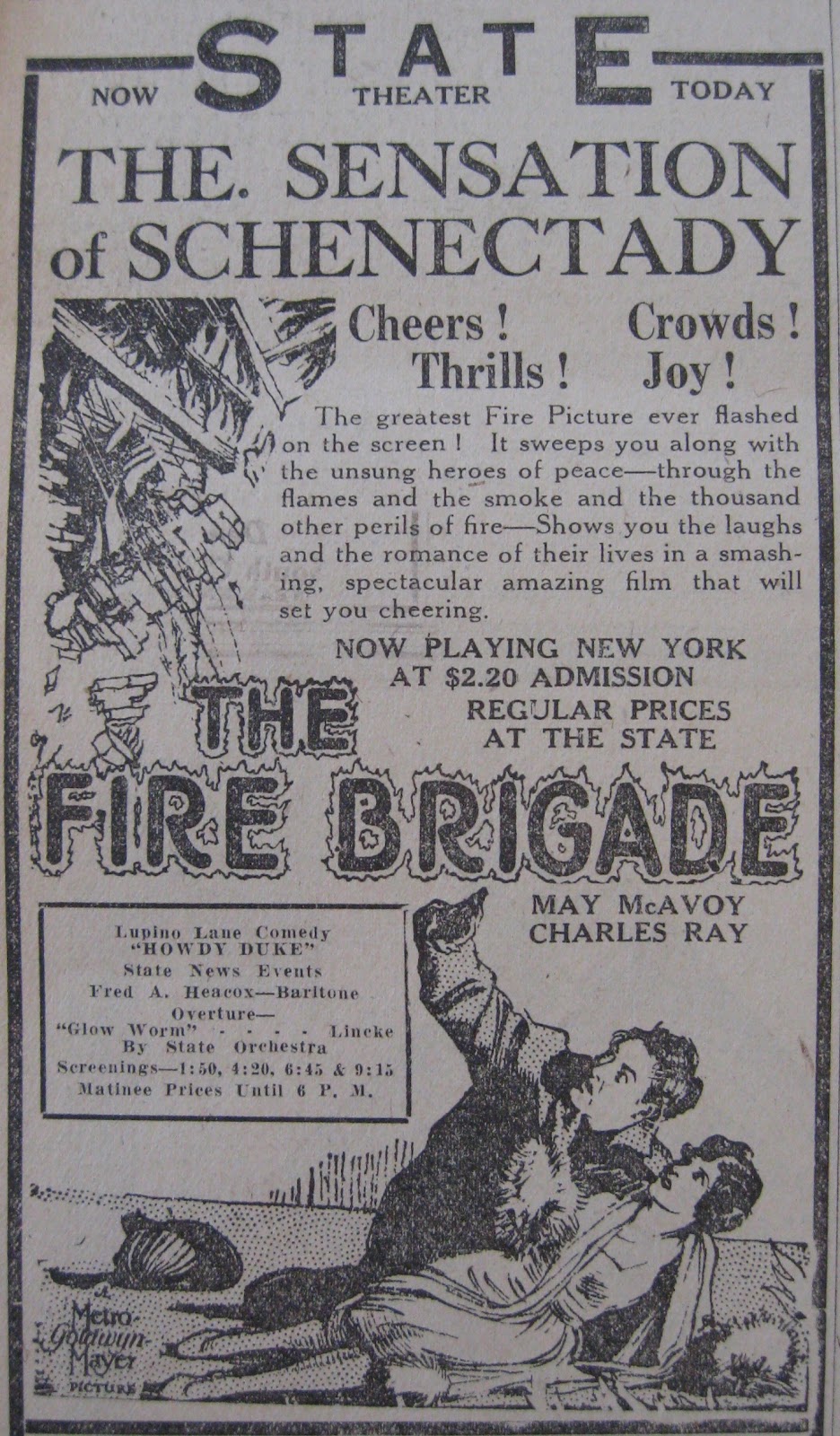
Advertisement for movie in Schenectady Gazette – 1927. Advertisements for movies were common in the newspaper during this period. This ad for the silent film The Fire Brigade appeared in February 1927, just a few months before sound movies, or “talkies,” became popular nationwide. Most movie advertisements in newspapers during this time featured drawings designed by the Hollywood production company; the State Theater put a local spin on this ad by calling the movie “the sensation of Schenectady.”


Entrance to Proctor’s Theater – 1936. The entrance to Proctor’s Theater in 1936 looks much the same as it does today (minus the "newsie" standing outside, of course), as the original look of the building has been preserved and restored. The first Proctor’s Theater in Schenectady was built in 1912 off Liberty Street by the Erie Canal. The present Proctor’s Theater, designed in an Italian Baroque style by architect Thomas Lamb, was opened in 1926. It is on the National Register of Historic Places and is a local landmark. Photo from Larry Hart Collection.


Actress Ginger Rogers visits Schenectady County – 1946. This photograph shows actress Ginger Rogers visiting Schenectady County to see the family of her then-husband, Jack Briggs, in Quaker Street. The couple visited on November 24, 1946, to celebrate the 60th wedding anniversary of Briggs' grandparents. Briggs, a Schenectady County native, was also an actor. The couple met when working on the set of Tom, Dick and Harry (1940) and married in 1943, divorcing in 1949. Many other famous musicians, actors, and entertainers have visited Schenectady over the years, including famous clown Emmett Kelly, jazz legend Duke Ellington, and then-actor Ronald Reagan, who was a spokesman for G.E. Photo from Larry Hart Collection.

Matinee crowd at Lincoln Theater – 1950. A crowd of moviegoers lined up at the Lincoln Theater on Brandywine Avenue. Visitors to the Lincoln Theater during the 1930s and 1940s often saw Edward Spellacy, known as “the popcorn man.” Spellacy sold hot, fresh-popped popcorn for 5 cents per bag from a cart with a steam-powered dancing metal clown on top. Photo from Larry Hart Collection.