Monday, March 25, 2013

Schenectady Inventor Revolutionized Golf


Drawing of Schenectady Putter, patent no. 723,534, patented by Arthur F. Knight. Image from United States Patent and Trademark Office, viewed via Google Patents (http://www.google.com/patents/US723534). 


This blog entry is written by Schenectady County Historical Society trustee John Gearing. 

Every so often I search Ebay for items that have “Schenectady” in their description, just to see what turns up. Almost without fail, there will be at least one antique golf club described as a “Schenectady putter” up for sale. With curiosity piqued and the Spring golf season about to begin, some historical investigation seemed to be in order.

In 1900 Arthur F. Knight lived in Schenectady, where he was a electrical engineer at General Electric and an avid golfer at the Mohawk Golf Club. By 1902 Knight was a star of Mohawk's golf team, but like all golfers, even those of today, he was bitten with the bug of improving his game. Engineer Knight decided to try designing an improved putter. Putters of the day consisted of a vertical blade with the shaft attached at the heel. Knight's design was for a low-profile, blocky aluminum head with the shaft attached near its center. His teammates on the Mohawk team thought the putter odd looking, but in those early days of organized golf there were few rules governing golf equipment. Knight was quite pleased with the new putter. One day that summer a visiting Garden City golfer named Devereux Emmet borrowed Knight's putter and then took it home for “further tests.” Emmet let America's leading amateur golfer, Walter J. Travis, who also played at Garden City, try the putter and within a few days Knight received a letter from Travis asking for one of Knight's new putters.

Arthur F. Knight in 1901. Image from Knight surname file, Grems-Doolittle Library Collection. 

Walter J. Travis had a reputation as an innovator. He had pioneered the wound rubber golf ball, using one to win the 1901 US Amateur championship. He also had experienced problems with his putting. Travis enthused over Knight's putter, declaring it “the best putter I have ever used.” By some accounts Travis used his “Schenectady” putter in winning the 1902 US Amateur title, and according to the Walter J. Travis Society he used the putter in the 1903 US Open, finishing second. Knight's putter became famous in 1904 when Travis used it to become the first non-British golfer to win the British Amateur.  Knight suddenly was besieged with orders for his putter. He dubbed the patented (1903) design the “Schenectady Putter” and established the Schenectady Golfclub Company at 831 Union Street. An advertisement at the time lists a price of $2.50 and reminds customers “The genuine has 'SCHENECTADY' cast on every head.”

The Schenectady Putter also played a leading part in one of the great golf matches of the era. The 1904 Nassau Invitational featured the top American amateurs, including Walter J. Travis fresh from his triumph at the British Amateur. Travis made it to the finals, where his opponent was 17 year old phenom Jerry Travers. Travers had beaten some excellent golfers en route to the finals, but had been having putting trouble. Before his showdown with Travis a friend loaned him a Schenectady putter to try. Travers liked it and decided to play it. In the finals, both Travers and Travis used Schenectady putters. The match went to extra holes and on the 21st hole Travers used his Schenectady putter to sink a 10-footer and win the match in an astounding upset that marked his ascendancy to the top ranks of amateur golf.

Golfer Walter Travis with the Schenectady Putter. Image from Walter J. Travis Society (http://travissociety.com)


Some accounts of the Schenectady Putter state that the Royal and Ancient Golf Club (of Scotland), the rules-making body, banned Knight's invention shortly after Travis won the British Amateur, with the implication that this was a reaction to Travis victory in the British Amateur. According to the USGA this is simply not the case. In 1910 the “R & A” adopted rules banning “mallet-headed”  clubs. Since they considered the Schenectady Putter to fall into this category, it was banned. The USGA, however, elected to interpret the rule differently than their British cousins. The USGA only banned clubs that were actual mallets, akin to a croquet mallet. By the American definition the Schenectady Putter was legal and continued to be used in sanctioned events in America. The Royal and Ancient Golf Club lifted its ban in 1952.

Having revolutionized putting, Knight patented hollow steel golf club shafts in 1910. Steel shafts, Knight found, would resist twisting at impact better than hickory shafts and provide more accurate shots. This time though, his invention was banned for use in sanctioned events in both England and America until the late 20s. Golf club makers produced steel shaft clubs for recreational use instead. Ironically, when golfing's rule-makers lifted the ban they said the clubs were legal because they did not confer an advantage on the golfer, despite the fact that they were intended to do just that. By the 1930s, steel shafted clubs were the standard.


Retired golf pro Jim Thompson poses with an original Schenectady Putter, part of his personal collection, ca. 1959. Image from Grems-Doolittle Library Photograph Collection. 

Knight was not through inventing. He also patented a table-top golf game played on a fabric “course” with tiddly winks. Knight was also involved with golf course design and designed both the Schenectady Municipal golf course and the Edison Club's course.

Arthur Franklin Knight was born in Rensselaer on September 6, 1868. He was married to Grace Van Vranken, daughter of Benjamin Van Vranken. Arthur F. Knight died at age 71 on May 5, 1936. He left substantial bequests to the Ingersoll Home, Ellis Hospital, the Old Ladies Home, the Children's Home Society, and the Schenectady Day Nursery.


Sources:
Schenectady Gazette May 5, 1936 obituary
Schenectady Gazette May 7, 1939 article “Most of Knight Estate Is Left To Institutions”
Ancestry.com; Rootsweb, “Descendants of Richard and Sarah Rogers Knight and Others”
“Better Golfing Through Chemistry,” American Heritage's Invention and Technology, Vol. 9, Issue 1, 1993.
 Mike Cullity, “Museum Moment: Schenectady Putter Helped Travers Make His Mark”, www.usgamuseum.com, August 18, 2011.
www.usgamuseum.com, “Walter Travis”.
“List of Past Champions,” www.usamateur.org
“1902 U. S. Open Golf Tournament Scores,” www.About.com
The Walter J. Travis Society, travissociety.com
B.B.H., “The Origin of the Schenectady Putter”, The American Golfer, 1911, Vol. 8, 371-373.
“The Schenectady Putter,” www.thegolfballfactory.com
Patent 976,267, Arthur F. Knight, US Patent Office, November 22, 1910. Steel shaft golf clubs.
“The Rise of Golf c1895-1950,” www.patentlygolf.com
Patent 723,543, Arthur F. Knight, US Patent Office, March 24, 1903. Schenectady putter.
Patent 711979, Arthur F. Knight, US Patent Office, October 28, 1902. Table-top golf game.

Monday, March 18, 2013

"Undesirable Subjects for Credit:" Schenectady's Confidential Reference Book for Merchants' Protective Union Subscribers

Page from Confidential Reference Book, 1884. From Grems-Doolittle Library Collection. 


Many researchers are familiar with city directories, which provide a person's name, occupation, and address. There is one directory in our collection that is a bit unusual; it includes a list of local residents, their occupation, and address, and brief notes regarding the person's credit. It is entitled Confidential Reference Book and was created for the use of local subscribers to the Merchants' Protective Union. It was considered the property of the Merchants' Protective Union and was loaned to member merchants for one year.

The Merchants' Protective Union's national organization was established in 1868 "to promote and protect trade, by enabling its subscribers to attain facility and safety in the granting of credits, and the recovery of claims at all points." Taking the slogan "For the Continent from New York to San Francisco," the Union established branches in a number of American cities during the 1870s and 1880s. It is unclear when the Schenectady branch was founded; the copy of the credit rating book in our collection is dated October 1884. It is also unclear how many local merchants belonged to the Merchants' Protective Union; a notice in an 1885 issue of the Albany Evening Times numbers the participating merchants in Albany at 200.

The introduction to the volume reinforces the confidential nature of the information contained in the book, and merchants are exhorted to "always consider the RATING in connection with the name, otherwise you will do injustice to the individual, and injustice to the register. If it was the purpose to present a list of intentional dead-beats, simply, there would be no rating -- only a roll of names." The volume instead lists all types of "undesirable subjects for credit," including those who are honest but poor, those who pay their debts but pay them so slowly that low-margin credit extended to them may result in a loss, or those who are careless.

The books was used not only for merchants to make decisions in whether to extend credit to individuals, but also to refer claims to an attorney authorized by the Merchants' Protective Union's local branch to sue debtors. "About the first move made in a new locality," wrote the Syracuse Sunday Times of the Merchants' Protective Union, "is the appointment of a respectable attorney who is to have charge of all collections and the legal business connected therewith." It appears that in Schenectady this attorney was Horatio G. Glen.

The explanatory key from the last page of the Confidential Reference Book. From Grems-Doolittle Library Collection. 


The explanatory key at the back of the volume lists a guide to the ratings contained in the book, which are as follows:
A. Considered honest, but unable to pay.
B. Careless and neglects to pay.
C. Too slow for desirable credit.
D. ______ ______ ______ ______ (a 1886 San Francisco volume designates this category as "send for special report")
E. Changes residence often.
F. Has attachable property.
G. Property in wife's name.
H. Extravagant and poor calculation.
I. Assignment of wages.
*. Special report in office.
K. Has paid bills formerly reported.
L. Is paying on bills formerly reported.
V. Insolvent.

The listings also include the number of merchants that a debtor owes, along with a notation that indicates the type of business the debtor owes (a guide to which is also included in the explanatory key at the back of the volume). While these categories are illuminating to those looking at the volume today, it may be a frustration to researchers that the majority of entries are classified under the "D" label; we have no further information about these cases.

The methods of the Merchants' Protective Union were met with sometimes fierce opposition. Many were concerned that, through the credit books, an unscrupulous or vindictive shop owner could ruin the reputation of a person, or that an honest person who happened to fall in to debt to just one or two creditors could have his credit and reputation ruined to all others. Some business owners refused to join the Merchants' Protective Union, despite having customers in debt, because they felt that the ill will bred by such a system would harm relations with customers over the long run. In addition to maintaining the yearly reference book, the Merchants' Protective Union also advertised the names of debtors in local newspapers and on posters put up for public display. Local branches did this in Utica, Watertown, Rochester, and Syracuse, among other cities. The Syracuse Sunday Times noted that the method of publicizing debtors "called down on the Union, in this city and elsewhere, very severe condemnation." The Elmira Telegram called the Confidential Reference Book a "black-mailing book" and remarked that if a branch were to be established there, "the printing office that will print such a contemptible piece of work out to be sacked within twenty-four hours and the proprietors treated to a coat of tar and feathers."

Monday, March 11, 2013

The Heyday of Bicycles in Schenectady, 1890-1910

Two women stop during a bicycle ride around the Schenectady area, ca. 1900. Women's participation in the bicycle craze during the 1890s led to the decline of corsets, inspired "common-sense" dress, and allowed greater mobility for women. Women also joined men as members of cycling clubs formed during this period. Many suffragists and women's rights advocates saw the bicycle as a mechanism for women's freedom; in 1896, Susan B. Anthony told New York World reporter Nellie Bly, "I think [the bicycle] has done more to emancipate woman than any one thing in the world. I rejoice every time I see a woman ride by on a wheel. It gives her a feeling of self reliance and independence the moment she takes her seat; and away she goes, the picture of untrammelled womanhood." Photograph from Larry Hart Collection.


Like other localities across the United States, the closing years of the nineteenth century and the opening years of the twentieth century served as the peak of the popularity and ubiquity of the bicycle in Schenectady. Although bicycles existed in various forms as early as 1817, the popularity of bicycles mushroomed nationwide in the 1890s due to the development and mass production of the safety bicycle. Before this time, bicycles (such as the "high wheel" type) were mostly used by young men for sport. The creation of the safety bicycle ushered in the bicycle's widespread use for affordable, everyday transportation for people of all ages, including women.


Undated photograph of bicycle shed at the General Electric Works in Schenectady. Photograph from Grems-Doolittle Library Photograph Collection. 


Local bicycle dealers and repair shops were first listed in Schenectady directories beginning in 1892; by the turn of the century, there were fifteen. Some dealers, such as the People's Cycle Company, Schenectady Cycle Company, and Weber Cycle Company, focused solely on selling bicycles and accessories and making repairs, while other businesses sold bicycles alongside their sporting goods. Cycling groups were formed in the region, and Schenectadians such as W.E. Underhill and William C. Vrooman joined the League of American Wheelmen, a national organization for cyclists that advocated for improved roads and highways. Bicycle parades and races were held throughout the region.


Advertisement for the Weber Cycle Company in the 1896 Schenectady City Directory. 


Outside a Schenectady bicycle shop, ca. 1895. Photograph from Larry Hart Collection. 

During the 1890s, a cinder sidepath was built along the south side of Route 5 (State Street / Central Avenue) between Schenectady and Albany, and was made specifically for bicycles. Schenectady resident Russell Fradgley remembered paying $1.00 per year for a license to use the sidepath in 1903. "Spotters" were stationed along the route to check that a badge was visible on passing bicycles. Those without a badge were subject to a 10-cent toll. Fradgley, a member of the Albany Bicycle Club, earned several medals for one-day bike rides of more than 100 miles. "We often rode from Albany to about three miles west of Amsterdam, back to Albany, then to Schenectady and return. That would make up the 100 miles," he recalled. "We used the paths all the way and zipped past the traffic of that day. We had papers signed along the route to prove we made the trip."

A group of young Schenectadians relax with bicycles, banjo, and songbook, ca. 1909. Photograph from Larry Hart Collection. 


A boy rides his bicycle near the foot of Washington Avenue in Schenectady, ca. 1890. Photograph from Grems-Doolittle Library Photograph Collection. 


Monday, March 4, 2013

House History Resources in the Grems-Doolittle Library

Members of the Kokernak family on the porch of their home at 780-782 Bailey Street in Schenectady.
From the Wadsworth S. Kokernak Photograph Collection.

The Grems-Doolittle Library offers a number of research tools that can help to enrich your understanding of the origins of your house, neighborhood, and community, and how their histories have unfolded over time. Resources in our library can provide strategies for researching house histories, help to identify your home's architectural style/details, trace the history of your neighborhood or community, trace the owners/residents of your home and approximate a construction date, and discover biographical information about the people who lived in or owned your home.

Two of the key resources that can help to trace the history of a home or neighborhood in the city of Schenectady are city directories and maps/atlases (particularly Sanborn Maps). These resources are "snapshots" that document the city at a particular period of time. By using these resources in conjunction with each other, you can identify changes in street names and numbers, identify residents, find for what purposes a building was used (i.e. apartments, store, saloon), and chart the development of various neighborhoods in the city.

Image of a portion of Centre Street (now Broadway) from the 1884 Sanborn Map.  These maps provide a great deal of information, including building structure and composition, street numbers, stories, outbuildings, and building use.

Like the Sanborn Maps, city and county atlases offer information about street numbers and building construction. They offer slightly less detail about the specifics of buildings themselves, but they do offer information that Sanborn Maps do not include -- the names of owners or residents of property. Other detailed maps in our collections, such as the 1850 Dripps city map and 1856 Fagan county map, offer similar information. Simple city street maps do not show individual houses or ownership, but they do show the development of the city's streets and neighborhoods.

Portion of map of Rotterdam in Schenectady County atlas, 1866. The maps of the the county's towns in this atlas provide a great deal on information about roads, businesses, and the owners/residents of farms and homes. 

Aside from maps and directories, our collections of personal papers, business records, and other collections of original documents can also prove to be useful. Our Historic Manuscripts Collection includes a number of resources that may be helpful, including deeds, wills, legal matters documents, and correspondence. Vault Book 79, from our Historic Manuscripts Collection, offers descriptions of properties that were offered for sale through the local real estate firm, Fitch and Griffes, from 1870 through 1880. Nineteenth-century historian Jonathan Pearson extracted information from assorted deeds, mortgages, wills, legal disputes, and other documents to create land ownership chains and sketch maps of the city's oldest streets (our library volunteers are currently working on indexing Pearson's work, referred to as the Jonathan Pearson Street Books). The Godfrey Family Papers feature information about Clark Godfrey's work in developing the Rosendale Estates in Niskayuna. The James Frost Papers provide survey notes, maps, and other information about a number of properties, including many in the area of Duanesburg and Princetown.

Representative page from one of the Jonathan Pearson Street Books. This page shows Pearson's notes and a sketch map for certain properties on Union Street in Schenectady. 

Books in our collections can also help to conduct research about the history of your house -- for example, how to "read" your home for architectural clues and how to create a chain of ownership using deeds. We have several books that can help to identify architectural styles and features, including resources that focus on architecture regionally and locally. Local histories, histories of particular neighborhoods, and genealogies may provide information about a local home or farm or illuminate the history of a community's settlement or development.

Other resources in our library, including clipping and surname files, newspapers, local government information, building/structure inventory forms, photographs, census records, wills, tax lists, and assessment rolls, can be valuable resources of information as well. A research guide to house history sources in our library can be found here.

Above all, always be willing to ask our library staff and volunteers for help in brainstorming about what resources might be of use to you -- we're here to help!


Monday, February 25, 2013

Accessing the Mohawk Mercury

Portion of an advertisement for dry goods at Charles Martin's store in the Mohawk Mercury, February 9, 1795.  Grems-Doolittle Library Collections. 


This blog entry is written by volunteer Robert J. Jones. 


The Mohawk Mercury was a weekly newspaper published in Schenectady during the last decade of the 18th century.  In the Historical Society’s collection, we have microfilm of the paper between February 9, 1795 and March 13, 1798.  Published originally by Abraham Brockaw and Cornelius Wyckoff, Wyckoff became the sole publisher in September of 1795 according to a notice of the dissolution of their business partnership printed in the newspaper.  After this notice, no further mention is made of Brockaw, and he fades into history from the pages of his former paper.  Wyckoff, on the other hand, continues his business of selling books and doing print jobs aside from the newspaper itself.  He becomes active in various religious groups and uses his paper to promote books and publications of a religious nature.  According to an August 22, 1954 newspaper clipping from the Union-Star newspaper that we have in the library, a certain John L. Stevenson bought the paper. It is unclear if Stevenson continued printing the Mercury, but in 1799 he was publishing a newspaper under the name Schenectady Gazette (no relation to the present-day Schenectady newspaper), so it’s possible that he simply changed the name of the original publication.  In 1802 Stevenson changed the name of the Gazette to the Western Spectator and Schenectady Advertiser.  Finally in 1807, he discontinued publication. 

Published every Tuesday with essentially the same format in all the issues for which we have examples, the Mohawk Mercury was never more than four pages long; the first two pages were reserved mostly for national and international news, with some state information.  Pages three and four were almost exclusively local news and notices, generally in the form of business ads.  While the first two pages are interesting in their own right for a glimpse into the important matters of post-Revolutionary America, the real treasure of the publication for researchers of local history are the second two pages.  Given the ads and notices published, the Mohawk Mercury reads like a Who’s-Who of 1790’s Schenectady.  In total, some 1,439 individual names are printed on its pages.  Scanning the list of surnames gives an immediate impression of the ethnic make-up of the city at that time.  Not surprisingly, the overwhelming majority of names are ones we closely associate with old Schenectady: Van Antwerp, Veeder and Vedder, Van Eps, and Vrooman just to stick to the V’s.  Most of the names are of course Dutch, but names from other backgrounds are also present such as German, Welsh, Slavic (probably Polish), English, French and Scottish.

A few of those indexed in the paper have no last names.  At least four slaves, Jacob, Jap, Bawn and Joe are listed with no surnames, and of course all had run away.  Run-away wives were also a frequent subject of public notices with warnings not to harbor or help them. During election season, long lists of committee members were published showing who supported each candidate and telling us where these people lived.  Often these contain the names of many of the same businessmen and other worthies who variously ran ads in the paper.  Since the issues we have date from the founding of Union College, for several months after the institution’s founding, a series of witty essays was published lauding or decrying the college, its students and faculty.  All of them of course were published anonymously!

Considering that few other sources for Schenectady give us this kind of information for this time period, the Mohawk Mercury is a treasure trove for researchers.  Until recently, however, accessing this information has been difficult and time-consuming because no complete index existed. A partial index from issues nos. 9–30 was completed some time ago, but considering that the final issue we have was no. 170, very little information was actually accessible.  In the fall of 2012, I completed the index, and it is currently available for use at the Society’s library.  It can also be found online here

Tuesday, February 19, 2013

The Log Cabin Statesman


Head-and-shoulders portrait of President Abraham Lincoln, traditionally called "last photograph of Lincoln from life." Image from the Library of Congress (www.loc.gov). 

This blog entry is written by volunteer Hannah Hamilton. 


He was a physical marvel of his time, and remains an intellectual wonder for all mankind. He, more so than any other president, embodied what many consider to be the American Ideal. Born on a bed of bearskins which hung from the wall by leather straps, receiving only one year of schooling before educating himself through toil of mind and body, he rose to be the man who would ultimately abolish American slavery and preserve the Union. He was “The Giant of the West,” a living paradox in his own right, and his tale has become the stuff of legends.

“It is near midnight, and I have just come in from seeing enacted a tragedy which will ring down through the ages ‘Till time shall be no more,’ the assassination at Ford’s Theater of Abraham Lincoln, the president of the United States.” –Captain Charles Lewis of Schenectady, NY; April 14, 1865

A Mathew Brady photograph of Lewis taken in Washington on August 7, 1863. Photo from the collections of the Efner City History Center in Schenectady.

Captain Lewis, the son of Taylor Lewis (one of Union College’s earliest professors), was one of at least two Schenectadians present at Ford’s Theater the night of Lincoln’s assassination. In Lewis’ diary, held at the Efner City History Center along with numerous contemporary documents, he recounts the horror and excitement of that tragic night. Lincoln’s death came four short days after the end of the Civil War, and blackened a time of celebratory elation in Washington D.C. and the North. Lewis’ journal provides modern scholars with a firsthand look at the immediate impact of Lincoln’s death, and is especially special to a Schenectadian audience.

Lincoln visited Schenectady twice, the first time following his election as president in February of 1861. Though Lincoln had lost the city of Schenectady in the 1860 election by 33 votes, he was met by an enthusiastic crowd as his train rolled across Union Street five minutes ahead of time. The journey was not a pleasant one for the president, who was described as looking exhausted and frail. 

With rumors of assassination and secession already circulating, it was much to the alarm of everyone aboard the Ernestus Corning when the reverberation of a celebratory cannon welcoming the president blasted out several of the train’s windows. Despite the warm welcome which met him on the rundown Schenectady streets, Lincoln refused to leave the train and take the platform erected for him, because he had refused to do so in other towns. Instead, from the back of the train, he announced to the crowd that he had, “no speech to make, no time to make one and not sufficient strength to make one if [he] so desired,” according to Robert Freeman, the engineer at throttle on the Ernestus Corning.


A 20th century artist’s depiction of Lincoln’s 1861 visit to Schenectady. Located in Lincoln, Abraham In Schenectady clipping file, Grems-Doolittle Library.


President Abraham Lincoln visited Schenectady for the second time in 1865, and this second time, just like the first, he did not leave the train. The funeral train of the president passed through Schenectady piloted by the city’s own Alonzo J. Wemple, born October 1st 1833. Wemple, who served as a railroad engineer for several decades, “recalled feeling pity for the Confederate prisoners of war who were loaded into boxcars and shipped to prison camps in the North.” It was with great pride that he joined the elite team of engineers who piloted the funeral train of Abraham Lincoln, and drove the train as it passed through the city of silent onlookers in 1865.

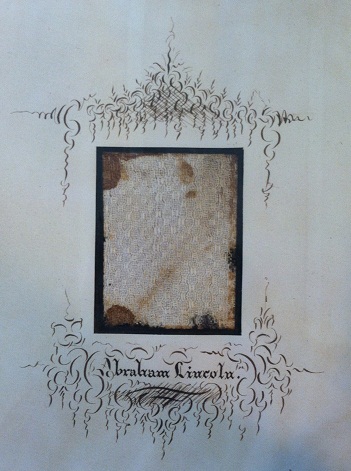
An artifact held at the Schenectady County Historical Society Museum with a note reading, A piece of the towel used as a bandage round the head of our late President Abraham Lincoln on the night of his assassination. Presented to Joseph H. Lester by Yours Truly, William J. Clark. Collections of the Schenectady County Historical Society. 

Wednesday, February 13, 2013

"A Mutual Flame:" The Love Letter of John Van Rensselaer

First page of Gen L 2, a love letter which is fully transcribed below. From the collections of the Grems-Doolittle Library. 


In celebration of Valentine's Day, we'd like to feature one of the love letters in our collections. Although we cannot be certain, we believe the letter may have been written by John S. Van Rensselaer, a 1810 graduate of Union College. John S. Van Rensselaer went on to become a lawyer in Albany and married Ann Dunkin of Philadelphia, not the "Miss Getty B." addressed in the letter below. The letter was written when Van Rensselaer was a teenager, likely around the age of 16, and it expresses the sentiments expected in a letter of courtship -- longing for his beloved, cherishing her lock of hair, and vowing to hold her intimate thoughts and tender feelings close to his chest. The original letter is fully transcribed below, with the line breaks, punctuation and underlining of the original maintained.


Miss Getty B............

A Love Letter


Union College Dec 27, 1807

My amiable friend,

At length my doubts have ended,
at length my charmer has condescended to con-
fess to her Van Ransalaer a mutual flame.
Imagination alone can paint to your mind
my sensations at present. With unfeigned
delight I am anticipating the pleasure of
again beholding you, of again pressing you
to my bosom which sighs for you alone.
How shall I express my gratitude for the lovely
lock of hair you sent me. The form of it was
so congenial to pleasure I felt on reading your
letter, that I unintentionally imagined that
our harts were united in one. Forgive me my
lovely friend, if in the warmth of my expres-
sions I have intimated any thing repugnant
to that delicacy to which I would rather sacrifice
my own happiness, than offend. You desired
me in your last letter to send you a lock of
my hair as I valued your affection, "need I again
mention how much I value it." still circum-
stances oblige me to confess that the unrelenting
Barber has unfortunately sheered it so close,
that it is altogether impossible to say properly
that my head is in possesssion of a single lock
of hair intire. You have requested me so often
not to shew your letters to any one, that if it
is possible I am almost offended with you.
Can my dear girl suppose that I can be
so mean and ungenerous as to betray an af-
fection which she has deigned to bestow on me.
Banish such ideas, and know my charming
angel I am selfish enough to imagine that if
another was to participate with me in reading
your letters. I would not be sensible of that
pleasure which I now derive in perusing
them. Present my sincere respects to my
dear Peggy G... and tell her I shall wear her
chain to my watch as a sacred momento of
her friendship. My respects to all enquiring
friends. I subscribe myself with pleasure
Your devoted
JS Van Rensala

P.S. Inclosed I send you
a list of the students
of Union College