Friday, January 29, 2016

Newspapers of Schenectady's Immigrants

The amount and variety of news we can receive in 2016 is non-stop and never ending. Tablets, phones, Facebook, and Twitter, and the 24-hour news cycle are all relatively new ways to keep updated on current events. These along with the more traditional newspapers can make the process overwhelming. Flashback to 100 years ago and you might have the opposite problem. News was limited to newspapers and through other people that you interacted with throughout the day. A unique way to receive news came along with the advent of the first radio news program in August, 1920. From there, the next innovation was the television with the first news broadcast on TV in 1930 and the first regular news broadcast in 1940. Absolutely none of this matters if you can’t understand the language, customs, and traditions of the country you just moved to. So just how did the growing immigrant population in Schenectady figure out what was going on in their city? Certain pioneering immigrants started newspapers that highlighted the issues that were important to these immigrant groups. Many of the papers were published in both English and in the native tongue of the publisher and were generally published as a weekly paper. This entry focuses on the German, Italian, and Polish newspapers of Schenectady.

Oswald E. Heck and the Herold-Journal


Oswald E. Heck as a young man. In addition to his skills as a newspaper editor, Heck published a book of poems in German titled Leben und Weben (Life and its Weavings) in 1922. Photo courtesy of the February 1, 1923 issue of the Daily Gazette.
German immigration to the United States increased dramatically in the 19th Century and they were the largest group of immigrants from 1840 to 1880. Schenectady’s commercial and industrial growth during this time drew many Germans to the area. Many early German immigrants worked in broom manufacturing, but ALCO and GE soon became the main draw to Schenectady. The first German language newspaper in Schenectady was the Deutscher Anzeiger (German Indicator) which was formed in 1873 and lasted until 1897. Three years later another German paper was established, Das Deutsch Journal. Oswald E. Heck who had worked as a compositor on the Deutscher became the editor of a new German paper named Das Deutsche Journal. Heck came to Schenectady with his family and started working for ALCO, but his knack for writing led him to work for the Deutscher where he learned to set type and would write an occasional article. Heck and Das Deutsche Journal compositor Thomas Unseld Sr.  would go on to start another German newspaper in 1910 named the Schenectady Herold. World War I caused the merger of the Herold and Das Deustche Journal, creating the Schenectady Herold-Journal which published its first paper in April, 1917. With a new name came a new headquarters and the paper moved to 206 Clinton St. The paper was growing and required an even larger quarters by 1921 when the offices moved to 151 Barrett St. Unseld Sr. died in 1951 and his post as treasurer of the Schenectady Herold Printing Company was filled by his son, Thomas Unseld Jr. Heck died in 1954 and left his interest in the company to his children, Oswald D. Heck (who was very important in NYS politics, but that’s a story for another post), Else Raag, and Edwin Heck. The paper continued until 1964 when it ceased publication. Microfilm of the Schenectady Herold-Journal for certain years can be found at the archives of the University of Albany.

Italian-American Giornale

Collage of Italian language newspapers featuring Viva l'Italia, Il Corriere Di Schenectady  and Albany's La Capitale. Courtesy of the Beinecke Rare Book and Manuscript Library, Yale University.
One problem with researching ethnic groups through newspapers is the lack of an actual newspaper to research.  Researcher and future presenter at the Schenectady County Historical Society Robert Pascucci was quoted in a June 25, 1984 Gazette article that few of the ethnic newspapers remain today and that “This material has been lost in the Capital District…Unfortunately, the interest doesn’t seem to have been there.” As far as news reports on the Italian-American community, modern researchers don’t have a lot of resources to turn to. The news that was published in Schenectady’s larger newspapers often focused on the criminal aspect.  Schenectady Papers like The Evening Star covered the arrests of Italians sometimes reporting in broken English with headlines like “Me Take-A You Life." With articles like those, it’s no surprise that Italian immigrants started their own newspapers.  One of the most prominent Italian papers in Schenectady was Ettore Mancuso’s The Record (Previous librarian, Melissa Tacke wrote a great post on Ettore Mancuso and The Record). The Record focused on the concerns of Italian-Americans, and often published articles and advertisements in both Italian and English. Other Italian language papers in Schenectady were the Il Corriere di Schenectady and The International, but few issues of these papers exist today. The library’s Ettore Mancuso Collection has issues of The Record and a guide to this collection can be found here.

Enthusiasm of the Polish Press

Article from the Feb. 6th issue of the
 Gazeta Tygodniowa. Courtesy of
Phyllis Zych-Budka.
A common thread that ran through the papers run by Schenectady’s immigrants was a willingness to support their fellow countrymen along with their new city. The previously mentioned Record would often publish articles promoting local Italian businesses and push for Schenectadians to buy local.  Similar to that idea, Polish papers like Tygodnik (Weekly News) and Gazeta Tygodniowa (Weekly Gazette) would boost the accomplishments of Schenectady’s Polonia. SCHS member Phyllis Zych-Budka is currently writing a book about the Maska Dramatic Club, which was a Polish theater group. Phyllis recently brought in several articles from various Schenectady Polish newspapers relating to various Maska plays and events.  The difference in tone between the Polish papers and English papers is quite noticeable. The English papers were more factual, relating the location of the play, a brief description of the plot, and who was in the cast. The Polish papers were very descriptive and the publishers are adamant about getting people to attend and support events put on by other Polish-Americans. Examples of the publisher's style can be seen in the clippings posted.  


Article on the 50th anniversary of General Electric where the Polish division achieved first place in the float contest. The float featured F.G. Halturewicz as Thomas Edison and Stanley Zych as Steinmetz. The author goes on to write that "Our float was excellent, beautiful, and in good taste, full of color and most important depicted the progress of General Electric..." Clipping and translation courtesy of Phyllis Zych Budka.

The Grems-Doolittle Library is looking for issues or clippings from some of these difficult to find newspapers or if you know of any other immigrant run newspapers. Contact Librarian, Michael Maloney at 518-374-0263 or librarian@schenectadyhistorical.org if you have any leads.

Tuesday, January 19, 2016

The Brothers Glen

Thanks to volunteer Diane Leone for research assistance.

The Glen surname is attached to a couple different places around New York. Glenville in Schenectady County is named after Alexander Lindsay Glen and Scotia was named by Alexander after his home country Scotland. The Glen Sanders Mansion in Scotia was originally built by Alexander, and expanded by his son John Glen. Its name comes from the marriage of Alexander’s great-granddaughter Debra Glen to John Sanders. Glens Falls is named after John Glen Jr., confusingly not the son of John Glen, but of John's son Jacob. Like many of the Glens before them, John Jr. and his brother Henry were quite prominent throughout Schenectady. The brothers were also held in high esteem with many with many people of national historic significance and were acquainted with the likes of William Johnson, Governor George Clinton of New York, Alexander Hamilton and George Washington.
Furniture from the Glen Sanders Mansion is on display at the Schenectady County Historical Society. Courtesy of the Grems-Doolittle Library photo collection.
The brothers Glen were born in Albany to Jacob Glen and Elizabeth Cuyler, John was born in 1735 and Henry in 1739. Their father Jacob was a merchant and trader who owned a house on Steuben Street in Albany. He was also closely affiliated with Albany city government as he was elected assistant alderman to the second ward in 1734 and 1735 and appointed firemaster in 1741. Their mother Elizabeth Cuyler was also well connected in Albany. Her father was Johannes Cuyler who served as assistant alderman, and eventually alderman for Albany’s second ward in the early 1700s. Johannes was also elected as a representative to the New York General Assembly and a number of other public offices, including mayor of Albany in 1725. After Jacob died in 1746, Elizabeth continued to raise their children at the “Glen House” till her death in 1785.

Both Henry and John started off as merchants in Albany. According to the website “The People of Colonial Albany,” John may have been a business partner with the venerable fur trader Hendrick Bleecker as he was identified with Glen as the occupants of a second ward house in a 1767 tax list. Starting in the 1760s, John started buying land in Schenectady, Fort Edward, and what would become Glens Falls. The acquisition of this land by John Glen is suspect to local legend and he acquired it either through a debt that was owed to him, by a card game, or in exchange for hosting a party for mutual friends. Henry also became interested in real estate and owned houses in Albany and Schenectady.

The brothers were also heavily involved in military affairs and the family’s affiliation with William Johnson during the French and Indian War resulted in John being appointed quartermaster general with Henry as his assistant. John was also the captain of the Second Battalion of Militia of Schenectady which included Jacob Schermerhorn as 1st Lieutenant, John’s brother Henry as 2nd Lieutenant, and other prominent Schenectady residents.
Letter to Henry Glen from Jonathan Mix, telling of suspending any further preparations for transporting garrisons & stores to western posts from Gen. Washington. Courtesy of the Grems-Doolittle Library Collection
During the American Revolution, Henry continued to serve in the army as Assistant Deputy Quartermaster for the northern department of the army where his role was to gather and facilitate the distribution of military supplies for northeastern New York. He supplied provisions and transportation for the five forts in the Mohawk Valley and also managed the construction of new barracks in Schenectady, where he was stationed. Often funding these projects and buying supplies with his own money as was the case in the spring of 1781. The frontier towns were desperately in need of supplies, troops were deserting, and it was feared that Schenectady might be attacked. Boats were being built in Schenectady to transport materiel to Fort Stanwix and Henry Glen used his own credit to build 16 bateaux for the military. Henry was extremely devoted to the cause of the Revolution, but disheartened that his fellow countrymen did not feel similarly in a letter to Colonel Hugh Hughes Henry Glen writes that “…no man longs more to make an end of the War than I do by carrying it on with Vigour, I am and always was willing to pledge my Life and little Property for the support of the war but am sorry to find the Virtue and Exertions of the People are lost throughout the whole Country.” In addition to his duties as quartermaster, Henry was the captain of the local militia.


Partial letter from Henry Glen to New York's Board of Treasury from 1788 regarding
his payment as Commissioner of Indian Affairs. This letter is an example of
some of the financial woes that Henry encountered after the Revolution.
Courtesy of the Grems-Doolittle Library Collection
There wasn’t much mentioned about John Glen during or after the Revolutionary War. Some sources mention that he was also a quartermaster during the Revolution, but I haven’t been able to accurately verify this. He was a friend of George Washington and may have even hosted Washington at his house at 58 Washington Avenue in Schenectady’s Stockade on Washington’s first visit to Schenectady in 1775. John Glen was listed on the roster of the 2nd Albany Militia, and on July 25, 1778 he was also called to appear before the Commissioners of Conspiracies on July 25, 1778 and signed an oath of allegiance four years later in 1782. Unfortunately, significant debt forced John from his home in 1810 and he was supported by friends until his death in 1828 at the age of ninety-three.


John Glen Jr.'s house at 58 Washington in Schenectady. A New York State historic marker was placed in front of this house, but has since deteriorated to the point where only the signpost remains. Courtesy of the Grems-Doolittle photograph collection.
For Henry Glen, the end of the Revolutionary War brought about a continuation of the public service that he started as clerk of Schenectady County in 1767. He served as a state assembly member from 1786-1787, then as a representative in the U.S. Congress from 1793-1801. He also continued his position as deputy quartermaster and was involved with the movement of supplies and troops throughout New York State. Shortly after the war Henry fell into debt which was caused partially by his personal expense during the war. This debt stayed with him for most of his life and he was met with much difficulty in trying to recover payment from the government for the multiple positions he served in during and after the war. Henry’s fortunes were never completely recovered, and as Chris Hunter states in his paper A Slave to the Army: Henry Glen and Public Service in the Early Republic, “he died January 6 1814, ending his adulthood as he had begun it, in the service of the government.”

The Grems-Doolittle Library at the Schenectady County Historical Society holds the Glen Family Letters follow this link for an index to the letters: http://schenectadyhistorical.org/admin/wp-content/uploads/2010/07/Historic-Manuscripts-Collection-Glen-Letters.pdf. 


Tuesday, December 29, 2015

The Marquis de Lafayette in Schenectady

Thanks to library volunteer Diane Leone who helped research this post.

Portrait of the Marquis de Lafayette by Charles Willson Peale in 1779-1780.
 Courtesy of Washington and Lee University
Silk Ribbon with an
engraving of Lafayette
by Myron King of
Troy, NY. Courtesy
of the Grems-Doolittle
Library Collections
In the excellent new-ish musical Hamilton, a hip-hop musical based on the life of Alexander Hamilton (which sounds crazy, but it works), the Marquis de Lafayette is referred to as “America’s favorite fighting Frenchman." He certainly was one of Schenectady’s favorites and similar to other towns and cities in the United States, Lafayette made a deep impression on the residents of Old Dorp.

Lafayette first visited Schenectady in 1778 during the American Revolution to investigate a conspiracy that supposedly involved some residents of Schenectady. He concluded that the suspicions of a conspiracy were “very far from groundless” in a March 3rd report to the Albany Committee of Safety.  He personally questioned a suspected soldier about the conspiracy and while he could not retrieve a confession, Lafayette was sure that there was a treasonous plot forming in Schenectady.  The suspicion was based on a report that British Major Christopher Carleton, nephew of Canada’s Governor Guy Carleton, was seen in Schenectady making preparations and gathering information. An attempt was made to capture Major Carleton and Lafayette even offered a reward of fifty guineas for his arrest. Lafayette’s suspicion was correct and Major Carleton went on to run a very successful raid along the shores of Lake Champlain in the fall of 1778.
 
Lafayette’s second visit to Schenectady occurred on his momentous tour of the United States which began on August 15, 1824. According to Larry Hart, Schenectady’s Common Council created a committee in 1824 to convince Lafayette to visit Schenectady. The committee was made up of some of Schenectady’s most prominent citizens including Union College President Eliphalet Nott, James Duane and John Vrooman among others. This committee met Lafayette on his way from New York City to Albany and while Lafayette couldn’t make the visit right away, he promised to visit the next year.  The newspaper, The Schenectady Cabinet had been dedicating a page per issue to Lafayette’s visit to America. The Cabinet was so sure that Lafayette would visit Schenectady after his trip to Albany that in their September 7th, 1824 issue they stated that “La Fayette, it is understood, may be expected in this city within a few days.” The proclamation was a bit premature, as Lafayette was not able to make his visit until June 11, 1825 on his way back from Little Falls.
 
Certificate from Schenectady Mayor Issac Schermerhorn stating that Major Joseph Sunsaul (sp?)
 helped escort General Lafayette to Governor Joseph Yates' Stafford House in Albany,
dated September 26th, 1825. Courtesy of the Grems-Doolittle Library Collection.
Schenectady was more than ready for his scheduled arrival. As Lafayette was traveling down the partially constructed Erie Canal from Little Falls on the day before his Schenectady arrival, members from an arrangements committee traveled up the canal to meet the esteemed general and his party. When the committee reached Lafayette, a messenger was sent back to Schenectady to tell everyone what time he would be arriving. At 7 p.m. on Saturday, June 11, cannons and heavy artillery that were set up on the canal bridge near Water Street shook Schenectady, notifying its inhabitants of Lafayette’s arrival.  According to a September 26, 1933 recollection of the visit from the Schenectady Union-Star, “All was bustle and suppressed excitement. The people crowded the canal bridges and assembled on both banks of the canal all the way from the flats to the City Hall.” The continuous shout of “Welcome Lafayette” rang along the streets. The packet boat that carried Lafayette and his party eventually reached City Hall where they were greeted by Mayor Isaac Schermerhorn. He was then introduced to the Common Council and surviving Revolutionary War heroes. Over forty years after the end of the American Revolutionary War, General Lafayette still recognized James Lighthall, one of the veterans who served with Lafayette during the war. Lafayette went on to express his appreciation to Schenectady at a dinner in the Givens Hotel by saying that “Schenectady had been most kind in times of danger to a young commander who now comes here after a lapse of 47 years, to offer his affectionate devotion, good wishes and the tribute of his old and new feelings of respect and gratitude.” Lafayette's visit to Schenectady only lasted three hours, but his legacy resonated with its residents.


Part of Governor Joseph Yates' farewell address to General Lafayette. Yates writes that
Lafayette's heart "beat with the throb of patriotism and now ours beat with gratitude for him."
 Courtesy of the Grems-Doolittle Library Collection.

Copy of Lafayette's response to Governor Yates' farewell address, written by Lafayette's secretary Auguste Levasseur.
Courtesy of the Grems-Doolittle Library Collection.  
Lafayette Street is one of the most prominent examples of the Marquis' influence here. When a new street was to be opened in the early-1800s citizens of Schenectady suggested naming it Lafayette Street instead of Division Street.  The Common Council agreed and unanimously voted to name it Lafayette Street. Lafayette’s visit influenced the arts in Schenectady as was witnessed in a play called The Pageant of Schenectady by Constance D’Arcy Mackay. The Pageant of Schenectady was produced in 1912 and featured Lafayette’s highly esteemed visit. It was a five-part play commemorating the 250th anniversary of the founding of Schenectady. Performed on May 30th through June 1st in 1912, it follows Schenectady’s history from the early Native Americans to “The Intellectual and Industrial Forces of the City of Today.” Lafayette’s visit to Schenectady apparently stuck out in the mind of the playwright who dedicated an entire episode of the play to Lafayette’s arrival. Titled “The Welcome to Lafayette”, this episode follows Mrs. Van Epps, Elsbett Van Epps, Barent Sanders, and a group of children as they organize a reception for Lafayette. Mrs. Van Epps remarks that “To think of him is to remember the cause of American Liberty.”

Excerpt from Harold A. Larrabee's "Lafayette at Schenectady."
Courtesy of the Grems-Doolittle Library Collection.
Lafayette’s death also had a lasting impact on several Schenectadians including Union College philosophy professor Harold A. Larrabee who wrote a poem in 1934 titled "Lafayette at Schenectady." The poem was presented at Union college in 1934 to commemorate the 100th anniversary of Lafayette’s death and is a moving and interesting recollection of Lafayette’s life and his visit to Schenectady.  It is steeped in history and in the foreword Mr. Larrabee states that the poem is “based on authentic records, and sources could be cited for nearly every line.” 27 years after Larrabee’s poem was recited, Mayor Malcom E. Ellis proclaimed May 20, 1961 as Lafayette Day in Schenectady. In his proclamation, Mayor Ellis said that he “enjoins all of our citizens to pay grateful homage to the memory of Marquis de Lafayette by appropriate civic ceremonials.” While “appropriate civic ceremonials” doesn’t sounds all too exciting, Ellis’ proclamation shows that even over 100 years after his death, the people of Schenectady were still thinking of Lafayette and wanted to honor his memory.


Friday, December 11, 2015

Wayne Tucker Postcard Collection

Before the rise of Email and Facebook, postcards were a quick and easy way to keep in touch with friends and relatives. Postcards really became popular at the turn of the 20th Century and postcard collecting, uncommonly known as Deltiology, followed soon after. One such collector was former Glenville resident, Wayne Tucker. Mr. Tucker passed away recently and  graciously willed his postcard collection to the Schenectady County Historical Society. Mr. Tucker was an avid collector of postcards and the donated collection comprises 19 binders filled with thousands of postcards, trade cards, and other ephemera. The majority of the postcards relate to the City of Schenectady, but they also cover many of the towns and villages in Schenectady County. The collection is quite comprehensive and will often have postcards of the same place or landmark from different years, showing how it developed over time. Since there are postcards from various time periods, the collection also shows how postcards evolved over time. Below is a sample of the collection, but be sure to visit the Grems-Doolittle Library at the Schenectady County Historical Society to view the whole thing.

Illustrated postcards of city scenes were very popular and are some of the most common. This one shows the Van Curler Hotel from the Scotia side of the Great Western Gateway Bridge.


Freed's Big Liquor Store was founded in 1898 on Broadway in Schenectady. Herman Freed operated the store until prohibition hit the U.S. He then temporarily retired from the liquor business to open Schenectady's first used car dealerships. In 1934, Mr. Freed opened another liquor store at 111 Broadway. 
Schenectady after the blizzard of February 14, 1914. This is an example of a real photo postcard. This type of postcard is often unlabeled as any extra printing required more money than many postcard printers were willing to spend.
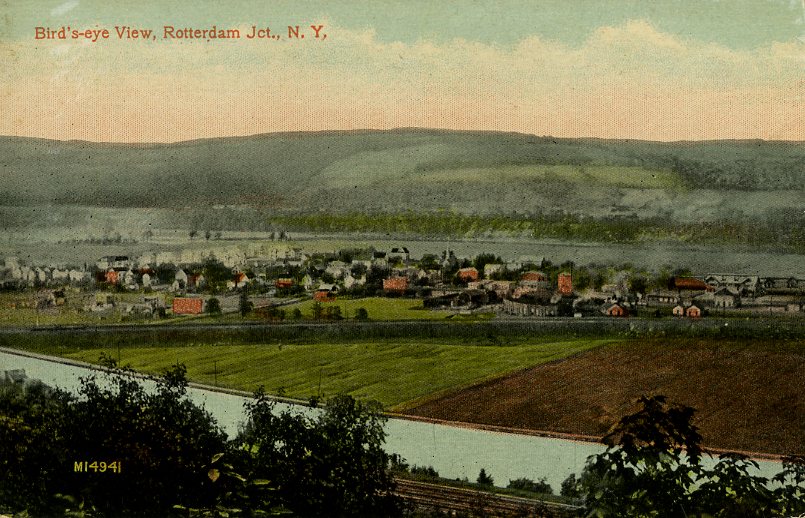
This postcard shows the bird's-eye view of Rotterdam Junction.  
 

Many of the real photo postcards show scenes from everyday life. The first postcards features the Scotia Fire Department, along with the baby of  one of the firefighters. The second shows men working on Mariaville Road/State Route 159.

 
Along with postcards, this collection also has quite a few trade cards. By the 1880s, many businesses used trade cards to advertise their goods. This card advertises the rejuvenating powers of Burdock Blood Bitters.


 Similar to modern advertisements, businesses used cute animals and kids in their advertisements. I'm not sure what a cat playing with a sword has to do with H.F. Smith's One-Price Clothier, but I would shop there after seeing this card.

Staff and volunteers have started indexing this collection and the index should be on our website in the next few months. A big thanks goes out to Wendy LeBlanc and the family of Wayne Tucker for facilitating the donation.

Wednesday, November 25, 2015

Brothers of the Brush and Sisters of the Belle

 Courtesy of The Rotterdam Story Yesterday, Today & Tomorrow from the Grems-Doolittle Library Collection.
The Sesquicentennial of Rotterdam was an 8-day event from July 10th to July 18th, 1970 commemorating the 150th anniversary of the founding of the town of Rotterdam. Each day in the Sesquicentennial had a different theme, with events that  corresponded to that theme. Saturday, July 14 was "Government & Veterans Day" which included tours of Rotterdam Town Hall, a mock town hall meeting, a veterans memorial service, and the 14th Calvary demonstration of Civil War and Revolutionary War guns and cannons. The Sesquicentennial was meant not only to celebrate the anniversary, but as a way to bring the residents of Rotterdam closer together. One way of doing this was by creating chapters of the Brothers of the Brush and Sisters of the Belle.


Photo of the Untouchables chapter of the Brothers of the Brush. Seated: John Papp, Buddy Dunn, Bill Stoddard, Tom Keough. Standing: Dom DeVito, Jack Dunn, Curt Rodd, Bernie Armstrong, Jr., David Martin. Courtesy of The Rotterdam Story Yesterday, Today & Tomorrow from the Grems-Doolittle Library Collection.
Members of the Brothers of the Brush agreed to grow facial hair, and wear the official badge and derby on official "Sequi-celebration days". Participants signed a charter and came up with a name for their Brothers of the Brush chapter. The charter for the Brothers stated that "Members of this organization, being civic-minded boosters of Rotterdam, N.Y. and Rotterdam's Sesquicentennial, hereby agree to wear, as evidence of their loyalty and interest, either full Beards, sideburns, mutton chops, mustaches or other hairy facial appendages, and will wear the official 'Brothers of the Brush' button, the official headgear, and other regalia as directed by the 'Brother of the Brush' from now on henceforth, until July 18, 1970."  Rotterdam historian and photographer John Papp was the chairman of a chapter named the Untouchables. Other chapters included the Bristle Boys, Colonial Clubbers, Stumpjumpers, and Uncle Bill's Hillbillies. Uncle Bill's Hillbillies were known to walk around Rotterdam carrying either a shotgun or a small pig. Members of the Hillbillies were also known to lock their members up in the stocks as shown in the photo below. 
Photo of Uncle Bill's Hillbillies chapter of the Brothers of the Brush. Seated: Mickey Symanski, Tony Famiano, John Green, Matt Malejka, Tony Gallo, Gary Deluke. Standing: Fred Geddes, Andy Senese, Gil Woodside, George Grezeskowiak, Reed Hart, Les Jacobs, Norm Hart (in the stocks), Newell Calkins, Russ Welch, Fred Smulovitch, Jr., Stan Rogowicz (in the stocks), Bob Hart, Lee Archer, Biff Fontaine, Chuck Hebert, Frank Famiano, Pete Starson, Tony Marollo. Pigs and dog are unnamed. Courtesy of The Rotterdam Story Yesterday, Today & Tomorrow from the Grems-Doolittle Library Collection.
A funeral procession was organized for the late Mr. Ray Zor who was "made obsolete by the unwillingness of many Rotterdam men to shave." He was then eulogized by Reverend A.W. Burns on June 4th 1970, saying that "We come here not to praise, but to bury Brother Ray Zor. On Monday mornings he has sliced our cheeks and chins and shed our blood, as though for the remission of our sins of the weekend..." Courtesy of The Rotterdam Story Yesterday, Today & Tomorrow from the Grems-Doolittle Library Collection.
Sisters of the Belle also known as Sesqui-Belles, were required to dress in clothing similar to that of the 1800s on Sesqui-celebration days and had to wear their official membership buttons at all times. Like the "Brothers", Sisters of the Belle formed chapters of about 10 members with names like the Flaming Belles, Tinkerbelles, Bushels and Bonnets, and the Liberty Belles. The belles would also go door to door selling commemorative coins and plates, as well as men's ties and bonnets. Both the Sisters of the Belle and Brothers of the Brush were subjected to fines for not participating. The events of the "Sisters" included a fashion show with prizes for best period costume, most authentic dress, and best hoopskirt design. Other activities included needlework, crafts, and baking. One afternoon, the Sesqui-belle chapters known as the Keekees and the Dingalings met up for a game of softball. While some of the belles were playing, others were dressed in old-fashioned bathing suits and picnicked on the field.


The Tinker Belles Chapter of the Sisters of the Belle. Seated: Karalee Duckwald, Shirley Ennis, Pat Wilsay, Vera Brown, Betty Simpson. Standing: Ethel Morris, Marilyn Nold, Diane Pedersen, Alice Miller, Theresa Morris, Gay Hofmann. Courtesy of The Rotterdam Story Yesterday, Today & Tomorrow from the Grems-Doolittle Library Collection. 

Turtle Belles Chapter of the Sister of the Belle. Seated: Debra Papp, Eileen Papp, Arlene Rose, Jenny Gordon. Second Row: Dorothy Peek, Hedy Hyjek, Ida Chignon, Virginia Hopkins, Cathy Adair, Melvina Borst, Dolores Papp, Gladys Montanaro. Third Row: Mary Dingman, Linda Nuttall, Leoline DeVito, Virginia Charbonneau, Clara Cromer, Pat Guynup, Margaret Miller.Courtesy of The Rotterdam Story Yesterday, Today & Tomorrow from the Grems-Doolittle Library Collection.
The Sesquicentennial was a success and its profits (no doubt helped by the Brothers of the Brush and Sisters of the Belle) were divided among a variety of community organizations.

More photos from the Sesquicentennial. Courtesy of The Rotterdam Story Yesterday, Today & Tomorrow from the Grems-Doolittle Library Collection.


Monday, November 16, 2015

Larry Hart News Negatives Part II

As promised, here are some more images from the Larry Hart news negative collection. Also, a reminder that the Grems-Doolittle Library has been digitizing some of our photo collection and putting the images on the New York Heritage Digital Collections site which you can find here: http://nyheritage.nnyln.net/cdm/landingpage/collection/p16694coll45. Our current collection on the site focuses on sports and recreation in Schenectady. More photos are added periodically, so check back every once in a while to see what's new.


This photo from the 1954 Scotia Golden Jubilee parade shows the Scotia Chamber of Commerce Queen and her court. Scotia's Golden Jubilee was a week long event that featured speakers, parades, fireworks, athletic contests and more to commemorate Scotia's fiftieth anniversary.

Two soap box derby racers racing down the track.
Operators at the switchboard at the Telephone Company Building on Clinton Street.
This great night shot of Schenectady shows some of the old standbys of downtown, including Woolworth's and Wallace's.
The 1949 Christmas Parade featured this huge inflatable "train".


Robert Kennedy addressing a crowd in Schenectady's City Hall.
Political rally for Harry Truman at Schenectady's Union Station in 1948.
Kids dancing at a block party on Weaver Street in 1954
Some acrobatics from a trick rider during a parade.

Monday, November 9, 2015

Larry Hart News Negatives Part I

It always feels nice to finish a large project. One such project was the scanning of the Larry Hart News Negatives from our Larry Hart Collection. Volunteers Victoria Bohm and Robert J. Jones digitized almost 5,000 negatives from this collection in order to make them more accessible for researchers. Larry Hart was a photographer and reporter for the Union-Star as well as a reporter for the Schenectady Daily Gazette where he remained a columnist until his official retirement in 1980, although he continued to write freelance. He was mainly a political reporter but, is probably best known for his historical column, “Tales of Old Dorp” which first appeared in the local section of the Daily Gazette on May 14, 1974, and ran through the 1990s.

This collection is a compilation of both black and white and color negatives in a variety of sizes. The subject matter of the negatives varies widely and there are negatives of accidents, fires, building openings, and demolitions (as seen in this previous blog post: http://gremsdoolittlelibrary.blogspot.com/2012/11/accidents-fires-openings-and_19.html).  As well as images of sports and recreation, construction, farm life, parades, and street scenes all throughout Schenectady County. The photos below are some of my favorites, and since it was tough to pick out so few, a second blog will be posted next week that features some more of these great scenes of life in Schenectady.

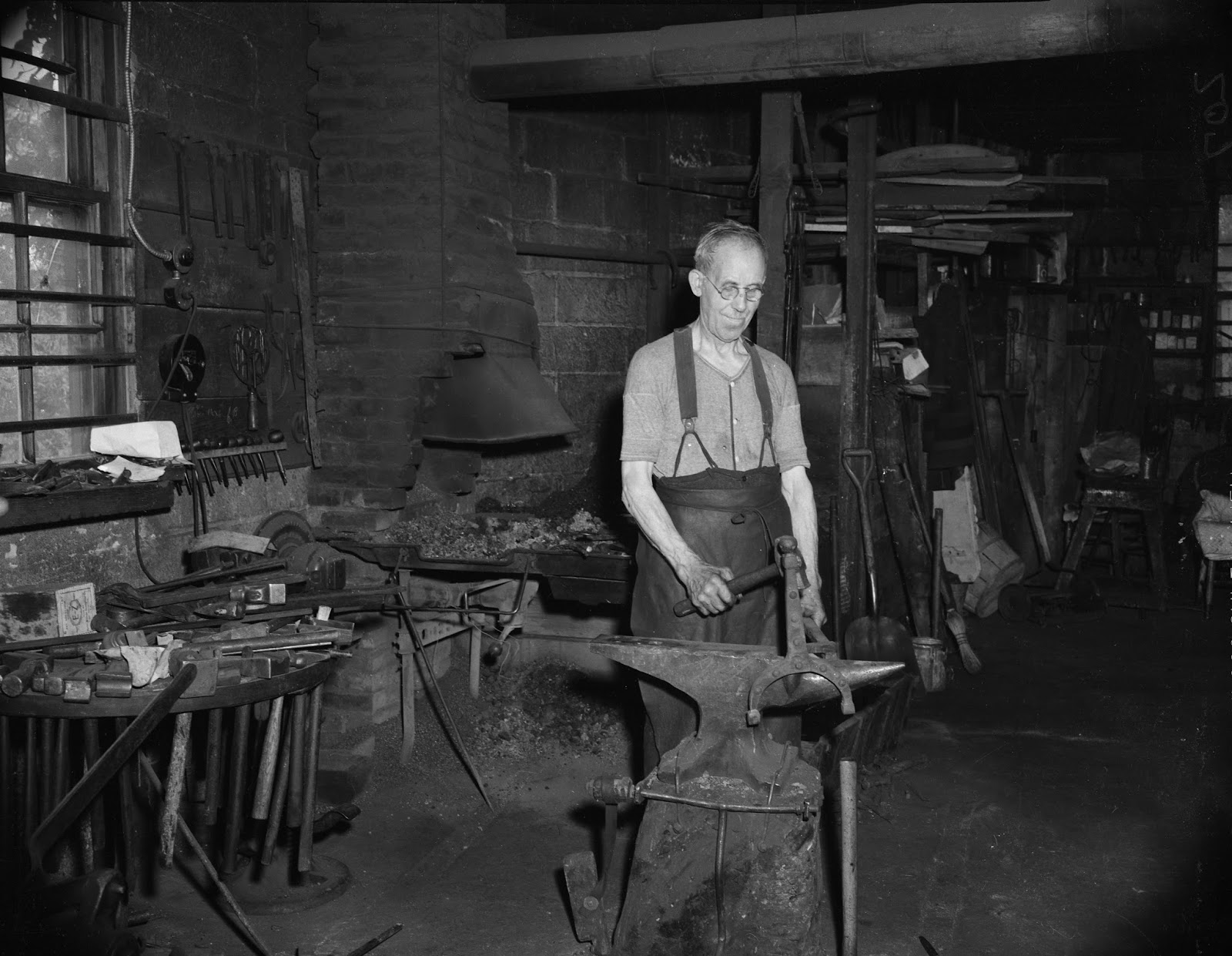
This photo from July, 1948 shows Freihofer's blacksmith making horseshoes for their delivery horses. Freihofer's ended delivery by horse and wagon in 1962


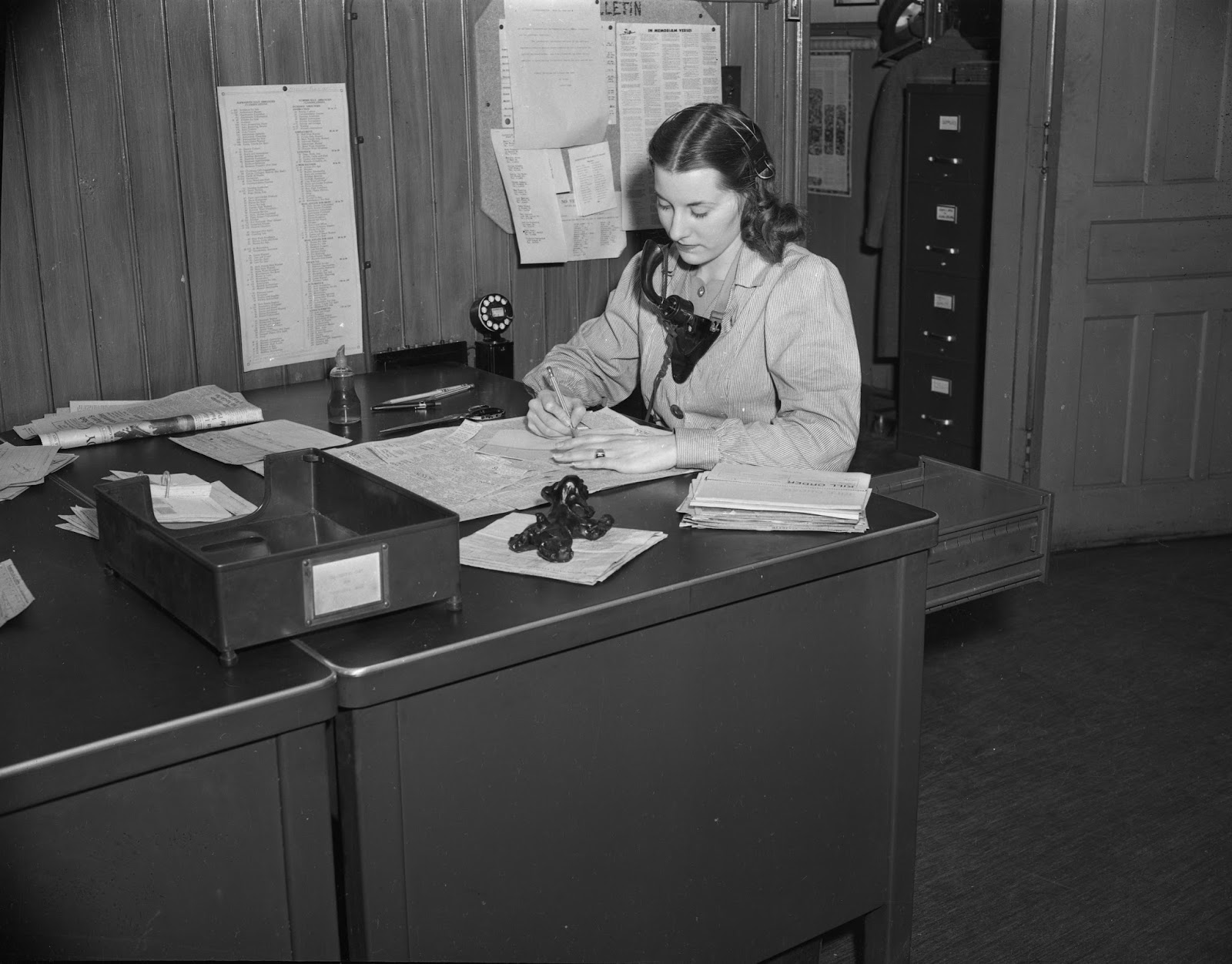
The News Negative Collection features behind the scenes photos of the Daily Gazette. In this photo, a copy reader for the Gazette is working at her desk, wearing what looks to be a hands-free Dictaphone.
Construction worker showing his patriotic spirit.
Think this young fisher by the Mohawk River caught anything? 
This rather adorable photo was taken in the old headquarters of Schenectady's fire department on State and Veeder. It was opened on July 1, 1900 and used as a fire house until the new central station on Erie boulevard was opened. After it closed as a fire station, the Schenectady Police Department used it as the headquarters for its traffic division and it became known as the traffic barn. The building was condemned in 1950 and razed in 1956.


Up to his neck in pumpkins!
The testing of a tank (Possibly an M48?) made by ALCO. This photo was most likely taken at the U.S. Army Reserve Center in Niskayuna where they had a testing ground for new tanks. Comment below, or email Mike at librarian@schenectadyhistorical.org if you know what type of tank this is.


Ever wonder what the inside of the clock tower in City Hall looks like? This photo from the 1950s shows a man repairing the clock mechanism.
This amazing night time shot taken from Broadway highlights Schenectady's industrial side. 
 
-Mike Maloney