This blog post was written by library volunteer Diane Leone.
Any
resident of Scotia or the surrounding area is familiar with Collins Park, a
recreational gem visible to anyone approaching the village of Scotia from the
Western Gateway Bridge. Having served the community for approximately one
hundred years, the park’s origins are inextricably linked to the founding of
Scotia itself.
One
of the founding fathers of the village of Scotia was Alexander Lindsay Glen
(called by the Dutch Sander Leendertse Glen), from the Scottish noble house of
Lindsay. According to his descendants, in 1655 he purchased 100 acres of land
from the Mohawks, members of the Iroquois confederacy. Lindsay was also one of
the original fifteen men who held land from the Schenectady patent of 1664. The
house he built, which he called Nova Scotia in honor of his homeland, was
unfortunately too close to the river’s edge, with erosion weakening the
foundation. As a result his son,
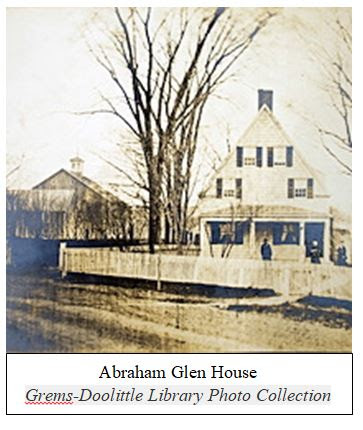
Johannes, built what is now called the Glen Sanders Mansion in 1713. Upon his
death, his son Jacob inherited the home with the proviso that he construct a
house for his brother Abraham. That structure, the Abraham Glen House, currently
houses the Scotia branch of the Schenectady Public Library.

In
1895 the brothers created a private park that sported trees for shade, as well
as seating, a baseball diamond with bleachers, tennis courts, and a pavilion
for dancing. The park offered recreational activities in summer, as well as
winter. The J. C. baseball team, named for James Collins, played at the park.
Visitors
also enjoyed the lake, where they could rent flat-bottomed boats from the lake
house for 10 cents an hour, and also pick pond lilies for 2 cents per lily. The winter offered tobogganing, a wildly
popular sport in the latter part of the 1800s. The photo below, from the 1870s,
shows the toboggan slide, which ran north from Dyke Road, now Schonowee Avenue.
The background to the creation of Collins Park
is not entirely clear. The
private park closed in 1905 after James Collins’s death. In 1922, with the
death of his daughter Anne, the Abraham Glen home was bequeathed to the Daughters of Wisdom nuns, who ran a children’s home. Since
the house did not meet their needs, Anne Collins’s executors offered the land
to the village, which
acquired the Abraham Glen house—it became the Scotia Free Library in 1929— and
the attached land, including the western rim of the lake, for $30,000, with the
proviso that the land be designated a public park named after the Collins
family. Fund-raising activities helped defray the cost, $5,000 of which was
donated by General Electric. In 1924, Collins Memorial Park consisted of 26
acres maintained by the Collins Park board. That board handed the park over to
the village in April of 1928, with Scotia now responsible for completing the
payment for the property. The deed was executed that July.
The
rest of what came to be Collins Park was acquired separately. A man named Neil
Ryan owned property to the east of the park, including the remainder to the
lake. His proposal to sell the land to the village for $65,000 came before the
village board in November of 1928. Unfortunately, no further documentation is
available on the actual vote, or how that section of land was incorporated into
the park. Interestingly, the
deed for that section of the park is dated 1937, with a different seller.
Thus
was born Collins Memorial Park. It provided a variety of activities, including
tennis, baseball, horseshoes, swings, toboggan slides, and skating equipment
for children, as well as individuals to oversee the playground.
In Scotia 100 Years...Memories of a Village, lifetime resident Marion Gilgore recalls the
warning system for ice-skaters on Collins Lake.
“There was a building right behind the library
with a flagpole. If the flag was blue—the ice was safe and if the flag was
red—the ice was too thin to skate on. Of course there was always someone who
would try to skate when the flag was red and fall through the ice. Then they
would call the fire department."
After
World War II, the state undertook a project to deepen the Erie Canal network
and needed a site to deposit the excess dredging material. Scotia mayor, Bill
Turnbull, made an arrangement with the State Waterways Maintenance Department
to have this material fill in the lower part of Collins Park, thus expanding
it. In 1946 more than 1 million cubic yards of fill was added to a marsh area currently
inside the park and on the side of Schonowee Avenue abutting the Mohawk River. The
community—both individuals and groups—assisted with donations of trees, as well
as the creation of a Little League park and beach area and the construction of
additional tennis courts.
Around
the same time, the now famous Jumpin’ Jacks had its start. Jack Brennan
purchased land along Schonowee Avenue from the Sanders family to build what was
initially called Twin Freeze, and then Jumpin’ Jacks, where he would sell soft
ice-cream, a newly popular treat.
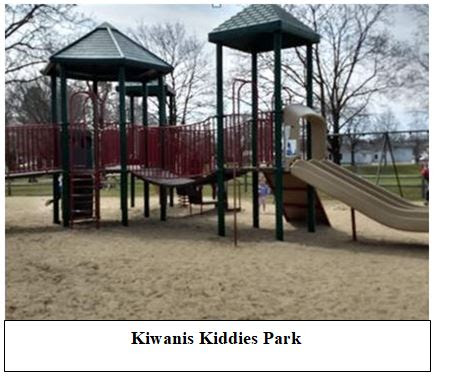
Over
the years, facilities have been added or improved, thanks to service
organizations such as the Kiwanis Club (which funded the Kiddies Park) and the
Rotary Club. In the 1960s, the swimming area and beach were moved to the
current area. The park was a popular venue for baseball, basketball and even
Scotia-Glenville High School football games. As Alan Hart so fondly reminisces
about the Tartans in Dear Old Scotia:
Before the new field behind the school was laid
out, however, I remember going to home football games on the old field at
Collins Park in the 1950s. It was a blast! The field was laid out east to west
in the bowl behind the library, and if you were a kid like I was, it was pretty
easy to sneak in and watch the game without paying. The entrance was sectioned
off with ropes, but if you waited for an opportune moment once the game had
begun, you could duck under the ropes when the man tending the entrance was
watching the action on the field. Then you could use that money your mother
gave you for your ticket on an extra hotdog or two! (2)
A
wonderful recreational area on the river side of Schonowee Avenue next to Jumpin’
Jacks is Freedom Park, which was created in 1976 as part of the state’s
Bicentennial celebration. It has picnic tables, an amphitheater/stage area
where free summer concerts draw large crowds, and a small dock called Scotia
Landing. Quinlan Park is a popular fishing area located on Washington Avenue on
the eastern edge of Collins Lake.
The
lake is a 55 acre oval-shaped body of water located in the park’s center. Residents
use it for fishing, ice-fishing and boating. Unfortunately, the lake is filled
with invasive aquatic species, such as water chestnuts, milfoil and pondweed.
To remedy this situation, dredging was performed in 1977-78 and again between
1988 and 1992, when the unearthing of Native American artifacts forced the town
to stop. To make matters worse, the 2011 tropical storms Irene and Lee
deposited river sediment into the lake, closing this popular spot for swimming.
In June of 2021, the town of Glenville put into effect a plan to eliminate
milfoil. It is hoped a water herbicide treatment in the spring of 2022 and 2023
will help rid the lake of water chestnuts.

Another
incident in the lake’s history occurred in 1948, when four boys borrowed a
rowboat without permission and proceeded to the island in Collins Lake. The
quite irritated owner swam to the island to recover his craft, leaving the
culprits stranded. In the afternoon, the father of one of the boys saw the
quartet on the island, gesturing and shouting. Recognizing his son, he went to
the police station, where the boat owner was persuaded, rather reluctantly, to
rescue the group.
Today,
Collins Park continues to draw the community throughout the year. In winter,
families enjoy sledding down the hill behind the library (the former Abraham
Glen House), and hardy souls can be seen ice fishing on the frozen lake. During
the warmer months the park comes alive with a variety of activities. The tennis
courts are popular, and there is always at least one baseball game going on,
with friends and families rooting for their teams and players. Walkers and
joggers fill the park paths, and picnickers at Freedom Park enjoy the
waterfront view. People flow between the park and Jumpin’ Jacks, where they can
grab a quick bite or maybe a refreshing ice cream. On certain summer evenings,
people bring lawn chairs to enjoy the musical entertainment in Freedom Park’s
amphitheater. In July and August the US Water Ski team holds daily practices
and weekly performances along the Mohawk shore, where large, enthusiastic
onlookers crowd the shoreline behind the restaurant and in Freedom Park.
The
Collins family left the village of Scotia a wonderful legacy.
Special
thanks to Village of Scotia historian Beverly
Clark for her help in locating and gathering information for this blog.
Bibliography:
Armstrong,
Shirley. "Boys 'Marooned' 4 Hours on Collins Lake Island." Schenectady Gazette, June 26, 1948, 6.
Briere, Shenandoah. "Village of Scotia Weeding out Collins
Lake." Daily Gazette (Schenectady, NY), August 8, 2021, 15.
Campbell, Ned. "Familiar Summer Story: Collins Lake Beach
Closed." Daily Gazette (Schenectady,
NY), June 5, 2014, A1.
Hart, Alan. Dear Old Scotia. Scotia, NY: Old Dorp Books, 2004.
Hart, Larry. "'Deal Struck 51 Years Ago Influenced Park's
Growth." The Gazette (Schenectady, NY), September 7, 1997, B07.
Schenectady County Historical Society. Glenville. Charleston, SC: Arcadia, 2005. Scotia, 100 years 1904-2004 : Memories of a Village. N.p., 2004.
"Settlers at
Schenectady, 1661-4." In History of
the Mohawk Valley: Gateway to the West 1614- 1925, edited by Nelson Greene.
Chicago: S. J. Clarke, 1925.
Sloan, Frances Anderson. "History Walks with Scotians" columns in the Scotia-Glenville Journal.
Weatherwax,
Bonnie, Heritage Coordinator. Scotia-Glenville
American Revolution Bicentennial Book of
Remembrances, June 18-26. 1976. N.p., 1976.
Collins
Park clippings files at the Schenectady County Historical Society