Showing posts with label Artists. Show all posts

Tuesday, January 12, 2021

Samuel Hayden Sexton, Schenectady’s Artist

This post was written by library volunteer Diane Leone.

In the days before photography, untrained local artists, or limners, were often employed to capture the important people and places in a community. For Schenectady, one such artist who was able to elevate his work above the mere craftsmanship that characterized this group was Samuel Hayden Sexton, who lived and worked in the city his entire life. Over his fifty-seven year career, he produced portraits, as well as landscapes and historical paintings. Currently, about seventy works are known to exist, some unsigned but attributed to the artist.  

Sexton was born in Schenectady in 1813, the son of Ezekial Sexton and Henrietta Hayden, his second wife. Samuel initially followed his father into a career as a cobbler, but eventually was attracted to art. He wed Sarah Fullagar and worked from his State Street studio. The couple had two children, James and Langley, who died young. 

Sexton was known as a “face painter,” who could render a “reasonable likeness,” but he also produced landscapes. The details of his training are not entirely clear. In 1835 a local newspaper, Reflector and Schenectady Democrat, claimed that although Sexton was primarily a self-taught painter, for a short time he may have been mentored by an accomplished artist in New York City. This claim is disputed by Ona Curran, art historian and one-time curator of Decorative Arts at the Schenectady Museum, now the Museum of Innovation and Science. She believes that Sexton was untrained until 1838, based on his sudden change in technique and style, as well as the introduction of subjects that would likely be accessible only in metropolitan galleries that exhibited works embodying contemporary art trends. He likely studied at institutions such as New York City’s American Art-Union or the National Academy of Design, where he exhibited a few times in the 1840s and 1850s.


Portraits

Sexton painted portraits primarily using live models, but he was also known to use other paintings, and less commonly, sketches as his sources. He preferred his subjects to pose for a frontal rather than a profile view. Many of his subjects were well-known individuals, including lawyers, educators, politicians, and business people, as well as their wives and children. Ona Curran explains the composition, or arrangement of elements within his work:

As for composition, he usually placed a three-quarter view of the sitter on the canvas. One arm invariably rested on the side of a chair. The hand of the other arm often reposed in the sitter’s lap and usually held an accessory item such as a hat, book or pair of glasses. A drapery often appeared in the background. He paid a great deal of attention to details. Accessories such as shawls, beaver hats, lace caps and ruffles were painstakingly done. As for color, the costumes of his sitters were painted most often in tones of black and white, draperies and chairs in shades of red. Green was often blended into the background color (Curran, p. 12).

The art historian notes that the flatness that characterized his earlier work disappeared by 1840, by which time his portraits showed more realism, better body proportions, greater three-dimensionality and distinctiveness. As she notes, however, he still showed an inability to paint hands skillfully, a shortcoming common to those not trained as professional artists, as seen in the portrait below of Nicholas Marselis, a merchant and boat builder.

Painting of a old white man dressed in black, sitting in a red chair, holding wooden tools used boat building.
Samuel Hayden Sexton, Nicholas Marselis, 1848, oil on canvas. Schenectady County Historical Society.

According to Curran, his artistic ability peaked in 1855, after which his production decreased. This 1852 oil painting of Ichabod Spencer, noted minister and a founder of the Union Theological Seminary, reveals the artist’s skill, as well as his standard three-quarter pose.

Portrait of a middle-aged white man in voluminous collegiate robes, holding a book.
Samuel Haydon Sexton, Ichabod S. Spencer, D.D., 1852, oil on canvas, gift of Mrs. Katherine Spencer Leavitt, Union College Permanent Collection. https://muse.union.edu/mandeville/project/19th-century-portrait-collection/

A few of Sexton’s works were painted from earlier works. The inspiration for his depiction of DeWitt Clinton (1840) was Charles C. Ingham’s fine 1824 portrait of the New York governor. According to Curran, he also completed two paintings of subjects who were deceased, likely using daguerreotypes, although not enthusiastic about the practice. 

Although the artist’s output dropped, Curran lists twenty extant portraits produced between 1857 and 1877. Some of them are unsigned but attributed to Sexton, such as a painting of John Ellis, first president of Schenectady Locomotive Works. In addition to all of his existing portraits, the Frick Art Reference Library has attributed to him three additional portraits, whose whereabouts are unknown. Another attributed work, a portrait of Eliphalet Nott, noted minister and Union College president, was unfortunately lost in a fire.

Historical Paintings

Five of Sexton’s historical paintings are extant. His first known work is The Schenectady Massacre (ca. 1833), a depiction of the 1690 burning of the Schenectady stockade by the French and Indians. Interestingly, the work is not historically accurate. Although step-gable roofs were characteristic of Dutch architecture from the colonial era, Curran theorizes that the simpler A-line steep roof was more likely to be featured in a frontier settlement like 1690 Schenectady. Furthermore, according to Kathryn Weller, former curator of collections at the Schenectady County Historical Society, French attackers likely outnumbered their Indian counterparts.

Painting of Native American firing rifles at buildings in a Dutch colonial village with white colonists running away or lying on the snow-covered ground.
Samuel Sexton, Schenectady Massacre, circa 1833, oil on canvas. Schenectady County Historical Society.

An 1813 sketch by a local man, Giles F. Yates, was the inspiration for Sexton’s four paintings of the Old Dutch Church--two dated 1843 and two dated 1845--which stood on the corner of Union and Church Streets and was the congregation’s third building, the first at that location. Although the paintings of the 1813 building were done many years later, a new church building served parishioners starting in 1814. Curran is not sure if the works are accurate representations, noting that “it is highly probable that the paintings served as memorials to the venerable old church rather than a documentation of local architecture” (Curran, p. 14).

Painting of a church with Dutch colonial buildings in the background.
Samuel Sexton, A North View of the Old Dutch Church in Schenectada, 1843, oil on canvas. Schenectady County Historical Society.

Landscapes

Although considered a “face painter,” Sexton’s exhibition records in New York City from the 1840s and 1850s describe his paintings as landscapes and Biblical works, none of which have been located. Of Sexton’s seventy existing paintings, five are landscapes, all painted in 1890, the year of his death. Four are titled Mohawk Valley Landscape, offering four different scenes, and the other is Frog Alley River, referring to a part of the Mohawk which once separated Schenectady from Van Slyck’s Island before the land was filled in. According to John Caldwell, art historian and art critic, these works were inspired by the American Barbizon School, a movement characterized by naturalistic landscape painting. 

Samuel Sexton, Frog Alley River, 1890, oil on cardboard. Schenectady County Historical Society.

Caldwell also notes that Sexton’s commissions may have decreased during the second half of the century as photography became more popular. Like other artists, Sexton had to earn a living. A bill to J. B. Clute in 1846 reveals that Sexton did additional jobs to help generate income, including painting a statue as well as stove plate ornament. The same bill itemizes the costs of two drawings and a sketch. Perhaps Sexton did more of this work as the years progressed. 

Sexton enjoyed local, if not national, recognition for his work, and earned a reasonable income. However, Joel Monroe, author of Schenectady, Ancient And Modern, claims that the artist died in a state of poverty in 1890. Sexton’s significance is assessed by Ona Curran as follows: “Today, in the author’s opinion, his work has merit more from a historical point of view than an artistic one, and serves as a documentation of nineteenth century Schenectady persons and places” (Curran, p. 9).
Some of his paintings may be viewed at the Schenectady County Historical Society, which featured an exhibition of Sexton’s works in 2008.

Black and white photo of old white man sitting, surrounded by easels and painting supplies.
Sexton in his studio, 1889. From Schenectady Ancient and Modern by Joel Henry Monroe.

Bibliography

Caldwell, John, et al. A Catalogue of Works by Artists Born by 1815. Metropolitan Museum of Art, 1994. Metropolitan Museum of Art, www.metmuseum.org.

Curran, Ona. 19th Century Artist Samuel Hayden Sexton. Schenectady, Schenectady Museum, 1970.

Monroe, Joel Henry. Schenectady, Ancient And Modern: a Complete And Connected History of Schenectady From the Granting of the First Patent In 1661 to 1914: Presenting Also Many Historic Pictures And Portraits of Those Who Have Been Conspicuous Figures In Its History. Geneva, N.Y.: Press of W.F. Humphrey, 1914.

Stanforth, Lauren. Learn about Artist Samuel Sexton and Visit the Exhibit about Him by Laura Linder and Ona Curran Rotterdam Square Mall. Facebook, 25 Sept. 2009, 4:35 pm, https://www.facebook.com/notes/schenectady-county-historical-society/learn-about-artist-samuel-sexton-and-visit-the-exhibit-about-him-by-laura-linder/137281358151. Accessed 30 Oct. 2020.

Friday, March 17, 2017

Jeanne Robert Foster

This post was written by library volunteer Diane Leone.

Women’s History Month usually calls to mind the achievements of luminaries such as Susan B. Anthony and Harriet Tubman.  While these seminal figures rightly continue to be honored, other lesser-known women have made important contributions to society.  One such local individual is Jeanne Robert Foster. She escaped a poverty-stricken childhood in the Adirondack Mountains to pursue a varied career as a poet, journalist, model, art and literary critic, literary agent, municipal employee, and advocate for the Adirondack wilderness, before dying at the advanced age of ninety-one in 1970.  Mrs. Foster undoubtedly deserves the appellation of “Renaissance Woman.”

Early Life


Foster's mother, Lucia Newell
Oliviere was a staunch supporter
of women's suffrage. Find out
more in our previous blog post:
http://bit.ly/2mQgFr2.
That Jeanne was to defy expectations was clear even at birth.  Born Julia Elizabeth Oliver on March 10, 1879, she was the first child of Frank and Lucia Oliver.  The infant was declared stillborn by the attending doctor and left on the windowsill while he took care of the new mother.  To his surprise, upon returning to the newborn a bit later, she was alive. 

Today, the Adirondacks are viewed as a scenic getaway destination.  In the latter part of the nineteenth century, although the monied class enjoyed the mountain resorts and camps, life for the residents was anything but easy.  They were a hardy sort, many of them immigrants, who eked out a hardscrabble life logging, farming, and mining.  Jeanne recalled that hers was the only family with deep American roots in the region; most settlers had ancestors from France, Canada and Northern Ireland’s Protestant population.  Born in Johnsburg, she spent her early years in the town of Minerva, in Essex County, where her father farmed.  When she was seven, the family pulled up roots again, moving southeast to Chestertown, where Mr. Oliver was a lumberjack and carpenter. As a poor family with four young mouths to feed, the Oliver's tried to reduce their financial strain by sending their oldest child to live with relatives for a period of about four years.  From the ages of eight to twelve, Jeanne stayed with several members of her extended family, returning home in 1892.

Jeanne’s early life was an indicator of her intelligence and will to succeed.   Her father, a religious man, was uneducated, whereas her mother was a graduate of the Albany Normal School and taught in Chestertown.  An extraordinary student, Jeanne was interested in writing, and several of her articles were published in the local newspaper.  Her first foray into that arena was the article “Autumn Leaves,” describing the seasonal foliage of her beloved Panther Mountain.  With her strong academics, Jeanne was permitted to take the teaching examination at age fifteen.  The following year she was teaching school and helping supplement her family’s limited income.  Unlike uneducated women whose lives were severely limited, Jeanne would use this initial opportunity to improve her prospects.

Marriage and Expanding Career


Jeanne Robert Foster as drawn by
Harrison Fisher. 
 What changed life her immediately, however, was Jeanne’s marriage on August 25, 1897, at age Vanity Fair, who asked her to pose for the magazine.  The December 1900 issue included a photo spread featuring his new find.  Her connection with Dodge led to an introduction to noted illustrator Harrison Fisher, who chose Jeanne to be the Harrison Fisher Girl of 1903, an archetype of the beautiful American woman.  Her modeling career led to a job as an assistant to the fashion editor of the Hearst newspapers.
eighteen, to 46-year-old Matlack Foster, a local man.  In 1968, she gave her reason: “I feared the usual life.  I did not want it.  I married a man older than my father so that I would be protected from –real—life” (Londraville 18).   The couple moved to Rochester, where Matlack was in the insurance business; they also traveled quite often to New York City for extended stays.  During this period, Jeanne graduated from Rochester Athenaeum and Mechanics Institute (now Rochester Institute of Technology) and took classes at New York City’s Stanhope-Wheatcroft Dramatic School, landing several acting roles in the American Stock Company.  Considered quite attractive, Jeanne had a fortuitous meeting with David Dodge, the editor of

Photograph of Jeanne Robert
Foster taken in 1900. 
Many young women of the time would have viewed this position as the pinnacle of success.  Jeanne’s career trajectory, however, was on the rise.  Her sister Francesca’s bout with typhoid led Jeanne to travel to Boston in 1905 to help nurse her back to health.  Fortunately, her new situation allowed her to attend classes at Boston University and Harvard, with a particular focus on literature and writing.   Her literary talent led to a job with the Boston American, where, among other subjects, she wrote about the problems of the poor, a topic of lifelong interest.  Jeanne remained in the city until 1910, her husband eventually joining her.  A meeting with journalist Albert Shaw at a party led to a job with the American Review of Reviews, of which he was the editor in chief.  Her assignments were varied, requiring her to review books, critique poetry, and write about art, literature, theater, education, and topics of interest to women.  Her work took her to Europe several times, and gave her entrĂ©e to famous figures, particularly men, who were to play important roles in Jeanne’s life.

Poet


As noted earlier, Jeanne’s love for writing began in childhood.  In 1916, she published two books of poetry: Wild Apples and Neighbors of Yesterday.  The former is a collection of lyric poems. Neighbors of Yesterday consists of narrative verse, the poems telling stories about the people of her beloved Adirondacks. The idea for an important poem in that collection, “Union Blue,” was sparked by Jeanne’s editorial work on a photographic history of the Civil War.  In the poignant lines below (qtd. in Londraville 37-38), a father who joined the Union forces with his son tells his neighbor about his fallen son’s jacket, which he saved from a robber:

               It’s mostly tatters now, the pocket tore
               A dozen times; I always mended it.
               I couldn’t let those robbers lay their hands
               On Sonny’s coat.  I’ll have it laid at last
               Inside my coffin, when I come to die. 
                                                            (70, lines 97-101)

 A third volume of poetry, Rock Flower—like Wild Apples, traditional in form—was released in 1923 to positive reviews.  A versatile writer, Jeanne even penned a one-act play, Marthe, which won the Drama League Prize of 1926.  In 1986, Noel Riedinger-Johnson edited Adirondack Portraits: A Piece of Time, a posthumous anthology of Foster’s unpublished poetry and prose.  As Riedinger-Johnson notes, along with Willa Cather and Sarah Orne Jewett, Foster was considered the best of an “American feminine literary tradition,” highlighting “…universal human values and the self-reliant spirit of American pioneers” (xxxii).

Influential Relationships


Jeanne’s affairs of the heart were complicated. She was married to a much older man, who was not particularly successful in business. As he aged, he had heart problems, and spent a good deal of time away from his wife, residing at the Schenectady home that Jeanne had helped purchase for her parents in 1901. Meanwhile, Jeanne traveled widely, meeting many people. She became very close with several men, including journalist Albert Shaw; art connoisseur John Quinn; and the eccentric Aleister Crowley, noted as a spiritualist, philosopher, poet and mountaineer. As the authors note in Dear Yates, Dear Pound, Dear Ford, she denied being unfaithful with these men, but her diaries throw into question her denials (Londraville XXVII). In spite of these unconventional relationships, Jeanne was a product of her times, when it was not acceptable for a woman to be altogether independent. She wrote in a 1970 letter that “genius is male” (qtd. in Londraville 138), and commented in her diary that “...in order to reach her potential she needed to be attached to a superior man (Londraville XXVII).

Drawing of Foster by John Butler Yeats in 1917.
John Butler Yeats, portrait artist and father of the great poet William Butler Yeats, was a major influence in her life. From their initial meeting in a New York City restaurant in 1911 until his death in 1922, they were the closest of friends. At the center of literary and artistic circles, Yeats mentored Jeanne as a writer and encouraged her to focus on dramatic poetry. He considered Neighbors of Yesterday to be her best work. His death was a great loss to Jeanne. Since his family did not have the financial means to transport his body to Ireland, Jeanne offered to have him interred in the local cemetery in Chestertown, New York, where he lies today next to her.

Art collector and love interest
of Jeanne Robert Foster.
Of singular importance was art connoisseur John Quinn, whom Jeanne considered the great love of her life. During their six-year relationship, from 1918 to 1924, when he died of cancer, Jeanne was indispensable to Quinn, renowned for his collection of modern art. Acting as his companion as well as his assistant, Jeanne used her journalism skills and appreciation of art to serve as “combination secretary, art buyer, and literary liaison” (Londraville, Dear Yates 172) for Quinn. In that capacity, she traveled to Europe and met important writers, such as Ezra Pound, Ford Maddox Ford, T. S. Eliot, and James Joyce, as well as the art world’s Constantin Brancusi, Henri Matisse, and Pablo Picasso. Before his death, Quinn entrusted Jeanne with the task of selecting some of his prolific correspondence for donation to the New York Public Library.
Two other important relationships were with with British novelist Ford Maddox Ford and American poet Ezra Pound, who lived as an expatriate in Europe. In 1923, Ford, Quinn, and Pound cofounded the transatlantic review, a monthly literary magazine based in Paris. Jeanne served as the American editor of the periodical, which folded after only one year. Friendships endured, however, with Jeanne promoting Ford and his works on this side of the Atlantic. They exchanged letters until his death in 1939. Ezra Pound, a towering figure in 20th century modernist poetry, was generous in promoting promising writers, including Jeanne. He critiqued her poetry and supported her continued efforts at writing dramatic Adirondack verse, which both he and Yeats praised highly.

Later Years


With Quinn’s death, Jeanne focused more on her family. Following her resignation from the American Review of Reviews in 1927, she shuttled between New York City and Schenectady, caring for her father, husband and brother, who all died over the next few years. Now middle aged, with limited resources, she was about to embark on still another career. For about a decade beginning in 1928, Jeanne engaged in research on the New York State Constitutional Convention for Dr. George R. Lunn, a previous Schenectady mayor. From 1938 to 1955, she was the tenant relations counselor for the city’s Municipal Housing Authority. In that capacity, she advocated for affordable housing for seniors, and founded the Golden Age Club at Schonowee Village, which eventually morphed into the Schenectady Senior Citizen Center.

Finally retiring in 1955, this dynamo of a woman described her new burst of energy as a “Renaissance” (Londraville, Dear Yeats 226), writing poetry again and even teaching poetry writing to senior citizens. Now in her twilight years, Jeanne’s Neighbors of Yesterday was reprinted in 1963, increasing an awareness of Jeanne’s work and the early days of the Adirondacks. Although Jeanne died before completing a new book on Adirondack verse, she often corresponded with, and drew inspiration from, noted Adirondack conservationist Paul Schaefer. Below is a poem in Adirondack Portraits (Foster 145), celebrating a mountain beloved by both:

Crane Mountain (for Paul Schaefer)   
How can I lift my mountain before your eyes,
Tear it out of my heart, my hands, my sinews,
Lift it before you—its trees, its rocks,
Its thrust heavenward;
The basic cliffs, the quartz of the outcrop,
The wide water in the cup of the lower summit,
The high peak lifting above the timberline
Gathering the mist of fifty lakes at sunrise;
The waterfall tumbling a thousand feet,
White with foam, white with rock-flower in summer;
The wreathing of dark spruce and hemlock,
The blood splashes of mountain ash,
The long spur to the north golden with poplars;
A porcupine drinking, bending without fear
To his image?
When darkness shall be my home,
Eternal mountain, do not leave my heart;
Remain with me in my sleep,
In my dreams, in my resurrection.
                                                                          
Crane Mountain
Jeanne received official recognition for her contributions to Schenectady. In 1959, she was named Schenectady Senior Citizen of the Year, and two years later named an honorary Patroon by the mayor. After suffering two heart attacks in the 1960s, Jeanne died on September 22, 1970 at the advanced age of 91. She is buried in Chestertown Rural Cemetery, nestled between the graves of Matlack Foster and John Butler Yeats.

As her biographers, Richard and Janis Londraville, aptly state, “…Foster literally walked out of the woods and into a brave new world (249).” Clearly, she left some very large footprints.


Works Cited

Foster, Jeanne Robert.  Adirondack Portraits: A Piece of Time.  Edited by Noel Riedinger-Johnson,          Syracuse, Syracuse UP, 1986.
Londraville, Richard, and Janis Londraville.  Dear Yeats, Dear Pound, Dear Ford: Jeanne Robert   
     and Her Circle of Friends. Syracuse, Syracuse UP, 2001.
Riedinger-Johnson, Noel. "Jeanne Robert Foster." Adirondack Portraits:  A Piece of Time, by Jeanne Robert Foster, edited by Riedinger-Johnson, Syracuse University Press, 1986, pp. xxi-xli.


Works by Jeanne Robert Foster

Foster, Jeanne Robert.  Marthe.  Boston, Sherman, French and Co., 1927.  This work is included in                Riedinger-Johnson’s Adirondack Portraits:  A Piece of Time.
---. Neighbors of Yesterday. Boston, Sherman, French and Co., 1916.
---. Rock Flower. New York, Boni and Liveright, 1923.
---. Wild Apples. Boston, Sherman, French and Co., 1916.  

Thursday, September 18, 2014

The Art of City Directory Advertisements


In this advertisement for a tailor in the 1882 Schenectady City Directory, the entrepreneur boasts that he is "the" tailor in town. Image from the collections of the Grems-Doolittle Library. 


City directories are commercially published compilations of the names, addresses, and professions of people in a city. For history enthusiasts, directories provide a treasure trove of information about a community at a specific time. They are a tremendous resource for a number of research purposes, from genealogical and biographical research, to house history research, to a researching the history of a community, neighborhood, or ethnic enclave.


This page of advertisements from the 1862 Schenectady directory features a variety of typefaces, in addition to illustrations, to draw the eye. Advertisers in nineteenth-century directories were more apt to use a variety of dramatic typefaces, rather than images, to promote businesses. Image from the collections of the Grems-Doolittle Library. 


Advertisement for the Schenectady Lyceum and Academy, a school for boys, in the 1842 Schenectady directory. the 1842 directory was the first directory to be produced for the city. Image from the collections of the Grems-Doolittle Library. 


The advertisements featured in city directories are also useful. They not only document the businesses and services that existed in a community -- sometimes highlighting long-gone industries; advertisements in directories also provide a look at the art and style of advertising during a particular era.

This advertisement from the 1925 city directory is an early example of a directory illustration that uses a cartoonish drawing style, in contrast to more realistic drawing styles. Cartoon images are infrequent in the directories, but can be found starting in the 1920s. Image from the collections of the Grems-Doolittle Library. 


While many advertisements in directories focus on sellers of goods, advertisements also focused on services in the community. One example is this advertisement in the 1933 Schenectady directory for the insurance company Ter Bush & Powell. Image from the collections of the Grems-Doolittle Library. 

The iconic style of the 1950s can be seen in this advertisement for the Schenectady Engraving Company, from the 1952 Schenectady directory. Image from the collections of the Grems-Doolittle Library. 


This blog entry features a number of advertisements from Schenectady city directories from the mid-nineteenth century to the late twentieth century. In their language and imagery, they give modern viewers a peek into Schenectady's past, and we can compare the advertising of yesteryear to the advertising of today.

This advertisement for the Chamber of Commerce in Schenectady from the 1952 Schenectady directory is unusual in its use of two colors of ink. Image from the collections of the Grems-Doolittle Library. 

Photographs included in advertisements in directories are useful. Many images show the front of local businesses; a few show the interiors of businesses, such as this interesting image from the interior of Alling Rubber Company in State Street in Schenectady. Image from the collections of the Grems-Doolittle Library. 


Interested in exploring city directories in the holdings of the Grems-Doolittle Library? You can find a complete list of the directories in our holdings by clicking this link. To begin your research, visit our Library or contact our Librarian.

This ad for the Schenectady Gazette appeared in the 1980 directory. Many of the ads in the 1980s directories target advertisers in addition to consumers. Image from the collections of the Grems-Doolittle Library. 

Full-page advertisement for the Teller & Sanford hardware store in downtown Schenectady in the 1906 Schenectady directory. Image from the collections of the Grems-Doolittle Library. 


Friday, February 28, 2014

Friends and Neighbors: The Sketchbook of Grace Buck


Drawings of Eugenie Des Jardins and Mrs. Mabel T. Buck. Eugenie Des Jardins was a classmate of Grace's who lived nearby on Oakwood Avenue. Mabel T. Buck was Grace's grandmother; she came to live in the home with Grace and her parents in the mid-1930s. Image from Grace Buck Sketchbook, collections of the Grems-Doolittle Library.

The library recently received a compelling sketchbook created by a local young woman, Grace Buck, in the early 1930s, when the artist was 13 and 14 years old. Among the drawings of cartoon characters and film stars from magazines are several pencil drawings of Grace's family members, friends, and neighbors. Grace Buck's sketchbook is interesting not only because it captures the work of a young woman in our area, but because she depicts in her drawings a number of people who lived around her. Images taken from her sketchbook are included here.

Photograph of Grace Buck from 1937 Mont Pleasant High School yearbook. As a young person, Grace was active in the A Capella Choir and the Art Club at Mont Pleasant. Image from the collections of the Grems-Doolittle Library. 

Grace Augusta Buck was born in Schenectady in 1918 to Daisy (Gilbert) and William Buck. She attended Pleasant Valley School, then went on to Mont Pleasant High School, where she graduated in 1937. In the 1937 Mont Pleasant High School yearbook, she is listed as being involved in Art Club and the A Capella Choir. While it is unknown as to whether she continued to draw, she continued to sing for decades, as a soloist and in choirs. After she graduated from high school, Grace began to work for the General Electric Company. She was active in the First Methodist Church, Rotterdam Homeowners Association, the Schenectady Choral Society, Schenectady Floricultural Society, and in alumni activities for Mont Pleasant High School. She married Willard Roy Hunt in 1956; the couple resided at the same home on Flower Road in Rotterdam where Grace grew up. Grace Buck Hunt died in 2012. She is buried at Schenectady Memorial Park in Rotterdam.

Drawings of Virginia and Beatrice Rolfe, daughters of Floyd and Bertha Rolfe, who lived nearby on Lakeview Avenue. Image from Grace Buck Sketchbook, collections of the Grems-Doolittle Library.

Drawing of Grace's mother, Daisy (Gilbert) Buck. Image from Grace Buck Sketchbook, collections of the Grems-Doolittle Library. 

Several of the drawings in the sketchbook, like this image, depict actresses and models that Grace had drawn from photographs. Image from Grace Buck Sketchbook, collections of the Grems-Doolittle Library. 

Friday, February 7, 2014

Remembering the Schenectady Massacre

Schenectady Massacre by Samuel Sexton. Sexton focused primarily on portraiture, but this painting depicts the Massacre.  It portrays the atrocities committed against the people of Schenectady (such as the child's head being dashed against a wall), but also takes a number of inaccurate artistic liberties. In Sexton’s rendition, “Indians,” not French soldiers, attacked Schenectady. He also depicts a Schenectady that he was familiar with during his lifetime; brick, step-gabled homes insinuate a well-established community. The painting is part of Schenectady’s history as a fabricated romantic image of the past from the nineteenth century and as an artistic work by one of Schenectady’s most well-known artists. Image from collections of Schenectady County Historical Society.

This weekend marks the anniversary of the Schenectady Massacre. Late at night on February 8, 1690, a group of French and their Native American allies attacked the small Dutch and English settlement at Schenectady. The raiders silently entered the gates while many were sleeping, and at a signal, began to sack and burn the town. The attack came in retaliation for a series of Iroquois raids on Canada, including the Lachine Massacre. The original objective of the raiders was to attack Albany; however, an attack Schenectady offered a more feasible and easy means to "punish the English" and strike fear into the hearts of those in the frontier communities.

Nineteenth-century illustration depicting people fleeing Schenectady as it burns. Image from Schenectady Massacre clipping file. 

A document written by Robert Livingston recounts the horrors of the attack:

"They divided themselves into three troops and after they had everything well spied out and found that the gates were open and that nowhere there was any sentinel on duty and that on account of the heavy snow which had fallen the day before no one had been in the woods by whom they could have been detected, the full wrath of God was poured out over us. Having posted three or four men before every house, they attacked simultaneously at the signal of a gun. They first set fire to the house of Adam Vroman, who when he offered resistance was shot through the hand. After several shots had been fired, his wife, hoping to find an opportunity to get away, opened the back door, whereupon she was immediately shot dead and devoured by the flames.... His eldest daughter...had her mother's child on her arm.... Asked...whether the child was heavy...she said yes, whereupon [one of the invaders]...took the child form her and taking it by the legs dashed its head against the sill of the house, so that the brains scattered over the bystanders....

"The women and children fled mostly into the woods, almost naked and there many froze to death.... Oh, we poor, miserable people, how we were scattered during that dreadful night, the husband being separated from his wife and the children from both, one hiding for 2 or 3 days in the woods and in swampy and marshy land, where God in His mercy nevertheless did not forget them....

"The rest, then, who escaped the bloody sword, were condemned to be prisoners, but here again God's guiding hand clearly appears, for many sorrowful women and children and some old men, seeing this dreadful journey ahead of them, which meant practically death, doubtless offered up their prayers to God, who from the depths of their woe granted them delivery.... Considering that the old men and children and also the women would be a hindrance to them in their flight, they [the French and their allies] discharged them from their place of confinement to the great joy of all...." (Source: Gilder Lehrman Institute of American History. More excerpts from this document can be read by visiting Digital History).


List of people killed in the Schenectady Massacre, from Documentary History of the State of New York by E.B. O'Callaghan. 


The men who invaded Schenectady burned nearly all the homes and barns in the community, and killed 60 people -- 38 men, 10 women and 12 children. 27 men and boys were taken prisoner to Canada, along with 50 horses. By morning (February 9), the settlement was in ruins. Many who were not killed or taken prisoner fled as refugees to Albany. Symon Schermerhorn famously rode while wounded to Albany to warn that community's denizens of possible attack. Following the Massacre, some fled the community never to return. Others remained at Schenectady to slowly rebuild the town.


This Dutch-language document was penned on behalf of the inhabitants of Schenectady following the Schenectady Massacre. Many of the survivors of the Massacre fled the settlement, but a small group of survivors began to rebuild the town, and in this document they offer a plan of attack, advising a “march to Canada with six hundred or more christians and as many savages as may be obtained” to bring ammunition and provisions “in order to do as much damage to the enemy as possible.” By May 1690, a Colonial Congress met at New York City to organize an attack on Canada, and the survivors at Schenectady had constructed a fort at the intersection of Washington Avenue and State Street for protection. Image from Historic Manuscripts Collection, Grems-Doolittle Library. 

Friday, May 31, 2013

Caricatures of Prominent Schenectadians

Real estate and insurance man A. Vedder Magee circles the planet in Just For Fun. From collections of Grems-Doolittle Library. 

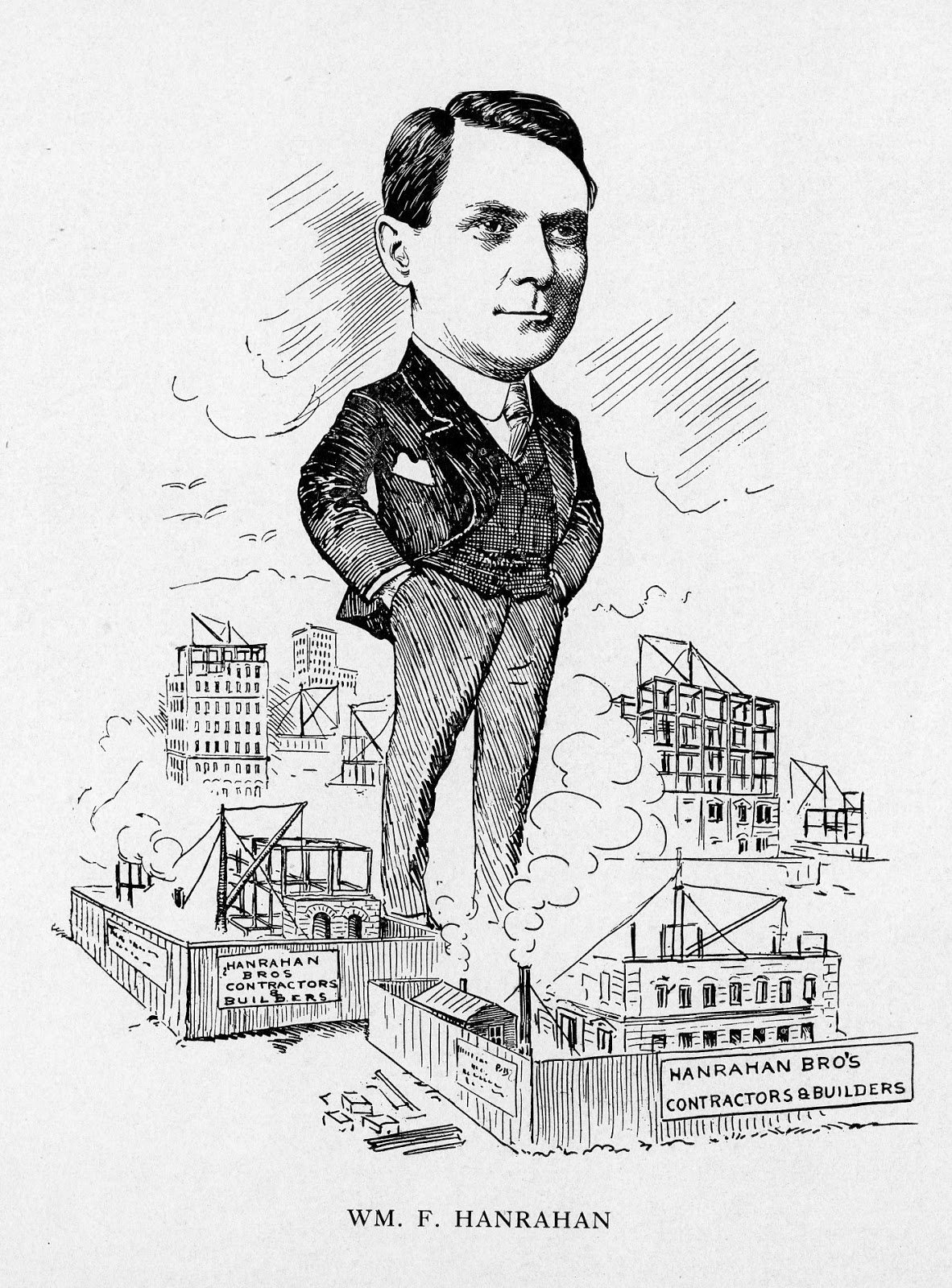
Some time around 1908 or 1909, a cartoonist created scores of caricatures of men prominent in the local community. Those depicted were businessmen and merchants, doctors and dentists, lawyers and judges, political figures, police officers and sheriffs, artists and musicians. The heads of the men are all rendered realistically, as in a photograph, while the men's bodies and surroundings are drawn in a more cartoonish style. The artist also inserted little jokes into the the drawings -- men's clothing store owner Henry Stern is shown being approached by a man wearing a barrel, the general manager of the Schenectady Railway Company skis along on trolleys, and the sun mutters "I am jealous of him" as as it shines behind L. O. Ripley, manager of the Schenectady Illuminating Company. Many of the men in the book are shown with symbols of their hobbies -- such as bowling, fishing, or singing -- in addition to symbols of their vocations. In the excitement of the early age of automobiles, the cars of a select few men are also depicted in loving detail.

The drawings were reproduced and printed in the format of a book, bound between leather covers embossed with the words "Just For Fun." The book's origins are somewhat mysterious. According to a 1953 Union-Star article, the men were all drawn by an itinerant caricaturist: "the name of the artist and his whereabouts are not known. In the book he bound nothing but the caricatures and the names of the men he drew." Although the drawings all appear to be in the same hand, in flipping through the book, we came across two drawings that appear to be signed. One bears the name "Berryman," while another is signed "Thomson." Given the approximate year and the focus on the professional, business, and civic leaders of the city, it's possible that the drawings could have been produced for the Schenectady's Board of Trade's week-long "Skedaddle to Schenectady" fair in 1909. Or perhaps it was indeed produced "just for fun." A few of the images from the book are included below.


Builder William F. Hanrahan overlooks his Schenectady building empire in Just For Fun. Hanrahan was one of many builders depicted in the books, as Schenectady grew in leaps and bounds during the era. From collections of Grems-Doolittle Library. 

Caricature of Dr. George W. Bates from Just For Fun. From collections of Grems-Doolittle Library. 

Alderman Harry G. Ellis outlines his plans for public baths in Just For Fun. From collections of Grems-Doolittle Library. 

Bad guys tremble before Sheriff William H. Hathaway in Just For Fun. From collections of Grems-Doolittle Library. 

George William Slaght, manager of the Saul Clothing Store in the Lorraine Building in Schenectady.  In addition to his work, Slaght also had music as a hobby. Many of the men in the book are shown with symbols of their hobbies in addition to symbols of their vocations. From collections of Grems-Doolittle Library. 


Monday, January 14, 2013

"A Magazine Offering Comment on Schenectady's Sophisticated Side": The Schenectadian


Campaigners march down State Street on the cover of the November 1933 Schenectadian, drawn by Walter Reagles. Notice the Nicolaus Restaurant's parrot in the background. From the collections of the Grems-Doolittle Library.  


There are many interesting local periodicals that have been published over the years. One of the most interesting -- and certainly the most cosmopolitan -- is The Schenectadian, a very New Yorker-esque magazine published from 1933 to 1935. From burlesque show reviews, commentary on wrestling, and a narrative of sailing down the Klondike Ramp in a wagon to analysis of local politics, discussion of up-to-the-minute fashions for women and men, and modern poetry, The Schenectadian captured the "high" and the "low" of culture in Schenectady during the era, and did so with humor and style.

An eye-catching subscription notice in an early issue of The Schenectadian by an uncredited artist. "You may prefer to see her in a grass skirt or a full beard, but those things take time and money. Just remember that she is doing her best and so are we." From the collections of the Grems-Doolittle Library.  

Walter Reagles remembered that he, along with Milton Enzer, the director of Union College's news bureau, and GE employees Kenneth Patrick and Ross Lindblom, "felt the need of a local magazine which contained a metropolitan point of view" and set out to create a magazine that "imitate[d] the style of the New Yorker." Reagles was at that time the art director at General Electric. The team published the first issue of The Schenectadian in October 1933. The Schenectady Gazette described it as "a magazine offering comment on Schenectady's sophisticated side." The magazine continued to be published monthly through at least May 1935.

Illustration by James Gisondi from The Schenectadian. From the collections of the Grems-Doolittle Library.  

Illustration by Mary Sauter from The Schenectadian. From the collections of the Grems-Doolittle Library.


The Schenectadian presented a clever, urbane look at local politics, local history and personalities, theatre, community events and social news, movies, radio, and concerts. Other pieces in the magazine explored the worlds of the city's bars and burlesque shows (under the heading of "Sin and Sociology"), and an ongoing series of articles traced the effects of the Depression and New Deal efforts locally. The magazine also included fiction and poetry, and offered reviews of the fashions available for purchase at local clothiers such as the Lady Lee Shop, the Evelyn Shop, Gelber's, and the Vanity Fair Shop, as well as department stores such as Barney's, the Wallace Company, and the Carl Company. Readers were encouraged to send in reminiscences for a "Do You Remember?" column, and the "Dorplets" column provided a tongue-in-cheek look at all aspects of life in Schenectady. Walter Reagles' "Vignette" series highlighted local people from William "Buck" Ewing, catcher for the Mohawk Colored Giants baseball team, to Monsignor John Reilly, to police officer Thomas William Walsh. Another semi-regular feature, "Business Women," written by Frances Travis, profiled women in local business and government. In ubiquitous sprinklings throughout the magazine, The Schenectadian also poked fun at ill-worded headlines from local papers such as the Schenectady Gazette and the Schenectady Union-Star.

Sketch of a burlesque dancer by Dora Abrahams from The Schenectadian. Abrahams (later De Vries, then Mathieu) moved to New York City and had success as an illustrator. Her work was published in the New Yorker, Life, Vogue,  and Glamour. A Schenectady native, she credited Walter Reagles with "discovering" her and encouraging her as an artist. From the collections of the Grems-Doolittle Library.

Like the New Yorker, The Schenectadian also provided a showcase for talented cartoonists and illustrators. Artists such as Dora Abrahams, James Gisondi, Edwin Sauter, Mary Sauter, Walter Reagles, Bradley Wilson, Howard Blanchfield, and James Barstow were regularly featured in the magazine. Many of the artists whose work was featured in The Schenectadian worked in the General Electric Company's art department.

The cover of the June 1934 issue of The Schenectadian, by Edwin Sauter, is a satirical sign of the times during the Depression; new graduates go from diploma to shovel to work on Civil Works Administration (CWA) projects. From the collections of the Grems-Doolittle Library.


Illustration by Bradley L. Wilson from The Schenectadian. From the collections of the Grems-Doolittle Library.


This sketch of Mohawk Giants catcher William "Buck" Ewing, drawn by Walter Reagles, accompanied  a vignette written about Ewing. It appeared in the November 1933 issue of The Schenectadian. From the collections of the Grems-Doolittle Library.

The Grems-Doolittle Library has several issues of The Schenectadian available for researchers to view. A complete listing of issues in our holdings is provided below. Please contact Librarian Melissa Tacke (librarian@schenectadyhistorical.org; 518-374-0263, option 3) if you have issues of The Schenectadian not listed that you are willing to donate.

The Schenectadian
Vol. 1, No. 1 - October 1933
Vol. 1, No. 2 - November 1933
Vol. 1, No. 3 - December 1933 / January 1934
Vol. 1, No. 4 - February 1934
Vol. 1, No. 5 - March 1934
Vol. 1, No. 6 - April 1934
Vol. 2, No. 1 - May 1934
Vol. 2, No. 2 - June 1934
Vol. 3, No. 1 - November 1934
Vol. 3, No. 2 - December 1934 / January 1935
Vol. 3, No. 3 - February 1935
Vol. 3, No. 4 - March 1935
Vol. 3, No. 5 - April / May 1935