Showing posts with label Drawings. Show all posts

Friday, May 31, 2013

Caricatures of Prominent Schenectadians

Real estate and insurance man A. Vedder Magee circles the planet in Just For Fun. From collections of Grems-Doolittle Library. 

Some time around 1908 or 1909, a cartoonist created scores of caricatures of men prominent in the local community. Those depicted were businessmen and merchants, doctors and dentists, lawyers and judges, political figures, police officers and sheriffs, artists and musicians. The heads of the men are all rendered realistically, as in a photograph, while the men's bodies and surroundings are drawn in a more cartoonish style. The artist also inserted little jokes into the the drawings -- men's clothing store owner Henry Stern is shown being approached by a man wearing a barrel, the general manager of the Schenectady Railway Company skis along on trolleys, and the sun mutters "I am jealous of him" as as it shines behind L. O. Ripley, manager of the Schenectady Illuminating Company. Many of the men in the book are shown with symbols of their hobbies -- such as bowling, fishing, or singing -- in addition to symbols of their vocations. In the excitement of the early age of automobiles, the cars of a select few men are also depicted in loving detail.

The drawings were reproduced and printed in the format of a book, bound between leather covers embossed with the words "Just For Fun." The book's origins are somewhat mysterious. According to a 1953 Union-Star article, the men were all drawn by an itinerant caricaturist: "the name of the artist and his whereabouts are not known. In the book he bound nothing but the caricatures and the names of the men he drew." Although the drawings all appear to be in the same hand, in flipping through the book, we came across two drawings that appear to be signed. One bears the name "Berryman," while another is signed "Thomson." Given the approximate year and the focus on the professional, business, and civic leaders of the city, it's possible that the drawings could have been produced for the Schenectady's Board of Trade's week-long "Skedaddle to Schenectady" fair in 1909. Or perhaps it was indeed produced "just for fun." A few of the images from the book are included below.
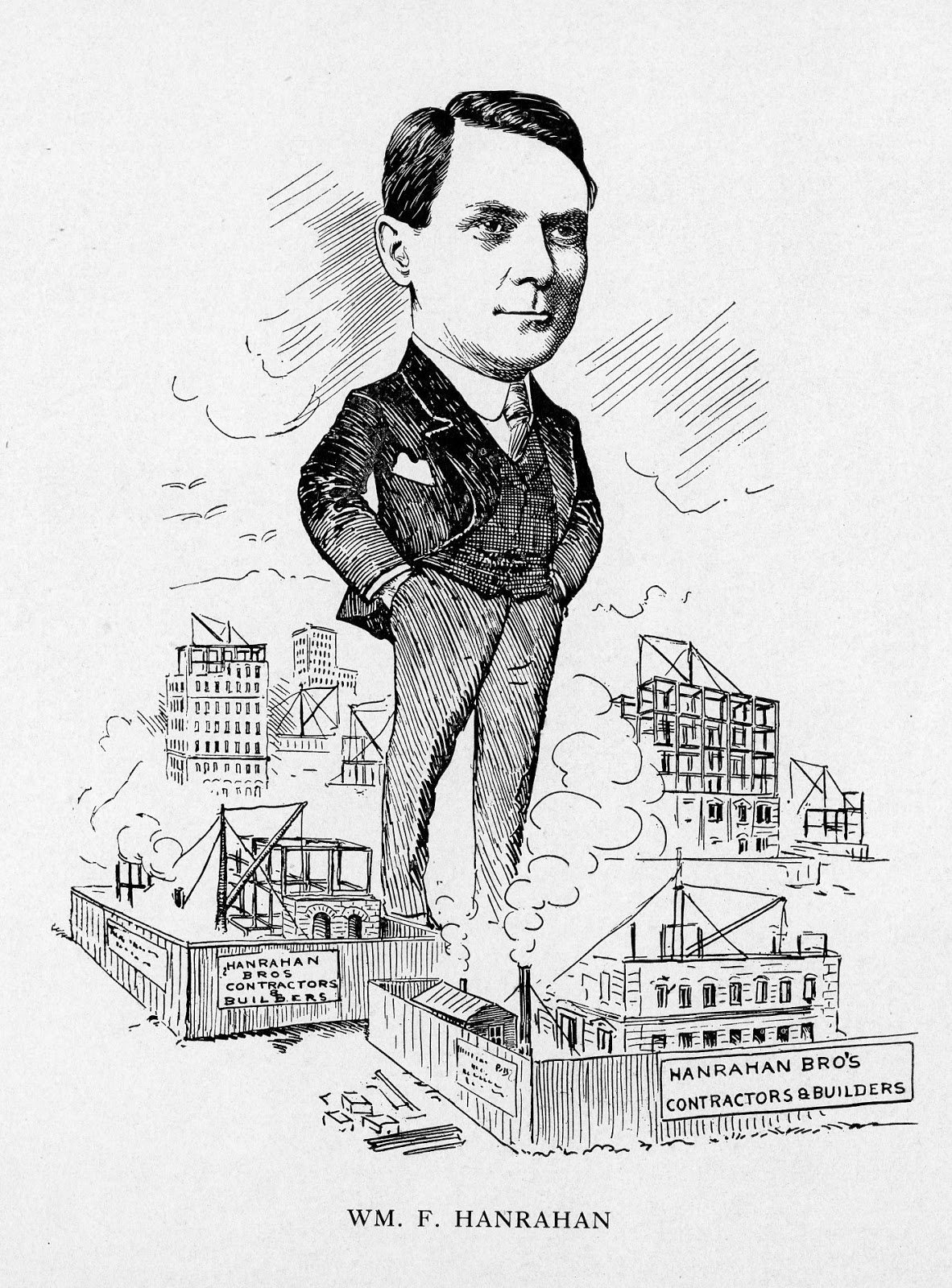

Builder William F. Hanrahan overlooks his Schenectady building empire in Just For Fun. Hanrahan was one of many builders depicted in the books, as Schenectady grew in leaps and bounds during the era. From collections of Grems-Doolittle Library. 

Caricature of Dr. George W. Bates from Just For Fun. From collections of Grems-Doolittle Library. 

Alderman Harry G. Ellis outlines his plans for public baths in Just For Fun. From collections of Grems-Doolittle Library. 

Bad guys tremble before Sheriff William H. Hathaway in Just For Fun. From collections of Grems-Doolittle Library. 

George William Slaght, manager of the Saul Clothing Store in the Lorraine Building in Schenectady.  In addition to his work, Slaght also had music as a hobby. Many of the men in the book are shown with symbols of their hobbies in addition to symbols of their vocations. From collections of Grems-Doolittle Library. 


Wednesday, December 26, 2012

History in Pen and Ink: Prints of Drawings from the H.S. Barney Collection

The H.S. Barney Company, also known as Barney's department store, was an institution in the downtown Schenectady shopping area for nearly 140 years. In addition to conducting business, the store also helped to tell the story of Schenectady's history through a series of attractive and interesting prints. The prints are roughly chronological, and depict different aspects of the city's history from 1833 through 1929.

There is a bit of mystery surrounding the origin of the prints. Some of the prints were reproduced in local newspapers in advertisements for the Barney's department store. The earliest such advertisement we were able to find was in a 1955 advertisement in a special 100-year anniversary edition of the Schenectady Union-Star. There appears to be a total of 10 drawings in the collection, each bearing the notation "From the H.S. Barney Collection of Original Pen Drawings." The first two are not signed, but all appear to have been drawn by the same artist, and the drawings numbered 3 through 10 are signed with the initials "F. B. R." We have been unable to determine who the artist is, exactly when the prints were made, how many were made, or how they were distributed. Anyone who has additional information about these prints is encouraged to contact Librarian Melissa Tacke by phone at 518-374-0263, option 3, or send an email to librarian@schenectadyhistorical.org.

Below are images of some of these compelling prints.


This is the first drawing in the series. A 1955 Barney's advertisement in the Union-Star describes this drawing as depicting "H.S. Barney's arrival by mulecart in Schenectady in 1833." In this scene looking east up State Street, viewers can see the Erie Canal, the railroad, and the area that is now Veterans' Park. Image from Grems-Doolittle Library Collections.

The local fraternal organization Mystic Order of the True Blues was a short-lived organization, being in existence roughly from 1867 to 1870. Joel Henry Monroe in his book Schenectady Ancient and Modern describes platform of the True Blues as being "to awaken Schenectady by carnivals and burlesque shows and characterizations of certain institutions and incidents." According to newspaper reports of the time, upwards of 30,000 out-of-towners visited Schenectady for the 1870 carnival and parade organized by the True Blues. Image from Grems-Doolittle Library Collections.


A street scene in front of the H.S. Barney Company on State Street around the turn of the twentieth century. The H.S. Barney Company, later known as Barney's, was a fixture in downtown Schenectady until the store closed its doors in 1973.  Image from Grems-Doolittle Library Collections.

This drawing seems to have been inspired by Schenectady's 1914 flood, described as the worst flood in the city's history. The Mohawk River's level was raised by 25 feet. The flooding forced hundreds of people from their homes, and many people had to be evacuated from their homes in boats. Notice the rats who have commandeered a plank of wood as a raft. Image from Grems-Doolittle Library Collections.

Although Schenectady was no Chicago in the 1920s, the effect of crime during Prohibition was present in the city. This depiction of Prohibition-era crime may have been been influenced by a story on file in the city police department which was also shared by Larry Hart in his book Schenectady's Golden Era, 1880-1930. A bootlegger transporting liquor smuggled from Canada was traveling near Amsterdam on November 7, 1924 when "a high-powered car pulled alongside and another man jumped onto the running board, held a revolver against the driver's heart and ordered him to stop. They took over his cargo, valued at about $3,000, and drove him to the Rotterdam hills and told him to 'start walking.'" The car was later found abandoned near the intersection of State Street and Ferry Street in Schenectady. Image from Grems-Doolittle Library Collections.

The last in the series of drawings shows a local connection to the stock market crash in 1929 that led to the Great Depression. Two concerned men are shown inside the office of the Edward B. Smith & Co. stocks and investment securities company at 212 State Street in Schenectady. The two men might be the men listed in the 1929 city directory as proprietor and manager -- Edward Smith and Theodore Lydgate. Image from Grems-Doolittle Library Collections.