Showing posts with label Glenville. Show all posts

Thursday, April 11, 2019

Glenotia Park

This post was written by library volunteer Diane Leone

In the early decades of the twentieth century, a recreational gem sat just on the doorstep of downtown Scotia. In 1907, a tiny island in the Mohawk River, once called the Isle of the Mohawks, was leased by the newly created Scotia Athletic Association from the Sanders family, owners of a riverfront home, now the Glen-Sanders Mansion. The lessees hoped to create a sports and recreational venue, which they named Glenotia Park, for Glenville and Scotia. The lease was granted with the proviso that there would be no disorderly conduct, hard liquor, or late-night carousing. Although the athletic association lost its lease after five years, the park continued to operate under different proprietorship. Until its closure in the early 1930s, Glenotia was the scene of many picnics, swimming lessons, ballgames, dances, and other forms of entertainment.

Idyllic scene of Glenotia Park in 1920. Courtesy of the Larry Hart Collection in the Grems-Doolittle Library & Archives.
Over the years, Glenotia was a favorite summer gathering place. Clara Wege McGuire recalled riding the Crane Street Trolley over the Washington Avenue Bridge, and walking from the stop near the Sanders residence down to the park. The island was accessible via a portable pontoon bridge that spanned the Mohawk’s narrow inlet, called Sanders Creek, at the end of S. Ballston Avenue. The association built a baseball diamond and a one-eighth mile track to accommodate athletic events. Crowds came to cheer on a variety of locally formed baseball teams that vied against each other. Scotia High School’s first track meet on May 22, 1909 was a big event, with the community participating in a parade that marched down Mohawk Avenue. The team defeated Altamont, Rensselaer, and Schoharie. In the fall of 1924, while a football field was being constructed at nearby Collins Park, the Glenotia ballfield was the practice site for Scotia High’s first official team, which played games against opponents from Catskill, Little Falls, and Johnstown.
The pavilion at Glenotia park. Courtesy of the book Glenville, NY: Images of America.
Young people enjoyed Saturday night boating, as well as dances, held in the upper part of a two-story wood pavilion built on stilts to protect it from the ravages of winter ice and spring floods. The structure featured a concession stand and a lower level for picnickers. While most people were respectful, the constables and deputies on duty had to deal with occasional troublemakers. One man who attempted to instigate trouble at a dance was thrown into the river by Deputy Phil Kline, to the delighted cheers of everyone.

Other forms of evening diversion were traveling shows and movies. One show, titled Ten Nights in a Bar Room (1910), was based on the 1854 pro-temperance novel. The accompanying advertisement was for Kickapoo Indian Juice and Body Purifier, a well-known patent medicine of the era. A park patron noted that fight movies were shown for adult males inside a tent. Young boys were relegated to the outside, where they had to peek into the tent to watch the the “flickers.” One controversial film was the 1910 heavyweight bout, at the time dubbed “The Fight of the Century,” in which Jack Johnson knocked out James J. Jeffries, becoming the first African American heavyweight champion. As a result of racist attitudes, the film was the subject of censorship in many places, including Scotia. Since Glenotia was outside the village boundary, the film was shown there. The 1915 Johnson-Jess Willard bout, in which Johnson lost his title, was also shown.

Billboard advertising the Mohawk Swimming School. Courtesy of the
Larry Hart Collection in the Grems-Doolittle Library & Archives.
Many area residents had fond memories of traditional summer pastimes, such as picnics and swimming. One woman, reminiscing years later about Saturday church picnics, recalled that while the men worked at GE from 6 am to noon, the women would transport and prepare the food, anticipating the arrival of their husbands and male relatives. As she describes a childhood memory of soaring over the water in a swing, “I can feel the breezes now as they blew up my petticoats and dress revealing the Hamburg ruffle on my ‘short drawers.’” 1
Swimmers at the Mohawk Swimming School.
Courtesy of the Larry Hart Collection in
the Grems-Doolittle Library & Archives.
Swimming was a popular activity at Glenotia. Launching into the river from long ropes attached to trees was a favorite pastime. As Clara Wege McGuire pleasurably recalled: “Once at the river, what a day it would be! As a child there was no way to describe it, except that it was worth a whole year in school to look forward to it.”2

Dredging for the Barge Canal deepened the river, leaving a gravel beach area. In 1915, after Claude and George Chrisman’s brief unsuccessful stint at running a swimming school, German immigrant Werner Gewecke leased the island, opening the Mohawk Swimming School, which was incorporated into the park. He promoted it widely, and even arranged with the Schenectady Railway Company for a bargain fare for trolley riders bound for Glenotia. One ad for the school promised a “Large Bathing Beach — Big Diving Tower & Floating Tables. Swimming Taught in Scientific Way.” He charged $ .05 for park admission and $.10 for swimming. To attract customers, he constructed bathhouses, fortified the beach with extra sand, and built a movable multi-level diving platform. A refreshment stand sold ice-cream. Gewecke’s technique was to suspend students from harnesses attached to the side of his boat so that they would learn to swim safely. Aspiring swimmers were assured that they would learn by the end of the summer. As the sign on Gewecke’s boat read: “We guarantee you will swim or your money back!”3
Courtesy of the book Glenville, NY: Images of America.
Glenotia’s popularity waned as the years brought social and economic changes. The growing accessibility of the automobile made it easier to travel to recreational sites that were farther away. Radio became a household fixture, opening up a new entertainment format that kept some people at home. With the 1929 stock market crash and the onset of the Depression, disposable income dried up. Sadly, on top of all these developments, the pollution of the river made swimming hazardous. According to Gewecke’s daughter Ruth, her father closed the swimming school in 1927, although the Schenectady County Historical Society’s book on Glenville gives 1930 as the closing date. The pontoon bridge was removed, as was the pavilion, whose wood beams were incorporated into a home near the river. The once-popular park closed in 1931-32, meeting the same fate as Rexford’s Luna Park and Forest Park in Ballston, two local amusement parks from the same period.

For years, Glenotia remained unused and forgotten, with ownership changing several times since the park’s closure. It was returned to the public’s awareness in 2012 when the 19 acre island was placed on the market for $91,900, as reported in the Daily Gazette. Since the land is designated as a conservation zone, usage is limited. However, the island could be utilized for recreational or educational purposes. Today, it remains just offshore, overgrown, a deserted piece of the past.

Quotations were taken from newspaper articles on file at the Schenectady County Historical Society under “Glenotia Park.”
1. "More of Ruth O's Memories," Scotia-Glenville Journal, April 14, 1976.
2. “Little-Known Glenotia Park Was Popular Spot,” Schenectady Gazette, June 23, 1979.
3. Hart, Larry. “Glenotia Park Was a Popular Place,” Scotia-Glenville Journal, April 22, 1993.


Thursday, August 30, 2018

Rotterdam Sesquicentennial Parade

Rotterdam and Glenville have an almost 200 year old rivalry. This rivalry was based on which town was officially created first. Both towns broke off from Schenectady in 1820, but there is no official record as to the exact date. This rivalry was stoked during a match of tug of war over the Mohawk during the sesquicentennial (150 year) anniversary for both towns in 1970. Glenville won, but accusations of cheating have blemished their mighty feat of strength (read more about this match in a recent Gazette article by Stephen Williams: https://dailygazette.com/article/2018/05/21/glenville-and-rotterdam-to-tug-it-out).

While Rotterdam was left dripping and injured (2 Rotterdam residents were treated for rope burn and one for a broken wrist) we like to think that they had some other successes, such as their celebration of facial hair (read more in a previous blog post: http://gremsdoolittlelibrary.blogspot.com/2015/11/brothers-of-brush-and-sisters-of-belle.html) and their Sesquicentennial Parade).

The parade was assembled at Mohonasen High and went down a 2 mile stretch of Curry Road to Westcott Road and disassembled at the former Army Depot. The Gazette estimated that around 4,000 people lined up to participate in the parade, including bands, dancers, people on floats and others.  A wide variety of organizations throughout Schenectady County were represented such as the Rotterdam Blue Jays, Rotterdam Republican Club,  the Schenectady "Electric City" Chorus, General Electric, Freihofers, and more.

We recently received a donation of photos of the parade that show the parade in all it's glory with creative floats, sharp looking marching bands, and cool vintage cars. Check some of them out below:


The Rotterdam Republican Club won an award for "Most Beautiful Float".

Wednesday, January 10, 2018

Schenectady County's Lustron Home

This blog post was written by SCHS volunteer Gail Denisoff.

When millions of GIs returned home from World War II, they faced the biggest housing shortage in US history.  Veterans and their young families were desperate for homes of their own and wanted to take advantage of the low interest rates guaranteed by the GI Bill.  Construction companies were frantically trying to meet the need as suburbs were springing up around cities nationwide.   Wilson Wyatt, the federal government's new Housing Expediter, estimated that 3 million houses needed to be built between 1946 and 1947 and the demand for most of these homes was among low and middle income families.

Prefabricated houses were proposed as a remedy for the crisis with nearly 300 companies entering the industry in the late 1940’s.   It was believed that manufacturing and technical advances generated by the war would result in homes rolling off production lines by the millions. This never happened. In 1946 and 1947, only 37,000 prefabricated houses were put up.  For many prospective buyers, prefabricated housing still carried the stigma of the shoddy emergency housing built during the war. Some had aesthetic objections to visible joints between panels and thin painted plywood walls. Local building codes and the opposition of labor unions were also obstacles.

Enter the technologically sophisticated Lustron House - “The House America Has Been Waiting For”.  Of all the companies joining the prefab market, Lustron was one of only three to receive a direct federal loan. Led by Chicago industrialist and inventor Carl Strandlund, who had worked with constructing prefabricated gas stations, Lustron offered a home that would "defy weather, wear, and time."

Advertisement for the Lustron Home in Life Magazine.
Strandlund's Lustron Corporation set out to construct 15,000 homes in 1947 and 30,000 in 1948. However, the corporation eventually constructed just 2,498 homes between 1948 and 1950.  Lustron homes were built entirely of steel in a former airplane factory using materials and technology developed during the war. Interior and exterior surfaces were steel with a porcelain enamel finish baked onto panels. The roof shingles and all framing were also made of steel. The houses, which sold for $6,000 to $10,000, arrived in 3000 pieces on a specially designed truck.

Homeowners had a choice of three models -  Westchester, Newport and Meadowbrook; the most
popular being the Westchester Deluxe with approximately 78 built in New York State.  Most homes were built on concrete slabs by local Lustron dealer/builders following a factory manual which estimated they could be completed in 360 man-hours.   Owners also had a choice of two or three bedrooms and could choose from four exterior colors; surf blue, dove gray, maize yellow and desert tan.  Interior colors were neutral gray, ivory, blue, yellow and pink. Local dealers supplied flooring options. In 1949 Lustron also offered garage packages

The Lustron Corporation declared bankruptcy in 1950, despite being an extremely well-funded, well-
publicized, government-supported enterprise that was manufacturing a desperately needed product. Production delays, the lack of a viable distribution strategy, and the escalating prices for the finished product all contributed to the failure. Additionally, local zoning codes also played a part. Some accounts suggest an organized effort from the existing housing industry to stop Strandlund.  Another issue was that dealerships had to pay for homes in advance and needed to order in quantity to make a profit.  When Lustron closed, dealerships had paid for thousands of homes that were never manufactured and many lost a great deal of money. 

Although builders reported a strong interest in the homes, locally only 18 homes were built by Albany builder Upstate Construction Corp. and 21 by Amsterdam/Schenectady builder Wilson Bartlett Taylor by the end of 1949.  Both companies were undoubtedly hurt financially when Lustron ceased production.  Dealerships nationwide submitted testimony to a subcommittee of the Senate Committee on Banking and Finance stating their confidence to sell the homes if manufacture continued.  Upstate Construction Corp. of Albany reported by telegram: 

“Have been a Lustron dealer for 8 months and have erected and sold 20 Lustron houses without use of a sales force or sales effort.  Have used this time (8 months) to train crews.  Now can turn out a Lustron house ever 3 days in 350 erection hours.  Have just employed large sales staff and can sell 100 houses in matter of weeks.  Am prepared to erect 100 houses in next 4 months and 300 houses in year.  Have 18 years as leading builder in our area.  Lustron is best value ever offered.  All dealers this section in similar position having spent months training crews.  None employed any sales effort during training period.  We’re all ready now to meet tremendous demand for Lustron.  If Lustron permitted to continue this year, success is assured.”  Despite the efforts of the 221 dealerships who testified to the Senate, Lustron ceased production in March of 1950.

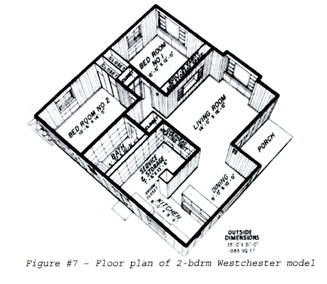
One Lustron home that has been preserved in near original condition is on Slater Drive in Glenville. Built in 1949, it was the Westchester Deluxe 2 bedroom model in dove gray built on a slab foundation.  When inspected, only two changes to the original home were noted – the outside trim had been painted and the bathroom door replaced. It was added to the National Register in 2008 and at that time was still occupied by the original owners.  The home has steel panels inside and out with built in closets, original metal kitchen cabinets, built in vanity and dining room hutch.  It also retains the original bay window and aluminum casement windows, signature gutters and zigzag downspout, entry porch, steel rooftiles and chimney and inside wall panels and trim elements. Photos of this home were taken as part of the New York State Lustron Home Survey in 2007 and some can be seen below. 


As a testament to the durability of Lustron homes, today almost 2000 are still standing although many have been modified over the years.  A good number enjoy official protection through the National Register of Historic Places.  Even though many owners are trying to preserve the original integrity of the homes, existing Lustron homes face an uncertain future.  Because of their small size and the changing demands of modern living the homes do not appeal to young buyers. Only time will tell if these homes can sustain modern family life or if alternative uses for them can be found.


Tuesday, February 7, 2017

The Battle of Beukendaal

Translated to English from Dutch, Beukendaal means Beech Dale and that area around Sacandaga and Spring Road in Glenville was known for the number of Beech trees growing. The area is notable for being the only battle of King George's War to occur in the Mohawk Valley, the Battle of Beukendaal in 1748. The Battle of Beukendaal is often referred to as the Beukendaal Massacre (I mistakenly referred to it as a massacre in the last post), but this gives the wrong image of what actually happened at Beukendaal. It was more of a failed Schenectady militia campaign than a massacre.

The main cause of the King George's war had to do with events that occurred in Europe, the War of Jenkin's Ear and the War of the Austrian Succession. The conflicts of the War would eventually spread to the colonies in the form of territorial disputes between the British and their Indian allies and the French and their Indian allies. It was the third of four French and Indian Wars and took place mainly in Massachusetts, New York, New Hampshire, and Nova Scotia.
The British siege of the French fortress at Louisburg in Nova Scotia was one of the hallmarks of King George's War. British forces captured the fort in 1745 after a six week siege. Courtesy of Wikipedia.
A precursor to the Battle of Beukendaal came dangerously close to Schenectady. On November 16, 1745 the settlement of Saratoga was raided by the French and their Indian allies. Over 100 inhabitants were either killed or captured during this attack. This attack caused many of the settlements north of Albany to be abandoned. The attack on Saratoga worried many in New York and a draft of 200 men were sent to Albany and Schenectady from the militias of Ulster, Dutchess, Orange, Westchester, Queens, and Suffolk.

Another scare came to Schenectady in 1746 when two slaves were captured by a party of French Indians.  A party of men from Albany and Schenectady pursued the raiding party and came upon the house of Simon Groot. The raiding party had set fire to Groot's house, taken a prisoner, murdered and scalped a boy, and shot a man who was attempting to escape. The militia was unable to further track the raiding party. The raid on Groot's house and the increasing amounts of violence in the area was likely a cause of Abraham Glen requesting permission to raise a company of 100 volunteers for the defense of Schenectady and the frontier. There wouldn't be any battles near Schenectady until July 18, 1748 when three Schenectady men were attacked by French Indians in Glenville. This would spark the events of the Battle of Beukendaal.

Much of what we know about the Battle of Beukendaal comes from a letter to William Johnson from Albert Van Slyck who who fought in the battle, but there have been several other accounts. Van Slyck wrote that a group of men gathered to raise the frame for a barn by the Mohawk River in Scotia on July 18, 1748. Three of the men, Captain Daniel Toll, Dirk Van Vorst, and Toll's slave, Rykert departed to gather some horses that wandered off. Shortly afterward, the others raising the barn heard gunshots and Albert's brother, Adrian, sent his slave to Schenectady to warn the residents there and to try to gather men.
The DeGraaf Barn that Toll, Van Vorst and Rykert were working on was eventually raised after the Battle of Beukendaal. Courtesy of the Grems-Doolittle Library Photo Collection.
A group of Connecticut Militia members were stationed at Schenectady and upon getting the news, immediately crossed the river. Others in Schenectady joined making the total around 60-70 to the 100 French and Indians who made the attack. Unfortunately, the Schenectadians were too unorganized and gathered in four small groups who attacked at separate times. The first group reached the Kleykuil, a clay pit lying between Sacandaga and Spring Roads, and found Daniel Toll propped against a tree waving to the group. As they approached Toll, they supposedly found him lifeless with a crow tethered to his arm (this story has been unverified and doesn't show up in Albert Van Slyck's letter). This group was then ambushed and fired upon from the nearby woods. The second group met up with the first and retreated to the nearby DeGraaf house to stage their defense.

Corn growing at the site of the Beukendaal Battle in 1997. Courtesy of the Grems-Doolittle Library Photo Collection.
The men in the DeGraaf House pried of the clapboards and fired on their enemies from the house. The attackers allegedly tried to set the house on fire a few times, but nothing succeeded in driving them from their defense. The third group eventually arrived, took a good look at the situation, and decided that battle wasn't for them so they turned around and retreated.  Those in the DeGraaf house managed to hold off the attack until the fourth group joined and drove off their attackers.

Photo of the DeGraaf house where the Schenectady Militia defended themselves against the French Indian attackers. The house was demolished in 1915. Courtesy of the Grems-Doolittle Library Photo Collection.
Twelve Schenectadians were killed along with seven Connecticut soldiers, including their commander Lieutenant John Darling. Thirteen others were captured and taken to Canada. Dirk Van Vorst had managed to escape captivity and joined up with the third group (Van Vorst's reluctance at being recaptured, or killed after escaping the first time may have played a role in the third group's unwillingness to join the battle.) With the battle over, the bodies of the dead were brought back to Schenectady and placed in Abraham Mabee's barn which was located at present day 10 and 12 North Church Street. The number of French and Indian casualties were never confirmed, but are thought to be minimal.

In 1929, the Schenectady Chapter of the Daughters of the American Revolution installed this monument to those who were killed during the Beukendaal Battle. Courtesy of the Grems-Doolittle Library Photo Collection
It's tough to visualize now, but Schenectady County was once on the frontier. Attacks like the Battle of Beukendaal highlight the danger that settlers were constantly in and how difficult it was to protect residents in the area.

Monday, January 30, 2017

Hardin's Crossing: What's in a Place Name

Finding the origin of place names can be a tricky business sometimes. In Schenectady County, the origin of some place names are more apparent than others. Glenville, Duanesburg, and Princetown were named after prominent people who lived there, namely Alexander Lindsay Glen, James Duane, and John Prince. Scotia and Rotterdam were named after places. Scotia, after the home country of Alexander Lindsay Glen, and Rotterdam after the port of Rotterdam in the Netherlands. Schenectady and Niskayuna are both forms of place names given to them by Native Americans in the area. Schenectady means "beyond the pines" or "over the pine plains" and Niskayuna means "extensive corn flats."

Checking out some of the hamlets in the area and we have Alplaus. Alplaus derived from the Dutch Aal Plaats which means place of the eels. Carman in Rotterdam was originally named Athens Junction after the junction of the New York Central and a railroad from Athens, NY. It was eventually renamed after Will Carman who opened a general store at the crossing. This all leads to a research question that I received recently. What was Hardin's Crossing, and where was it located? Was it a ferry or railroad crossing? Who was this enigmatic Hardin who had a crossing named after him? Some of these questions were easier to answer than others.


This map shows the lands of Hardin as well as the Fitchburg and New York Central railroads that crossed Sacandaga Road. Courtesy of the Grems-Doolittle Library Map Collection.
Specifics about Hardin's Crossing were difficult to come by. I quickly came to find out that it wasn't listed on any modern maps and articles that I found would refer to Hardin's Crossing, but often had no background as to why it was called that. We are lucky to have former Don Keefer's research files on Glenville and Scotia. Keefer was the Glenville town historian as well as the Schenectady County historian for a while and his research is very valuable when researching anything about Glenville.


Photos of the DeGraff House on what is now Sacandaga Road. The DeGraff House marked
the site of the Beukendaal Massacre where 20 men from Schenectady were killed and 13 were
captured by French and Indian attackers after a viscous battle.
Keefer's research binder on the Beukendaal Massacre had a few article on Hardin's Crossing. It turns
out that in 1915 both the schoolhouse and the area of Hardin's Crossing were changed to Beukendaal to commemorate the Beukendaal Massacre. The charge to change the name was led by none other than the Schenectady County Historical Society, little did they know that they would cause a bit of confusion to their librarian 102 years down the road. So that article solved the "where" of Hardin's Crossing which was very close to the site of the Beukendaal Massacre near Sacandaga Road.

I then went to our map files to see if there were any maps that might show the site so I could learn what the crossing part of Hardin's Crossing referred to. An undated map of the 10th School District of Glenville shows two railroads that cross Sacandaga Road, the Fitchburg and the New York Central Railroad. This map gave me some more definitive proof that an Hardin (unknown first name) owned property in the area and I also found out that the crossing was a railroad crossing.

This page from the  U.S., Selected Federal Census Non-Population Schedules, 1850-1880 shows the wealth of Sidney Hardin (outlined in yellow). He owned 200 acres of land and the cash value of his farm was $8,000 which would put it at over $200,000 today. This made him one of the more wealthy landowners in the area. A separate census page puts his personal estate at $2,166. Courtesy of Ancestry.com
The "who" was a bit more difficult to find out, I knew it was a Hardin, but finding out which one was tricky as none of the articles mentioned which Hardin the crossing was named after. The Hardins lived in Schenectady since the mid-1700s, but there weren't a ton of Hardins in the area. The Hardin family file in our library had a page from Cuyler Reynolds' Hudson and Mohawk Genealogical and Family Memoirs which gave a short history of the Hardin family and listed many of the Schenectady County Hardins. It turns out that there were two Hardins that had farms in Glenville, Sidney and Jonathan Tripp Hardin. The 1866 Beer's Atlas lists many of the property owners in Glenville and sure enough J. & S. Hardin were both shown on the map right near the crossing of Sacandaga Road and the New York Central Railroad. Jonathan Tripp Hardin would go on to live in Schenectady, but Sidney stayed in Glenville.

Sidney died in 1880 at the young age of 54. In a 1965 Raw Materials of History column from the Schenectady Gazette, Neil Reynolds states that even though the Hardin's Crossing was changed to Beukendaal, "the name Hardin's Crossing still persists." So Sidney Hardin's memory lasted a while after he died. Not being a native to Schenectady County, I wonder if anyone Glenville natives still call this area of Sacandaga Road Hardin's Crossing.

Thursday, September 5, 2013

Old Schoolhouses of Glenville


Children outside of West Glenville School. The school closed in 1953. Glenville historian Percy Van Epps, who attended the school as a youngster in the 1860s and 1870s, remembered visits from a traveling magician, spelling bees, singing "Under The Willow She's Sleeping" accompanied by the wheezing of a melodeon, and teachers -- from the beloved Canadian "man of mystery" to the "lazy ignoramus" who stole money from the schoolchildren. Photo from Grems-Doolittle Library Photograph Collection.

"Countless volumes could be written telling of the many and varied occurrences of interest, sometimes laughable, often pathetic, happening in the numerous little red school houses scattered over our hills and dales . . . a highly organized and determined effort is under way to absolutely abolish these cherished, and on the whole efficient, institutions of our rural communities; an effort, however, vigorously and ably opposed, it would seem fitting if more of these odd happenings might be recorded before they pass into oblivion."
- Glenville historian Percy Van Epps (1859-1950), as part of reminiscence entitled "Our Little Red School House."

School days are upon us once again, so it's a good time to take a look back at schools of days gone by. In the rural schoolhouse, one teacher taught children from first grade through eighth grade. The group of pupils taught by the teacher might be as small as 7 or 8 or as many as 25 or 30. In the years of the nineteenth century, the class sizes would ebb and flow with the seasons; more children could attend during the winter months, as many had to work helping their families on local farms during the spring and fall. Schools had no central heating, electricity, or running water. Students had to go outdoors to use a privy if nature called during the day. A wood-burning stove, which was often tended by one or two of the older boys in the school, heated the room. In cold winter months, the students might cluster around the wood stove, trying to get warm, during the first hour of the school day. Along with "reading and 'riting and 'rithmetic," students learned history, geography, spelling, and English, and many teachers also made the time to squeeze in music, nature study, and art. The school was also a site for exhibitions, where students showed off to their parents and their community what they had learned through recitations, spelling bees, and singing.

These little schoolhouses were ubiquitous in rural parts of Schenectady County for over a century; here are images of just a few, from the town of Glenville.

School District #10 (Beukendaal) was created in 1825. This was the original school building on the site, which was demolished in 1915. It was replaced by a cobblestone schoolhouse that remained open until 1953. "I have remarked here on a former occasion, that I would do more for this school than any other, because this was the school of my youthful days," said John Hagadorn at an exhibition of singing, reading, and essays at the school in 1880. "Near this spot I have met with my school mates to study, and join in the innocent amusements of school days. The swift wings of time have broken up these pleasant associations . . . So it will be with you children, you are now passing through a period of time which will never again return. Strive to make the best use of your time, while attending school, so that when you are grown up you may look back with the pleasing satisfaction that you have not spent your time in vain." Photo from Grems-Doolittle Library Photograph Collection.

A group of girls from the Hill School in 1926. Pictured are Sadie Buzinski, Helen Wronkowski, Clementina Farrone, Jennie Wronkowski, and Mabel Leffler. Photo from Grems-Doolittle Library Photograph Collection.


Interior of Washout Road School, 1915. It was also called the Rabbit Hollow School. This schoolhouse, which was likely the second built on the site, was constructed in 1913 at a cost of $650.00. It was last used as a school in 1953. Photo from Grems-Doolittle Library Photograph Collection. 

Children outside of West Glenville School, 1940-1941. Thelma P. Lally, the educator and philanthropist for whom the Lally School of Education at the College of Saint Rose in Albany is named, was the teacher at the school that year. Photo from Grems-Doolittle Library Photograph Collection.

School District #6 (Upper Sacandaga Road) was created in 1815 (the district number was changed to 17 in 1867). This is a photograph of the second schoolhouse on the site, which burned down in 1932 after the stovepipe and chimney caught fire. Photo from Grems-Doolittle Library Photograph Collection. 

Teacher Della Relyea and her pupils, ca. 1910. School District #7 (Swaggertown Road) was created in 1815 (the district number was changed to 14 in the 1860s). The building at the junction of Swaggertown Road and Spring Road, known as the Little Mud School for its stucco exterior, was built around 1840. It closed in 1945 and the buildings was demolished during the 1970s. Photo from Grems-Doolittle Library Photograph Collection.

A horse-drawn sleigh outside of the Greens Corners School in 1908. Photo from Grems-Doolittle Library Photograph Collection.

Photograph of the School District #5 (Greens Corners) schoolhouse, taken in 1996. The school closed in 1946. Historian and caretaker Adrienne Karis has led the effort to restore and preserve this classic one-room schoolhouse, which is open to the public for tours. More information about the schoolhouse and about arranging a visit can be found at www.townofglenville.org/Public_Documents/GlenvilleNY_Historian/index. Photo from Grems-Doolittle Library Photograph Collection.

School District #13 (Johnson Road) was created in 1835. Also known as the Hill School, all that remained of the building by 1967 was the foundation. This photo dates from 1926, when Marietta (Taylor) Campbell taught at the school. Campbell remembered that her class that year numbered about 20 pupils. The boys took care of the wood stove that warmed the school. To come to work, she took the trolley from Scotia to the Waters station on the Fonda, Johnstown and Gloversville Railroad, from which she walked up Waters Road and Weatherwax Road to the school on Johnson Road. Photo from Grems-Doolittle Library Photograph Collection.

This photo features the 1913 pupils of teacher Mildred Van Eps (standing at left) at School District #9 (Hoffmans). These children attended school in a yellow brick schoolhouse. It was torn down in the 1920s and was replaced by a two-story schoolhouse. The last group of pupils of the school, in 1953, numbered 11 students. Photo from Grems-Doolittle Library Photograph Collection. 

Wednesday, May 2, 2012

Schenectady County Church Records


St. Luke's Church in Schenectady. The Grems-Doolittle Library has records of baptisms, marriages, and deaths in St. Luke's Church from 1916-2002. Photograph from the Grems-Doolittle Library Photograph Collection.

The Grems-Doolittle Library has copies of church records - including records of births/baptisms, marriages, deaths/burials, and church membership - from a number of churches in Schenectady County. Such records are extremely helpful to genealogists in substantiating family connections, and provide important biographical information for those interested more broadly in local history. These records are especially useful in tracing the lives of people who lived in the area before 1880-1881, when New York State first required records documenting births, marriages, and deaths.

Page from the baptismal register of Woestina Reformed Church in Rotterdam. These records, like most of the church records in our collection, are transcribed and indexed.

There is a quick-reference guide to Schenectady County church records available in our library. This guide at a glance includes information about the city or town, denomination, church name, and the date ranges for various types of records associated with each church. This guide to Schenectady County church records at a glance can be found here.

Records from German Lutheran Church, 1800s.
If you're not sure what church records to check in looking for ancestors, our staff and volunteers can help you. Also, if we do not have church records available for a congregation you are looking for, we may be able to provide you with a referral to locate those records. We also have church histories, clipping files, and other resources regarding local churches if you are looking for more information about the ethnic community or neighborhood the church was associated with.  

In addition to church records for Schenectady County, the Library also has holdings of church records for other counties in New York State. Stop by, give us a call, or send an email to ask about our holdings for other counties you might be interested in!


Tuesday, October 25, 2011

E.Z. Carpenter Collection

E.Z. Carpenter, ca. 1880.
Grems-Doolittle Library Photograph Collection.
Edwin Zachariah Carpenter was born in 1835, the son of William Carpenter and Anne Heddon. Carpenter, a long-time resident of Glenville, collected historical material about local people, families, businesses, and events. Scotia historian Neil Reynolds describes Carpenter as a self-styled historian “who chose to specialize in the seamy side of life,” recording the “the anecdotes, the tall tales, the nicknames and characteristics” of the townspeople along with the basic facts of their history and genealogy.

Carpenter's focus on gossip and on "the seamy side of life" are reflected in his notes from a conversation with painter Samuel H. Sexton: "I spoke to Sexton of Oothout, recently buried and he promptly answered 'yes, the d----d old simpleton and [illegible], his whole life has been a total failure. He never allowed an opportunity to slip to speak of his having graduated from Union College and was always quoting snatches of Greek and Latin, but he hadn't the mental grasp to read a sensible newspaper article that demanded half an hour's close attention.'" Carpenter's lively and at times lightly mean-spirited details impart a juiciness to the genealogical facts of birth, marriage, and death. Reynolds recommends Carpenter's information for those who don't mind gossip about their ancestors and who can appreciate some lore along with the facts.

Carpenter is perhaps best known for his self-published magazine, The American Historian and Quarterly Genealogical Record. Willis T. Hanson, in his History of Schenectady During the Revolution, investigated the authorship of The American Historian and Quarterly Genealogical Record, which was noted on the title page as being “edited by the Historical Society.” Hanson writes in 1911: “Indirectly, from the publisher, the writer has learned the history of this little magazine. There was no ‘Historical Society’ … Mr. Carpenter had no associates in his enterprise. He was sole editor, proprietor and printer, setting his own type and using as hand press which he still has.” 

Neil Reynolds notes that Carpenter’s most steady work was as a printer and publisher. He also served for a time as Glenville Justice of the Peace and was involved in real estate in Glenville. After a lifetime of chronicling and collecting information about Scotia and Glenville history, Carpenter died on December 20, 1917 at the home of his niece, Mrs. H.L. Schermerhorn. He is buried in the cemetery of the First Reformed Church of Scotia.

The collection is comprised of a variety of material created and compiled by E.Z. Carpenter, a historian, genealogist, and collector from the town of Glenville. The bulk of material pertains to people, organizations, and events in Glenville and Scotia. The collection includes original historic documents and copies of historic documents, copies of deeds and documents pertaining to legal matters, pension papers, genealogical notes, and newspaper clippings. The collection also includes occasional notes or other materials added by Scotia historian Neil Reynolds.

Materials of special interest in the collection include Carpenter’s genealogical material about a number of Glenville families, Carpenter’s notes on his conversations with painter Samuel H. Sexton, transcribed copies of the diary of Abram O. Veeder, and material pertaining to the legal and financial dealings of E.Z. Carpenter. A finding aid for the collection can be found here.