Showing posts with label Prohibition. Show all posts

Friday, December 16, 2016

From Saloons to Soft Drinks in Schenectady

While researching The Union Inn for a recent Daily Gazette story (https://dailygazette.com/article/2016/12/13/schenectady-s-union-inn-building-sold-to-local-businessman) I noticed that there were many (over 100) businesses listed under the soft drink section of the 1921 Schenectady City Directory business listings. "Schenectady sure loved soft drinks" I thought to myself, not immediately realizing the implication of the term soft drink in prohibition era Schenectady. I continued my research into 1919 where there were 110 saloons and cafes in the 1919 directory, and it all fell into place.
Anheuser-Busch released soda and
malt syrup to try and profit off of
prohibition. Grape Bouquet was
released in 1922.

When prohibition put the kibosh on alcohol sales, brewers, distillers, and saloons needed alternate products if they wanted to survive. Some of the largest breweries around today were the ones that found creative solutions to the prohibition problem. Coors started a ceramics business that surprisingly makes more money than the brewing side of the company. Yuengling made ice cream until about 1985, and then started back up again last year. Others large brewers made barley or malt syrup, low alcohol near-beer, and of course, soft drinks. It was the same story with brewers in the Capital Region many began making sodas, malt vinegar and syrup, and some breweries went into the bottling business.

One of the saloons turned soft drink shop was Schreck's Hall on 1118 Albany Street.
Courtesy of the photograph collection at the Grems-Doolittle Library.
With many of their main suppliers turning to soft drink production, saloons would soon follow suit and sell those products. Many of the saloon owners in 1919 Schenectady City Directory are the same selling soft drinks in the 1921 directory. Some of them were probably legitimately just selling soda such as the Schenectady Coca-Cola Bottling Company on Foster Avenue. Others, were definitely selling hard drink in addition to their soft drinks. These soft drink establishments were scattered throughout the city although the streets around lower Broadway seemed to have the most.

Schenectady City Directory advertisements for the
New York and Orange Crush Bottling Works as well as
the Saratoga Natural Carbonic Co. 
A letter to the editor in the February 18, 1925 issue of the Schenectady Gazette takes aim at these soft drink places, "If one has the inclination and the price he or she can easily obtain whiskey, alcohol, wine or beer. And this is prohibition Shades of-- somebody: "Soft drink places!" Oh yea. Please pass the salt." The writer goes on to say that "If Captain Funston or the police want to check crime, it might be well for them to look after places where crime is hatched and bred."Another letter to the editor by A Thirsty Schenectadian laments the quality of good soft drinks to be had in Schenectady, saying that he wouldn't miss alcohol or beer as much if there were better soft drinks to be had. He complains that he has gone to soda shops up and down Schenectady but has yet to "find a drink that doesn't need a cold glass of beer to destroy the awful taste." He goes on to compliment the soda shops of Richmond, Virginia where you could find a "10 ounce drink made from fresh fruit with an appetizing taste for 9 cents" where in Schenectady you get warm lime phosphate in a 5 ounce glass for 6 cents."

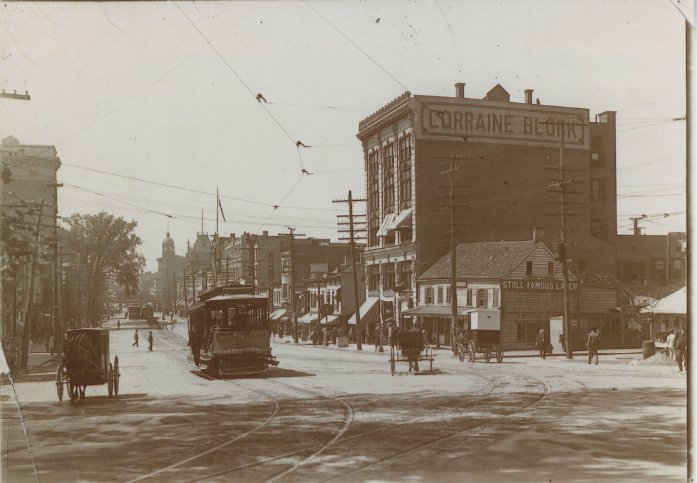
Soft drink shops on State Street were also popular places to quench your thirst. 
The building next to the Lorraine Block building with the "Stoll Famous Lager"
sign was the Oak Cafe. Courtesy of the photograph collection at the Grems-Doolittle Library.


This photo of State Street shows O'Connor's Tavern on the left which was previously The Holland Inn.
Courtesy of the photograph collection at the Grems-Doolittle Library.
By 1924, both Albany's Mayor William Hackett and Schenectady's Mayor Campbell were on to the "soft drink" game in their city's. Hackett had recently enacted a measure to close up the "undesirable saloons and so-called soft drink" places throughout the city and Campbell met with him on February 2nd to discuss the ordinance. I haven't been able to find evidence of a soft drink ordinance in Schenectady but similar ones were passed in other towns and cities in the area.

Over time, Schenectady's love of "soft drink" establishments had dwindled. The creation of the special service squad of the Schenectady Police Department helped put many these businesses. Created in 1927, they conducted 600 investigations into disorderly houses, gambling houses, and disorderly places in that year.  The end of prohibition further reduced the number of soft drink shops and only 8 of these soft drink shops were listed in the 1935 city directory

Thursday, September 29, 2016

The Schenectady Beer Squad


Policeman Karl Peters manning the traffic signal
at the intersection of State and Centre Street
c. 1924. Courtesy of the Grems-Doolittle
Library Photo Collection.
The year was 1933 and the age of prohibition was over. Rum runners no longer had to run, people could bathe again as bathtubs no longer had to be used for making gin, and you no longer had to pay off your local pharmacist for a whiskey prescription. Bars and saloons began springing up across Schenectady, but some were still more used to the unregulated speakeasies of the ‘20s and early ‘30s and they didn’t always follow the new laws and regulations set up by the New York State Liquor Authority and Division of Alcoholic Beverage Control.  By 1936,  the Schenectady Police Department started getting cracking down on these unlicensed bars, as well as other violators of Alcohol and Beverage Control Laws. That solution was to assign patrolmen Joseph Madden, Karl Peters, and Charles Cole to the newly formed beer squad.

The beer squad had the task of cleaning up grills and taverns that didn’t comply with regulations controlling the sale of liquor. Liquor dealers were not caught completely unaware as a two week educational process was enacted by the squad. Madden, Peters, Cole, and even Police Chief William Funston surveyed the city and warned tavern owners that those who did not obey the regulations would be harshly punished. One of the first victims of the beer squad was Thomas Burns a bartender at the Hotel St. Clair on North Broadway. Burns was charged with selling liquor on primary day and his bail was set at a whopping (for the time, at least) $500. This law forbidding selling liquor on primary and election day is thankfully now defunct (as we could all probably use a drink on election day), but it was meant to combat the tradition of trading votes for booze. This tradition goes back to George Washington who won campaigns by “swilling the planters with bumbo” which was a type of rum.
Advertisement of the Hotel St. Clair. They probably needed a new bartender
after Mr. Burns was busted by the beer squad.
By July of 1936 there was talk about increasing the size of the beer squad. This talk did not come from the Police Bureau, but from the Schenectady Wine, Beer and Liquor Dealer’s Association. They held a conference with Police Chief Funston, not to chastise or criticize the beer squad, but to call for more men to oversee the over 110 alcohol selling establishments in Schenectady. The association was also concerned that taverns outside of city limits weren’t being held accountable the same way those in Schenectady were. The biggest complaint was that taverns outside of the city were allowed to stay open later. Schenectady County also had a beer squad of three patrolmen who Sheriff Thomas Walsh said “make a careful checkup of all places selling alcoholic beverages.” By the end of 1936, the beer squad made 7 arrests and 5 convictions for violation of alcohol and beverage control laws, bringing in $1,025 out of a total $11,952 for the whole police bureau in 1936.

Patrol car from 1941. The beer squad was a plainclothes department, so there
would be no patrol car or uniform to tip off wary bartenders. Courtesy of the Larry
Hart Photograph Collection.
The beer squad worked closely with the special service squad to clean up the streets of Schenectady.  The special service squad was created in 1927 to investigate disorderly and gambling houses, many of which were probably operated out of the bars that the Beer Squad investigated.  Newspaper reports from the 30s and 40s show Karl Peters and Joseph Madden assisting in the arrests of those being charged with prostitution, operating a disorderly house, and running dice and numbers games. Schenectady was especially notorious for illegal bookie joints according to a Times Union article by Marv Cermak. Cermak writes about a Schenectady institution called the Bellevue Athletic Club that was a front for a bookmaker. The Bellevue Athletic Club may have started out as a legitimate sports club, but by the late 1950s it was known for Schenectady gambling kingpin James “Dietz” DiDonato and William “Wild Bill” Anderson, DiDonato’s “lieutenant.”
"Dietz" and "Wild Bill" (sporting sesqui beard). It was suspected that DiDonato
had ties to the mafia. When asked if it was true he stated that his Schenectady operation
was a "small town affair" referring to possible mafia connection in Utica he said
"I've only been in Utica once in my life. All the racketeers I ever knew were right here."
Photo is courtesy of Fultonhistory.com.
It appears that the Beer Squad was merged with the Special Service Squad at some point during the early 1940s as a newspaper report lists former beer squaders Joseph Madden and Karl Peters as working in the special service squad. Newspaper reports of Schenectady’s beer squad start to decrease around 1938 and 1939. By the mid-1950s other types of beer squads start to pop up like the Ballantine Beer Squad, the Schaefer Beer Squad and the Schlitz Beer Squad, all bowling and softball teams.

Wednesday, September 9, 2015

Taverns and Inns of Schenectady, Part IV: Prohibition and Speakeasies


Sketch of the ALCO Plant. Courtesy of the Grems-Doolittle Library Photo Collection.

Leading into the 1900s, Schenectady saw an industrial reawakening. General Electric and the American Locomotive Company (ALCO) were growing at a tremendous rates and both industries were a major factor for the rapid increase of Schenectady’s population. Other industries contributed to Schenectady’s growth, and soon, workers from all over the world were moving to Schenectady for work. This increase in population led to a need for more drinking establishments. Houses and hotels, the Vendome and Van Curler were two of the most popular, would pop up around Schenectady in the early 1900s and they offered food, drink, and lodging to people passing through. The need for workers in GE and ALCO was mainly fulfilled by immigrants, including many who were from Italy and Poland. The influx of immigrant workers into Schenectady helped Schenectady become one of the fastest growing and most industrious cities in New York.  Immigrants in Schenectady would often end up residing in the neighborhoods close to their workplace. The East Front Street Neighborhood was where many of this new immigrant group settled. Front Street’s proximity to ALCO and other factories made it a natural spot for workers to live in (see our previous blog post on the East Front Street Neighborhood for more information http://gremsdoolittlelibrary.blogspot.com/2014/04/the-east-front-street-neighborhood.html.)

The Hotel Vendome had several name changes throughout the 1800s. It was opened in 1850 as The Eagle and between 1865 and 1868, it was renamed The Carley House. The clock tower was added in the early 1890s and it was reopened as the Barhydt House. The final name change occurred in the late 1890s when it became the Hotel Vendome. Courtesy of the Grems-Doolittle Library Photo Collection.

An example of the punishment a
keeper of a disorderly house would get.
From the February 4, 1905 issue
of the Amsterdam Evening Recorder
Police and public officials did not consider this new immigrant group to be a large part of Schenectady’s criminal element, but the press would often have a field day reporting on crimes that Italians and Poles committed. Like much of the population, a large amount of the arrests of Italians and Poles occurred due to excessive drinking and many of those arrested were considered “intemperate” by the police. Crime occurred mainly within the neighborhoods that the immigrants resided in and both the Fifth Ward of Schenectady and Front Street were notorious for dive bars and houses of ill-repute. The Fifth Ward housed John Verra who was known as the “King of the Red Lights” and Jennie “The Terror” Salerno who, according to Robert Pascucci’s Electric City Immigrants, was a corpulent but muscular woman who ran a saloon with an extremely rough reputation. On Front Street, there was Raffaelo Negro’s “resort of all bad Italians of the neighborhood” and Louis Farone’s disorderly house on Monroe Street. Stories of crime in these saloons and taverns may have been favored by the press, but many immigrants were being arrested for smaller offenses like petit larceny, gambling, and in the case of Italian street musicians, disturbing the peace. Pascucci's book is an excellent resource for finding more about these neighborhoods and can be read online at http://schenectadyhistory.org/resources/pascucci/index.html.

Advertisement for The Franklin from the July 25, 1914 issue of the Schenectady Gazette.
A hotel located several blocks from the East Front Street Neighborhood served a different type of worker. The Franklin Hotel at 225 Liberty Street was known to many actors, musicians, and others on the vaudeville and burlesque circuit. The Franklin was as a place where “a thirsty prohibition-era actor could always find something to wash away the dust after three-a-day performances.” The Franklin was owned by the Gartner family from 1913-1950 and saw some of the best vaudeville acts get a drink or have a meal at the hotel. Actors from the old Proctor’s theater on Erie Boulevard would go to the Franklin after late night shows where they would be served a night lunch and play poker throughout the night. During Prohibition, the actors would be served Nate Gartner’s “home brew” and just about anything else they could find. An interview with Nate Gartner from the Daily Gazette recounts the time that a 12 year old Milton Berle visited The Franklin. Nate says that Berle was on a diet to bulk him up a bit and that he was always accompanied by his mother. Other acts that lunched at the Franklin included Jimmy Cagney, the Avon Comedy Four, Stan Laurel, and even Harry Houdini.

While many speakeasies had tight security, they could still be quite dangerous
as seen in this article from the October 23, 1930 issue of The Saratogian.

During prohibition, rum runners and bootleggers would often drive up to Canada to obtain alcohol for local speakeasies. In his book Schenectady’s Golden Era, 1880-1930, Larry Hart recounts the story of Paul Gay who would regularly make the rum run from Schenectady to Canada to supply his own speakeasies. He was caught one time before the prohibition laws were solidified, fined $50 for illegal entry into the U.S., and sent on his way. Speakeasies would often serve wine, liquor. The low-alcohol beer, also known as near beer, served during prohibition was deemed inadequate and a popular saying during the time was that “Whoever called it near beer was a poor judge of distance!” Drinkers of near beer would often spike it with the alcohol that was sold at pharmacies. Bootleggers were often more likely to get highjacked than caught by the police. One bootlegger called the cops to report his vehicle stolen. The Schenectady Police found his heavily modified car on State Street. The bootlegger’s car had a special body and suspension in order to carry heavy loads and an armored plate over the gas tank. These additions didn’t stop the highjackers who drove up beside the bootlegger’s car, jumped on the running boards and pointed a revolver at him, and ordered him to stop.
A prescription for medicinal alcohol from Whelan's Drug Store in Schenectady. During prohibition, prescription liquor was one of the only legal ways to obtain alcohol. Courtesy of the Grems-Doolittle Library Collection.

The Schenectady History Museum’s exhibit A Night on the Town in Schenectady 1850-1950: One Hundred Years of Fashion & Frivolity features fashion from the early 1900s and is a great depiction of what it was like to be a socialite during this time. Check it out at our 32 Washington location and stop by the library to learn more about Schenectady’s historic hotels and taverns.