Showing posts with label Family papers. Show all posts

Tuesday, November 1, 2022

What happens to donated archival materials at SCHS?

Over at the Grems-Doolittle Library, we love everything about October. What’s not to love? There’s peak leaf peeping, sweater weather, apple everything, and of course, National American Archives Month! This October, the Grems-Doolittle Library staff and volunteers were busy preparing for our new shelving system and looking forward to many more years of collecting the documentary heritage of the county once the system is in place! However, many librarians and archivists across the country celebrated National American Archives by pulling back the curtain and revealing some of the behind-the-scenes work that goes into making archival materials available and accessible for current researchers and future generations of researchers. While I'm little late to the party, I wanted to join in the spirit by talking a little about what happens when people donate their personal papers, family archives, or organizational records to the Grems-Doolittle Library.


The first step in any archival donation is reviewing the materials with the donor. At SCHS, we use our Donation Questionnaire and Donation Guidelines to get the conversation started. For example, I need to know how much material is currently in the possible donation, what types of materials are included (e.g. documents, photos, framed items), how the material is currently stored or organized, and how the material came to be in the donor’s possession. I’ll ask follow-up questions to figure out how the material relates to Schenectady history, the materials we already have in the collection, and our ability to care for the materials long-term. Our Collection Development Plan informs and guides the decisions we make about what donations to accept. If I decide to accept the donation and add the materials to our collection, the donor needs to sign a deed of gift and we’ll then need to set up a date and process to transfer the materials.

When the donated collection arrives, I evaluate it for preservation/intellectual property/privacy concerns and create a processing plan. The processing plan explains what work needs to be done so the collection can be safely stored, properly documented, and easily accessed by future researchers. It includes the decisions that I make as the SCHS archivist and my rationale so that future archivists and curators can build on those choices or use the collection for exhibits and special projects. The library's highly skilled volunteers help with this processing, but we may also engage a library science/archives/history intern, depending on the season and the amount of work involved.
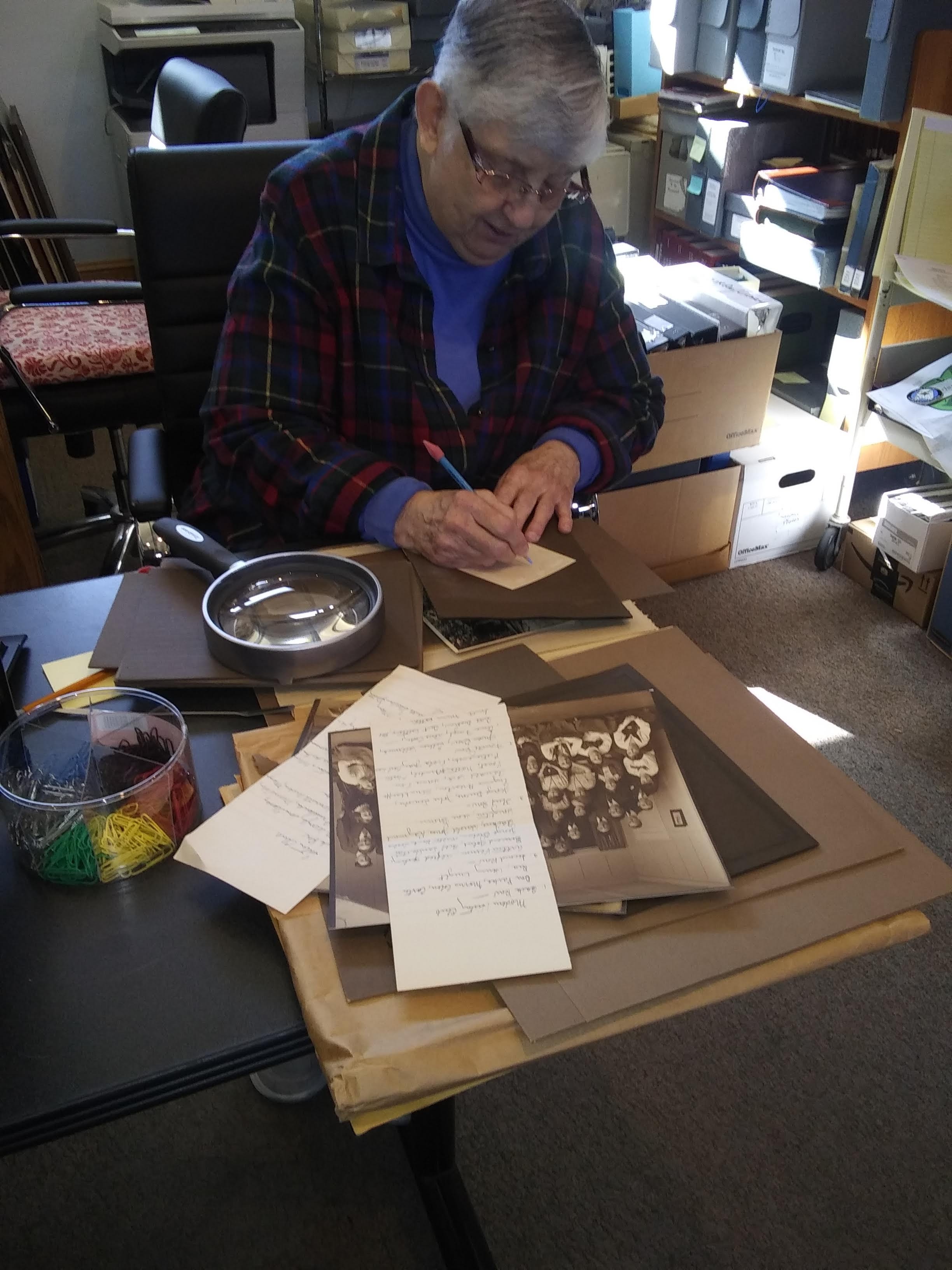
An older woman sits at a desk writing notes about the historic photos spread out in front of her. A magnifying glass sits on the desk to her right.
Carol, a retired librarian and one of the library's longest-serving volunteers, works on researching and describing materials in a donated collection.
 

For every accepted donation, we catalog the collection in our online catalog. The materials often need to be arranged for best preservation and ease of use by future researchers. Sometimes this means maintaining the original order used by the collection creator (scrapbooks, for example), but it often means creating a logical order out of something that seems like chaos. Information provided by the donor can be helpful in determining the arrangement, especially if there are any privacy or intellectual property concerns. For example, a collection of photographs could be organized by the contents of the photos (e.g. all of the portraits together) or by photographer if there is more than one. If the intellectual property is held by the photographer and not the donor, it often makes more sense to organize the photos by photographer so that we can more easily answer questions about copyright, digitization, and duplication. Finally, we describe the collection in a finding aid. Finding aids provide information about the collection to help researchers identify relevant materials and navigate access and use of the collection. They are usually more detailed than the entries in the online catalog, and they follow a format that most other archival repositories use. In addition to our online catalog, researchers can find our collections using EmpireADC, a state-wide finding aid discovery platform. 

After the initial cataloging, we transfer the materials into archival/preservation housing such as acid-neutral folders, photo sleeves, and specialized archival boxes. While we work on processing the collection, the library volunteers and I implement necessary preservation solutions such as creating digital copies of at-risk media like VHS tapes, copying newsprint materials, isolating materials that may have mold or pest damage, flattening rolled or folded materials, and stabilizing oversized/fragile/damaged materials. Once the collection is processed and stabilized, the materials are stored with the other archival collections in our climate controlled vault. We regularly monitor the area for preservation concerns such as changes in heat/humidity or the presence of damaging agents such as pests and water. 

A young woman with curly hair stands next to a table, bending over and holding a camera, taking a photo of a scrapbook. The scrapbook sits on a table with lights and gray foam blocks to make photographing it easier.
Brynn, one of our newest library volunteers and soon-to-be library science student, photographs a donated scrapbook. Scrapbooks often present a variety preservation concerns, so photographing is one way we can preserve the content.
 

Researchers who want to view or use the collection can make appointments in the library. The finding aid will note if any materials are restricted due to privacy, intellectual property, or preservation concerns. As the collection is used, we may need to update the finding aid and catalog record with any new additions to the collection from the donor or new information that comes from researchers using the collection in the future. Materials in the collection that appear to have significant research value (e.g. something unique to Schenectady's history or a person with a regional/national/international impact/reputation) and clear intellectual property rights will be evaluated for potential digitization and future blog posts or other promotional activities. We add digitized collections to our NY Heritage site.
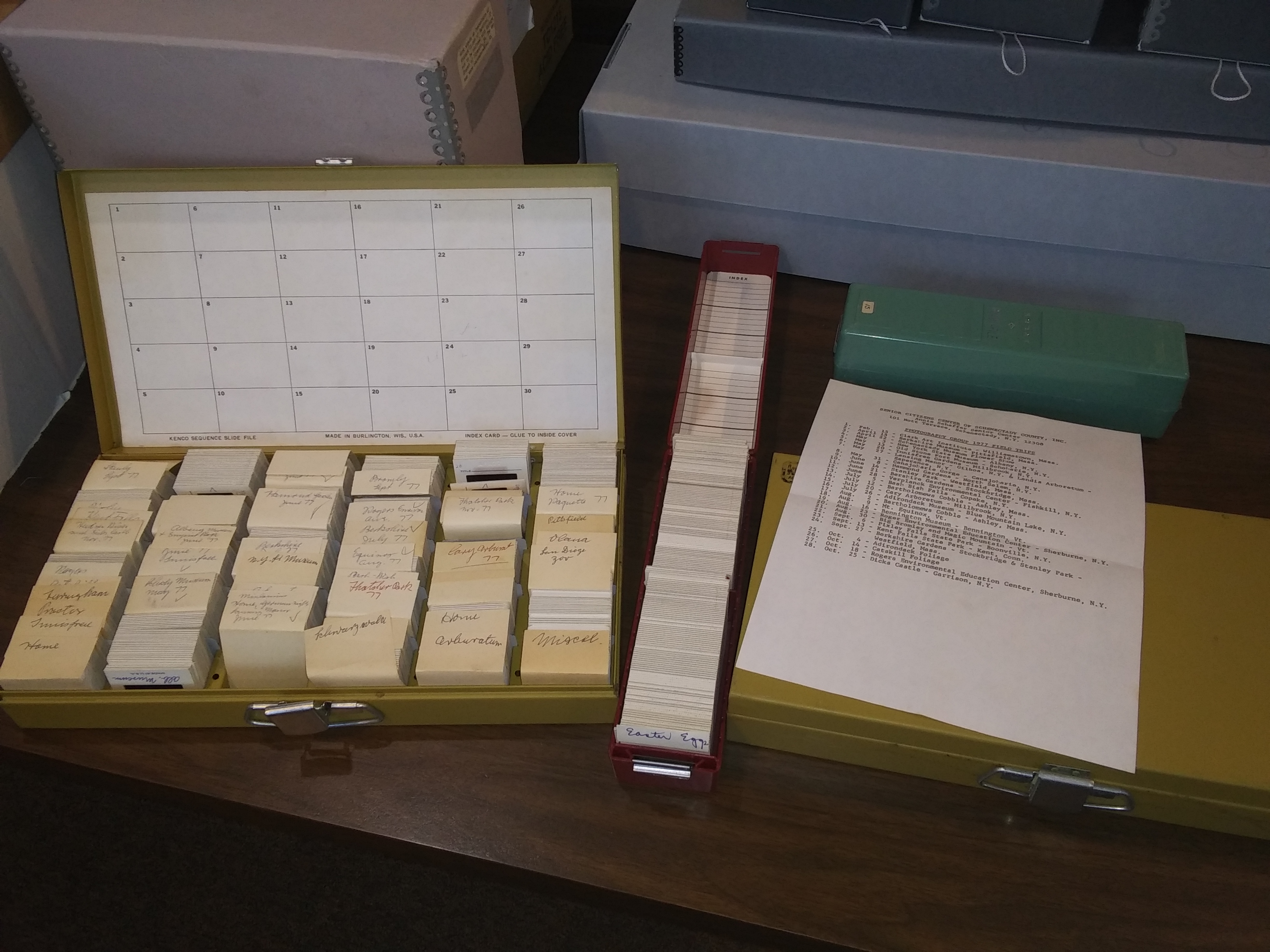
Part of a newly donated collection of slides from the Annie Schaffer Senior Center Photography Club, ready to be processed.


Tuesday, February 1, 2022

Organizing Family Papers and Photos

For many people, January and February are the months they spend the most time at home. The cold and snowy weather discourages them from venturing outside, or they feel like they need time to decompress from the excitement and stress of the winter holidays. With the recent increase in COVID cases, many people find comfort and safety in just staying home. If you're spending more time at home these days, this might be a good time to focus on organizing your family papers and photos. Like genealogy research, organizing your family papers will help you connect to your personal and local history, build relationships with your relatives and friends, and strengthen your memories. Here are some tips and resources to help you organize your family's papers and photo collections:

 Basic rules for organizing family archives:

  • Do what you can at your own pace. It's better to go slowly and give yourself time, especially if you're working with materials that bring up a lot of emotions or memories.
  • Don't be overwhelmed by the idea of doing it 'exactly right.'
  • Practice safe handling and incorporate good preservation practices into your process.
  • Label as much as you can, especially on the outside of enclosures (e.g. folders and boxes). Try to answer the five W questions (who, what, where, when, and why). Putting this information on a label will make it easier to organize your collection and reduce the amount of handling you'll need to do in the future.

Practice good personal records management for the paper you are creating or collecting today:

The day-to-day business of living generates a lot of paper: receipts, pamphlets, bills, napkins, free mailing labels, shopping lists, and scraps of reminders (just to name a few). Some of these things need to be saved for a specific period of time (e.g. tax returns) and some of these things should be saved indefinitely (e.g. wills and birth certificates). Most of the paper you create and collect should be discarded, but when you're busy and focused on living your life, it's easy to let it all accumulate and mix together. One of the best things you can do for yourself and the future generations who might inherit your papers is to set aside some time regularly (e.g. every month) to sort your papers, discard what is ready to be discarded, and file what needs to be saved. Labeling and filing what you need or want to keep will make it easier to figure out what should be kept indefinitely or passed on to future generations.

Figure out what's important to keep:

There's lots of information online about what people should keep and for how long, but a lot of this advice focuses on the practical or current use of personal papers. Tax returns, for example, should be saved for several years in case you are audited or you need to amend a past return. Receipts should be saved so you can reconcile your financial statements, return items, or make claims against a warranty. However, when thinking about your papers from a historical perspective, the value or reason for keeping something may change and no longer fit the original or practical purpose. Not everything is meant to be kept indefinitely, and the reasons for keeping something may be unique to you and your family!

What to save indefinitely as part of your family archives varies from person to person and family to family, but there are a few ways to help you determine what's best for your collection. First, ask yourself:

  • How much space do I have to store the collection properly? 
  • How much money do I have to invest in archival storage boxes or folders? 
  • How much time do I have to spend organizing and labeling the collection? 
  • How much energy do I have to spend organizing and labeling the collection?
  • Who is going to help organize or take care of this collection? 
  • What will happen to the collection when I can no longer care for it?
  • What resources do I have to save the content of something if the condition is deteriorating quickly? For example, newspapers deteriorate quickly and can harm the papers stored with them. Photocopying or scanning can help you save the information in a newspaper article or obituary and allow you to discard the damaged original.

The answers to these questions will help you determine how large your collection can be and which materials you should prioritize. It's alright if you can't keep something! 

There are some types of papers that are almost universally considered important enough to keep indefinitely, even if their practical purpose no longer exists:

  • Vital records: birth, adoption, death, marriage, and divorce certificates/records
  • Photos and home videos or recordings
  • Heirlooms and the documents that explain where they came from and how you inherited them
  • Land and building records: deeds, architectural drawings
  • Letters and diaries
  • Military records: enlistment cards, discharge papers, service awards

For other types of papers, consider these questions when trying to figure out whether to keep them indefinitely:

  • What does this document tell me about the person who created it? Does it help to make the person more real or relatable?
  • What does this document tell me about the time period it was created in? Is it an example of how everyday people experienced a significant historical event?
  • Is the information in this document unique or can I find it in some other part of the collection?
  • How does this document relate to other materials in the collection? Does it provide information that will make other documents easier to understand?
  • Is this something I care strongly about or that other people care strongly about? Ask your relatives and friends!
  • Is the item in good condition? Does it require special handling or preservation? Can the information be saved in another format that's easier to care for?

Keep like with like:

  • Find natural groups -- by type (e.g. all of the photos together), by topic (e.g. all of the family vacation photos and documents), by creator (e.g. all the letters/diaries/documents created by your grandmother), by date (e.g. everything created in 1995 together).
  • Keep existing groups together when possible -- e.g. one of your ancestors may have already organized a portion of the collection (e.g. a scrapbook). Their work may help you with figuring out how to organize new additions or give you insight into what they knew about the family history and how they thought about what to keep.
  • There will be groups within groups -- e.g. the folders for family vacations may include a folder or two just for photos.
  • Organize with preservation in mind -- some materials are more sensitive, deteriorate more quickly, or require special handling. You may want to organize these into their own boxes or folders, even if they connect with another group, so that they can be handled more carefully.
  • Ultimately, there is no 'exactly right' way to organize your collection -- some materials will fit into multiple categories. Do what makes sense to you and fits within your capabilities.
  • Don't forget about your digital files! You can organize these using similar systems or criteria you use for analog materials.

Further reading:

Preservation Resources for Paper and Photo Collections

Resources for Preserving Digital Family Archives

How to Organize Your Family Keepsakes and Collections by Denise May Levenick

Organize Old Family Photos with the Parking Lot System by Denise May Levenick

When to Keep and When to Throw Away Important Documents by Elizabeth Larkin

How Long to Keep Tax Records and Other Documents by Consumer Reports


Wednesday, June 24, 2020

GE Engineer Catches the Influenza in 1918

Photo of West Dollar Island, Lake George, circa 1910
West Dollar Island, circa 1910. Photo from John Apperson's collection, provided by Ellen Apperson Brown.

This post was written by guest writer, Ellen Apperson Brown.

In the Apperson family, we’ve passed down a story about our Uncle John who came down with the dreaded influenza, went to the hospital, but decided to leave after just a few days. He hated being cooped up, and figured, if he had to die, it wouldn’t be in a hospital!  As the story goes, he sneaked past the nurses, caught a streetcar home, collected his camping gear, and headed into the north woods, as far from civilization as possible. 

I have just completed a project, transcribing more than a thousand of my great uncle’s letters and other documents, and arranging them in chronological order, so it is easy to look back to the documents from 1918, and see what he was doing in that year.

In 1918, John Apperson worked as an engineer at General Electric, second in charge of GE's Power and Mining Department. He also was responsible for protecting and preserving about fifty islands at Lake George. In August, one of Apperson's friends from G.E., Robert H. Doherty, wrote a tribute to Apperson, comparing him to the valiant knights in King Arthur's Court and listing all their accomplishments in removing squatters, rip-rapping island shores, making a survey of all the islands, and cleaning them up, ready to have the state start welcoming overnight campers.

Within a month, however, the vigorous, enthusiastic engineer (age 40) was caught up short by the so-called Spanish influenza. His friends, probably overriding his objections, called an ambulance, and he was taken away to Ellis Hospital. According to a receipt, found in a trunk of old letters, he was admitted on September 25th, and stayed until September 30th, with fees that covered nursing care and ambulance, making a total of $36.00.

One interesting document, from September 21st, is letter from the management at G.E., stating: “You are a highly trained and specialized engineer who cannot be replaced at the present moment.” Having already reached the age of forty, he probably wasn’t thinking about enlisting. He knew full well that he was doing important work in the Power and Mining Engineering Department.

On October 2nd, there is a letter from a friend, Jim Cawley, saying he was sorry to have missed Apperson during his visit to Schenectady, and that he had heard John was sick. Then, a week or two later, Jim wrote again, saying he had come back to Schenectady, couldn’t see him, but enjoyed being put up at the Mohawk Club. These clues still left a big gap in my knowledge. What was Jim Cawley doing in Schenectady? Where was John? At Lake George? Staying with a friend? 

Well, a little further research suggests that his destination must indeed have been Lake George, although it is uncertain where exactly he camped – whether on Dollar Island or perhaps on Commissioner’s Island. I wonder if he had he strength to paddle over in his canoe, or whether he had to catch a ride. 

Jim Cawley had made friends with Apperson a few years earlier, having heard about him through his club, the American Canoe Association. By 1918, Jim was an officer of the ACA, and heard about Apperson’s projects, rip-rapping shores and generally protecting the islands of Lake George. He wanted to write an article for an A.C.A. publication, using Apperson’s photos. He wrote: 

Dear Apperson:
As I told you when I saw you last on Phantom Island, I would drop in to see you on the day that I hit Schenectady. But unfortunately I was unable to get in touch with you. I spent three hours with the Advertising Department and called your department, but found that you were home ill. After I left the plant I looked up your name in the telephone directory, but failed to find it; so was unable to have a talk with you.

I do not know when I will get to Schenectady again, but I should like to have a talk with you regarding the article on the work that has been done on the Islands. In other words, to come right out with it, I want to borrow some of your excellent photographs to tone up the article, to make up for my lack of ability to write. Perhaps some time when you do have time, you could get together what you think I would need and let me know, but I think that within a month or so I may get around your way again and I shall certainly look you up, as I will have more time than I had on my last trip.

Hoping to see you sometime again – and asking you to give my kindest regards to Mr. Rushmore, I am

Yours for the Fourth Liberty Loan,
James S. Cawley 

Warwick S. Carpenter, the Secretary of the Conservation Commission, had also become one of Apperson’s (nick-named Appy) closest friends and allies. Carpenter was responsible for editing and publishing issues of The Conservationist, and when he came to Schenectady in October, he was hoping to get Appy’s permission to run some of his photographs in an upcoming article about Lake George. Not being able to reach him, Carpenter sent this letter:

Dear Apperson:
At the request of Mr. Houghton I am enclosing herewith two prints of some very excellent collections of tin cans.
 
I have been trying to get over to see you ever since one evening when I called at Mr. Rushmore’s house and found that you had retired. Every minute of my time has been taken up or I would have made another attempt. 

Hoping that you are getting along all right now and with kindest regards, I am

Sincerely yours
Warwick S. Carpenter (October 17, 1918)

Returning to work in late October, Apperson was swamped by all the work he’d missed. Apperson wrote several thank you letters to Jay Taylor, the State Forester at Lake George, and to his wife, thanking them for their hospitality during his illness, thus establishing that he had, indeed, fled to Lake George to rest and recuperate after his illness. Surprisingly, he refers to the possibility that Taylor himself may have come down with the flu:

Dear Taylor:
My work has piled up during my absence and it seems necessary for me to stay here this week-end. I hope your sickness is not serious and if I can do anything to assist you or send you anything please let us know.

My progress is still rather slow but I am nevertheless making progress.

With best regards to you and your family, I remain

Very truly yours,
J. S. Apperson (October 31, 1918)

On November 8th, he wrote again:
 
I do hope you have recovered and all members of your Tongue Mountain Village are well. You are no doubt pleased with the war news. However, the celebration was somewhat premature. I will agree with you now that your boy should be back in a short time.

In my letter last week I think I failed to again express my appreciation of the good attention you and Mrs. Taylor gave me during my sickness, and I can assure you that I cannot forget this kind attention, which I never before needed.

And on November 14, he wrote to Mrs. Taylor, saying:

I have your note of the 11th and I am glad to find that Jay is much better. I am sorry to hear that you have deserted your village, but probably it was the wisest thing to do….

Again allow me to thank you for the very kind attention, which you and Jay gave me during my illness.
 

Thursday, May 16, 2019

The Blakeslee Family of Schenectady

This blog post was written by library volunteer Erin Hill-Burns.

Editorial note: Every once in a while, a historian or historical society will find items that are not their scope and send them on to a more fitting repository. This recently happened when Saratoga County Historian Lauren Roberts sent us a family history book titled Happenings in Our Home that was kept by the Blakeslee family of Schenectady. Library volunteer Erin Hill-Burns did some extensive genealogical research on the Blakeslee family and found a very interesting connection between the Blakeslees and the Schenectady County Historical Society. Read more about the family below. -  Librarian, Mike Maloney

On 17 April 1909, John Roy Blakeslee and Mabel Mary Shea, both graduates of Cornell University, were married in Syracuse, New York. After a honeymoon, the couple began their life together in Schenectady, where John had a job at General Electric.[1]

John was born 6 April 1878 in Whitehall, New York.[2] He grew up in Whitehall, likely the son of John Blakeslee, a dry goods merchant, and Elizabeth (Spooner) Blakeslee. The elder John died in 1892, Elizabeth died in 1912, and both were buried in Whitehall.[3]

Mabel was born 21 February 1880 in Pulaski, New York and later moved to Syracuse; she was the daughter of John W. Shea, a lawyer, and Sylvia L (Cross) Shea.[4] John died in 1925, Sylvia died in 1943, and both were buried in Syracuse.[5]

Shortly after their marriage, John and Mabel began keeping notes of family events, gatherings, milestones, and more in a diary/scrapbook titled Happenings in Our Home. This book gives information and clues about their family history as it happened, including some insights into everyday life in early 20th century Schenectady.[6]

2210 The Plaza, Schenectady (as of 2011). From Google Maps.
John and Mabel had one daughter, Sylvia Elizabeth, born 27 September 1913.[7] The family lived in rented homes in Schenectady until 1921,[8] when they bought their own house on The Plaza in Niskayuna; “No more rent. No more flats,” they commented.[9] The house, at 2210 The Plaza, was built the year they moved in, and still stands today.[10]
  
By April 1928, John had worked at G.E. for twenty-five years, joining the “Quarter Century Club.”[11] As of the 1940 census, John had no occupation listed, suggesting that he had retired from G.E. before then.[12] In the mid-1940s, John served as Deputy Town Clerk in Niskayuna.[13] 

In 1930, John and Mabel’s daughter Sylvia graduated from Schenectady High School.[14] In her high school yearbook, Sylvia was (self?) described as, “Sphere: Being quiet; Hope: To be able to wisecrack; Sin: Studying.” Despite her apparently quiet tendencies, that same yearbook listed her as a part of Glee Club, debating clubs, Le Cercle Français, and the National Honor Society.[15] She attended Syracuse University where she graduated with a degree in Library Science in 1934, and then returned home and began working at the Schenectady County Public Library.[16]

Sylvia joined the Daughters of the American Revolution (DAR) in 1934,[17] and was regularly involved in DAR events in Schenectady over the years.[18] She was also active with other social groups and happenings around town. [19]

As a member of the library staff, Sylvia was a fixture in the community. She held discussions on recently published books.[20] She and others worked to answer many diverse questions from library patrons; for example: “Amount of the tuition to the University of Georgia. A student wanted to know how much money to take with him;” “the burying place of Benedict Arnold;” “the correct formation of the wedding procession;” and “dimensions of the court of the women in the temple of Herod.”[21]

Newspaper clipping showing Sylvia Blakeslee (possibly in the middle) at the Schenectady County Historical Society.
Sylvia was also involved with the Schenectady County Historical Society throughout the years.[22] One notable contribution was that, in a collaboration between the Schenectady County Public Library and the Historical Society, Sylvia cataloged the 1,400 volumes of the Historical Society library, which had never been cataloged. This required the classification of all of the books, numbering them according to the Dewey decimal system, and typing cards for a card catalog.[23]
  
On 7 February 1955, John Blakeslee died at age 76.[24] Less than two years later, on 20 October 1956, Mabel died, also at age 76.[25] Both were buried at Park View Cemetery, in Schenectady.[26] After her parents’ deaths, Sylvia, who was unmarried, remained living in the family home at 2210 The Plaza, and still worked at the library.[27]

Around 1959, Sylvia married Howard Rowback.[28] After they were married, Howard worked for the County Sheriff’s Office, Sylvia continued working for the library, and they lived at the Blakeslee house, 2210 The Plaza.[29] Howard died about ten years later, on 23 April 1968, and he was buried at Park View Cemetery, near Sylvia’s parents.[30]

Sylvia worked at the library until her retirement in 1971, after thirty-seven years of service – apparently “the longest service record of any staff member of the library.”[31]

In 2001, Sylvia sold the house at 2210 The Plaza, the home that her parents purchased eighty years earlier.[32] Around that time, she moved to Tinton Falls, New Jersey (a town where her cousin lived); she died there on 15 April 2008, at age 94, “after a long battle with Alzheimer’s disease.” No descendants were named in her obituary. She was buried back in Schenectady, in Park View Cemetery, near her parents and husband.[33]

Images from the Blakeslee's Happenings in our Home can be seen below:

This page documents the Blakeslees vacation to Green Lake near Gloversville. 
Thanksgiving 1918 included "Carnations from Mildred".


Sylvia "Betty" Blakeslee was a suffragette in the making, asking her mother why she doesn't get to vote when her father can.

Mabel Blakeslee documents many events throughout the 1910s including the United States joining the Allies during World War I.


All referenced websites were viewed 13 May 2019.
[1] John R. and Mabel (Shea) Blakeslee Family Notes, in Joseph C Bridgeman, Happenings in Our Home (Boston: Samuel Ward Company, 1903); Grems-Doolittle Library, Schenectady County Historical Society, Schenectady, New York, 2019. The book has pages with headings for recording events, milestones, etc. There is a handwritten note on the Introduction page, “This book is begun on Christmas night, 1909.” There are dated entries throughout the book, some in different inks or pencil, and occasionally in different handwritings; many entries may have been written at the time of or shortly after events happened. New York State Department of Health Bureau of Vital Statistics, Certificate and Record of Marriage, no. 1101, John Roy Blakeslee and Mabel Mary Shea (1909); accessed in “New York, County Marriage Records, 1847-1849, 1907-1936,” database with images, Ancestry (https://www.ancestry.com/search/collections/fsmarriagenewyork/).

[2] “U.S., World War II Draft Registration Cards, 1942,” database with images, Ancestry (https://www.ancestry.com/search/collections/wwiidraft/), card for John R. Blakeslee, serial number U1573, Local Draft Board no. 354, Schenectady, New York; citing NARA, RG 147, roll 49. Also Blakeslee Family Notes, “Birthdays.”

[3] 1880 U.S. census, Washington County, New York, population schedule, Whitehall, enumeration district (ED) 158, page 20, dwelling 188, family 230, John R. Blakeslee; accessed in “1880 United States Federal Census,” database with images, Ancestry (https://www.ancestry.com/search/collections/1880usfedcen/); citing NARA digital publication T623, roll 943. 1892 New York state census, Washington Co., pop. sch., Town of Whitehall, p. 1 (penned), Roy Blakeslee; accessed in “New York, State Census, 1892,” database with images, Ancestry (https://www.ancestry.com/search/collections/1892nycensus/). 1900 U.S. census, Washington Co., New York, pop. sch., Village of Whitehall, ED 146, sheet 22A, dwell. 471, fam. 513, Roy Blakslee [Blakeslee]; accessed in “1900 United States Federal Census,” database with images, Ancestry (https://www.ancestry.com/search/collections/1900usfedcen/); citing NARA digital publication T623, roll unspecified. For parents’ deaths and Elizabeth’s maiden name, see Ancestry, Find A Grave, database with images (http://www.findagrave.com), memorial 61844621, Elizabeth Spooner Blakeslee (1938-1912), Boardman Cemetery, Whitehall, Washington Co., New York; gravestone photograph by Jen Snoots. Also, Blakeslee Family Notes, “The Life Immortal.”

[4] “Descendants Search,” database, Daughters of the American Revolution Genealogy Research (http://services.dar.org/Public/DAR_Research/search/?Tab_ID=5), descendants list for member Sylvia Elizabeth Blakeslee. Blakeslee Family Notes, “Birthdays.” “Blakeslee Funeral to Be Private,” Schenectady (New York) Gazette, 22 October 1956, page number not shown, col. 2; accessed in “Go and Search My Archives,” searchable images, Old Fulton New York Postcards (http://fultonhistory.com/). 1880 U.S. census, Oswego Co., New York, pop. sch., Richland (Pulaski Village), ED 263, p.31, dwell. 10, fam. 10, Maybel Shea; accessed in “1880 United States Federal Census,” database with images, Ancestry (https://www.ancestry.com/search/collections/1880usfedcen/); citing NARA digital publication T9, roll 915. 1892 New York state census, Onondaga Co., pop. sch., Syracuse Ward 11, p. 4 (penned), Mabel M. Shea; accessed in “New York, State Census, 1892,” database with images, Ancestry https://www.ancestry.com/search/collections/1892nycensus/). 1900 U.S. census, Onondaga Co., New York, pop. sch., Syracuse Ward 18, ED 159, sheet 8B, dwell. 144, fam. 204, Mabel M. Shea; accessed in “1900 United States Federal Census,” database with images, Ancestry (https://www.ancestry.com/search/collections/1900usfedcen/); citing NARA digital publication T623, roll unspecified.

[5] Find A Grave, memorial 135754086, John W. Shea (1850-1925), and memorial 135754104, Sylvia Cross Shea (1853-1943), Onondaga Valley Cemetery, Syracuse, Onondaga Co., New York, gravestone photographs by Diane LM.

[6] Blakeslee Family Notes.

[7] Blakeslee Family Notes, “Births.” “New York State Birth Index - 1913,” images, InternetArchive (https://archive.org/details/New_York_State_Birth_Index_1913), p. 96, entry for Sylvia E Blakeslee, 27 September.

[8] 1910 U.S. census, Schenectady Co., New York, pop. sch., Schenectady City Ward 12, ED 218, sheet 8B, dwell. 121, fam. 186, John R. Blakeslee household; accessed in “1910 United States Federal Census,” database with images, Ancestry https://www.ancestry.com/search/collections/1910uscenindex/); citing NARA digital publication T624, roll 1078. 1920 U.S. census, Schenectady Co., New York, pop. sch., Schenectady City Ward 12, ED 181, sheet 5B, dwell. 65, fam. 123, John R. Blakeslee household; accessed in “1920 United States Federal Census,” database with images, Ancestry (https://www.ancestry.com/search/collections/1920usfedcen/); citing NARA digital publication T625, roll 1263.

[9] Blakeslee Family Notes, “Moving.” 1930 U.S. census, Schenectady Co., New York, pop. sch., Niskayuna town, ED 47-9, sheet 5A, dwell. 113, fam. 124, John R. Blakeslee household; accessed in “1930 United States Federal Census,” database with images, Ancestry (https://www.ancestry.com/search/collections/1930usfedcen/); citing NARA digital publication T626, roll unspecified. 1940 U.S. census, Schenectady Co., New York, pop. sch., Niskayuna, ED 47-18, sheet 12A, household 296, John R. Blakeslee household; accessed in “1940 United States Federal Census,” database with images, Ancestry (https://www.ancestry.com/search/collections/1940usfedcen/); citing NARA digital publication T627, roll 2774. The house number listed in the Blakeslee Family Notes and Records is “311 Plaza,” while later records refer to “2210 The Plaza;” there is no reason to suspect this is not the same house, homes on the street may have been renumbered.

[10] Schenectady County, New York, “Schenectady County Search,” database, Image Mate Online (http://imate.schenectadycounty.com/imate/), Public Access, “Report,” 2210 The Plaza.

[11] “10 Employees Join G. E. Quarter Century Club,” Schenectady (New York) Gazette, 21 April 1928, p. 10, col. 7; accessed in “Go and Search My Archives,” searchable images, Old Fulton New York Postcards (http://fultonhistory.com/).

[12] 1940 U.S. census, Schenectady Co., New York, pop. sch., Niskayuna, ED 47-18, sheet 12A, household 296, John R. Blakeslee.

[13] “Niskayuna Board Names Appointees,” Schenectady (New York) Gazette, 4 January 1946, unnumbered first page, “Second Section,” col. 7; accessed in “Go and Search My Archives,” searchable images, Old Fulton New York Postcards (http://fultonhistory.com/). “Niskayuna Town Board Sets Salaries,” Schenectady (New York) Gazette, 2 January 1947, unnumbered first page, “Second Section,” col. 7; accessed in “Go and Search My Archives,” searchable images, Old Fulton New York Postcards (http://fultonhistory.com/).

[14] “Schenectady Girl to Enter Syracuse Univ.,” Schenectady (New York) Gazette, 19 July 1930, p. 11, col. 7; accessed in “Go and Search My Archives,” searchable images, Old Fulton New York Postcards (http://fultonhistory.com/).

[15] Schenectady High School Yearbook 1930 [title page not shown], unnumbered page 29; database with digital images, “U.S., School Yearbooks, 1900-1990,” Ancestry (https://www.ancestry.com/search/collections/yearbooksindex/), New York > Schenectady > Schenectady High School > 1930 > image 29.

[16] “Leaving Library,” Schenectady (New York) Gazette, 27 May 1971, p. 28, cols. 4-5; accessed in “Go and Search My Archives,” searchable images, Old Fulton New York Postcards (http://fultonhistory.com/).

[17] “Member Search,” database, Daughters of the American Revolution Genealogy Research (http://services.dar.org/Public/DAR_Research/search/?Tab_ID=3), entry for member Sylvia Elizabeth Blakeslee Rowback, no. 288238.

[18] For example, “D.A.R. Chapter Has First Season Meeting,” Schenectady (New York) Gazette, 18 September 1937, p. 17, cols. 3-5; accessed in “Go and Search My Archives,” searchable images, Old Fulton New York Postcards (http://fultonhistory.com/). “Missionary Tells Experiences on Zamzam to D.A.R Members,” Schenectady (New York) Gazette, 19 September 1941, p. 25, cols. 6-8; accessed in “Go and Search My Archives,” searchable images, Old Fulton New York Postcards (http://fultonhistory.com/). “DAR Chapter Plans to Meet on Thursday,” Schenectady (New York) Gazette, 13 October 1959, p. 25, col. 5; accessed in “Go and Search My Archives,” searchable images, Old Fulton New York Postcards (http://fultonhistory.com/).

[19] “Festival of Nations,” Schenectady (New York) Gazette, 18 February 1936, p. 13, col. 1; accessed in “Go and Search My Archives,” searchable images, Old Fulton New York Postcards (http://fultonhistory.com/).

[20] “Collegiate Center Unit To Hear Talk on Books,” Schenectady (New York) Gazette, 14 January 1937, p. 10, col. 6; accessed in “Go and Search My Archives,” searchable images, Old Fulton New York Postcards (http://fultonhistory.com/).

[21] “Public Library Handles Varied Class of Wants,” Schenectady (New York) Gazette, 4 August 1936, p. 4, col. 3; accessed in “Go and Search My Archives,” searchable images, Old Fulton New York Postcards (http://fultonhistory.com/).

[22] “Social Notes,” Schenectady (New York) Gazette, 30 September 1972, p. 12, col. 3; accessed in “Go and Search My Archives,” searchable images, Old Fulton New York Postcards (http://fultonhistory.com/). Sylvia E. Rowback, Niskayuna, Death Notice, The (Schenectady, NY) Daily Gazette, 17 April 2008, p. B7; transcript accessed at America’s News, NewsBank (https://infoweb.newsbank.com/).

[23] “1,400 Historical Volumes Listed,” Schenectady (New York) Gazette, 27 October 1938, p. 12, col. 5; accessed in “Go and Search My Archives,” searchable images, Old Fulton New York Postcards (http://fultonhistory.com/).

[24] “New York, Death Index, 1852-1956,” database with images, Ancestry (https://www.ancestry.com/search/collections/nystatedeathindex/), entry for John R. Blakeslee, died 7 February 1955. Death Notices: Blakeslee, Schenectady (New York) Gazette, month and date unknown, 1955, p. 27, col. 7; accessed in “Go and Search My Archives,” searchable images, Old Fulton New York Postcards (http://fultonhistory.com/).

[25] “New York, Death Index, 1852-1956,” entry for Mabel M. Blakeslee, died 20 October 1956. “Blakeslee Funeral to Be Private,” Schenectady (New York) Gazette, 22 October 1956, page number not shown, col. 3; accessed in “Go and Search My Archives,” searchable images, Old Fulton New York Postcards (http://fultonhistory.com/).

[26] Find A Grave, memorial 166123199, John R Blakeslee (died 7 February 1955), and memorial 166123200, Mable Blakeslee (died 23 Oct 1956), Park View Cemetery, Schenectady, Schenectady County, New York, Section D Lot 191; no gravestone photographs.

[27] Manning, Schenectady City including Grand Boulevard District of Niskayuna (New York) Directory For Year Beginning September, 1957-1958 (Schenectady: H. A. Manninng Co. of N.Y. Inc., 1957), p. 290.

[28] Manning, Schenectady City including Grand Boulevard District of Niskayuna Directory, 1959-1960, pp. 286 (Blakeslee), 651 (Rowback). In this directory, Sylvia was listed as both “Sylvia E Blakeslee” and as “Sylvia B Rowback (Mrs. Howard).”

[29] Manning, Schenectady City including Grand Boulevard District of Niskayuna Directory, 1961-1962, p. 618.

[30] Social Security Administration, “U.S., Social Security Death Index, 1935-2014,” database, Ancestry, (https://www.ancestry.com/search/collections/ssdi/), entry for Howard Rowback, 1968, SS no. 076-03-7745. “Rowback Dies at 69, Was Deputy,” Schenectady (New York) Gazette, 25 April 1968, p. 33, col. 2; accessed in “Go and Search My Archives,” searchable images, Old Fulton New York Postcards (http://fultonhistory.com/). Find A Grave, memorial 166296084, Howard Rowback (died 25 April 1968), Park View Cemetery, Schenectady, Schenectady County, New York, Section D Lot 191; no gravestone photograph.

[31] “Leaving Library.”

[32] “Schenectady County Search,”; Public Access, “Report,” 2210 The Plaza.

[33] Sylvia E. Rowback, Niskayuna, Death Notice. Find A Grave, memorial 166296717, Sylvia E Rowback (died 15 April 2008), Park View Cemetery, Schenectady, Schenectady County, New York, Section D Lot 191; no gravestone photograph.

Friday, June 12, 2015

Band of Brothers: The Correspondence of Charles and Douglas Snell

Envelope of a letter from Charles Snell to his parents.
The envelopes in this collection have a variety of different stamps. 
The 71st anniversary of D-Day was on Saturday, June 6th 2015. Although I’m a little late writing this blog post I would like to highlight a part of our collection that commemorates World War II, the Charles and Douglas Snell Collection. This collection comprises letters that were written by Charles and Douglas to family and friends during the last two years of World War II.


Diagram of Charles' living quarters in the South Pacific which he calls his "home".

Charles and Douglas Snell were the sons of William A. and Kathryn Snell of 418 Plymouth Avenue, Schenectady, NY.  Both Charles and Douglas enlisted in the Army in 1943, but they were sent to different theaters. Charles was sent to California and fought in the South Pacific while Douglas was sent to England. While the bulk of this collection is correspondence, there are also a few political cartoons, newspaper articles, postcards, and pictures.
The letters are usually short on specific combat information as they were heavily censored by the government. Some of the letters have pieces cut out of them due to this censorship or words redacted. The brothers often “self-censor” their letters and an example of this can be seen in Charles’ correspondence. In the heading of his letters he will describe his location as “Somewhere in the Pacific Ocean Area.” Both brothers were vague in saying exactly where they were located as this information would definitely be censored. There is some general information about what the brothers are working on, they mention classes or lectures that they go to and in the letter displayed below Charles states that he “heard his first radar today.”


Letter from Charles Snell to his parents.
The letters also contain a lot of information about military life. They talk about training routines, food, entertainment, inspections, life on the home front and items they might need from their family. Charles goes into great detail about his time spent in the California before he was deployed. He gives descriptions of national parks, talks about his love of gardening and classical music and his work with the Chaplain. Douglas describes his time in England and discusses the people, places and things he encountered there. Douglas’ sense of humor is also on display in the correspondence. Accompanying the newspaper clipping below was a note from Douglas stating that he “wasn’t as bald as the picture made him out to be.” He also calls notice to a particularly painful pun that he uses in one of his letters by saying he was “short on shorts (ouch).”

Clipping from the Schenectady Union-Star showing Douglas Snell in the jeep
 that he drove for the chaplains in his unit.
There is also some discussion about political views and the 1944 presidential election between Franklin Delano Roosevelt and Thomas Dewey. Charles, a Roosevelt supporter writes to his parent that “I suppose you heard about the election by now Ha! The Dewey men on ship made a lot of noise but won’t bet a cent on the election.” Douglas also mentions that he supports Roosevelt and was happy when he was elected.

Many of the letters in this collection were written using “V-Mail”. These letters were written on small sheets of paper and after going through the mail censors they would be photographed onto microfilm and transported. When the microfilm arrived, the letters would be blown up and printed.
Example of a V-Mail letter sent by Douglas.
These letters give us a very personal connection to the authors as the brothers write about their family and friends in Schenectady. After returning from his tour in the Pacific, Charles married Julie Kamerer and moved to Silver Spring, Maryland. Douglas enrolled in Union College and eventually moved to Norristown, Pennsylvania. Both brothers died in 1997 and are buried at Arlington National Cemetery.

A finding aid for the Charles and Douglas Snell Collection can be found here.

Thursday, November 13, 2014

Man's Best Friend: Dogs in the Collections of the Grems-Doolittle Library

Dorothea Godfrey of Schenectady and her canine friend Zev enjoy some outdoor reading in this photograph, taken in the early 1930s. Image from Godfrey Family Collection.


Dogs have been reliable workers and companions for humans for many thousands of years. In Schenectady County, as is the case around the world, humans have loved and shared their lives with canine friends throughout history. Dogs pop up in city, suburb, and rural scenes in Schenectady County, and are found especially frequently among family photographs and with children.

Enjoy these images of dogs found in our library's collections. Interested in learning more? Visit our Library or contact our Librarian.


An unidentified dog noses around the Duane Mansion in Duanesburg in this undated photo. Image from Larry Hart Collection. 


A young Katharine Furman poses with the family dog in this photograph taken at a Schenectady studio in the 1880s. Image from Godfrey Family Collection.


A curious neighborhood dog follows a Schenectady mailman on his route, circa 1950. Image from Larry Hart Collection. 


Bonnie and Alan Hart, the children of local historian Larry Hart, cuddle at home with their new puppy in 1951. Larry Hart's notes on the back of the photograph read, "Corky's first day at home ... he was 4 weeks and a day old at the time." Image from Larry Hart Collection. 

A dog comes along for a ride with owner Lucas W. Devenpeck and an unidentified driver. Image from Devenpeck photograph file, Grems-Doolittle Library Photograph Collection. 

At the 1949 cornerstone-laying ceremony for the Schenectady Animal Protective Foundation's new animal shelter on Maple Avenue in Glenville, a local dog was honored with a special role. The homeless dog was found the day before the ceremony on Rosendale Road, and was enlisted to help lay the cornerstone of the new shelter that would house animals like him on their way to finding new homes. The humans in the photo are, left to right: Alfred Nicholaus, life member of the Animal Protective Foundation (APF); Harry R. Summerhayes, Jr., President of the APF; Donald Wait, the humane officer of the APF who found the dog; Hazel Eddy, Vice President of APF. Image from Larry Hart Collection. 

Members of the Van Vranken family pose with their dog outside their home in West Glenville. Image from Van Vranken photograph file, Grems-Doolittle Library Photograph Collection.


Mont Pleasant High School principal George Spaine shakes hands with a dog outside of the high school in 1942. Image from Larry Hart Collection. 


Three dogs join their companions, unidentified members of the Van Horn family, for relaxation on a sunlit stoop. Image from Van Horne photograph file, Grems-Doolittle Library Photograph Collection.