Showing posts with label Library News. Show all posts

Friday, December 29, 2023

Projects and partnerships - looking back on 2023

It’s important to take time to reflect on the work we do at SCHS, particularly the ways we’ve carried out our mission, the projects we’ve completed, and the relationships we’ve built. On this blog, we periodically talk about the work that goes into running the Grems-Doolittle Library. Some of these posts focus on big projects and changes such as the African American Historical Records Project and last year’s archival shelving upgrade. Looking back on 2023, we have a couple of special projects and partnerships that we’d like to highlight. While some of these are single, stand-alone activities, most of them represent relationships that will generate collaborations and projects in 2024 and beyond.

Union Street between Ferry Street and Church Street, 1892 (photo from the Stockade 1892 Photo Album, Grems-Doolittle Library). This is one of the properties students researched during the Siena Service Learning Project.

Siena College Service Learning Project- During March of this year, the Siena students worked with Marietta and the library volunteers to transcribe 19th century legal documents, create metadata for early 20th century photos, create condition reports for archival materials in the Grems-Doolittle Library, and compose descriptions for our small manuscript collections. Their work will be incorporated into future NY Heritage and Consider the Source NY digital collections, enable greater access to our archival collections, and improve the information available in our online catalog and resources. In April, the students researched buildings on State and Union Streets and composed narratives that Mike will utilize in developing future walking tours and programs.

Goose Hill Neighborhood History Project - Led by the Goose Hill Neighborhood Association, this is an ongoing project to record the history of the Goose Hill neighborhood through oral histories, conversations with long-time residents, research, and preservation of photos, documents and other personal items related to the area’s history.
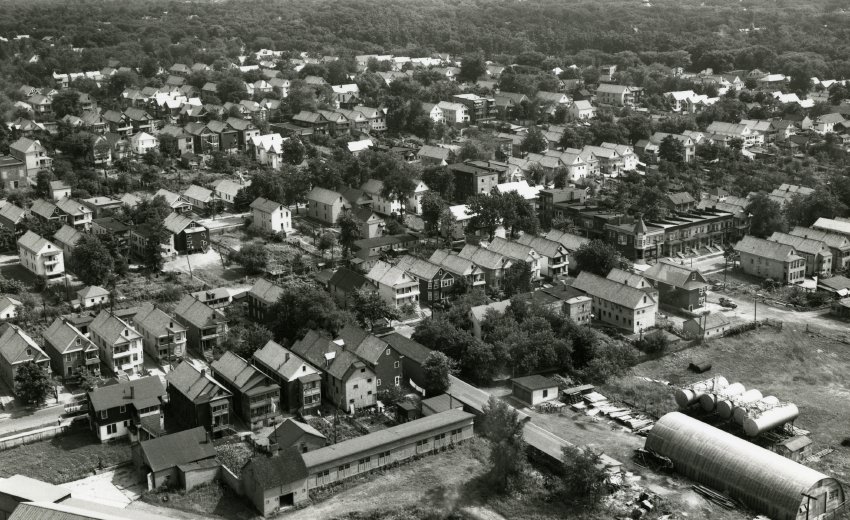
View of the Goose Hill neighborhood from the top of the Seneca St. tower, circa 1950. Photo from the Larry Hart Photograph Collection, Grems-Doolittle Library.

City and Town Historians scanning and consultations - SCHS has always built and maintained relationships with the county and municipal historians in our area. Our collections often support their research and they’ve regularly contributed to our programming and publications. In the past few years, we’ve expanded our work with the municipal historians to include digitizing and preserving at-risk items in their collections, consulting on preservation and archival processing, and providing guidance on collection development and record-keeping.

Jazz collection with Susan Brink - We often work with individuals, families, and organizations to add their archival collections to the SCHS Library, and we’re always excited to talk to them about how their materials connect to broader Schenectady County history. Occasionally, an individual contacts us about collaborating on a collection that is broader and more varied in scope. This is an example of such an undertaking: Susan Brink, journalist and producer, has been active in the jazz community for years and recently started collecting Schenectady’s jazz history, focusing on the musicians and organizers who kept jazz alive in our area. The collection is now part of the SCHS Library and we’re excited to continue working with Susan and other jazz aficionados to build the collection.

Poster for the 16th Annual Accordion Center Band Concert, 1960, from the Jazz Collection, Grems-Doolittle Library.

Collaborative Knowledge Center and Digitization Hub - Two years ago, SCHS was invited to serve as the Capital Region’s Diversity and Collaborative Knowledge Center by the NYS Archives Partnership Trust. This was part of a grant project to expand access to historical materials related to underrepresented people and events in NY state history, train K-12 teachers on how to access and use these materials in their classrooms, and develop relationships between educators, historians, archivists, and institutions in our area. We’ve continued serving in this capacity this year and supporting institutions in our area who are working to digitize and describe materials in their collections and increase access to those resources. One example from this year: Historic Cherry Hill used our scanning equipment to digitize a set of diaries which document race, class, gender relations, household management and economy, and family structure in one Gilded Age Albany household. The diaries will soon be available on NY Heritage.

It’s also important to talk about the day-to-day, continuous work like processing collections, digitizing materials, transcribing documents, preserving items and collections, cataloging, and creating guides and other discovery tools. Thanks to our fantastic volunteers, we make steady, significant progress on our preserving priorities, make our collections discoverable and available for researchers, and use the materials for exhibits and education. In 2024, I plan to spend more time posting about the day-to-day, behind the scenes operations of the library. I hope you're able to take time to reflect on this past year, rest and recharge, and look to new year with excitement!

Thursday, November 2, 2023

HistoryForge Mapping Project for Schenectady County

An exciting new project is underway at the Grems-Doolittle Library! As many of our researchers and members know, the library’s collections include an impressive number of maps, photographs, deeds, and survey documents from around the county. These materials and the information they contain are vital to a variety of research topics, but many researchers struggle to use them effectively. One of the most frequent questions we receive is “where is this place today?” Reading maps and matching textual or photographic data to geographic data can be difficult, and researchers often ask for assistance in deciphering the information. Trying to match a historic document to a physical place in our modern world can be frustrating! The SCHS librarian and library volunteers are working on a new tool that will greatly improve this kind of research: HistoryForge! 


1892 Schenectady City atlas map showing part of the Stockade neighborhood (Grems-Doolitle Library Map Collection)

HistoryForge is an open-source platform that integrates the historic demographic data in census records, directories, and other sources, allowing for its visual representation on historic maps layered over a Google Map. The result is a powerful tool for any community in the United States to explore its past. It was first designed by Bob Kibbee, the former Map and Geospatial Librarian at Cornell University, and David Furber, a software engineer. The project was launched by The History Center in Tompkins County, New York, in 2016. After several years of refining the software, the project is now an open-source, online environment available to any community to adopt and adapt to engage with their local historic maps, censuses, and documents. Last year, the HistoryForge project received a grant from the National Endowment for the Humanities. As a part of the NEH's "A More Perfect Union" initiative, the grant allows The History Center in Tompkins County to continue to improve the open-source software, add more data, and engage more partners. The SCHS Library was invited to partner with the HistoryForge team to test new features, refine user manuals, and suggest improvements to the project. We’re joining partners from around the country to help build a full-featured web environment that will provide a new way of exploring local history!


HistoryForge layers historic maps, photos, census data, and directory data onto a live Google Map. This allows users to see the geographic connections between people, buildings, and historic materials. HistoryForge users can review records connected to individual people, buildings, and businesses to see detailed information, documents, and photos. Searching the census and directory data, researchers can create map visualizations which will help them discover patterns, track how neighborhoods and demographics changed over time, and explore unfamiliar locations.


State Street, Schenectady, NY (Grems-Doolittle Library Photo Collection)

To bring this valuable tool to life, we need your help! HistoryForge is powered by volunteers. Community members build the project by transcribing census records, entering building information, connecting digitized documents and photos to people and building records, and constructing historic map layers. Volunteers can work on this project in person at the SCHS Library or at home on their own computer. Volunteers need patience, attention to detail, a commitment to accuracy, and experience typing. We’ll provide all of the training and instructions volunteers need to successfully build the database and connect records to the map. If you’re interested in volunteering, please complete our HistoryForge Volunteer Interest Form or contact Marietta Carr, SCHS Librarian, at librarian@schenectadyhistorical.org.

As we add information, data, and maps to the HistoryForge, researchers will be able to see our progress at https://schenectady.historyforge.net/

1905 City of Schenectady and Village of Scotia Atlas (Grems-Doolittle Library Map Collection)


Friday, June 30, 2023

Siena College Service-Learning Project at SCHS

Education is a key component of our mission. We present a variety of programming aimed at educating the public, including our school programs aimed at K-12 students. We also regularly host interns to give to college and graduate students invaluable work experience. This year, we had an opportunity to go beyond our usual education work and influence the next generation of historians, teachers, journalists, and creators by inviting Siena College students for a unique behind-the-scenes look at the work of our institution!

Professor Jenn Dorsey approached SCHS with an idea for her Spring Introduction to Public History students to do service-learning projects with Marietta Carr, Librarian, and Mike Diana, Director of Education. Service-learning is a vital piece of the Siena College’s curriculum and something that Professor Dorsey incorporates into her history classes. She views service-learning as a way for her students to practice historical thinking, engage with the history of the Capital Region, and support local cultural institutions like SCHS. 

Students worked with historic photos and maps like this view of Wall St.

For this Public History class, Marietta, Mike, and Prof. Dorsey developed 5 projects that gave students hands-on experience in processing, preserving, and describing archival materials, and using primary sources to develop historical narratives. During March of this year, the Siena students worked with Marietta and the library volunteers to transcribe 19th century legal documents, create metadata for early 20th century photos, create condition reports for archival materials in the Grems-Doolittle Library, and compose descriptions for our small manuscript collections. Their work will be incorporated into future NY Heritage and Consider the Source NY digital collections, enable greater access to our archival collections, and improve the information available in our online catalog and resources. In April, the students researched buildings on State and Union Streets and composed narratives that Mike will utilize in developing future walking tours.

Digitizing documents, like this drawing from the Patents Collection, was an essential part of the students' work.

The students approached their work at SCHS with great enthusiasm. They were eager to apply the concepts they’d covered earlier in the semester and learn the basics of archival processing. For most of the students, this was their first time directly handling original archival materials or working in a special collections library. Many of these students are considering careers in the history field, and this experience provided a glimpse into a possible future career. We’re grateful for the work these students produced and the opportunity to contribute their education!

Friday, October 7, 2022

Archival Storage System Upgrade

It’s an exciting time for the library! We are preparing to upgrade the shelving in our archival collections area. The new shelves are a much-needed improvement which will increase our storage capacity by 65%! This upgrade will ensure our ability to continue collecting historic documents, photos, maps, videos, and music of Schenectady County. 

Installation is scheduled for mid-November, so we’ve spent the summer and early fall preparing, including inventorying collections, rehousing materials, and stabilizing fragile materials. The next step in our preparations is to move approximately 860 linear feet of archival materials from the vault into the library research room to make space for the new storage system and keep the materials safe during the installation. Once the materials are safely moved, we can remove the old storage shelves and prepare the vault for installation. After the installation, we can return the materials to the vault. Because the archival materials will take up all of the available space in the research room, the library will be closed to the public starting October 10th. The library will reopen December 12th.  


We've started moving the boxes from the vault up to the library research room. All available space on the shelves, tables, and floor will be used for temporary storage.

Please contact the librarian, Marietta Carr, if you have questions or if you would like to help move boxes: librarian@schenectadyhistorical.org or 518-374-0263 x3.


Thursday, July 2, 2020

SCHS Reopening: Changes to Library Operations

As NYS enters Phase IV of New York Forward, SCHS is excited to once again welcome visitors and researchers to our sites! Beginning Monday, July 6, the doors of our Library, Museum, and the Mabee Farm Historic Site will be open. However, as we prioritize our community's health and safety, and follow NYS guidelines, we have a few changes to our operating policies. All visits to our sites must be scheduled in advance.

Photo of bilboard nex to a road. Bilboard reads "Schenectady Lights and Hauls the World. Population 100,000. Welcome"
We're excited to welcome you back to our sites!

This post details the changes to library operations that will be in effect for the foreseeable future. Please contact the librarian if you have any questions.

Research Appointments
  • Researchers must contact the librarian at least one day in advance to schedule an appointment to visit the library. Contact the librarian at librarian@schenectadyhistorical.org or 518-374-0263 x3
  • When scheduling an appointment, please specify which materials you plan to view and the desired length of the appointment.
  • SCHS members may visit the library for free as a benefit of their membership; non-members pay $6 per person, per visit to use the library.
  • Admission fees can be paid online, over the phone, or in person. Read the "Payment Options" section on our Research Resources page for more details: https://schenectadyhistorical.org/research/
  • Appointments will be available Monday-Friday, 9am-12pm and 1pm-5pm, and Saturday, 10am-2pm. No research appointments will be scheduled from 12-1pm Monday-Friday.
Visiting the Library
  • Everyone using the library will be required to wear masks that cover their noses and mouths at all times.
  • Researchers should bring their own masks.
  • Everyone using the library must maintain 6 ft. social distancing whenever possible.
  • The number of people in the library at any time will be limited to comply with NYS guidelines on capacity.
  • Signs will be posted around the lobby and library to remind visitors and researchers of the current protocols.
  • Researchers are encouraged to bring their own laptops and devices. Use of the library's computers will be restricted to library staff and volunteers.
  • The library staff will sanitize commonly touched surfaces, including shared work-spaces, frequently throughout the day.
Access to Materials
  • Researchers must specify which materials they plan to use during their research appointment. Peruse the Collections & Catalog page for finding aids, guides, indexes, and descriptions of materials in the library collections
  • All materials will be retrieved by library staff and volunteers.
  • Materials will be quarantined for up to 72 hours after use, in accordance with current expert recommendations.
Handling Materials
  • Researchers should wash their hands before entering the library. Frequent handwashing is encouraged.
  • Use of hand sanitizer will not be allowed while handling materials. Studies have shown that hand sanitizer can damage historic materials.
  • Researchers must not reshelve or refile any materials. Library staff will move materials to quarantine areas after use.
Visit the Research Resources page on the SCHS website for more information such as library services, research room rules, and fee payment options.

Photo of a library volunteer waving her hands in excitement while sitting at a desk with a computer.
We look forward to working with you again!

Monday, March 30, 2020

COVID-19 Archive Project

We are all making history right now, as we live through the COVID-19 pandemic. It's an emergency of historic proportions, and has been compared to the Black Plague, or the 1918 Spanish Flu. Like those past crises, COVID-19 will be a major topic of study for future historians. Years from now, Schenectadians will look back and wonder: “How did the COVID-19 pandemic affect Schenectady County? How did our ancestors respond to the crisis?” "What was life like for people quarantined?"

You can help future researchers understand for themselves what life right now is like. You can help future historians understand the pandemic's immense impact on our community, and on ourselves, and on our way of life. You can help future historians understand how this international emergency changed your life, and changed our world, forever.

Consider recording your unique perspective for inclusion in the SCHS archives. Diaries, scrapbooks, photo albums, letters, songs, poems, short stories, and other works of art are all important sources for future historians. Be creative: there are infinite ways you can express yourself, and document the impact of COVID-19 on you, your loved ones, and your neighbors. Help us, by:

--Contributing to a global collection of stories: https://covid19.omeka.net/
--Sharing your story using our form: https://forms.gle/RmvbpGEnUkmT2VU29
--Creating a personal diary, scrapbook, or photo album (analog/physically or digitally)
--Collecting the letters, emails, and notes that you’ve created or received to stay in touch or communicate with others during this difficult time of isolation

--Creating art, poetry, music, and other creative expressions related to the current crisis

The COVID-19 pandemic and its economic impact is an on-going, changing situation. It will take time to document how we are all affected, so we encourage you to contact us when you are ready to donate your materials whether that's today, or in the next few weeks, or several years from now. We're open to collecting materials of any format, digital or analog. If you have questions about ways you can contribute to the SCHS archive collection, or about documenting your experiences, contact the SCHS librarian, Marietta Carr, at librarian@schenectadyhistorical.org.


Pages from Sadie Levi's diary 1886. Learn more about this diary: http://gremsdoolittlelibrary.blogspot.com/2012/01/research-in-library-identifying-diarys.html


Tips for creating journals, diaries, and scrapbooks:
  • Pick your format. You can jot notes in a calendar, doodle and write in a blank notebook, or record yourself in a video log. It doesn't matter if you choose an analog format or a digital one as long as it works for you.
  • Schedule time for writing and/or construction. Set aside 10-15 minutes a day or whatever works for you for time and frequency. As long as you are regularly adding to your creation, you're creating historical value.
  • There is no wrong way to keep a journal or scrapbook. Add content that is meaningful to you in whatever way works best for you.
  • If you need inspiration, try answering the following questions:
    • What did you do today? How was today different from yesterday or a typical day in your life?
    • Who did you talk to today? What did you talk about? How did you feel during and after the conversation?
    • What new piece of information did you learn today? How do you think you will use this information? Where did this information come from? Why do you trust the source of this information?
    • Why did you decide to keep this journal or scrapbook?
    • When did you first become aware of the COVID-19 pandemic? What were your first thoughts or feelings?
    • Have you ever experienced an outbreak or similar situation before? How have you prepared or responded to this situation? How have the people around responded?
    • What brings you joy or comfort right now? What are your biggest concerns right now?
    • Think about what your 'normal' life entails and then describe how the current situation differs from your 'normal.' Talk about yourself: where you work, what activities you do, where you live, and who is in your family.
Tips for collecting letters, documents, art, and other creative expressions:
  • Designate a single location for your collection, whether that's a box or a digital folder
  • Don't worry about collecting every single possible item. Focus on making a habit of saving a copy of your documents in that single location.
  • Write or record information about your collection such as who participated in creating it, when you started and finished collecting, and what formats (e.g. email, JPGs, photos, letters) are present in the collection.
  • Find an organization that makes sense to you and record a few notes about that organization. Did you sort items by type (e.g. all of the photos are together in one folder) or by creator (e.g. everything your spouse created is its own folder)? Did you do something else like alphabetize or organize by date?
  • Contact the SCHS librarian if you have questions about formats, organization, or preservation.
Letter from Charles Snell, sent while he was stationed in the South Pacific during WWII.

The SCHS COVID-19 Archive Project is one of many similar projects that archives around the world have started to document this historic period. Our project is informed by and modeled after the Society of American Archivists Documenting in Times of Crisis Resource Kit, History Colorado COVID-19 Experiences Project, and the Mass Observation Archive.

We wish you and your loved ones the very best. Be in touch and be safe.
~Marietta 

Thursday, October 10, 2019

Genealogy Day 2019

Join us on October 19, 9am-4pm, for Genealogy Day at Grems-Doolittle Library!

We have three speakers lined up to educate you on a variety of genealogy topics and the library will be open extended hours for research. Tickets are $8 for the day and free for members. See the schedule below for more details:

Maps can be great supplements to genealogy research, especially when using land records.


9-10:15am: “Complex Evidence: Untangling Multiple, Same-Name Individuals” presented by Judith Herbert

It’s pretty common for names to be reused in families, but it can be frustrating to track your genealogy when it seems everyone is named John, Jacob, and Mary. Judith Herbert, certified genealogist, will present strategies for untangling the confusion caused by same-name individuals within your family tree.

10:15-11:30am: “Patching Families Together Through Land Records” presented by Tina Post

When genealogists hit brick walls it’s not fun. Land records can provide the clues necessary to put stymied research on track again. This presentation will provide examples of how relationships can be gleaned using deeds, bounty lands and land grants. In addition, platting will be discussed as a means of creating more leads to investigate.

11:30-12:45pm: “Gravestone Conservation for the Genealogist” presented by Christopher White

Have you ever seen that unreadable gravestone or that toppled monument and wondered what can I do to address its condition? There is a correct way and a wrong way to remedy that gravestone. Christopher White, a genealogist, historian, and gravestone conservator, will present a program on gravestone conservation including cleaning, repair, what to do, what not to do, when to do nothing, and when to seek a professional conservator.

12:45-4pm: Research in the Library


Learn to care for gravestones and memorials at this year's Genealogy Day.
Best,
Marietta 

Thursday, August 29, 2019

Hello from the new librarian!


A walk along the lake, Central Park, Schenectady, NY. 1919 C.W. Hughes and Company, Mechanicville, NY (Wayne Tucker Postcard Collection at Grems-Doolittle Library). Like many of you, I enjoy postcards and collect them personally. This one caught my attention because one of my favorite activities is walking my dog in the park.


I’m thrilled to join the staff of the Schenectady County Historical Society as the librarian. I’ve been involved with historical societies and local history museums for most of my life, but my professional experience thus far has been in higher education. Most recently, I was the archivist at Cuyahoga Community College in Cleveland, OH. 

I grew up in Harrisburg, PA, in a family of teachers. When I started as a history major at Northeastern University in Boston, MA, most of my family expected me to follow in their footsteps, but I fell in love with processing archives and special collections. I started as an assistant in the University Archives and sought volunteer and intern positions in a variety of archives and museums.  One of my favorite internships involved cataloging souvenirs and books in the USS Constitution Museum collection. I earned a masters degree in history from Northeastern and a masters of library science from the University of Pittsburgh. My first job out of college was as a library circulation assistant at Harrisburg Area Community College, but my passion for archives and history drove me to establish the college’s archives and serve as the first archives and reference specialist. I moved to Cleveland a little over three years ago to take the archivist position at Cuyahoga Community College. My work as the archivist there focused on collaborating with faculty to bring the collection into the classroom and increasing the discoverability of the collection through finding aids and other descriptions. Currently, my goals as the SCHS librarian include learning where everything in the collection is located and getting to know the SCHS community, especially our excellent volunteers! Looking forward, I plan to encourage the community’s engagement with the collection through increased access and discoverability, grow and preserve the collection, and use the materials in a variety of programs and outreach activities.

As a new resident of the Schenectady area, I have a lot to learn about the history as well as figuring out my new job and the library collections. All of the staff, volunteers, and researchers have been generous with sharing their knowledge and teaching me what I need to know. I have a long reading list and I’m excited to explore the county. If you have suggestions for books to read, places to visit, or people to meet, please share! I hope you’ll stop by the library to say hello and tell me about your research, family, and memories of Schenectady. 

Erie Canal crossing the Mohawk River at the Aqueduct in Schenectady, New York. 1907 Robson & Adee, Publishers, Schenectady, NY (Wayne Tucker Postcard Collection at Grems-Doolittle Library). I learned about Ohio's perspective on the Erie Canal while living in Cleveland, and I'm starting to learn about its impact on Schenectady.
Best,
Marietta Carr