Showing posts with label Biographies. Show all posts

Saturday, August 29, 2026

Henry ‘Hank’ Bozzi and the Schenectady Mohawk Giants

 This post was written by guest contributor, Keith Wood. Mr. Wood is a teacher, historian, and author: https://www.keithbwoodauthor.com/

 Henry ‘Hank’ Bozzi, owner of the Schenectady Mohawk Giants, was described by the Schenectady Gazette in 1963 as “the promotional genius for pro and semi-pro sports here in the Golden Era before World War II.”[1]

Henry Bozzi was born on January 21, 1892, in Italy, to Mary and M.B. Bozzi.[2] The Bozzis arrived in Schenectady in 1901, with Henry as a nine-year-old. He grew up in the Mont Pleasant neighborhood. At twelve, he dropped out of school and began working for General Electric.[3] Bozzi decided to leave the plant and began serving as an apprentice at his father’s barber shop at 137 South Ferry Street. This gave him the freedom to promote local sporting events.[4]

Schenectady Gazette, 1923
 

In 1920, he became the booking agent for the Knights of Columbus, and over the next four seasons, his notoriety as a local promoter grew. By 1924, when Chappie Johnson brought his Colored All-Stars to Schenectady, Bozzi stood as the obvious choice as promoter for Johnson’s club.[5] Bozzi expanded his regional connections, while Johnson acquired Bozzi’s knowledge of local semi-professional teams. At the onset of the 1927 season, Chappie Johnson headed north to Canada to promote baseball in MontrĂ©al. Bozzi retained ownership of the team and rebranded it as Buck Ewing's All-Stars. Bozzi's relationship with Buck Ewing solidified his ability to continue the all-Black professional baseball team. At the end of 1928, Ewing received an opportunity with the Homestead Grays.[6] Without Ewing, Bozzi reincarnated the Mohawk Giant moniker from the 1913 club. 

By 1929, the Pittsburgh Courier described the Mohawk Giants as "the best club thereabouts since the great aggregation of 1914. 'Men were men in them days,' and that was a team."[7] Bozzi began receiving national attention. When Schenectady opened its Twilight League in 1931, Bozzi’s club became the primary focus. The Mohawk Giants stood as the standard by which semi-professional teams judged themselves. The 1932 season also saw the establishment of an Eastern New York Semi-Professional League. Many of the clubs that considered joining this semi-professional league were mainstays on the Mohawk Giants’ barnstorming schedule.[8] Once again, Bozzi’s club was sought out to strengthen a local league.[9]

Crowds at Mohawk Giants games at the A-Diamond in Central Park looked like “a huge bowl of overflowing humanity,” according to Dan Duval, the Union Star’s sports editor.[10] Bozzi collected admission for the bleachers behind home plate, but those fans willing to stand or sit along the baselines or in the outfield enjoyed free admission. Bozzi passed the hat around, but in the middle of the Great Depression, the hat often came back less than full.[11] For Bozzi, booking the club at the A-Diamond was an act of civic boosterism. Bozzi often brought his Mohawk Giants to Saratoga in August. His club’s popularity ensured solid crowds as they played games under the lights, allowing fans to see games after a day at the track.[12]

Two Mohawk Giants players posing in front of spectators gathering for the game.
 

Bozzi’s club played the House of David bewhiskered nine in front of over 3,000 fans at Central Park’s A-Diamond.[13] They also traveled to the home of baseball and played at Doubleday Field in Cooperstown against their town’s nine, and in 1932 they took part in the first night game ever played in Cooperstown.[14] The club barnstormed throughout the state and in the neighboring states of Pennsylvania, Vermont, and Massachusetts. The most coveted games were against Negro major leagues teams like the New York Black Yankees and the Brooklyn Royal Giants, including a 5 to 1 defeat of the Black Yankees in 1934 at the A-Diamond.[15]

By the early 1940s, holding on to the club for Hank Bozzi became more arduous with each passing season. Bozzi publicly announced that 1941 would be his last year in charge of the Mohawk Giants.[16] The following May, Bozzi sold the Mohawk Giants outright to McDonald Lewis, an African American business owner in Schenectady.[17] After a one-year hiatus, Bozzi brought the Mohawk Giants back for one last abbreviated season.[18]

From 1929 to 1940, the Mohawk Giants went 690-259 (.727), making them one of the strongest semi-professional teams in this era, white or Black.[19] The Mohawk Giants stood as a standard of excellence, providing entertainment for the region’s sporting communities.

Related reading: 

WMHT The Mohawk Giants: Schenectady and the Negro Leagues

Guide to the Frank Keetz Baseball Collection at SCHS

Schenectady in the Green Book

The Walter Johnson -- Frank Wickware Showdown 

Works Cited:

1 “Things You Ought to Know.” Schenectady Gazette. November 29, 1963.  
2 "United States, Census, 1910", FamilySearch (https://www.familysearch.org/ark:/61903/1:1:MRQZ-STB : Wed Aug 13 18:10:23 UTC 2025), Entry for M B Bozzi and Mary Bozzi, 1910. 
3 Keetz, The Mohawk Colored Giants of Schenectady (Schenectady: Schenectady Historical Society, 1999), 23.
4 “Barbershop Ad.” Schenectady Gazette. July 25, 1972.
5 “Tonight’s Ballgame Called Off.” Amsterdam Evening Recorder. July 29, 1924.
6 Gary Ashwill, “1928 Homestead Grays,” Seamheads Negro Leagues Database, accessed July 23, 2025, https://www.seamheads.com/NegroLgs/team.php?yearID=1928&teamID=HG&LGOrd=4. 
7 “Sports Shorts.” Pittsburgh Courier. June 20, 1929.
8 “Local Semi-Pro Baseball League to begin play in May.” Troy Times. April 5, 1932. 
9 “Mohawks play all Dorp team in mix tonight.” Schenectady Gazette. May 31, 1932.
10 Keetz, 71. 
11 “Games book by Incarnation.” North Adams Transcript. August 3, 1932.
12 “Buck Ewing and Mohawk Giants to play here today.” Hartford Courant. September 4, 1933.
13  “Mohawks beat House of David in close game.” Schenectady Gazette.  September 6, 1929.
14 “First night game draws record crowd.” The Otsego Farmer. September 9, 1932.
15 “Mohawk Nine halts rush of Yankees.” Syracuse Journal. August 25, 1934; & Lester, 67. 
16 “Dressing Room Chatter.” Amsterdam Evening Recorder. August 12, 1941.
17 Keetz, 138. 
18 “Pros defeat Mohawk Giants 10-3.” The Saratogian. July 26, 1943.
19 Keetz, 4. 

Thursday, August 29, 2024

Daniel Campbell: Businessman, Patriot, Human

This post was written by library volunteer Robert Baldwin.
Readers are advised that this post includes quotes from historical primary sources which contain offensive, insensitive, and racialized language. In the interests of accurately presenting the historical record, we do not alter the language used in original primary source documents. Spellings, punctuation, and grammar in the transcriptions are unaltered from the original document. 

 
For a recent research request at the SCHS Library, I investigated land-purchase activities of Daniel Campbell. The individual whom I assisted in this research effort was primarily interested in Campbell’s acquisition of land in Ballston; particularly, property the researcher owned in Ballston Spa that Mr. Campbell did at one time. Though my efforts had limited success for this individual, I became interested in gleaning the personality of Daniel Campbell. Research began with the Letter Book of Daniel Campbell 1771-1801, transcribed by Elizabeth D. Shaver, 1982-3. Subsequently, after investigating other sources, I discovered that information relating to the personality of Mr. Campbell was nominal. Thus, I determined that it was a worthy effort to probe Shaver’s work to paint Campbell’s personality. A fur trader, land speculator, salesman, and a military officer were among the most common labels associated with Mr. Campbell. Yet, my investigations indicated that there was much more to learn about him. What did he like? What caused him great disdain? What types of people did he embrace, or attempt to disenfranchise? Who were his favorite acquaintances, and who were not? What about politics and loyalty? How did family play a role in Mr. Campbell’s life?


Portrait of Daniel Campbell by Thomas McIlworth.

Let us begin with the most commonly known practices of Mr. Campbell without much reference to personality. The fur trade was not limited to the historical and stereotypical beaver pelt trade. He dabbled a great deal in a wide variety of furs/skins with his friendly "aborigines" (Campbell used this word frequently to describe Native Americans and used it interchangeably with "Indians"). Among these were as follows: leather (tanned cow or cattle hides), beaver, fox, deer, raccoon, otter, seal, martin, bear, fisher, musquash (muskrat), cat (referring to large cats such as mountain lions and bobcats), and elk. Of course, beaver was the most important, and followed by deer, leather, raccoon and bear. The least desirable was musquash, being inferior in quality, smaller than a beaver, and more difficult to skin and process. 

Among his most important inventory stores were wampum and cord to trade with Native Americans. Second in importance was rum, a common bartering item for fur trade. Let us not forget knives, very commonly a trade items for furs. Campbell's fur trade interactions with Native Americans led to his great feeling of appreciation towards them. He considered his Native trading partners both industrious and an excellent source of promoting revenue.


Mr. Campbell attributed his success as a merchant to the people with whom he worked. Diplomacy was critical. The fur trade was the basis for his early successes. Thus, appeasing Native American fur hunters and traders was essential for acquiring furs. Constant communication and negotiation with transporters, both within the colonies and over to Europe, required finesse. As for providing trade with the military, neither politics nor loyalty had a place until the outbreak of the Revolutionary War. Mr. Campbell and several other prominent citizens, were examined about their relationship with the British military. An ultimatum was decreed by the Schenectady Committee of Conspiracies, requiring said businessmen to cease all activities with the British or be imprisoned on a ship in Kingston for the duration of the war. Unfortunately for Mr. Campbell and his affiliates, their sworn allegiance to the United States destroyed many of their business activities until the end of the war. While the American Revolution did not destroy Mr. Campbell’s practice of land acquisition or nominal trade, it caused a great deal of angst and significant loss of commerce. Furthermore, Mr. Campbell spent a great deal of time attempting to recuperate unpaid debts created prior to the war. I would venture to say that approximately twenty percent of his letters were some form of correspondence with debtors as well as law enforcement to recuperate his revenues. As anyone might surmise, his letters reflected frustration and anger, not only towards debtors, but also with the legal system.


Though the fur trade was lucrative, Mr. Campbell’s merchandise trade is nothing to disregard. Within the letters there were two times that inventory was included, and quite extensive. He was very hard on his employees to assure that conducting inventory was complete and accurate. As a matter of curiosity, I discovered that the store’s ending inventory in 1772 was £2917:19:67 (2917 pounds, 19 shillings, 6 pence); or, equal to 2024 inflation rate $664,0768 (2024 USD). Mr. Campbell understandingly had reason to be so particular. Some inventory include: wampum, linen, textile, buttons, sewing supplies, clothing, hats, hand tools, garden tools, spices, wine, rum, dishes, chimney tile, playing cards, bridles, hardware, playing cards, gun powder, paper products, and horse trade or livestock. The inventories also provide evidence of Mr. Campbell’s involvement in the slave trade.

Painting of Campbell Mansion, State Street, Schenectady.


We cannot afford to be historical apologists for the darker sides of our ancestors. Mr. Campbell was not an exception. Five of the letters reference Campbell’s willingness and promotion of slave trade. He claimed ownership over enslaved people in his own household. Within his business practice, he brokered deals to purchase enslaved people for his clients. The following are a few examples of this from the transcribed letters:


2 August 1771 Letter:


“…It is very hard to get such negroes as you described and you are very right to purchase none but such as good character. If there of any I will immediately acquaint Mr. Sherbrook…”


28 August 1771 Letter: 


“…Mr. Walker desired me to remit the amount of these bills to Mr. Mills Sherbrooke merchant in New York as he said he wanted to purchase some Negroes I have paid the money to Mr. Mills Sherbrooke Merchant in New York agreeable to such directions…”


January 1772 Letter: 


“…to Mr. Tymes…I shall do my best to procure you a good Clarke and a servant or negro…”


26 April 1773 Letter:


“…I wish you could meet with a bargain of a negro gerrill* of about from 10 to 12 years old let her be sound. I have seen several advertisd in Mr. Gains paper. I have an order from Mr. Andrews at Detroit for one.”


I would be remiss to exclude how Mr. Campbell felt about the enslaved people on his property. He did value loyalty; and, he got it. His Black enslaved servants occasionally made sure he knew about ongoing property encroachments of contiguous landholders. Furthermore, he insisted that his servants were of sound body and high personal character.

Aptly dubbed a land speculator in a multitude of resources, Mr. Campbell gained most of his wealth in later years from purchasing, selling, and leasing land. The records indicate that Mr. Campbell purchased more than forty thousand acres of land. Land acquisition within the Kayaderosseras Patent was over twenty-four thousand acres alone. With very little thinking effort, we can clearly relate his prowess to real estate magnates of today. However, this undertaking not an easy task. He wrote many letters of inquiry, and those relating to offers and acceptances; relying heavily on messenger services via horseback and carriage. Several correspondence letters were unrelenting to the point of frustration and disappointment among parties. The acquisition of land was not only to increase his land wealth; rather most often his purchases led to lease agreements for tenants to pay to use the land, as well as improving the land. 

For example:

18 November 1773 Letter:


“…I have purchased amounts to 24000 acres. It is all wood land free of any quit rent to the (King?) or any other person forever…there are on my lands about 8 tenants who must either agree with me for rent or must purchase the land…”


January 1774 Letter:


“…I have been down to York this fall & made a purchase of 20,000 acres of land which lays all around Bauls Town** & is very convenient to settle…I make no doubt but next summer I shall settle fifty or sixty families…I shall endeavor to settle it by giving leases forever.”


It was Mr. Campbell’s expectation to find tenants who were capable, hardworking and trustworthy, being of very good character. Mr. Campbell often wrote letters admonishing those who did not meet his high standards, both tenants and neighbors. As a remote landlord, Mr. Campbell was fiercely protective of his land. When individuals living contiguous to his lands encroached, he took swift legal actions. Three common encroachment issues reflected in his letters referenced theft of wood, grains, and claiming property as their own. Mr. Campbell frequently communicated intentions of litigation and incarceration. Furthermore, he did not have any compunctions to claim property of perpetrators. The following excerpts from his letters illustrate this:

30 March 1773 Letter:


“As my negroes has informed me…that you cut down part of the grass to the amt of a wagon load of hay this seems to me strange that such measures should be carried into execution at a time when I was 100 miles from home…I suppose by measuring my land which no man had a right to do and what I never in my life expected from you…”     


24 January 1774 Letter:
 

“…having proof that William Brisby cut 150 loggs of my land…be assured I will prosecute you as the law directs if you do not immediately come & make me payment for the full value of every log you have cut & for deceiving me in this manner you shant have one acre of land from me altho I was determin’d to have given you a lease.”


Mr. Campbell was very possessive with his land holdings. It was apparent that what land he had great value. For instance in 1779, the land tax assessment value for his property in Ballston was £9,045. I took the time to determine the inflation and exchange rates from 1779 to 2024. The above-mentioned amount would equal $1,505,992.5013 (2024 USD) today. Who would not be protective of such an investment? Apparently, he took land holdings very seriously.


Ireland, the place of his birth, was always on Mr. Campbell’s mind. Several letters were to his brother, Davy. The letters give a positive portrayal of how Mr. Campbell felt about America. Whether the letters were about politics and business, the gist was obviously in favor of being an American. His letters would include land acquisition and his plans for them. Planting fruit trees, keeping sheep, growing profitable livestock, and a variety of trade excursions with the Native Americans were commonly addressed. In these letters, Mr. Campbell was a braggart; for example:


18 October 1773:


“… I now begin to follow your example in somethings which is in purchasing land…I have of late made a very large purchase of land which is well situated to settle, 20 & farthest not more than 25 miles from this town & a fine patent of land…I have purchased amounts to 24,000 acres…”


(then expressing his patriotic perspective) “…encouraging those to come to do making them & there posterity to come over to a free country not loaded with taxes, tythes, hearth money, high rents & twenty other burdens that must forever crushd the heart of goodmen…”


Ironically, the political, economic and social climate in America quickly changed shortly after this letter to Davy. In a colonial community increasingly confronted by taxation issues, restlessness of citizens, and increase in trade restrictions, Mr. Campbell began to question on which side of the fence he should fall:


22 July 1775 to George Folliot Esq:


“…I hope Mrs. Folliot & you enjoy your health these unhappy times As yet I have been a perfect looker on neither leaning to one side nor the other this far I wish & hope that America may never be tax’d without their own concent…”    


One letter to his brother Davy expressed feelings about war’s end and his ability to persevere:    


2 January 1784:


“…happy to be able to write and receive letters, unable to do during the unhappy war…I have not suffered much by the war in my property farther than it has prevented me from settling my land at present there seems to be a demand for land…I have good prospects having a good many tenants next year as many people from New England states are dayly moving in our state on account of having cheape land...I have not done any business as a merchant during the war…”


In studying history, we often see people of the past as a series of life events: birth, education, graduation, marriage, military service, election to office, etc. Their personalities, preferences, and viewpoints are often lost to time or difficult to determine from accessible sources. Delving into primary source documents such as these letters maintained at the Schenectady County Historical Society provides an opportunity to explore the personality and character of Mr. Campbell. Daniel Campbell can easily be perceived as a scoundrel, money-monger, demanding landlord, unrelenting bill collector, and a self-serving community leader. Certainly, his perspective on ownership and servitude of humans is neither politically correct nor humanly acceptable to today’s standards. Notably, a great deal of his economic and political endeavors are not foreign to leaders of today. Further study of Mr. Campbell’s letters might reveal more connections and parallels to the people, places, and events we encounter today as well as give insight into the person he was and the Schenectady he inhabited and helped shape.

* sic: girl

**Ballston, Saratoga County

Wednesday, July 13, 2022

William Van Bergen Van Dyck

William Van Bergen Van Dyck, age 100. Photo from the Van Dyck Personal Papers, Grems Doolittle Library.


This post was written by library volunteer Gail Denisoff.

Growing up in New Jersey, Billy attended a private school affiliated with Rutgers College. His father, Francis, was an analytical chemistry and physics professor at Rutgers, and was frequently asked to consult on projects by his friend and neighbor, Thomas Edison. As a boy, Billy often accompanied his father to Edison’s laboratory and later remembered being present at an early demonstration of the phonograph. An autographed photo that Edison presented to Billy as a birthday gift was one of his lifelong prized possessions.

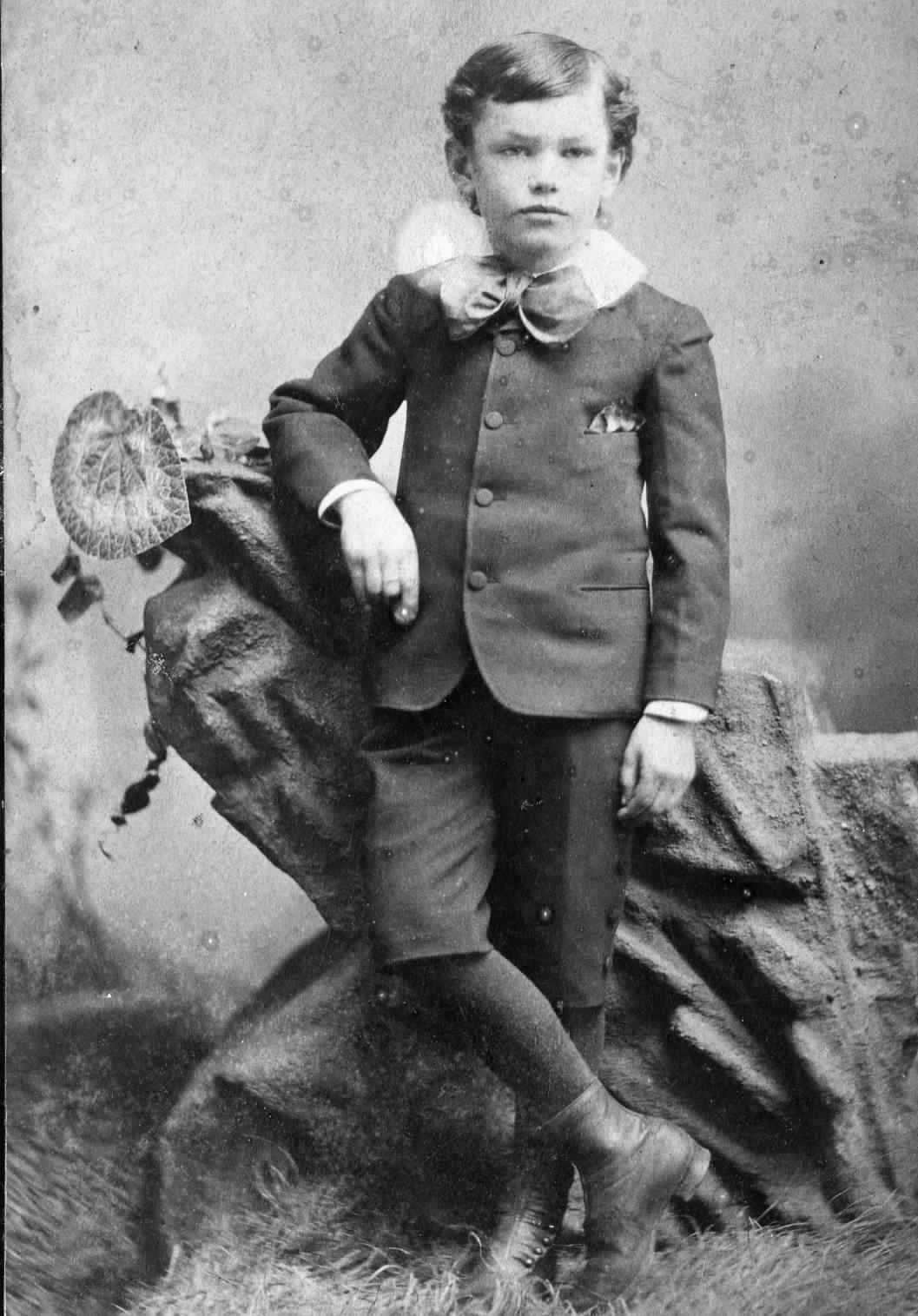
Billy circa 1880. Photo from the Van Dyck Personal Papers, Grems Doolittle Library.
 

After high school, Billy went on to Rutgers, graduating in 1896 with BS in prismatic glass and light reflection. In 1897 he graduated from Columbia with a degree in electrical engineering and then received an MS from Rutgers in 1898. While in college, he was captain of the varsity football team, played second base on the varsity baseball team, was a standout in the 100 yard dash, sang with the glee club, and was a member of Delta Phi, Phi Beta Kappa and Tau Beta Pi.

His first job out of college was with the American Luxfer Prism Company in Chicago where he was in charge of the research laboratory for a year. He then became a sales engineer for the company in Pittsburgh and New York. By 1899 he was back at Rutgers teaching math and electrical engineering. Two years later, he married Frances “Fanny” Johnson, a stage actress, and decided that two couldn’t live on what he made as an instructor so took an engineering and manufacturing position in North Carolina. 

In 1906, his international career began with a new position as an engineer in Santiago, Chile with the W. R. Grace Company, agents of General Electric. His next move was to Brazil in 1911 as a representative of General Electric of New York. He stayed in that position until 1914 when he was appointed Managing Director of Cia General Electric do Brazil. In 1918, he was named President of General Electric South America, a Brazilian corporation. 

Portrait of Billy taken while he was employed by GE in Brazil. Photo from the Van Dyck Personal Papers, Grems Doolittle Library.
  

During the time he lived and worked in South America, he took on several interesting projects. One of the first was in 1908 when he was still living in Chile. He purchased four electric automobiles, intending to sell them for a profit. He kept one for his own use and sold one to the Ambassador of England, but quickly found that there was no market for the other two. Realizing the cars would depreciate the longer he held on to them, he decided to trade them for a warehouse full of wine. He reasoned the wine might increase in value – and if he couldn’t sell it, he could always drink it.

Billy was proud of his attempt to light the Straits of Magellan. Located in Chile, near the tip of South America, it was a treacherous but essential waterway before the Panama Canal was built. One stretch close to the Pacific was particularly dangerous with high cliffs, a 40 knot current and 40 foot tides. His workers installed a light on a long flexible chain anchored to the bottom. Although successful for a time, the current and tides tangled the chain and the light eventually sank to the bottom. That was the first and only attempt to light the Straights.

Another interesting project was to provide light for the 1923 Brazilian Exposition. Billy was instrumental in achieving locally produced light bulbs. Prior to 1923, parts were made elsewhere and assembled in Brazil. Under his leadership, glass bulbs began to be manufactured in Brazil and other components soon followed. Because of this, he was able to obtain the contract for the design and installation of lighting for the exposition using crystal prisms and electric lights that reflected the light in a spectacular manner. The setup was a huge success.

Billy liked to tell the story of a Brazilian cowboy who rode a horse to his office and dropped $60,000 in cash on his desk for an electrical installation at his remote ranch. When Billy questioned whether he felt uneasy leaving that amount of cash with him the cowboy replied, “Not at all, Señor, after all, I can trust the General Electric Company!”      

While in Brazil, Billy was a founder and director of the American Chamber of Commerce of Brazil, President of the Rio de Janeiro chapter of the American Red Cross, a founder of the Rio de Janeiro Country Club, was the catcher for the American Rio baseball team well into his 40’s, and a director and president of the American Society of Rio de Janeiro. Sadly, Billy’s wife Frances died in 1922. She lived with Billy in Brazil but returned to the United States before her death. Billy also returned to the U.S. on several occasions. One was to attend the 75th birthday party of his old friend and neighbor, Thomas Edison. 

Billy traveled on the SS Western World in 1923 from New York to Buenos Aires. Image from

Pacific Marine Review, v. 19, August 1922, p. 469, archive.org.

Billy was on board the steamship SS Western World out of New York bound for Buenos Aires in May of 1923 when a telegraphed chess challenge was received from the SS American Legion that had just left Argentina. Three players from each ship participated in what would be the first chess game by wireless. Billy was captain of his team and fifteen moves were made the first night until communications were lost. The match continued the following night as reception was almost non-existent during the day. After four nights and thirty-five moves, each team declared victory when radio reception did not allow them to continue. Not minding that no winner was determined, Billy considered the match great fun and a unique experience.  

 Billy held the position of President of General Electric South America until 1926 when he returned to the United States and in June 1927 became the Manager of the Schenectady office of the International General Electric Company, a title he held until March of 1937 when he became Assistant to the President of IGE. On Valentine’s Day of 1931 Billy married his second wife, Schenectady native Elvira Haight, who had a daughter from a previous marriage.

One of the highlights of his tenure in Schenectady was bringing the King of Siam to meet with General Electric scientists as a guest of IGE. King Prajadhipok, who at that time was one of only two absolute monarchs in the world, was traveling incognito using the alias Prince Sukhodaya. On July 9, 1931, Billy traveled to New York City and joined the King’s party on a private railroad car. When they arrived in Rensselaer the car was disconnected from the train and a special locomotive was attached which brought the group directly to the General Electric plant. A telegraph sent to Billy the next day from the King’s secretary thanked him for the enjoyable day and asked if he could locate and return a vest the King left on the train.

International General Electric hosted many other guests from around the world including the Counsel General of Ecuador and Count Folke Bernadotte, the nephew of King Gustuv of Sweden. The Count sent Billy a letter thanking him for the day he spent in Schenectady meeting with a group of scientist that included Dr. Ernst F. Alexanderson. 

Billy traveled to South America on several occasions while he worked for IGE. On June 10, 1939 he was awarded the “National Order of the Southern Cross,” the highest decoration given by the Brazilian government to a private foreign citizen. The citation noted the award was given for his “distinguished service in the promotion of international good will between the United States and Brazil.”

Billy was very active in community affairs in Schenectady. He was a member of the Schenectady Chamber of Commerce, Rotary Club, YMCA of Schenectady, Chairman of the Schenectady Community and War Chest during World War II, and President of the Capital District branch of the Holland Club of America. He was also active in the Mohawk Club and the Mohawk Golf Club.

When Billy retired at age of 70 on December 31, 1945, after 34 years with GE, he didn’t slow down. He and Elvira traveled the world collecting art objects that they displayed in their home at 21 Washington Avenue. He was a founding member and Trustee of the Community State Bank for over 35 years, and was never late or missed a meeting, even when he was over 100 years old. At 104 he attended his 85th Rutgers reunion where he was honored as the oldest alumni and last living member of the class of 1895.

Billy at his 85th Rutgers reunion, the last surviving member of his class. Photo from the Van Dyck Personal Papers, Grems Doolittle Library.

Billy never had children but after his wife, Elvira, died in 1974 his niece, Florence Bucher came to live with him as his companion. He walked his dogs, first Firecracker and later Cracker Jack, around the Stockade neighborhood daily, often stopping by Arthur’s Market. He went to the Mohawk Club every day to visit with friends and play backgammon, chess, and cards. At 103, Billy’s started receiving nursing care in his home, but his mind stayed sharp. He said he had a cousin who lived to be 108 and wanted to beat that family record. Unfortunately, Billy passed away on March 18, 1981, at the age of 105, three years short of his goal. After local services at St. George’s Church, he was buried with his Dutch ancestors at Riverside Cemetery in Coxsackie.

During his long life, Billy lived through the administrations of 24 presidents from Ulysses S. Grant to Ronald Reagan. On his 100th birthday, Mayor Frank Duci awarded him the distinction of Patroon, Schenectady’s highest honor. A modest man, he said, at the age of 104, that he never did anything special -- “The only thing I ever did was get old!”


References:

Bishop, John Keith, “Stockade Spy Honors a Favorite Citizen”, The Stockade Spy, May 1974.

“GE’s Third Oldest Pensioner Holds His Own at Milestone Age of 100”, Schenectady GE News, March 12, 1976.

Hart, Larry, “Chess Foes Vie Across Ocean”, Daily Gazette, 1973.

Hayden, Barbara, “100 years young”, Knickerbocker News, Sept. 8, 1975.

Ryan, Buttons, “Former Coxsackian, at 102, Remembers Village History”, Greene County News, January 26, 1978.

Shapiro, Ricki, “104 Year Old Tells Tale of Travel, Achievement”, Daily Gazette, 1980.

“van Dyck: a little Dutch college”, Rutgers Alumni Association News, Winter 1979.

“W.V.B. Van Dyck: GE Brazil’s ‘Grand Old Man’”, General Electric News Worldwide, September 1974.

Van Dyck Personal Papers, Grems-Doolittle Library (2006.009)