Showing posts with label children. Show all posts

Tuesday, January 22, 2019

Back in my Day: Childhood, Play, and Schenectady

Our latest exhibit, Back in My Day: Childhood, Play, and Schenectady focuses on growing up and being a kid in Schenectady County. So we dug through our photo archives in order to pick out some great photos that show what childhood looked like for Schenectady's residents. Many of these are from our Schenectady Family Photograph Collection, as such, many of them are unlabeled. Here are some of our favorites:

Recess is an important part of the school day. Here we see kids lining up to go on the slide at Edison School in this undated photo (possibly 1910s?).

This photo shows school children crossing Erie Boulevard circa 1970s. They were most likely going to Riverside Elementary on Front Street.
Sometimes your toys are made to be toys, sometimes they're just things that you find lying around. This photo is from 1946, but is otherwise unlabeled.

Pets can be an important part of childhood (and adulthood). Here, Ruby and Antoinette Devendorf pose for a photo with their pup named Patsy. 

This photo shows the Hotchkiss kids peeking out of a car window in August 1920.
Two teenage girls dress up in 1890s-era clothing and pose as a "Gay Nineties" bicycling gentleman and lady in this 1939 photo.


Central Park was a very popular place for Schenectady's youth to play. This photo shows some rambunctious youngins climbing a rock in Iroquois Lake.
Wintertime activities for kids in Schenectady included playing on what looks to be pretty thin ice on the pond in Vale Park This photo is from 1910. 
A young Helen Mynderse dressing up as a Red Cross nurse.
Members of Schenectady High's 1908 class hanging out under what looks like a Japanese Cherry Blossom Tree. 
Back in My Day: Childhood, Play, and Schenectady will be open through most of November 2019 at the Schenectady County Historical Society. We hope you can come visit and relive your childhood with us!

Monday, November 9, 2015

Larry Hart News Negatives Part I

It always feels nice to finish a large project. One such project was the scanning of the Larry Hart News Negatives from our Larry Hart Collection. Volunteers Victoria Bohm and Robert J. Jones digitized almost 5,000 negatives from this collection in order to make them more accessible for researchers. Larry Hart was a photographer and reporter for the Union-Star as well as a reporter for the Schenectady Daily Gazette where he remained a columnist until his official retirement in 1980, although he continued to write freelance. He was mainly a political reporter but, is probably best known for his historical column, “Tales of Old Dorp” which first appeared in the local section of the Daily Gazette on May 14, 1974, and ran through the 1990s.

This collection is a compilation of both black and white and color negatives in a variety of sizes. The subject matter of the negatives varies widely and there are negatives of accidents, fires, building openings, and demolitions (as seen in this previous blog post: http://gremsdoolittlelibrary.blogspot.com/2012/11/accidents-fires-openings-and_19.html).  As well as images of sports and recreation, construction, farm life, parades, and street scenes all throughout Schenectady County. The photos below are some of my favorites, and since it was tough to pick out so few, a second blog will be posted next week that features some more of these great scenes of life in Schenectady.

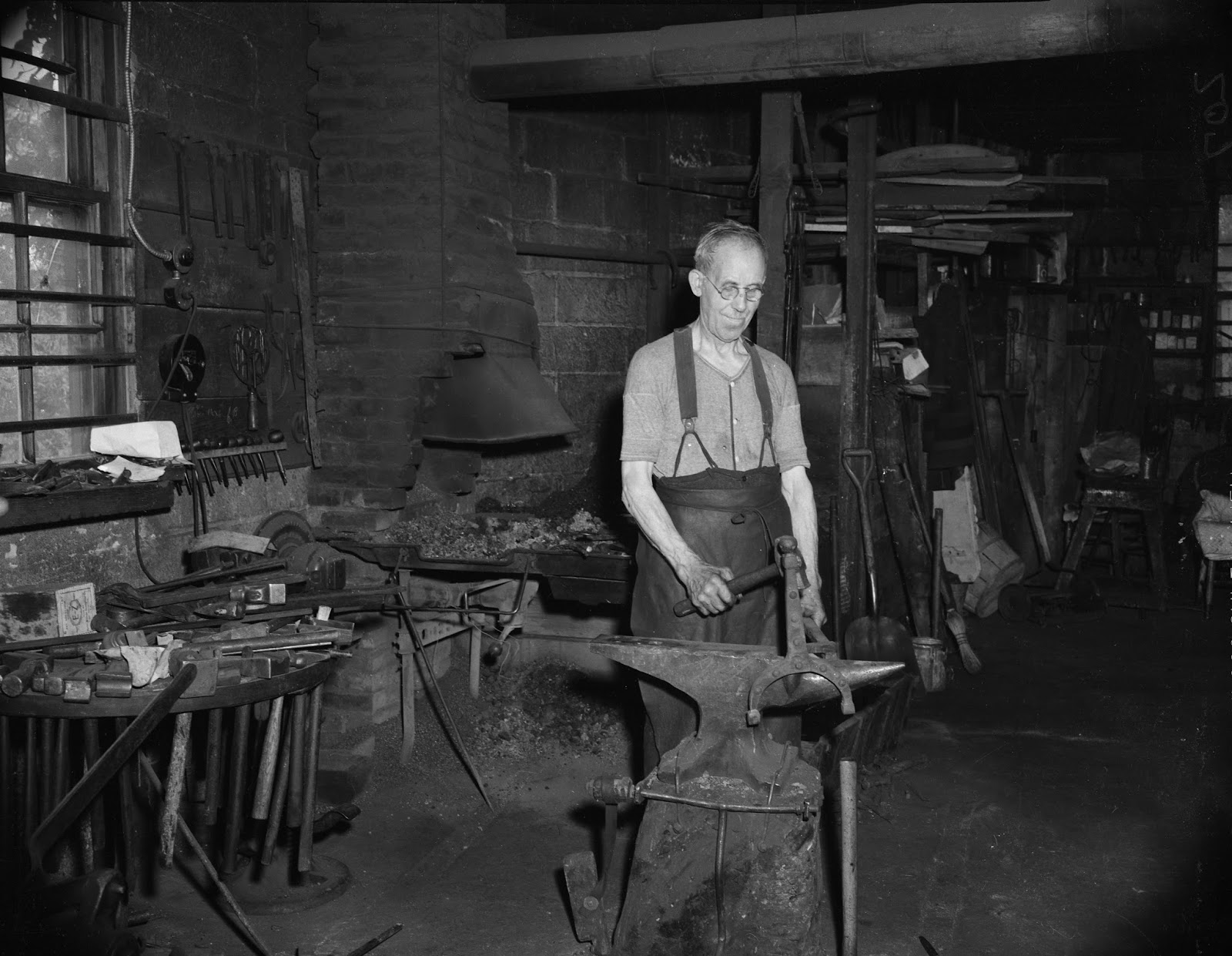
This photo from July, 1948 shows Freihofer's blacksmith making horseshoes for their delivery horses. Freihofer's ended delivery by horse and wagon in 1962


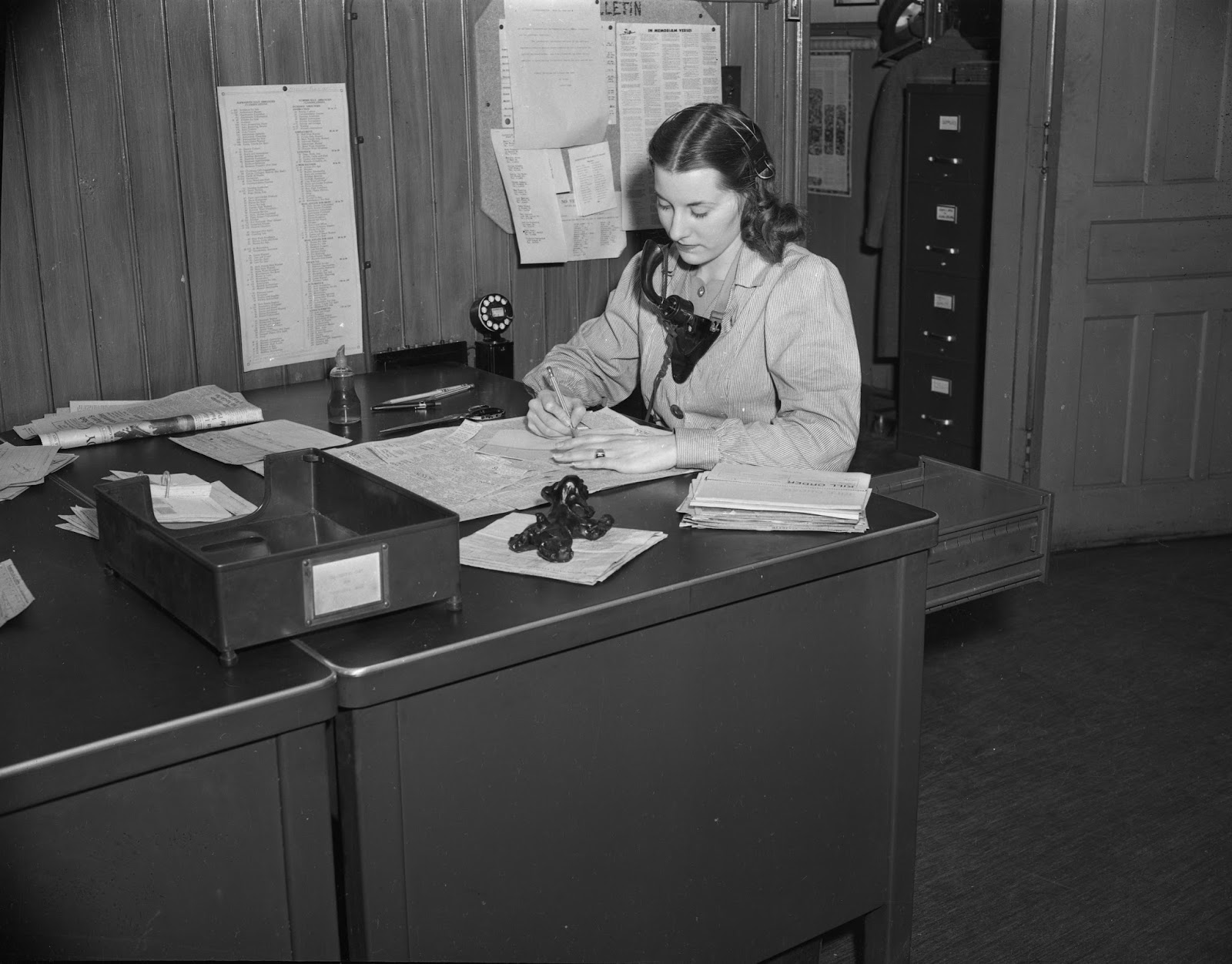
The News Negative Collection features behind the scenes photos of the Daily Gazette. In this photo, a copy reader for the Gazette is working at her desk, wearing what looks to be a hands-free Dictaphone.
Construction worker showing his patriotic spirit.
Think this young fisher by the Mohawk River caught anything? 
This rather adorable photo was taken in the old headquarters of Schenectady's fire department on State and Veeder. It was opened on July 1, 1900 and used as a fire house until the new central station on Erie boulevard was opened. After it closed as a fire station, the Schenectady Police Department used it as the headquarters for its traffic division and it became known as the traffic barn. The building was condemned in 1950 and razed in 1956.


Up to his neck in pumpkins!
The testing of a tank (Possibly an M48?) made by ALCO. This photo was most likely taken at the U.S. Army Reserve Center in Niskayuna where they had a testing ground for new tanks. Comment below, or email Mike at librarian@schenectadyhistorical.org if you know what type of tank this is.


Ever wonder what the inside of the clock tower in City Hall looks like? This photo from the 1950s shows a man repairing the clock mechanism.
This amazing night time shot taken from Broadway highlights Schenectady's industrial side. 
 
-Mike Maloney

Saturday, December 27, 2014

A Young Man's Mathematics Lessons

Pages of calculations and problem-solving in the lesson book of Daniel Toll. Image from Glen-Sanders Papers, collection on microfilm in the Grems-Doolittle Library (originals at New-York Historical Society in New York City). 


This blog entry is written by Schenectady County Historical Society trustee John Gearing.

Among the manuscript treasures of the Grems-Doolittle Library lies an oft-overlooked gem: the Glen-Sanders Papers. Members of the Glen and Sanders families resided in Scotia's eponymous mansion for over 200 years. In the mid-twentieth century the estate was broken up and the remaining Glen-Sanders papers came into the possession of the New-York Historical Society. The Schenectady County Historical Society has a copy of the papers on eighteen reels of microfilm. The collection includes correspondence and notes (the earliest of which is dated 1674), account books, maps, wills, and genealogical records.

A careful reading of such papers can help us better understand what life was like in Schenectady in earlier times. While one could be excused for assuming that eighteenth century life was far simpler and much less sophisticated than it is today, a mathematics lesson book in the Glen-Sanders papers suggests otherwise. The book bears the name of Daniel Toll and is dated 1790. The mathematics taught were practical in nature and covered topics essential to every successful merchant.

The first exercise taught young Mr. Toll how to subtract the weight of a container, the “tare,” to determine the weight its contents. For example, flour was sold at the wholesale level in barrels. This sounds simple, but some goods were sold in units of “hundredweights” (or 112 pounds) and tare was sometimes set at a percentage of the whole rather than the actual weight of the container. Conversions were often necessary. Also covered was the calculation of “Brokage,” which Toll defined as “the percentage charge levied by those called Brokers who find customers and selling them the goods of other men whether strangers or natives.” A budding merchant needed to calculate “tret” as well. Tret was the amount (typically 4 pounds per hundredweight) allowed for the wastage of goods during shipment.


Page dealing with the subjects of tare and tret in the lesson book of Daniel Toll. Image from Glen-Sanders Papers, collection on microfilm in the Grems-Doolittle Library (originals at New-York Historical Society in New York City).


Both simple and compound interest were covered in Daniel Toll's subjects. He was taught how to compute interest when the percentage was not a whole number, and how to compute either the return, the term, the principal, or the percentage when the other three factors were given. Fractions, both “vulgar” and decimal, were covered, along with multiplication.

The lessons were taught using pounds, shillings, and pence. Instead of being a decimal system like today's dollar, this system was based on multiples of twelve. Twenty pennies made one shilling, and twelve shillings made a pound. Merchants' calculations required converting pounds to shillings and pence, and vice versa. Some problems required converting everything to pence, completing the calculation in pence, and then reconverting the answer to pounds, shillings and pence.

Complex computations were taught using a sort of algorithm. For example, to determine the present value of a amount due to be paid in the future, Toll wrote:

“Answer
1. As 12 months are to the rate percent
So is the time proposed to a fourth number

2. Add that fourth number to ₤100

3. As that sum is to the fourth number
So is the given sum to the rebate

4. Subtract the rebate from the given sum
and the remainder is the present worth.”

Although this “answer” may be mystifying to modern eyes, a careful perusal of the Toll's sample problem shows that four steps above were easily translated into arithmetical calculations by students of the day.

Assuming the dates (1790 and 1793) in the lesson book are accurate, Daniel Toll would have been between 14 and 17 years old when learning the practical mathematics shown in this lesson book. The difficulty and complexity of Toll's math curriculum seems to compare favorably to that of today's students of the same age, suggesting that Schenectadians 224 years ago were not all that much different, in some respects, than we are today. Assuming that Jonathan Pearson's information is correct in his Genealogies of the Descendants of the First Settlers of Schenectady, Daniel Toll, it seems, grew up to be a physician, and not a merchant after all.

Thursday, December 4, 2014

The Mystery of the Teddy Bear

The cartoon that led to the origin of the teddy bear. 


This blog entry is written by SCHS Assistant Curator Kaitlin Morton-Bentley.

The teddy bear is one of the most beloved toys all around the world, both with children and with adults. Some teddy bears are made to be cuddled and loved, while some designer teddy bears are created to be admired from afar. This familiar object has a surprisingly contentious beginning. The name “teddy bear” comes from a story about Teddy Roosevelt on a bear hunt in 1902 and the first teddy bear was invented the same year. The details of these events, however, are still a bit mysterious.

President Roosevelt traveled to Mississippi to settle a boundary dispute with Louisiana. During a break in negotiations, he was invited to go on a special hunting expedition organized by local sportsmen on the Mississippi Delta. Roosevelt was eager to shoot a bear during the hunt but no bears could be found. The organizers of the hunt finally used their dogs to chase down a bear and tied him to a tree for the President to shoot.

All sources agree that Roosevelt refused to shoot the bear. What happened after, however, is debatable. Some sources say he refused because it was a very young bear and he did not want to take the life of a defenseless cub, and so he set the bear free.  Other sources reported that the bear was quite old, and Roosevelt did not feel the hunt was fair. He then ordered the bear killed by a knife and skinned.  Roosevelt’s decision to spare the life of a bear became famous when it was recreated in a cartoon by Clifford K. Berryman for the Washington Evening Star entitled “Drawing the Line in Mississippi.” Interestingly, early versions of the cartoon show a much larger and older bear, with later cartoons portraying the bear as younger and friendlier. It is this later version that has become famous for inspiring the birth of the teddy bear.


This teddy bear, on display in the exhibit The Teddy Bear: Celebrating the Bears in Our Lives, is modeled after the first teddy bears. Notice the long arms, pointed  nose, stooped back, and short fur. Early teddy bears had movable heads and limbs. Teddy bears today tend to have rounder faces, shorter unjointed limbs, and softer fur. 


Soon after the publication of the cartoon, stuffed toy bears called “Teddy’s Bears” began appearing in stores. The creation of the first teddy bear, however, is questionable. Inventors from both the United States and Germany claim to have originated the teddy bear at the same time.

In the United States, Morris Michtom and his wife Rose owned a small candy store in Brooklyn.  Inspired by Berryman’s cartoon of Roosevelt and the bear, Rose made a toy bear out of brown plush and stuffing with movable arms and legs. She placed the bear in the store window next to a copy of the cartoon and called the bear “Teddy’s Bear.” The bear quickly sold, and soon they had orders for a dozen more.  From this success Morris and Rose formed the Ideal Novelty and Toy Company in 1907, a toy company that lives on today as part of Mattel.

Across the Atlantic in Giengen, Germany, Margarete Steiff had been making and selling stuffed animals for decades before she created her first teddy bear in 1902. Confined to a wheelchair at a young age by polio, she had become an accomplished seamstress and by 1880 established her own company that sold felt elephants, monkeys, horses, camels, pigs, mice, cats, and dogs.  After observing brown bears in the Zoological Gardens in Stuttgart, her eldest nephew, Richard Steiff, suggested that she try making a toy bear with movable head and limbs. Margarete was skeptical at first, but when an American toy buyer from George Borgfeldt & Co. ordered 3,000 bears at the 1903 Leipzig Toy Fair, she was convinced of the potential of the stuffed bear.  The Margarete Steiff brand quickly grew into an international leader in teddy bear production that continues to produce a vast array of teddy bears and other stuffed animals for children and collectors alike. The Steiff Company maintains today that they created the teddy bear first.

In spite of the mysterious details surrounding Roosevelt’s bear hunt and the origins of the stuffed bear, the teddy bear only continues to gain in popularity worldwide. For play, comfort, or collecting, the teddy bear is like no other.

You can learn more about teddy bears and see some special bears on display by visiting our exhibit, The Teddy Bear: Celebrating the Bears in Our Lives. The exhibit is on display during the Festival of Trees through December 14, 2014. Admission to the Festival of Trees is $5.00 for adults and $2.00 for children ages 5-12. Children under 5 years of age are admitted free. For more information about the exhibit, or about the Festival of Trees, please contact Assistant Curator Kaitlin Morton-Bentley or call 518-374-0263, option 4.


Image from last year's Festival of Trees. The Festival is held annually as a joint fundraiser for the Schenectady County Historical Society and the YWCA of Northeastern New York.  

Thursday, November 13, 2014

Man's Best Friend: Dogs in the Collections of the Grems-Doolittle Library

Dorothea Godfrey of Schenectady and her canine friend Zev enjoy some outdoor reading in this photograph, taken in the early 1930s. Image from Godfrey Family Collection.


Dogs have been reliable workers and companions for humans for many thousands of years. In Schenectady County, as is the case around the world, humans have loved and shared their lives with canine friends throughout history. Dogs pop up in city, suburb, and rural scenes in Schenectady County, and are found especially frequently among family photographs and with children.

Enjoy these images of dogs found in our library's collections. Interested in learning more? Visit our Library or contact our Librarian.


An unidentified dog noses around the Duane Mansion in Duanesburg in this undated photo. Image from Larry Hart Collection. 


A young Katharine Furman poses with the family dog in this photograph taken at a Schenectady studio in the 1880s. Image from Godfrey Family Collection.


A curious neighborhood dog follows a Schenectady mailman on his route, circa 1950. Image from Larry Hart Collection. 


Bonnie and Alan Hart, the children of local historian Larry Hart, cuddle at home with their new puppy in 1951. Larry Hart's notes on the back of the photograph read, "Corky's first day at home ... he was 4 weeks and a day old at the time." Image from Larry Hart Collection. 

A dog comes along for a ride with owner Lucas W. Devenpeck and an unidentified driver. Image from Devenpeck photograph file, Grems-Doolittle Library Photograph Collection. 

At the 1949 cornerstone-laying ceremony for the Schenectady Animal Protective Foundation's new animal shelter on Maple Avenue in Glenville, a local dog was honored with a special role. The homeless dog was found the day before the ceremony on Rosendale Road, and was enlisted to help lay the cornerstone of the new shelter that would house animals like him on their way to finding new homes. The humans in the photo are, left to right: Alfred Nicholaus, life member of the Animal Protective Foundation (APF); Harry R. Summerhayes, Jr., President of the APF; Donald Wait, the humane officer of the APF who found the dog; Hazel Eddy, Vice President of APF. Image from Larry Hart Collection. 

Members of the Van Vranken family pose with their dog outside their home in West Glenville. Image from Van Vranken photograph file, Grems-Doolittle Library Photograph Collection.


Mont Pleasant High School principal George Spaine shakes hands with a dog outside of the high school in 1942. Image from Larry Hart Collection. 


Three dogs join their companions, unidentified members of the Van Horn family, for relaxation on a sunlit stoop. Image from Van Horne photograph file, Grems-Doolittle Library Photograph Collection.

Thursday, October 30, 2014

Girls Just Want to Have Fun

Girls from Schenectady High School laugh with delight after riding the Shoot-the-Chute at Rexford Park during a senior class trip to the amusement park in 1908. Image from Larry Hart Collection. 


The invention of the Kodak Brownie camera in 1900 revolutionized photography. Its low cost and the ease of using the camera not only made photography more accessible to everyone, including young people; it also led to the creation of the snapshot. From the Brownie era to the iPhone era, young people have enjoyed casually snapping photos of themselves and their friends, and sharing them with each other.

A number of photographs of Schenectady County girls and young ladies, simply having fun, are presented here. Enjoy them!

Interested in exploring the Schenectady County's past through photographs? Visit our Library or contact our Librarian.


Two teenage girls dress up in 1890s-era clothing and pose as a "Gay Nineties" bicycling gentleman and lady in this 1939 photo. Image from Grems-Doolittle Library Photograph Collection. 


Girls play basketball in gym glass at Van Corlaer Junior High School in this 1956 photo. Image from Grems-Doolittle Library Photograph Collection. 


Nott Terrace High School cheerleaders huddle up for this 1949 photo snapped in a school corridor. Image from Grems-Doolittle Library Photograph Collection.


A group of Schenectady High School girls pose at a trolley stop in this photo, ca. 1910. Image from Grems-Doolittle Library Photograph Collection.


Girls enjoy a lunchtime chat by their lockers at Mont Pleasant High School in this 1942 photograph. Image from Larry Hart Collection.


Margaret Hoffman laughs as Kathleen McElroy fits her into the Cinderella slipper at the 1948 Nott Terrace High School Junior Prom. Image from Grems-Doolittle Library Photograph Collection.

Friday, August 29, 2014

School Days from Schenectady County's Past


Students at their desks in a classroom at Elmer Avenue School in Schenectady, ca. 1910. Image from Grems-Doolittle Library Photograph Collection. 


For many people in the United States, Labor Day is the unofficial end of summer. For kids and teenagers in Schenectady County, school starts within a day or two after the holiday. In celebration of the return of school days (coming right around the corner!), we're highlighting images of school days from Schenectady County's past.

Interested in learning more about Schenectady County's past in photographs? Visit our Library or contact our Librarian.


Students congregate around Bigsbee School in Rotterdam in this 1953 photo. Image from Grems-Doolittle Library Photograph Collection. 


Students slated to graduate from the Union Classical Institute, a Schenectady high school, pose elegantly in this 1878 photograph. Image from Grems-Doolittle Library Photograph Collection. 


Students at Mohawk School in Scotia participate in a school play in this photograph from the 1950s. Image from Larry Hart Collection. 


Teacher Delta Relyea and her pupils pose outside of the Glenville District #7 schoolhouse at the corner of Swaggertown Road and Spring Road in this photo ca. 1910. Image from Grems-Doolittle Library Photograph Collection. 


Children line up to enjoy the slide at the Edison School in Schenectady in this undated photo. image from Larry Hart Collection. 


The 1911 Schenectady High School girls' basketball team poses for their yearbook photo. Image from Grems-Doolittle Library Photograph Collection. 


This 1954 photo shows the A.M. Kindergarten class at Van Corlaer Elementary School in Schenectady. Image from Grems-Doolittle Library Photograph Collection. 


Students from grades 5, 6, and 7 at the Zion Lutheran Church private school in Schenectady pose with an instructor outside their school building in this 1917 photograph. Image from Grems-Doolittle Library Photograph Collection.