Showing posts with label The Stockade District. Show all posts

Wednesday, July 13, 2022

William Van Bergen Van Dyck

William Van Bergen Van Dyck, age 100. Photo from the Van Dyck Personal Papers, Grems Doolittle Library.


This post was written by library volunteer Gail Denisoff.

Growing up in New Jersey, Billy attended a private school affiliated with Rutgers College. His father, Francis, was an analytical chemistry and physics professor at Rutgers, and was frequently asked to consult on projects by his friend and neighbor, Thomas Edison. As a boy, Billy often accompanied his father to Edison’s laboratory and later remembered being present at an early demonstration of the phonograph. An autographed photo that Edison presented to Billy as a birthday gift was one of his lifelong prized possessions.
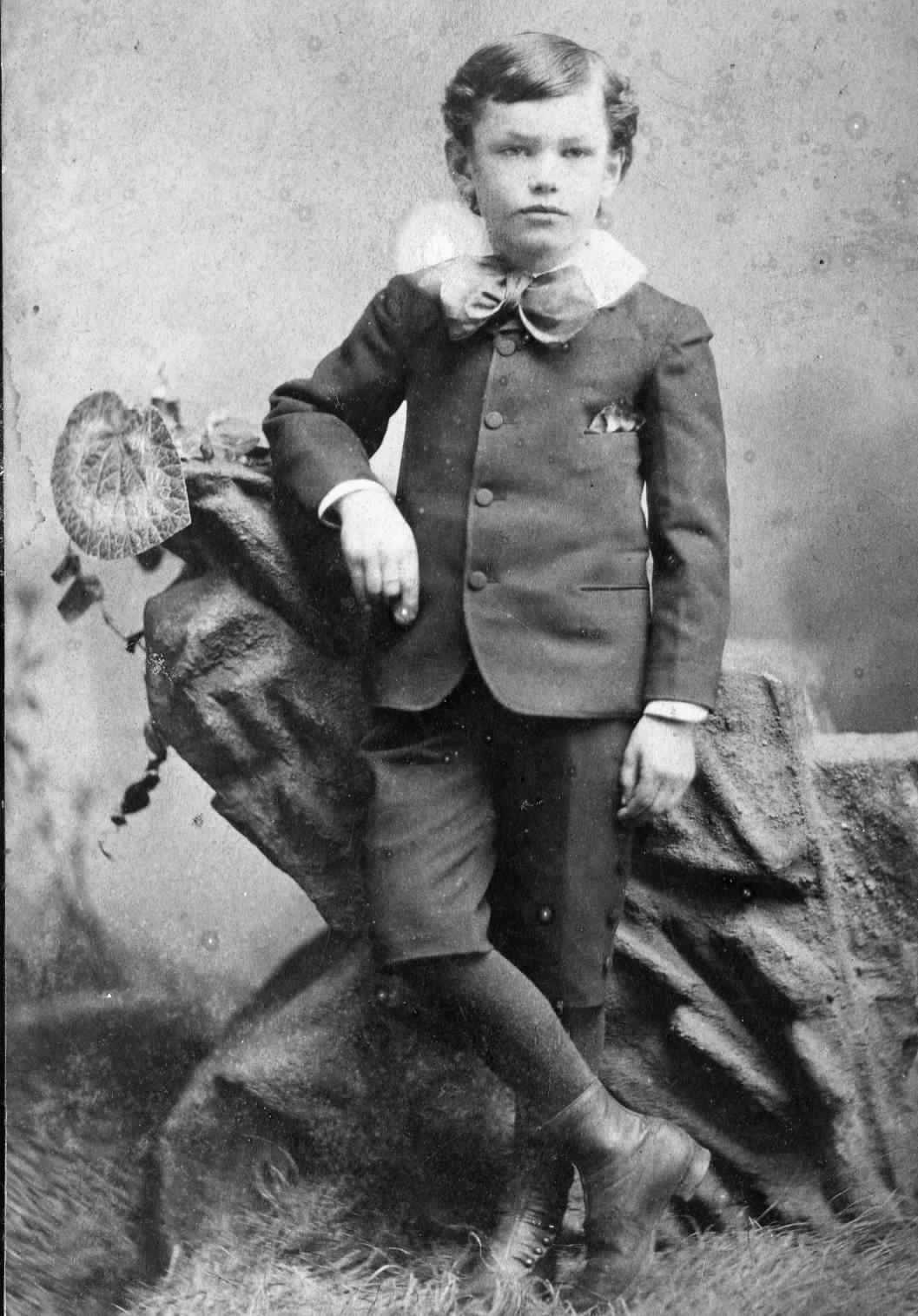
Billy circa 1880. Photo from the Van Dyck Personal Papers, Grems Doolittle Library.
 

After high school, Billy went on to Rutgers, graduating in 1896 with BS in prismatic glass and light reflection. In 1897 he graduated from Columbia with a degree in electrical engineering and then received an MS from Rutgers in 1898. While in college, he was captain of the varsity football team, played second base on the varsity baseball team, was a standout in the 100 yard dash, sang with the glee club, and was a member of Delta Phi, Phi Beta Kappa and Tau Beta Pi.

His first job out of college was with the American Luxfer Prism Company in Chicago where he was in charge of the research laboratory for a year. He then became a sales engineer for the company in Pittsburgh and New York. By 1899 he was back at Rutgers teaching math and electrical engineering. Two years later, he married Frances “Fanny” Johnson, a stage actress, and decided that two couldn’t live on what he made as an instructor so took an engineering and manufacturing position in North Carolina. 

In 1906, his international career began with a new position as an engineer in Santiago, Chile with the W. R. Grace Company, agents of General Electric. His next move was to Brazil in 1911 as a representative of General Electric of New York. He stayed in that position until 1914 when he was appointed Managing Director of Cia General Electric do Brazil. In 1918, he was named President of General Electric South America, a Brazilian corporation. 

Portrait of Billy taken while he was employed by GE in Brazil. Photo from the Van Dyck Personal Papers, Grems Doolittle Library.
  

During the time he lived and worked in South America, he took on several interesting projects. One of the first was in 1908 when he was still living in Chile. He purchased four electric automobiles, intending to sell them for a profit. He kept one for his own use and sold one to the Ambassador of England, but quickly found that there was no market for the other two. Realizing the cars would depreciate the longer he held on to them, he decided to trade them for a warehouse full of wine. He reasoned the wine might increase in value – and if he couldn’t sell it, he could always drink it.

Billy was proud of his attempt to light the Straits of Magellan. Located in Chile, near the tip of South America, it was a treacherous but essential waterway before the Panama Canal was built. One stretch close to the Pacific was particularly dangerous with high cliffs, a 40 knot current and 40 foot tides. His workers installed a light on a long flexible chain anchored to the bottom. Although successful for a time, the current and tides tangled the chain and the light eventually sank to the bottom. That was the first and only attempt to light the Straights.

Another interesting project was to provide light for the 1923 Brazilian Exposition. Billy was instrumental in achieving locally produced light bulbs. Prior to 1923, parts were made elsewhere and assembled in Brazil. Under his leadership, glass bulbs began to be manufactured in Brazil and other components soon followed. Because of this, he was able to obtain the contract for the design and installation of lighting for the exposition using crystal prisms and electric lights that reflected the light in a spectacular manner. The setup was a huge success.

Billy liked to tell the story of a Brazilian cowboy who rode a horse to his office and dropped $60,000 in cash on his desk for an electrical installation at his remote ranch. When Billy questioned whether he felt uneasy leaving that amount of cash with him the cowboy replied, “Not at all, SeƱor, after all, I can trust the General Electric Company!”      

While in Brazil, Billy was a founder and director of the American Chamber of Commerce of Brazil, President of the Rio de Janeiro chapter of the American Red Cross, a founder of the Rio de Janeiro Country Club, was the catcher for the American Rio baseball team well into his 40’s, and a director and president of the American Society of Rio de Janeiro. Sadly, Billy’s wife Frances died in 1922. She lived with Billy in Brazil but returned to the United States before her death. Billy also returned to the U.S. on several occasions. One was to attend the 75th birthday party of his old friend and neighbor, Thomas Edison. 

Billy traveled on the SS Western World in 1923 from New York to Buenos Aires. Image from

Pacific Marine Review, v. 19, August 1922, p. 469, archive.org.

Billy was on board the steamship SS Western World out of New York bound for Buenos Aires in May of 1923 when a telegraphed chess challenge was received from the SS American Legion that had just left Argentina. Three players from each ship participated in what would be the first chess game by wireless. Billy was captain of his team and fifteen moves were made the first night until communications were lost. The match continued the following night as reception was almost non-existent during the day. After four nights and thirty-five moves, each team declared victory when radio reception did not allow them to continue. Not minding that no winner was determined, Billy considered the match great fun and a unique experience.  

 Billy held the position of President of General Electric South America until 1926 when he returned to the United States and in June 1927 became the Manager of the Schenectady office of the International General Electric Company, a title he held until March of 1937 when he became Assistant to the President of IGE. On Valentine’s Day of 1931 Billy married his second wife, Schenectady native Elvira Haight, who had a daughter from a previous marriage.

One of the highlights of his tenure in Schenectady was bringing the King of Siam to meet with General Electric scientists as a guest of IGE. King Prajadhipok, who at that time was one of only two absolute monarchs in the world, was traveling incognito using the alias Prince Sukhodaya. On July 9, 1931, Billy traveled to New York City and joined the King’s party on a private railroad car. When they arrived in Rensselaer the car was disconnected from the train and a special locomotive was attached which brought the group directly to the General Electric plant. A telegraph sent to Billy the next day from the King’s secretary thanked him for the enjoyable day and asked if he could locate and return a vest the King left on the train.

International General Electric hosted many other guests from around the world including the Counsel General of Ecuador and Count Folke Bernadotte, the nephew of King Gustuv of Sweden. The Count sent Billy a letter thanking him for the day he spent in Schenectady meeting with a group of scientist that included Dr. Ernst F. Alexanderson. 

Billy traveled to South America on several occasions while he worked for IGE. On June 10, 1939 he was awarded the “National Order of the Southern Cross,” the highest decoration given by the Brazilian government to a private foreign citizen. The citation noted the award was given for his “distinguished service in the promotion of international good will between the United States and Brazil.”

Billy was very active in community affairs in Schenectady. He was a member of the Schenectady Chamber of Commerce, Rotary Club, YMCA of Schenectady, Chairman of the Schenectady Community and War Chest during World War II, and President of the Capital District branch of the Holland Club of America. He was also active in the Mohawk Club and the Mohawk Golf Club.

When Billy retired at age of 70 on December 31, 1945, after 34 years with GE, he didn’t slow down. He and Elvira traveled the world collecting art objects that they displayed in their home at 21 Washington Avenue. He was a founding member and Trustee of the Community State Bank for over 35 years, and was never late or missed a meeting, even when he was over 100 years old. At 104 he attended his 85th Rutgers reunion where he was honored as the oldest alumni and last living member of the class of 1895.

Billy at his 85th Rutgers reunion, the last surviving member of his class. Photo from the Van Dyck Personal Papers, Grems Doolittle Library.

Billy never had children but after his wife, Elvira, died in 1974 his niece, Florence Bucher came to live with him as his companion. He walked his dogs, first Firecracker and later Cracker Jack, around the Stockade neighborhood daily, often stopping by Arthur’s Market. He went to the Mohawk Club every day to visit with friends and play backgammon, chess, and cards. At 103, Billy’s started receiving nursing care in his home, but his mind stayed sharp. He said he had a cousin who lived to be 108 and wanted to beat that family record. Unfortunately, Billy passed away on March 18, 1981, at the age of 105, three years short of his goal. After local services at St. George’s Church, he was buried with his Dutch ancestors at Riverside Cemetery in Coxsackie.

During his long life, Billy lived through the administrations of 24 presidents from Ulysses S. Grant to Ronald Reagan. On his 100th birthday, Mayor Frank Duci awarded him the distinction of Patroon, Schenectady’s highest honor. A modest man, he said, at the age of 104, that he never did anything special -- “The only thing I ever did was get old!”


References:

Bishop, John Keith, “Stockade Spy Honors a Favorite Citizen”, The Stockade Spy, May 1974.

“GE’s Third Oldest Pensioner Holds His Own at Milestone Age of 100”, Schenectady GE News, March 12, 1976.

Hart, Larry, “Chess Foes Vie Across Ocean”, Daily Gazette, 1973.

Hayden, Barbara, “100 years young”, Knickerbocker News, Sept. 8, 1975.

Ryan, Buttons, “Former Coxsackian, at 102, Remembers Village History”, Greene County News, January 26, 1978.

Shapiro, Ricki, “104 Year Old Tells Tale of Travel, Achievement”, Daily Gazette, 1980.

“van Dyck: a little Dutch college”, Rutgers Alumni Association News, Winter 1979.

“W.V.B. Van Dyck: GE Brazil’s ‘Grand Old Man’”, General Electric News Worldwide, September 1974.

Van Dyck Personal Papers, Grems-Doolittle Library (2006.009)

Wednesday, March 25, 2020

Elizabeth Gillette, Schenectady's First Woman Surgeon

This blog was written by Grems Doolittle Library volunteer Gail Denisoff.

Even as a child, Bessie Gillette didn’t conform to the norm. When other girls were making clothes for their dolls, she was making furniture. While their dolls were the mother or daughter of the dollhouse, Bessie’s was a doctor. When they played girls' games, she ran a drugstore from the family woodshed using tapioca from the kitchen as pills and colored water as potions. This wasn’t surprising considering almost all of her mother’s family were doctors and surgeons. They were also men.

Born in Granby, Connecticut on October 21, 1874, Elizabeth “Bessie” Van Rensselaer Gillette was the daughter of Albert Henry Gillette, a carpenter, and Mary Pinney Jewett Gillette. Her mother’s family were early settlers in Ipswich, Massachusetts, and her father’s family stretched back to the settlers of Gramby and Simsbury, Connecticut. Her family boasts several well-known ancestors, including Mayflower passenger Thomas Rogers and Governor Jonathan Trumbull of Connecticut.  Her middle name comes from her mother’s uncle, Van Rensselaer Pinney, who died at the beginning of the Civil War. She had two older sisters, Angie Emma, who was born in 1869, and Lura Mary, who died two days after her birth in 1872.

In 1882, when Bessie was eight years old, a typhoid epidemic swept through their town. Bessie, her sister, and several cousins were victims. Bessie was sick for months, but her sister Angie and some cousins did not survive. After her recovery, she was a nervous and weak child. To build up strength, she spent much of her time outdoors riding horses, skating, climbing trees, and participating in sports.

After attending local district schools, Bessie was sent to a boarding school in Simsbury at the age of ten, and three years later to the Misses Booth Private School in Hartford. After graduation she attended Woodside College for Girls in Hartford. As a young woman with a mind of her own, Elizabeth wanted to follow in the footsteps of family members and become a physician. Her family and friends advised against it, thinking she was too delicate. She persisted and entered the New York Medical College and Hospital for Women in 1894. She graduated in 1898, losing only 3 days during that time to illness.

Elizabeth Gillette, circa 1890s. Photo from Gillette Family Photo File, Grems-Doolittle Library Photo Collection.
Now Dr. Gillette, she interned at Women’s Hospital in New York City, receiving her medical license in 1899. She continued working there as a staff physician and also worked in several of the city’s clinics. Additionally, she volunteered time in Mission Schools where she even taught stenography, keeping two lessons ahead of her students.

In 1900, at the age of 25, Elizabeth moved to Schenectady where she had an uncle, watchmaker and jeweler Charles Bickelmann. She opened a private practice on June 1st of that year in a home she purchased at 254 (now 252) Union Street, at the corner of College Street. Although not the first female physician in Schenectady (that distinction goes to Dr. Janet Murray who opened a practice on Jay Street in 1893), Elizabeth was the first licensed female surgeon in Schenectady County. While quite unusual for the time, she was warmly welcomed by her male counterparts and later invited to join the Medical Society of Schenectady County.
Dr. Gillette's house at 252 Union Street. Photo by G. Denisoff, 2020.


Elizabeth was a familiar figure around Schenectady. She often made house calls, first by horse and carriage and soon after by automobile. In 1904, she bought a 14 horse power Maxwell and was often asked by local car dealers to be photographed in her car to inspire other women to purchase one.


Dr. Gillette in her 1904 Maxwell. Photo from the Gillette Family Photo File, Grems-Doolittle Library Photo Collection.

After encountering several cases of cruelty to children in her practice, Elizabeth worked tirelessly to create a Humane Society in Schenectady which later included a home and shelter. In addition to being a founder, she also served as secretary of the society for many years. During World War I, she became involved in home front efforts and taught first aid classes and home care to soldiers’ families.

Elizabeth continued to study medicine all her life to keep up to date on new methods and procedures, especially in surgery, bacteriology and general medicine. She became a certified examiner for mental illnesses and a member of the surgical group of Ellis Hospital. Upon her 50th year of practice, she was honored by the Schenectady Medical Society for her meritorious service.


Dr. Gillette in her office, circa 1950. Photo published in the Daily Gazette.
With several lawmaker ancestors, it was no surprise that Elizabeth had a keen interested in politics. In 1919, a year before women obtained the vote, she was encouraged by Mayor George Lunn to run as a Democrat for the New York State Assembly from Schenectady District 2 and won by only 247 votes, becoming the first woman in upstate New York to be elected to the legislature and the last Democrat from Schenectady County to win until 1964. Her focus was on healthcare, regulation of drugs and mandating physicals for children working in factories. She also worked on local projects such as the construction of a well and pumping station to increase water supply and for funding to continue bridge and canal construction in her district all while maintaining her practice. At that time, terms lasted only one year and in 1920 she was defeated by Republican William Campbell who later became Mayor of Schenectady. She always encouraged women to become involved in politics, and in 1957, advised, “Vote in every election, go to every political meeting possible, learn all you can about political affairs – and always be a lady.”


Dr. Gillette, Legislative Portrait. Photo from New York Red Book, 1920.
She shared her large home with several boarders over the years. Around 1910 her parents came to live with her until their deaths in the 1920s. She was also interested in travel and in the 1930s took several prolonged ocean voyages. In 1931 she sailed to England and France, in 1933 from New York to Los Angeles through the Panama Canal and to Italy in 1935.

Elizabeth Gillette practiced medicine in Schenectady for six decades and was once nominated for the New York State “Doctor of the Year” award. By the mid 1950s she had slowed down a bit but still described herself as “one of those hard-core Connecticut Yankees.” She stopped making night calls and delivering babies, but declared, “I’m not in the operating room much anymore but I still set broken bones, something I love to do,” and planned to keep working “as long as my body will let me, I want to die in harness.”


Elizabeth Gillette and Agnes Haren. Photo from the Grems-Doolittle Library Photo Collection.

Dr. Gillette retired in 1959 at the age of 85, but stayed involved with civic organizations including the Schenectady Humane Society, the Schenectady Historical Society (a life member), and as life member and vice president of the local chapter of the Daughters of the American Revolution.

Dr. Elizabeth Van Rensselaer Gillette died at the age of 90 on June 26th, 1965, in her home. She never married and was survived by several cousins and her longtime live-in housekeeper and friend Agnes Haren. After private services locally, she was buried in her family plot at Granby Cemetery in her birthplace of Granby, Connecticut.

Elizabeth Gillette's gravestone. Photo by M. Cooley, 2015. Posted on FindAGrave.com.

She has been honored posthumously over the years for her contributions to the medical field. In 2000, Dr. Gillette was a recipient of the Capital Region Chamber of Commerce Women of Excellence Award. She earned recognition in 2017 as an inductee to the New York Historic Women of Distinction list by the New York State Senate.

Elizabeth’s Union Street home changed hands several times over the years, eventually falling into disrepair. Efforts were undertaken in the early 2000s by Schenectady County to restore it. The home is unique because it is one of the only Italianate style homes in the Stockade and serves as a gateway to the historic district. The exterior now looks similar to when she lived there and it still carries on a medical tradition with a woman chiropractor practicing on the first floor.

Sources:
"Biography of Elizabeth Van R. Gillette," The Medical Society of the County of Schenectady Capital Region Scrapbook: Pioneers in Medicine, Daily Gazette, by Jeff Wilkin, 7/13/2009
"Dr. Elizabeth Van Rensselaer “Bessie” Gillette," Find a Grave database and images
"Dr. Elizabeth Gillette," Schenectady Daily Gazette Obituary, June 28, 1965 
New York Red Book, An Illustrated State Manual, 1920
New York State Census 1905, 1915, 1925.
Schenectady County buys Gillette House, Spotlight News, by Jessica Harding, 9/14/2009.
United States Federal Census, 1880, 1900, 1910, 1920, 1930, 1940.
Women of Distinction, NYS Senate, 2017 Historical Inductees Honoring Women’s History Month

Sunday, November 17, 2019

200th Anniversary of The Great Fire of 1819

This post was written by library volunteer Gail Denisoff

November 17, 2019 marks a rather grim anniversary for Schenectady. Two hundred years ago on that day was the Great Fire of 1819, one of the most destructive events in the history of the city. The fire started around 4AM in the currying shop (tannery) of Isaac Haight on the corner of Water and Railroad Streets. A fierce southeast wind fueled the fire and soon the entire block was engulfed. As the wind blew throughout the day, the fire raged, jumping from one street to another, eventually burning the west end of the city between State Street and the Mohawk Bridge including most of Union, Church, Washington, and Front Streets. The bridge also caught fire, but firefighting efforts eventually saved it.

In all, 169 buildings burned, 150 families, many poor people lost their homes, and most of the city business district was destroyed. Damages exceeded $150,000 ($2.7 million today). More details about this fire can be found in a previous post: "The Most Destructive We Have Ever Witnessed": Schenectady's Great Fire of 1819.

At the time of the fire, firefighting techniques were quite primitive in the city. Schenectady had two fire engines and both were unserviceable.  Each residence was required to possess a leather fire bucket.  When a fire broke out and the signal sounded, the buckets were expected to be put out by the front door and fire fighters would run down the streets collecting buckets and form a bucket brigade from nearby wells or the river. The sheer force of the Fire of 1819, the strong winds and overwhelming size of the fire made this nearly impossible and firefighters focused on saving the bridge. Neighbors and Union College students helped people to save what they could from their homes. Miraculously, no lives were lost, but “many persons were much injured and bruised” according to an article in The Cabinet, a Schenectady newspaper from that time.

The cause of the fire was unknown. For lack of a better reason, it was commonly attributed to spontaneous combustion. According to The Cabinet, building ruins and cellars continued to smolder for days after. The proprietor of the Albany Gazette visited the site and reported: 

“The ruins present a most melancholy and awful scene of ruin and desolation; and the personal distress of many of the sufferers is great beyond description – widows and orphan children and many others, who were in the possession of respectable property, and in the enjoyment of most of the conveniences of life, are reduced to wretchedness, to penury and want, and their forlorn situation at the present season makes an irresistible appeal to the sympathy, the benevolence, and charity of their fellow citizens.” 

Another observer wrote in a local guidebook that “Schenectady was desolate, stripped of its livelihood and resources. Wharves were deserted, warehouses boarded up, transportation stalled and morale evaporated.”

Fellow citizens of Schenectady and surrounding areas stepped up to aid those suffering from their losses. The Cabinet reported that no more than seven buildings were insured. No insurance companies represented Schenectady and few people could afford to purchase coverage from Albany agencies. One shop was reported to have insured their inventory but not their building. As a result, most everyone affected needed assistance of some sort.

People from surrounding towns, especially Glenville, poured into the city bringing provisions to the fire victims. Loads of lumber came in to help build temporary residences. The Niskayuna Shaker community did as much as possible to aid the many poor who lost everything. Jeremiah Fuller dispensed freely from his large storehouse of grain for horses and livestock.

More formal assistance was soon needed and a meeting of citizens was held headed by David Tomlinson and Joseph C. Yates to solicit donations to aid the victims. The Common Council of Schenectady met numerous times in the aftermath. The minutes from these meetings detail forming committees to address the myriad of issues caused by the fire. A committee was formed to draw up a plan for the collection and distribution of funds for the relief of the suffering. The clerk of the board was asked to notify the Mayors of Albany and Troy that committees would be appointed to make collections in those cities.

Another committee was recommended "whose duty it shall be to ascertain the relative losses and wants of all the individuals who have suffered by the late fire and also to receive and distribute among the sufferers in proportion to their losses and their wants all monies and other contributions that may be received." Despite some victims expecting funds to be evenly distributed, assurance was given the public that they would be used to support the poor during the winter. The council adopted a resolution because "an erroneous impression had been received by the public that the collections made for the sufferers by the late fire in this City are to be distributed among them generally without any regard to their wants.” Another committee was assigned the job of procuring temporary accommodations for sufferers from the fire who had no other place to go and still another committee was named to ascertain the number of buildings destroyed.

A report of the fire along with a call for donations from the Mayor and alderman of the city was published in the Albany Gazette on November 25, 1819 and other newspapers around the state:

"... thus in a few hours, forty nine dwelling house, many inhabited by two and three families and seventy five stores and other buildings of consequence have been utterly destroyed, and their miserable inhabitants, with the commencement of a long and dreary winter turned into in the streets without shelter, and in many instances without furniture, without clothing and without bread, or the methods of procuring either, for such was the rapidity with which the flames spread, that a remnant only of movable articles could be removed  and much even of that remnant was again overtaken and afterwards consumed by the devouring element.  Under these circumstances the doors of those citizens whose dwellings were mercifully spared, have been flung open to the suffered, and subscriptions are raising throughout the city for their relief.  But no effort within the reach of that portion of the inhabitants, who have escaped the common calamity, can meet the exigencies of the case.  The local authors are therefore constrained by the sight of miseries too extensive for them to relive, to tell to other cities the tale of woe, and solicit their cooperation. To this end they have appointed the Rev Dr. Andrew Yates, Abraham Van Eps, and Nicholas F. Beck Esqs. as their agents to represent the necessities of the sufferers in this place, and to solicit, and gratefully to receive any benefactions that the charitable in your city may be disposed to bestow.”

Donations came from as far away as New York City. The Park Theater performed a play on the night of November 24 as a fundraiser and several influential business leaders held a meeting to aid the “poor and distressed inhabitants of the city of Schenectady, who have suffered by the fire, which has lately destroyed a great portion of that city.” In a letter dated December 24, Henry Yates Jr., Mayor of Schenectady, wrote to Henry Rutgers, one of the organizers of the fundraiser thanking him for the donation of $3,764 (over $62,000 in today's dollars) collected by the citizens of New York City.

In addition to trying to assist the victims of the fire, the Common Council also addressed the urgency to reorganize the city's fire fighting service as well as provide desperately needed equipment for the fire companies. Minutes from a special meeting held the day of the fire report the Council authorized the employment of 16 watchmen at a fee of one dollar each to watch for fires in the western portion of the city between the hours of 6 PM to 7 AM. They also authorized repairs to the existing hooks and ladders. At a meeting held on December 4th, a committee was appointed to "digest a plan of a new organization of firemen" and on December 8th another committee was named to ascertain the expense of buying a forcing pump or engine. At a meeting on December 11 this committee reported the acquisition of a forcing pump was practical and a new committee was named to select suitable persons to form hook and ladder and axe companies. On December 18 a number of appointments to the fire companies were made and additional appointments were made at a meeting on January 1, 1820. On January 22 the committee authorized to inquire into the cost of a forcing pump was empowered to buy one costing not more than $560 exclusive of hose and carriage "to be made after the model of the engine in Albany". On July 1 the Council adopted a resolution that all the fire engines should not leave the city at the same time without authorization.

Schenectady struggled to rebuild after the fire. With the completion of the Erie Canal by 1825 the business district moved several blocks east.  Building boomed and Schenectady soon became an important manufacturing, transportation and trade center.

Sources:
The Albany Gazette, November 25, 1819
The Cabinet (Schenectady weekly) November 24, 1819
Volume 1, Minutes, Common Council
Fire of November 1819 File: Schenectady Fire of 1819, SCHS

Tuesday, December 20, 2016

Christmas in Schenectady

This post features a few festive photos from our collection showing Christmas over the years.

A svelte Santa was chosen for the 1970 Christmas Parade.

Santa stopped trimming his beard for the 1985 Christmas Parade

One of the floats in the 1986 parade. 

Going back a bit further to the 1949 parade which featured this large
inflatable train.

Christ Church on State Street all decked out for Christmas in 1896.
What better way to spend your Christmas than hanging
out in Vale Cemetery. 

The Salvation Army collecting toys to give out on Christmas. 

Surrounded by toys at the Schenectady County Historical Society.

Holding lanterns by the Stockade's Christmas tree.

A very Stockade Christmas at the junction of Green, Front and Ferry.

Young carolers in Schenectady's Stockade neighborhood.

Thursday, November 6, 2014

Barracks, Brewhouses, and Burial Grounds: The Jonathan Pearson Street Books


This undated hand-drawn map by Lawrence Vrooman is an example of one of the rare original documents pasted into the Street Books. The map illustrates the intersection of Front Street, Ferry Street, and Green Street in Schenectady. Image from Jonathan Pearson Street Books, Book 3, portion of Page 7, in the collections of the Grems-Doolittle Library.


The Jonathan Pearson Street Books are a wonderful resource for anyone who is interested in the history of Schenectady from the early Dutch settlement through the mid-nineteenth century, or in researching genealogy and people of Schenectady from that time period. The Street Books are also a valuable resource for people researching the history of homes in the Stockade Historic District and in or near downtown Schenectady.


This page from the Street Books includes notes from an 1816 deed and illustrates property owned at the intersection of Washington Street and Water Street south of Mill Creek. Mill Creek, which ran off of the Binnekill, was piped in the 1880s. Image from Jonathan Pearson Street Books, Book 3, Page 150a, in the collections of the Grems-Doolittle Library.


The Jonathan Pearson Street Books consist of four scrapbook volumes of notes and sketch maps regarding property ownership in Schenectady, created and compiled by nineteenth-century Schenectady historian Jonathan Pearson. Pearson was born in New Hampshire, but moved to Schenectady as a young man and attended Union College. After graduating, Pearson taught at Union and served as the college's librarian for nearly fifty years. He developed a keen interest in the history of his adopted city and became a prominent historian of Schenectady. Pearson wrote a number of works about the history of Schenectady, including Contributions for the Genealogies of the Descendants of the First Settlers of the Patent and City of Schenectady, 1662-1800 (1873), History of the Reformed Protestant Dutch Church of Schenectady (1880), and History of the Schenectady Patent in the Dutch and English Times (1883). Pearson also learned Dutch to be able to translate early records that documented the history of Schenectady and Albany.


The historical notes that Pearson makes about the history of how streets were named or referred to is a particularly interesting feature of the Street Books. The images included here is one of two pages about names once used to refer to Ferry Street, including "New Street," "Market Street," and "The street that leads directly up to the Fort Gate." Image from Jonathan Pearson Street Books, Book 3, Page 2a, in the collections of the Grems-Doolittle Library.


The Street Books focus primarily on Schenectady’s original settlement area, now defined as the Stockade Historic District; to a lesser extent, the Street Books also cover the areas east and south of the original settlement. Source records referenced in Pearson’s handwritten notes include deeds, mortgages, wills, and other documents. Some notes appear to refer to documents held in private ownership. Occasionally, Pearson includes full transcribed copies of documents in addition to his notes. He also includes notes relative to the history of particular streets and alternate names the streets may have been known by before Schenectady streets were first given official names in 1799.


The Street Books occasionally include original documents pasted in among Pearson's note, such as this broadside advertising Jay Street properties up for auction in 1871. Image from Jonathan Pearson Street Books, Book 3, Page 82, in the collections of the Grems-Doolittle Library. 


The original arrangement of the Jonathan Pearson Street Books has been maintained. Each volume contains a section dedicated to a specific street. Streets covered by the Street Books include Amanda Street (now Chapel Street), Barrett Street, Church Street, College Street, Ferry Street, Fonda Street (now the portion of Jay Street north of Union Street), Front Street, Green Street, Jay Street, Jefferson Street, Liberty Street, Maiden Lane (now Broadway), Mill Lane, North Street, Pine Street, Rotterdam Street (once a portion of Washington Avenue south of State Street), State Street, Union Street, Washington Street (now Avenue), and Water Street (now the closed portion of street between Washington Avenue and South Church Street that runs just south of present-day Liberty Park).


This page from the Street Books includes Pearson's notes from the will of Harmanus Peek and a sketch map based on information from the will. Image from Jonathan Pearson Street Books, Book 3, Page 72b, in the collections of the Grems-Doolittle Library.


The physical volumes of the Jonathan Pearson Street Books are very fragile, as they are often composed of very thin paper pasted in layers on acidic scrapbook paper. To minimize damage to the original volumes, volunteers in the Grems-Doolittle Library have created high-quality digital scans of each page of the Street Books for general access.


Although small sketch maps are usually included at the bottom of a page of notes, some of Pearson's sketch maps are more elaborate, such as this piece of a map showing property ownership near the intersection of Liberty Street and College Street. Pearson also indicates how the construction of the Erie Canal transformed the interection. Image from Jonathan Pearson Street Books, Book 4, portion of Page 84, in the collections of the Grems-Doolittle Library.


Volunteers also indexed all instances of names of people, street names, landmarks, waterways, and other features found in the Street Books. The index to the Street Books makes it possible to quickly and easily find references to a variety of pieces of information. Genealogy researchers can locate where their ancestors owned property in Schenectady. Researchers of military history and fortification in Schenectady can quickly find references to forts, garrisons, palisades, and blockhouses. Researchers interested in occupations and industry can easily find references to mills, taverns, breweries, blacksmiths, hotels, restaurants, and tanneries. Those interested in transportation can find information related to bridges, ferries, railroads, and the Erie Canal. There are myriad possible research uses of this information-rich resource.

Some images from the Jonathan Pearson Street Books are included here. Researchers can gain full access to the scanned images of the Jonathan Pearson Street Books by visiting our Library or contacting our Librarian. A master index and guide to the Jonathan Pearson Street Books can be found by clicking this link.

Thursday, October 16, 2014

Exploring the Haunted Past of Schenectady's Stockade

This ghoulish group of skeletons was unearthed in the backyard of a home on Front Street in Schenectady's Stockade neighborhood in 1902. The skeletons were thought at the time to be remains of some of the people killed in the 1690 Schenectady Massacre. Photograph from Grems-Doolittle Library Photograph Collection. 


This blog entry is written by SCHS's Assistant Curator Kaitlin Morton-Bentley.

The Stockade Historic District is full of stories, some of them documented and some passed down over time. As the Halloween season is upon us, we’ve been researching stories of a haunted nature for our Candlelight Walking Tours. Here are some stories of ghosts from the past.

Late at night at 4 South Church Street, some say the sound of pacing footsteps can be heard. The number of paces is always the same – 22. In the 1870s Henry Horstmyer owned this house and every night around midnight, he would hear someone pacing back and forth in the living room. He counted 22 paces, but when he examined the room, found that it was only 18 paces wide. He hired carpenters to find an explanation but they could find none. Older inhabitants were able to provide the answer. During the Civil War a sixteen year old boy was hoping to enlist. He was afraid he would be rejected because of his small size, and so on the night before he was to report for duty he spent the night awake, pacing the floor back and forth. He was accepted into the army and later died at Gettysburg, but it is said that his spirit returned to the house to pace his small 22 paces for eternity.


Image of 4 South Church Street, where Henry Horstmyer heard mysterious pacing footsteps. Image from Grems-Doolittle Library Photograph Collection. 


In the 1700s Riverside Park was lined with small fishing docks and natives would routinely sell fish to settlers. One of these natives was an old Mohawk who was well-known in the area for his fishing and hunting knowledge. One day he visited the Stockade and gave a large present of fish to one of the townspeople without asking for any money in return. "The Great Spirit calls me," was his response when asked why. He returned to the river in his canoe. Boys swimming in the river reported that though his canoe was traveling against the current, they could not figure out how, for the Indian sat erect with his arms folded, not touching the paddles. His canoe was found floating in the river without him, and no body was ever found. A Dutchman traveling down the river thought he saw his friend on the shore, but as soon as his boat touched the bank, the Mohawk turned his head and disappeared. For some time after the Mohawk was seen sitting near the river, his knees pulled up to his chin, but whenever someone spoke to him, he disappeared.


A spooky moonlit image of the Mohawk River near Riverside park. Image from Grems-Doolittle Library Photograph Collection. 


Some ghosts are uneasy, some mysterious, and some, apparently, are rather generous. A poor shoemaker and his wife lived in an old house where the Erie Canal used to run. One evening as the shoemaker sat out on his porch as the sun was setting, an old man dressed in a gray coat passed by and motioned for the man to follow. The shoemaker was afraid and stayed on the porch, and then the man disappeared. The shoemaker told his wife the story, and she determined they would sit on the porch the next night and this time, they would follow the man if he appeared. The next evening they sat together as the sun went down, and again the man in the gray coat appeared. He beckoned to them, and this time the shoemaker and his wife followed. He led them through a garden gate to the back yard by an apple tree, then pointed to the ground and disappeared. The shoemaker’s wife marked the spot and the shoemaker found a shovel and started to dig. To their astonishment they dug up a pot of gold coins, buried long ago. It was the lost treasure of one of the victims of the 1690 Schenectady Massacre, and now the ghost could rest in peace knowing his lost gold was now found.


Interested hearing more tales of the supernatural and spooky in the Stockade? Register for one of our Candlelight Walking Tours on Friday, October 17 and Friday, October 24. Tours are held at 7:00 p.m. and 7:30 p.m. (a 7:15 p.m. tour will be added to both dates if demand requires). Cost is $10.00 per person, which includes refreshments after the tour. Pre-registration is required and spots for the tour are filling up fast! To register, purchase your ticket online, email our Assistant Curator, Kaitlin Morton-Bentley, or call 518-374-0263, option 4. Proceeds from the Candlelight Walking Tours benefit the Schenectady Heritage Foundation and the Schenectady County Historical Society.

Friday, August 8, 2014

Schenectady's Riverside Park

Picture postcard of Riverside Park, ca. 1915. Image from Grems-Doolittle Library Postcard Collection. 


Riverside Park, which lies along the Mohawk River north of Schenectady's Stockade neighborhood, was established during the administration of George Lunn, the city's first and only Socialist Mayor. Riverside Park was established in 1913, as were many of Schenectady's other parks, including Central Park, Pleasant Valley Park, and Hillhurst Park.


Winter fun in Riverfront Park, ca. 1920, as seen from the bridge that used to run between the foot of Washington Avenue and Scotia. Image from Grems-Doolittle library Photograph Collection. 


As Schenectady's new parks were created, city residents suggested a variety of names for the new parks. The Schenectady Gazette collected suggestions and published them during the spring of 1914. Suggested names for Riverside Park included Mohawk Park, Uncas, Handalaer Park, The Strand, Washington Park, The Esplanade, Iroquois Terrace, Governor's Garden, Western Gateway Park, Electric City Park, Edgewater Park, Erie Park, Beach Park, Bouwlandts, and Holland Park. The park was officially named Riverside Park in December 1914. Its official name was changed to Rotundo Park in 1949 to honor Dominick Rotundo, a member of the Schenectady County Board of Supervisors who died that year. While this name change was official, it didn't catch on with the public, and in 1999 the name of the park was changed again -- officially -- to Riverside Park.


Silhouettes of parkgoers can be seen in this view of Riverside Park in the 1920s. Image from Larry Hart Collection. 


In his 1919 report, Park Superintendent Daniel J. Sweeney lauded the establishment of a playground in Riverside Park, emphasizing that the municipal playground "not only stimulates interest and develops understanding and skill, but advances the physical and moral growth of the individual, brings the individuals participating closer together and facilitates unity of purposed and action. It also eliminates the unclean and unfair practice of the unguided and undeveloped youth." He also described his recommendations for the further development of Riverside Park, including the installation of a merry-go-round and swimming pool, and that the city should acquire land adjacent to the park to build a baseball diamond.

This undated view of the entrance to Riverside Park at the foot of Washington Avenue shows a much narrower footpath than the path that currently runs through the park. Image from Grems-Doolittle library Photograph Collection. 


The history of the cannon in Riverside Park is a mystery, and was a mystery even when the cannon was moved to the park in 1919 at the request of Stockade residents. Prior to its being in Riverside Park, the cannon was used as a hitching post for horse at the corner of State Street and Broadway. Local historian John J. Birch claimed that the cannon was dug up near the corner of State Street and Nott Terrace, while local historian Larry Hart claimed that the cannon was unearthed in the Stockade, near the corner of Front Street and Ferry Street. The cannon was thought to be of French make, and historians hypothesized that it may have been brought to Schenectady as a trophy of the French and Indian Wars. The cannon is said to have been fired in celebration at the end of the Revolutionary War in 1783. Reverend Dr. B. W. R. Taylor, president of Schenectady's Park Board when the cannon was installed in Riverside Park, said of the cannon, "It has at last found congenial resting place in Riverside Park and directly under the flag which floats from the tall staff adjacent to it. It will never speak again! It is too modest to tell its own history."


This 1970 view of Riverside Park shows the park at a still and silent time. Image from Grems-Doolittle library Photograph Collection. 


Thursday, July 24, 2014

"The Most Destructive We Have Ever Witnessed": Schenectady's Great Fire of 1819

This blog entry is written by Library Volunteer Victoria Bohm. 

Throughout its 350-plus years of history, Schenectady has had its fair share of destructive fires. Like most cities grown from colonial times built for the most part of wood, the threat of fire was familiar and inevitable. The lack of building codes and standards and zoning laws only enhanced that threat.

The great fire of 1819 was a particularly destructive event in Schenectady’s history. Firefighting -- its techniques, equipment, and manpower -- was still fairly primitive. The wooden structures creating the crowded, unregulated urban sprawl were an architectural tinder box wanting only that first spark. On November 17, 1819, between the hours of 4:00 and 5:00 in the morning, that spark was ignited in Isaac Haight’s currying shop on Water Street. By the time the fire was finally out, most of the city between State Street and the Mohawk Bridge (itself barely saved) lay in ashes. It was one of the worst disasters since the Massacre of 1690.


Len Tantillo's painting Schenectady Harbor renders the city as it may have looked in 1814, just a few years before many of Schenectady's buildings were destroyed by fire. 


The winds were definitely a major factor in 1819; the fire quickly jumped to John Moyston’s home and store, on the opposite side of the street from Mr. Haight's currying shop, and went almost immediately out of control. From there, adjoining buildings were quickly engulfed in the flames. As the stiff south-easterly wind swept the fire along, many buildings in the city between State Street and the Mohawk River burned to the ground; the pitiful remains smoldered on for days.

Injury to the firefighters and to all those who put themselves in harm’s way to help those directly threatened and affected, their persons and their possessions, was severe. About 160 buildings, including homes, storefronts, offices, barns, and other outbuildings, were simply destroyed, along with most of the personal property in them. Trees, grain supplies, and other provisions were destroyed. An article in the Schenectady Cabinet following the fire estimated the damage at over $150,000.00 (over $2.7 million today). Water Street, State Street, Church Street, Union Street, Washington Street, and Front Street all suffered massive damage. Fortunately, not one life was lost in the blaze. Those left homeless had to look to friends, relatives, and charity for help. Union College students were among the largest group who came to the aid of those in need, in helping to protect homes from being burned and in assisting those suffering from the losses after the fire. The town of Glenville started a succession of regional aid actions to bring the basic necessities to the victims, especially those who escaped with only the clothes on their backs in frigid November weather. The region’s Shaker Communities also stepped up to offer aid and comfort, and David Tomlinson and Joseph C. Yates headed up a relief drive in Schenectady.


Certificate signed by Henry Yates, mayor of Schenectady, appointing Daniel Vedder, Bartholomew Schermerhorn, Nicholas Bradt, and John Pangburn as Relief Collectors in Rotterdam (then referred to as the Third Ward of Schenectady) immediately following the fire of 1819. The collections were intended to help those "who, by an awful visitation of Providence, have been suddenly deprived of their dwellings, and in many cases of their all -- and who are thus cast, without a shelter, without cloathing [sic] and without bread, upon the charity of those friends and neighbors whom the devouring element has spared." Image from the Historic Manuscripts Collection, LM 323, Grems-Doolittle Library.


Schenectady in 1819 had only two fire trucks which, given the scope of the fire coupled with the wind and weather, proved almost useless. There were neither the material resources nor the technology to battle such a fire. And, it was later discovered that the winds had blown bits of burning shingles and other materials as far away as Charlton, a distance of about nine miles! Attempting to save personal property, even with so many able bodies, including the students from Union College, also proved for the most part futile. The best solution found with spur-of-the-moment desperation, was to heave furniture and other items onto any available flat-bottom boat and float out into the middle of the Mohawk River and stay along the banks to which the fire did not reach. The smoldering aftermath revealed yet another sad fact; very few of the buildings destroyed were in any way insured.


These notes of thanks, from people whose homes were saved by the efforts of volunteers who battled the fire in Schenectady, appeared in the Schenectady Cabinet newspaper on November 24, 1819, a few days after the fire destroyed a number of homes in the city. Image from 1819 Fire clipping file.


Jonathan Pearson’s History of the Schenectady Patent cites the 1819 fire as a catalyst for bringing in a newer, more modern style of architecture as the city rebuilt itself, specifically the English style replacing the original Dutch style. In his 1902 book Schenectady County, New York: Its History to the Close of the Nineteenth Century, author and historian Austin Yates claimed that no truly official documented historical record was ever made regarding the 1819 fire, and that most information about the fire came from eye-witness accounts jotted down before the witnesses died out. Yates then offered another re-telling of those extant descriptions collected through the years for articles and books.

Thursday, July 10, 2014

Rear Views of Schenectady Buildings


The garden and rear of 17 Front Street in Schenectady can be seen in this undated photograph. Notice the two people in the garden to the left of the path. Image from Grems-Doolittle Library Photograph Collection. 


Photographs of buildings in our holdings usually show the fronts of houses and businesses. The images shared here are unusual in that they show the sides of buildings not usually seen from the street, along with a few back gardens. Enjoy these "peeks beyond the streets" of places in Schenectady.

Interested in learning more about Schenectady County's past in photographs? Visit our Library or contact our Librarian.


This image of the rear of the Boston Store at 411 State Street was taken on January 9, 1906, in the aftermath of a fire in the building. Image from Grems-Doolittle Library Photograph Collection. 


This photograph of the rear of 32 Washington Avenue in Schenectady was taken when the building housed the G.E. Women's Club. Today, the building is the home of the Schenectady County Historical Society, and exhibit space, a lobby, and a library have been built on to the back of the building. Image from Grems-Doolittle Library Photograph Collection. 


House foundations, porches, fences, and clotheslines can be seen in this undated photograph of the backs of properties on Summit Avenue in Schenectady. Image from Grems-Doolittle Library Photograph Collection. 


View of the gardens and rear of the YWCA building at 44 Washington Avenue, circa 1931. Image from Grems-Doolittle Library Photograph Collection. 


The snowy backyards and back sides of the houses at 21, 19, and 17 Barrett Street, as seen in December 1956. Image from Grems-Doolittle Library Photograph Collection. 


Image of the rear of the home at 56 Washington Avenue as it appeared in 1890. Image from Grems-Doolittle Library Photograph Collection.