Wednesday, May 13, 2020

Preservation Team - Hannah

Preserving our historic collections is a key component of SCHS's mission, so as part of our Preservation Month celebration, we wanted to share some thoughts from the members of our staff who work directly with caring for our collections and historic buildings.

Hannah Miller started at SCHS as an intern, worked as a program assistant, and served as the Interim Librarian.

Hannah Miller

What led you to a career in preservation?
I started in preservation by accident. In college I thought I wanted to be a museum curator, so I decided to major in history. I went to Goucher College and they encourage all history majors to try the historic preservation minor. I started taking classes my sophomore year and decided that it was the career path that I would follow. I always had a fascination with house museums and architectural history. Preservation was the combination I didn’t know I was looking for until it was introduced to me. I think historic preservation is a practical implementation of history into everyday life. I wanted a career where I could engage with history but also engage with communities. Preservation fulfilled both of those roles for me.

What excites you about historic preservation?
Historic Preservation excites me because it has so many uses. Preservation has economic, environmental, and community benefits, along with its obvious historic benefits. Preservation affects everyone whether or not they realize it. Most people have interest in one of the areas that preservation benefits, even if they specifically disagree with another. I think it’s exciting to discuss preservation with different people and find out what different aspects excite them about it and what preservation means to them.

What worries you about historic preservation?
What worries me about preservation is connected to what excites me. Preservation has something for everyone, but I don’t think that everyone knows that. Generally speaking I think there is an idea that preservation is only about preserving old buildings for the sake of history and museums. While that may be true in some cases, it is not exclusively true. I don’t think everyone realizes the great environmental impact preservation can have because so many people think it is more environmentally friendly to tear down a historic building to create a more energy efficient buildings. But the waste that creates is massive and it has a very negative impact on the environment when the existing structure can often be used in an environmentally friendly manner. The same can be said about the economics of preservation. People see preservation as costly and don’t realize the real economic impact of historic neighborhoods, which can be great for communities.

Working on a project at Mabee Farm

What is your favorite historic artifact or building?
I have many favorite historic buildings. I get asked this question all the time and I can’t choose one, but will try to limit my list. I have a great fondness for Rosecliff in Newport Rhode Island, which is one of the buildings I looked into for my Master’s Thesis. Notre Dame Cathedral has also always fascinated me, I think its story going from great medieval cathedral to almost falling apart from neglect to great tourist attraction to its tragic fire says a lot about the history of preservation and its value.  Of course the Mabee Farm is also a special place to me. Having spent so much time there I believe it taught me a lot about preservation and how to run successful historic sites.

What’s been your favorite preservation project to work on?
My favorite preservation projects to work on have been about advocating for preservation. Preservation as a career can mean so many different things. I have leaned towards development and advocacy. I don’t consider myself a traditional preservationist in the sense that I always want to find new ways to encourage people to interact with preservation. Any project where I can discuss preservation with new people and get them interested in the field is always my favorite.

Do you have any tips or suggestions for how our members of our community can support preservation or preserve their own collections/buildings?
The best way to preserve your own houses is to research everything you do to a historic house before the work is done. Often mistakes are made in historic homes by using materials that are not compatible with your structure and in the long term will cause more damage. So do your research first and your house will be happy for another 100 years! There are a lot of great organizations in this area that specialize in preservation. The best way to support those organizations and the communities that they support is to use their resources and share them with others. By doing this we can grow support for preserving communities in our area, which gives it the great charm that it is known for. Preservation can only succeed with the support of its community, the best way to keep preservation going is to show people how preservation can be great for them and their community.

Thank you to Hannah for sharing her passion for preservation with SCHS!

Monday, May 11, 2020

Preservation Resources for Paper and Photo Collections

Thank you to everyone who joined us on Friday for the Preserving Paper and Photo Collections Facebook Live. You can check out the video on the Schenectady County Historical Society’s Facebook page, under “Videos.” This blog post complements that video by providing a few more details as well as links to further resources.

The goal of preservation is to extend the lifespan of historic and archival materials by mitigating the factors that cause deterioration. The main cause of deterioration is acid, and other factors include light (especially UV light), improper or excessive handling, high temperatures and humidity, fluctuations in environment, pests, mold, water, and fire.

Basic rules for preserving paper and photo collections:
  • One of the golden rules of archiving is to never do anything that is irreversible.
  • Do what you can. Don't be overwhelmed by the process, the cost, or the idea of doing it 'exactly right.'
  • Label as much as you can, especially on the outside of enclosures (e.g. folders and boxes). Try to answer the five W questions. Putting this information on the label will make it easier to organize your collection and reduce the amount of handling you'll need to do in the future.
  • Keep like with like. Organize your materials by type and by size to maximize your supplies and storage.
  • Remove fasteners like rubber bands, paper clips, and staplers. These will damage your materials over time; causing weak points, discoloration, and rust transfer.
  • Find the 'goldilocks' level of fullness for your boxes (i.e. a box that is not too full or too empty). A box that is too full will put uneven pressure on the materials inside and require some force to get documents from it, while a box that doesn’t have proper support will cause documents and photos to bend and warp.
Key terms:
  • Encapsulation -- A conservation treatment where an original item is housed in an enclosed archival plastic envelope; not the same as lamination or sleeving. Learn more: https://psap.library.illinois.edu/collection-id-guide/laminationencapsulation
  • Enclosures  -- A container used to store materials. Examples of enclosures include sleeves, boxes, canisters.
  • Lignin -- A molecule found in wood-pulp paper. It plays an important part in binding cellulose molecules together, but it also releases acid when it breaks down.
  • P.A.T. Passed -- Photographic Activity Test is a standard procedure (ISO 14523) to check for potential chemical reactions between materials used to make enclosures and photographs stored in those enclosures. Enclosures that carry the label "P.A.T. Passed" are considered stable and are recommended for archival storage, especially photos and photographic films.
  • Acid-free or acid neutral -- Material, usually paper, with a pH of 7.0 or greater when manufactured. Acid-free papers are distinguished from papers that contain a residue of the acids used to break up wood fibers during manufacture. The residual acid continues to attack the paper fibers, making the paper brittle over time. Archival papers are typically made from alpha cellulose, are lignin free, and often contain an alkaline buffer to counter any trace of acids used in processing or environmental acids.
  • Buffered -- A buffer is a solution that can neutralize acid. Enclosures that have been treated with an alkaline solution made from calcium carbonate or magnesium carbonate to compensate for residual manufacturing acids or from acidic environmental contaminants.
Basic rules for storing materials:
  • Store materials in a cool, dry, dark place with stable temperature and humidity. The ideal is a temperature between 65-70 degrees and humidity between 35-50%, but stability is definitely key.
  • Avoid storing your collection in basements, attics, or garages. 
  • Dust your storage space regularly, including the outsides of boxes. 
  • Think carefully about the enclosures you use for your collection. Folders should be acid free and buffered. Use cardboard boxes instead of plastic tubs. Purchase supplies that match the size of your materials (e.g. legal-sized folders for documents that measure between 11 to 13.5 inches long). Folders and sleeves should be longer and wider than the items inside them and items should fit comfortably without folding. Folders and sleeves should fit snugly inside of boxes.
  • Plastic, transparent sleeves (e.g. polyethylene sleeves) should be for materials that you plan to use or display often so you don't need to remove them from their enclosures or handle them directly. Not all plastics can be safely used. You might have figured this out the hard way when opening an old photo album only to find the plastic brittle, yellowed and sticking to the photos. The types of plastics that you want to look for are polyester, polypropylene and polyethylene.
  • When planning enclosures, measure three times. Measuring at multiple points ensures precision and will help you choose the correct enclosure.
  • Most materials can be stored vertically inside folders and boxes. Large or heavy items should be stored horizontally to prevent them from curling or squishing under their own weight.
Safe handling:
  • Gloves or no gloves? For most archival materials, clean, dry hands are more appropriate than gloves. Photographic materials, metals, and some fragile materials should be handled with gloves. Gloves can be cotton, latex, or nitrile. Latex and nitrile gloves should be the powder-free kind. Read more about the use of gloves in archives: https://blog.library.si.edu/blog/2019/11/21/no-love-for-white-gloves-or-the-cotton-menace/
  • Don't eat or drink while working with materials.
  • Avoid wearing scents, lotions, and hand sanitizers.
  • Make copies of fragile materials so you don't need to handle the originals directly.

Common preservation supplies:
  • Pencils --  Avoid using pens or ink on archival materials or when working with archival materials. Soft lead pencils work best. 
  • Photo marking pencil -- never mark your photos on their faces. In many cases, you can label photos on the back with a regular soft lead pencil, but you may need a photo-marking (e.g. Stabilo-All pencil) pencil to mark photos with coatings.
  • Boxes
  • Folders
  • Sleeves
  • Copy paper
  • Unbuffered tissue paper
  • Tweezers
Vendors for supplies:

Common preservation concerns:
  • Newsprint -- Newsprint, which must be produced as economically as possible, has more lignin in it than finer papers. At the mill, the wood that will be turned into newsprint is ground up, lignin and all. Lignin eventually turns paper yellow because of oxidation. The lignin will absorb more light, giving off a darker color. If newsprint were kept completely out of sunlight and air, it would remain white. After only a few hours of sunlight and oxygen, however, it will start to change color. Make copies of newspaper clippings and store them separately from the originals. Any materials that are stored with newsprint will absorb acid from the newsprint and will deteriorate faster. Once copies are made, you can choose to discard the newsprint original or store it in a folder away from light and heat. Learn more: https://www.archives.gov/preservation/holdings-maintenance/newspaper.html
  • Smells -- First, be sure the smell is not the result of an active problem (e.g. mold) and that materials are stored in an appropriate location. There may not be a way to remove the smell completely, but using dryer sheets (without dyes or fragrances), baking soda sachets, activated charcoal sachets, or unscented clay kitty litter can clear up most of the problem. Learn more: https://www.nedcc.org/free-resources/ask-nedcc/faqs
  • Rolled or folded items -- Folds and rolls cause weak points where your documents or photos will eventually break. It's best to store materials flat, unfolded and unrolled, whenever possible. There are a couple of techniques to help with unfolding, unrolling, and flattening. The least technical is to use weights to gradually flatten the item. You should avoid folding or rolling in the opposite direction as this will stress weak points and may cause breaks. Learn more: https://www.nps.gov/museum/publications/conserveogram/13-02.pdf
  • Fragile items -- Items that are torn, brittle, very old, and made of thin or delicate materials require extra care when storing and handling. Make copies so you won't need to handle originals except for special occasions. Use sturdy mats and folders to provide structure and support in storage. Consult with a conservator about options for repairing or stabilizing fragile items. Never use tape or glue on original materials. Learn more: https://sustainableheritagenetwork.org/digital-heritage/protecting-fragile-archival-materials
  • Displaying items -- Items may be displayed, but should be placed away from direct sunlight and heat sources. Items on display should be rotated so that they get a break from the stress of being on display. You may want to create a high quality copy for display instead of using the original. Learn more: https://www.archives.gov/preservation/family-archives/displaying.html
  • Insects and other pests -- Depending on the type of pest and the size of the problem, you may need to consult a professional exterminator and/or conservator. Focus on resolving the source of the problem, creating a safe storage environment, and preventing future damage. In many cases, pest damage is not reversible, but light cleaning may help remove debris and discoloration caused by pests. Learn more: https://www.archives.gov/preservation/environmental-control/insect-damage.html
  • Nitrate film -- Nitrate film was manufactured between 1890 and 1951. It is extremely dangerous and should not be stored in your home. Its gases are toxic and combustible. If you have nitrate film, you really need to find a home for it at a repository with proper cold storage facilities or properly dispose of it. Learn more: https://amianet.org/wp-content/uploads/Resource-Nitrate-Identifying-and-Handling.pdf

Links to further resources:


Wednesday, April 29, 2020

Historical Significance and Historical Markers


What we know and understand about the past is just the tip of the iceberg. Of everything that happened to people throughout time, only a fraction of evidence has survived the passage of time, and even that fraction is often too much for all of us to remember. So, how do we determine what is worth remembering, and how do we share our knowledge and understanding with each other and future generations? The concept of significance helps direct historical research and education.

New York State Historic Marker on State Street showing the location of Clench's Tavern. Photo from the Grems-Doolittle Collection. George Washington is obviously a significant historical figure, but what else can we learn from this marker?
It’s easy to say that historically significant people and events are ones that resulted in a great change for a large number of people. If we all wrote a list of people and events that match that criteria, our lists would include a lot of the same entries; for example, the American Revolution, Martin Luther King Jr., the ratification of the 19th Amendment, and Thomas Edison and his incandescent light bulb. Historic firsts are also generally considered significant. These people and events connect to other people and events in the complicated web that makes up our history; the more connections, the greater the significance. According to The Historical Thinking Project funded by the Department of Canadian Heritage, “A historical person or event can acquire significance if we, the historians, can link it to larger trends and stories that reveal something important for us today.” Age does not guarantee significance. A 200-year-old building is notable because few structures survive that long, but it's not necessarily significant. The key questions are "How does this connect with the rest of history?" and "What evidence exists to support those connections?"

Historic marker commemorating the Crane Street railroad station.
Photograph courtesy of Frank Taormina. This is the first railroad station in Schenectady and connects our city to the early history of the railroad, one of the most significant industries in our nation's history.

There are levels of significance: personal/familial (people, places, and events that are significant to you and your loved ones), local, regional, statewide, and national. These levels reflect the connections to other aspects of history, the number of people who are or were impacted, and the perspectives, biases, and access to historical evidence of our communities. Previous generations of historians and community leaders emphasized the study of white, upper- and middle-class men in history. People of color and white women have always been active and important in starting, shaping, and directing events, communities, and ways of thinking, but the evidence of their involvement was overlooked, neglected, and sometimes deliberately erased. Thus, with few exceptions, they were deemed not significant. This has been changing, but we have a lot of catching up to do.

In 1929, the Schenectady Chapter of the Daughters of the American Revolution installed this monument to the Schenectadians who were killed during the Beukendaal Battle. Photo from the Grems-Doolittle Library Photo Collection

We learn about historically significant people, places, events, philosophies, and movements in school, but there are many other ways to learn about them and many ways to share that knowledge. Institutions like SCHS play a vital role in this, but we aren’t the only venue. Historical significance plays a role in who and what is depicted on our money, stamps, and street signs. Historical significance informs our public spaces from where they are located to what they are named and the artwork and statues displayed in them. For example, the Schenectady County Forest Preserve in Duanesburg is “historically significant as one of James Duane's original Great Lots where remains of stonewalls, a farm house foundation and a small family cemetery can be found” (Schenectady County Nature Preserves and Trails). We’ve all seen historic markers, plaques, statues, and memorials (like the examples featured in this post) displayed in our public spaces.

37 Front Street was the site of the Eleven O'clock House. The name referred to the custom of craftsmen and shopkeepers stopping work for a drink at that hour of the morning. Is this building significant? Photo from the Grems-Doolittle Library Collection.
We all know that where an event happens impacts how it unfolds. Markers and plaques provide a physical reminder of the significance of a place to our history. They focus our attention on a concrete point, a quick glimpse into the past. While they can’t convey abstract patterns and nuanced details, markers can be a starting point in learning the complex, intangible connections in an area’s history and culture. They are valuable in travel, tourism, education, and memorial events, particularly when combined with dynamic methods of exploring history like tours. As part of the public space, the community determines their creation and maintenance. The next time you are out walking or driving, take note of the markers you pass. What do they tell you about the community? What questions do they inspire?

There are plenty of places in our county that have historical significance, but are currently unmarked. If you could pick any place in Schenectady County for a new historical marker, where would it be? What is the significance of that place? What would the marker say? The Schenectady County Historical Society wants to hear from you!

 Learn more about the historic markers included in this post:
-Railroad Beginnings in Schenectady
-Taverns and Inns of Schenectady, Part II: Tapsters in a Time of Crisis
-Taverns and Inns of Schenectady, Part III: From Taverns and Inns to Hotels and Saloons
-The Battle of Beukendaal
-The Historical Marker Database

Tuesday, April 7, 2020

The Inclusive Historian's Handbook - Review

One of the things I appreciate most about our community is the level of engagement and excitement around creating and promoting history. Members of our community participate in historical work in a variety of ways: writing and presenting new research on our area’s history, working with schools and students, collecting artifacts and archives, and advocating for history education and preservation.

There are a number of resources for individuals and organizations doing historical work. For the history practitioners in our community, I recommend checking out The Inclusive Historian’s Handbook, a digital resource that seeks to help anyone doing history to center inclusivity and diversity. Robert Weible, SCHS Board President and State Historian of New York Emeritus, co-edits the handbook with Modupe Labode (National Museum of American History, Smithsonian Institution) and William S. Walker (Cooperstown Graduate Program, SUNY Oneonta). The Inclusive Historian’s Handbook is co-sponsored by the American Association for State and Local History (AASLH) and the National Council on Public History (NCPH). It aligns with AASLH’s and NCPH’s goals of building diversity and inclusion across the historical community.

What is inclusivity and why does it matter to public historians?People are generally familiar with the concept of diversity and the importance of recognizing the ways race, class, gender, sexuality, religion, and other differences inform our experiences. A diverse historical record includes perspectives from members of all of the various groups that make up a community. Historically, the study of history has focused heavily on the experiences of white, literate, upper class men, but in recent decades, historians have moved to creating narratives that represent all groups within our society. Inclusivity and inclusion go beyond representation to emphasizing "whether members of diverse groups feel valued and respected within an organization, project, or social system" (Chris Taylor, "Diversity and Inclusion," The Inclusive Historian's Handbook, 2019). Practicing inclusion in public history helps us reach more of our community and, frankly, makes the historical narratives we create more interesting. Inclusive practices and philosophies give us more tools for documenting our communities, interpreting historical sources, engaging our communities, and preserving the historical record. According to Taylor, "Whether we focus these efforts outside our organizations and institutions or we look to reinvent our organizations and institutions from the inside out, inclusion is the common thread that continues to create increased levels of relevancy for the work of public historians."


The Inclusive Historian's Handbook is a collection of articles written by experienced historians on a variety of topics relevant to doing historical work in public settings like museums, archives, and historical societies. The articles combine practical advice with critical reflections and comprehensive bibliographies, and are designed to be accessible to anyone engaging with historical work. Unlike printed resources, the handbook is still growing. The website was launched in 2019 with a core set of articles on topics like accessibility, digital history, plantations, sexuality, and monuments. New articles are added regularly and the 'About' page contains a call for proposals of new content. According to the editors, "The advantage of a digital resource is that the Handbook can be both iterative and responsive. As the field changes and more practitioners are identified, the Handbook will be transformed" ("About," The Inclusive Historian's Handbook, 2019). One of the other key advantages is the ability to link to other resources. The handbook's bibliography and article citations are valuable to practitioners who need a thorough understanding of a topic or more details and examples of projects and practices in the field. As the handbook grows, I'm looking forward to more "View from the Field" articles, like Marian Carpenter's "The Challenges to Being Inclusive in Museum Collections."

This post was written by Marietta Carr, the SCHS Librarian and Archivist.


Monday, March 30, 2020

COVID-19 Archive Project

We are all making history right now, as we live through the COVID-19 pandemic. It's an emergency of historic proportions, and has been compared to the Black Plague, or the 1918 Spanish Flu. Like those past crises, COVID-19 will be a major topic of study for future historians. Years from now, Schenectadians will look back and wonder: “How did the COVID-19 pandemic affect Schenectady County? How did our ancestors respond to the crisis?” "What was life like for people quarantined?"

You can help future researchers understand for themselves what life right now is like. You can help future historians understand the pandemic's immense impact on our community, and on ourselves, and on our way of life. You can help future historians understand how this international emergency changed your life, and changed our world, forever.

Consider recording your unique perspective for inclusion in the SCHS archives. Diaries, scrapbooks, photo albums, letters, songs, poems, short stories, and other works of art are all important sources for future historians. Be creative: there are infinite ways you can express yourself, and document the impact of COVID-19 on you, your loved ones, and your neighbors. Help us, by:

--Contributing to a global collection of stories: https://covid19.omeka.net/
--Sharing your story using our form: https://forms.gle/RmvbpGEnUkmT2VU29
--Creating a personal diary, scrapbook, or photo album (analog/physically or digitally)
--Collecting the letters, emails, and notes that you’ve created or received to stay in touch or communicate with others during this difficult time of isolation

--Creating art, poetry, music, and other creative expressions related to the current crisis

The COVID-19 pandemic and its economic impact is an on-going, changing situation. It will take time to document how we are all affected, so we encourage you to contact us when you are ready to donate your materials whether that's today, or in the next few weeks, or several years from now. We're open to collecting materials of any format, digital or analog. If you have questions about ways you can contribute to the SCHS archive collection, or about documenting your experiences, contact the SCHS librarian, Marietta Carr, at librarian@schenectadyhistorical.org.


Pages from Sadie Levi's diary 1886. Learn more about this diary: http://gremsdoolittlelibrary.blogspot.com/2012/01/research-in-library-identifying-diarys.html


Tips for creating journals, diaries, and scrapbooks:
  • Pick your format. You can jot notes in a calendar, doodle and write in a blank notebook, or record yourself in a video log. It doesn't matter if you choose an analog format or a digital one as long as it works for you.
  • Schedule time for writing and/or construction. Set aside 10-15 minutes a day or whatever works for you for time and frequency. As long as you are regularly adding to your creation, you're creating historical value.
  • There is no wrong way to keep a journal or scrapbook. Add content that is meaningful to you in whatever way works best for you.
  • If you need inspiration, try answering the following questions:
    • What did you do today? How was today different from yesterday or a typical day in your life?
    • Who did you talk to today? What did you talk about? How did you feel during and after the conversation?
    • What new piece of information did you learn today? How do you think you will use this information? Where did this information come from? Why do you trust the source of this information?
    • Why did you decide to keep this journal or scrapbook?
    • When did you first become aware of the COVID-19 pandemic? What were your first thoughts or feelings?
    • Have you ever experienced an outbreak or similar situation before? How have you prepared or responded to this situation? How have the people around responded?
    • What brings you joy or comfort right now? What are your biggest concerns right now?
    • Think about what your 'normal' life entails and then describe how the current situation differs from your 'normal.' Talk about yourself: where you work, what activities you do, where you live, and who is in your family.
Tips for collecting letters, documents, art, and other creative expressions:
  • Designate a single location for your collection, whether that's a box or a digital folder
  • Don't worry about collecting every single possible item. Focus on making a habit of saving a copy of your documents in that single location.
  • Write or record information about your collection such as who participated in creating it, when you started and finished collecting, and what formats (e.g. email, JPGs, photos, letters) are present in the collection.
  • Find an organization that makes sense to you and record a few notes about that organization. Did you sort items by type (e.g. all of the photos are together in one folder) or by creator (e.g. everything your spouse created is its own folder)? Did you do something else like alphabetize or organize by date?
  • Contact the SCHS librarian if you have questions about formats, organization, or preservation.
Letter from Charles Snell, sent while he was stationed in the South Pacific during WWII.

The SCHS COVID-19 Archive Project is one of many similar projects that archives around the world have started to document this historic period. Our project is informed by and modeled after the Society of American Archivists Documenting in Times of Crisis Resource Kit, History Colorado COVID-19 Experiences Project, and the Mass Observation Archive.

We wish you and your loved ones the very best. Be in touch and be safe.
~Marietta 

Wednesday, March 25, 2020

Elizabeth Gillette, Schenectady's First Woman Surgeon

This blog was written by Grems Doolittle Library volunteer Gail Denisoff.

Even as a child, Bessie Gillette didn’t conform to the norm. When other girls were making clothes for their dolls, she was making furniture. While their dolls were the mother or daughter of the dollhouse, Bessie’s was a doctor. When they played girls' games, she ran a drugstore from the family woodshed using tapioca from the kitchen as pills and colored water as potions. This wasn’t surprising considering almost all of her mother’s family were doctors and surgeons. They were also men.

Born in Granby, Connecticut on October 21, 1874, Elizabeth “Bessie” Van Rensselaer Gillette was the daughter of Albert Henry Gillette, a carpenter, and Mary Pinney Jewett Gillette. Her mother’s family were early settlers in Ipswich, Massachusetts, and her father’s family stretched back to the settlers of Gramby and Simsbury, Connecticut. Her family boasts several well-known ancestors, including Mayflower passenger Thomas Rogers and Governor Jonathan Trumbull of Connecticut.  Her middle name comes from her mother’s uncle, Van Rensselaer Pinney, who died at the beginning of the Civil War. She had two older sisters, Angie Emma, who was born in 1869, and Lura Mary, who died two days after her birth in 1872.

In 1882, when Bessie was eight years old, a typhoid epidemic swept through their town. Bessie, her sister, and several cousins were victims. Bessie was sick for months, but her sister Angie and some cousins did not survive. After her recovery, she was a nervous and weak child. To build up strength, she spent much of her time outdoors riding horses, skating, climbing trees, and participating in sports.

After attending local district schools, Bessie was sent to a boarding school in Simsbury at the age of ten, and three years later to the Misses Booth Private School in Hartford. After graduation she attended Woodside College for Girls in Hartford. As a young woman with a mind of her own, Elizabeth wanted to follow in the footsteps of family members and become a physician. Her family and friends advised against it, thinking she was too delicate. She persisted and entered the New York Medical College and Hospital for Women in 1894. She graduated in 1898, losing only 3 days during that time to illness.

Elizabeth Gillette, circa 1890s. Photo from Gillette Family Photo File, Grems-Doolittle Library Photo Collection.
Now Dr. Gillette, she interned at Women’s Hospital in New York City, receiving her medical license in 1899. She continued working there as a staff physician and also worked in several of the city’s clinics. Additionally, she volunteered time in Mission Schools where she even taught stenography, keeping two lessons ahead of her students.

In 1900, at the age of 25, Elizabeth moved to Schenectady where she had an uncle, watchmaker and jeweler Charles Bickelmann. She opened a private practice on June 1st of that year in a home she purchased at 254 (now 252) Union Street, at the corner of College Street. Although not the first female physician in Schenectady (that distinction goes to Dr. Janet Murray who opened a practice on Jay Street in 1893), Elizabeth was the first licensed female surgeon in Schenectady County. While quite unusual for the time, she was warmly welcomed by her male counterparts and later invited to join the Medical Society of Schenectady County.
Dr. Gillette's house at 252 Union Street. Photo by G. Denisoff, 2020.


Elizabeth was a familiar figure around Schenectady. She often made house calls, first by horse and carriage and soon after by automobile. In 1904, she bought a 14 horse power Maxwell and was often asked by local car dealers to be photographed in her car to inspire other women to purchase one.


Dr. Gillette in her 1904 Maxwell. Photo from the Gillette Family Photo File, Grems-Doolittle Library Photo Collection.

After encountering several cases of cruelty to children in her practice, Elizabeth worked tirelessly to create a Humane Society in Schenectady which later included a home and shelter. In addition to being a founder, she also served as secretary of the society for many years. During World War I, she became involved in home front efforts and taught first aid classes and home care to soldiers’ families.

Elizabeth continued to study medicine all her life to keep up to date on new methods and procedures, especially in surgery, bacteriology and general medicine. She became a certified examiner for mental illnesses and a member of the surgical group of Ellis Hospital. Upon her 50th year of practice, she was honored by the Schenectady Medical Society for her meritorious service.


Dr. Gillette in her office, circa 1950. Photo published in the Daily Gazette.
With several lawmaker ancestors, it was no surprise that Elizabeth had a keen interested in politics. In 1919, a year before women obtained the vote, she was encouraged by Mayor George Lunn to run as a Democrat for the New York State Assembly from Schenectady District 2 and won by only 247 votes, becoming the first woman in upstate New York to be elected to the legislature and the last Democrat from Schenectady County to win until 1964. Her focus was on healthcare, regulation of drugs and mandating physicals for children working in factories. She also worked on local projects such as the construction of a well and pumping station to increase water supply and for funding to continue bridge and canal construction in her district all while maintaining her practice. At that time, terms lasted only one year and in 1920 she was defeated by Republican William Campbell who later became Mayor of Schenectady. She always encouraged women to become involved in politics, and in 1957, advised, “Vote in every election, go to every political meeting possible, learn all you can about political affairs – and always be a lady.”


Dr. Gillette, Legislative Portrait. Photo from New York Red Book, 1920.
She shared her large home with several boarders over the years. Around 1910 her parents came to live with her until their deaths in the 1920s. She was also interested in travel and in the 1930s took several prolonged ocean voyages. In 1931 she sailed to England and France, in 1933 from New York to Los Angeles through the Panama Canal and to Italy in 1935.

Elizabeth Gillette practiced medicine in Schenectady for six decades and was once nominated for the New York State “Doctor of the Year” award. By the mid 1950s she had slowed down a bit but still described herself as “one of those hard-core Connecticut Yankees.” She stopped making night calls and delivering babies, but declared, “I’m not in the operating room much anymore but I still set broken bones, something I love to do,” and planned to keep working “as long as my body will let me, I want to die in harness.”


Elizabeth Gillette and Agnes Haren. Photo from the Grems-Doolittle Library Photo Collection.

Dr. Gillette retired in 1959 at the age of 85, but stayed involved with civic organizations including the Schenectady Humane Society, the Schenectady Historical Society (a life member), and as life member and vice president of the local chapter of the Daughters of the American Revolution.

Dr. Elizabeth Van Rensselaer Gillette died at the age of 90 on June 26th, 1965, in her home. She never married and was survived by several cousins and her longtime live-in housekeeper and friend Agnes Haren. After private services locally, she was buried in her family plot at Granby Cemetery in her birthplace of Granby, Connecticut.

Elizabeth Gillette's gravestone. Photo by M. Cooley, 2015. Posted on FindAGrave.com.

She has been honored posthumously over the years for her contributions to the medical field. In 2000, Dr. Gillette was a recipient of the Capital Region Chamber of Commerce Women of Excellence Award. She earned recognition in 2017 as an inductee to the New York Historic Women of Distinction list by the New York State Senate.

Elizabeth’s Union Street home changed hands several times over the years, eventually falling into disrepair. Efforts were undertaken in the early 2000s by Schenectady County to restore it. The home is unique because it is one of the only Italianate style homes in the Stockade and serves as a gateway to the historic district. The exterior now looks similar to when she lived there and it still carries on a medical tradition with a woman chiropractor practicing on the first floor.

Sources:
"Biography of Elizabeth Van R. Gillette," The Medical Society of the County of Schenectady Capital Region Scrapbook: Pioneers in Medicine, Daily Gazette, by Jeff Wilkin, 7/13/2009
"Dr. Elizabeth Van Rensselaer “Bessie” Gillette," Find a Grave database and images
"Dr. Elizabeth Gillette," Schenectady Daily Gazette Obituary, June 28, 1965 
New York Red Book, An Illustrated State Manual, 1920
New York State Census 1905, 1915, 1925.
Schenectady County buys Gillette House, Spotlight News, by Jessica Harding, 9/14/2009.
United States Federal Census, 1880, 1900, 1910, 1920, 1930, 1940.
Women of Distinction, NYS Senate, 2017 Historical Inductees Honoring Women’s History Month

Saturday, March 14, 2020

What's in the box? Opening the County Home Time Capsules

Time capsules have been a popular way of commemorating and documenting occasions like anniversaries, business openings, significant calendar years, and completed construction. Creating a time capsule is a way to engage the community, reflect on the occasion or current moment, and communicate with future generations. Setting a time capsule can be a celebratory event, but unsealing one is often a delicate process. It's often difficult to know what kind of deterioration has happened to the materials inside. Unfortunately, capsules are often lost or damaged. Sometimes, we get lucky and everything goes well, the contents are undamaged, and the capsule completes its purpose.

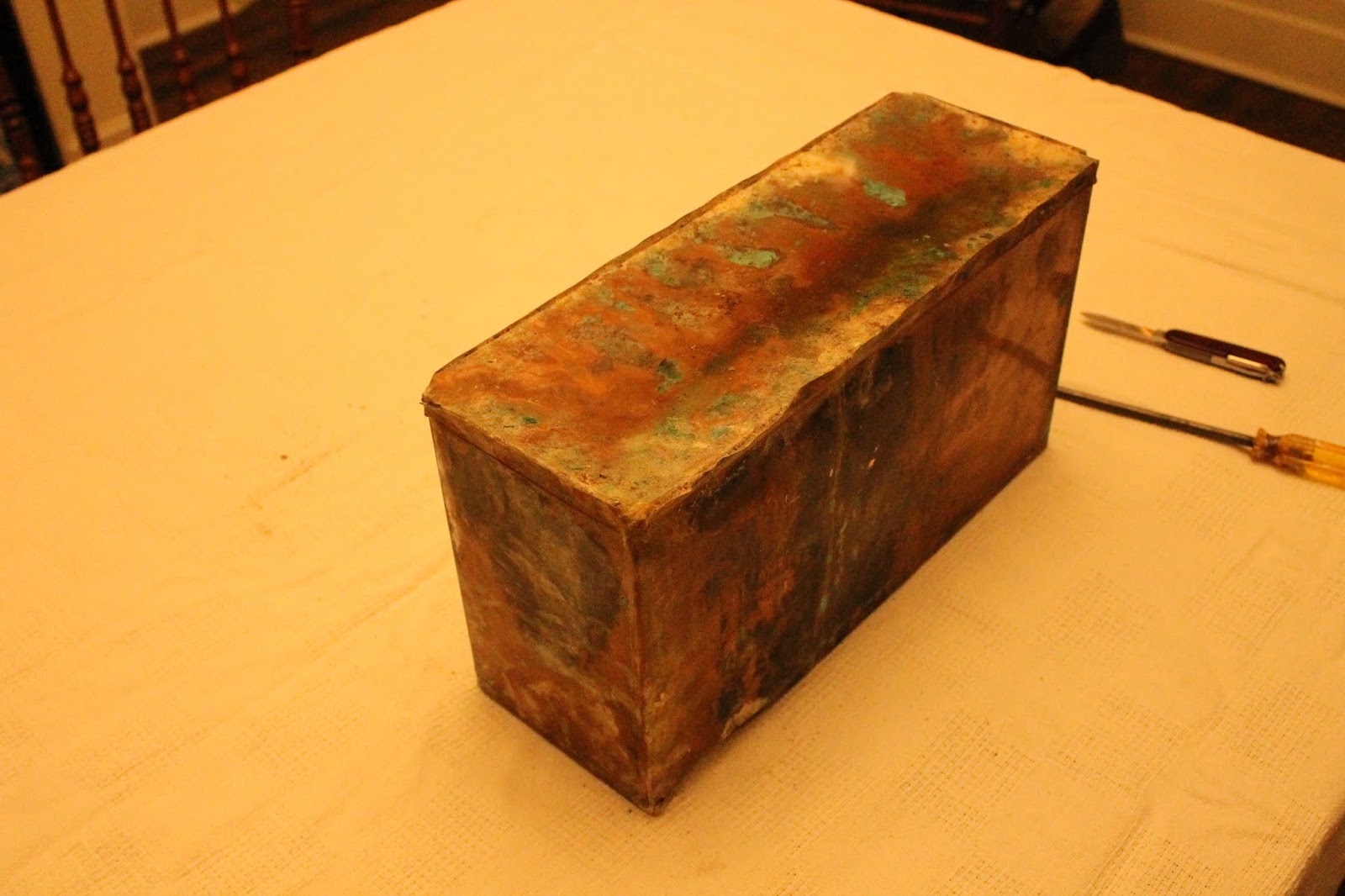
A few weeks ago, County Historian Bill Buell arrived at the Grems-Doolittle Library with two copper boxes. They had been found in a closet in the County Office building and nobody was sure where they came from. We decided to open them up and take a look.
What's in the box? This sealed copper box was found in a closet without any accompanying documentation.

One of the boxes was unsealed, so we lifted the lid and discovered a cache of newspapers, documents, and books. There was also a milk bottle cap. One of the documents revealed the box's purpose: commemorating the completed construction of the Schenectady County Home in 1934.
Program in Connection with Laying of the Cornerstone of the Schenectady County Home, July 14, 1934.

The Schenectady County Home is now called the Glendale Home. We decided that the time capsule was likely unearthed during the 2015 demolition of the Glendale Home facilities. We speculated that other box was a time capsule from a later addition to the County Home, but the box was sealed and we couldn't confirm until we opened it.
John, our facilities manager and blacksmith, checked the capsule for weaknesses and determined the best approach for opening it without harming the contents.

The capsule was sealed by folding a lip over the edge of the lid and reinforcing it with adhesive. John pried up the edge of the lip and forced a weak spot.

We're in! Once the lip was breached, John could grab the lid and prise it up.

Copper is a soft metal, so we could roll the top back like a sardine can lid. Time capsules usually are designed to be carefully destroyed when opened. If they were easier to open, they would be less effective in preserving their contents.

The first item emerges! The contents of this capsule are in good condition which shows how well the capsule did its job.

Like the previous capsule, this one contained newspapers, documents, and books. It did not contain a program explaining the occasion, but one of the documents was a speech titled "Remarks by Harold F. Lews, Chairman, Board of Supervisors. Dedication of Infirmary Building - October 30, 1960." One of the newspapers contained an article describing the addition of the Infirmary to the County Home.
Time capsules often include newspapers from the day the capsule is interred.
The 1960 time capsule included 31 cents and a Certs mint. Coins are often included in time capsules. We decided not to eat the mint, though it seemed to be in excellent condition.

For more information on the history of the County Home, check out the following sources: