Thursday, August 31, 2023

Graubart Jewelers: A Family Tradition in Downtown Schenectady

 This post was written by library volunteer Diane Leone.

Graubart Jewelers was an historic business in downtown Schenectady that operated for over a century (1897-2002), under the guidance of four generations of the Graubart family.

The founder of the business was Samuel Graubart, a Jewish immigrant from Austria who came to the US toward the end of the 19th century. He rented a property on lower State Street and named his business Samuel Graubart Jewelers. He was part of a wave of Jewish immigrants who came to America in the 19th and early 20th centuries. Those who settled in Schenectady often made their living as peddlers or opened modest businesses selling groceries, liquor and clothing. Some of these entrepreneurs saw great success, such as Jonathan Levi, who became a wealthy wholesale grocer, and Russian immigrant Lewis Golub, whose wholesale grocery warehouse, founded in 1908, gave rise to the well-known Price Chopper supermarket chain established by his two sons in 1932. 


When it opened in 1897, the store stood at the corner of Ferry and State Streets. Samuel relocated to 249 State Street about a decade later. In 1910 Samuel was joined by his son, Maurice. They finally moved the business to 166 Jay Street, where it remained for over eighty years until closing in December 2002. In time, the business was renamed Maurice B. Graubart Jewelers. Eventually Maurice and his wife, Anna, brought their two sons, Walter and Hershel, into the family business. Both boys helped out in the store on a part-time basis. Hershel began doing so at age 11, cleaning the counters for his grandfather. Two years later he was working daily after school let out. With the onset of World War II the brothers entered the military, but returned to the business after the conflict ended. Again, the business was renamed; this time to Maurice B. Graubart and Sons.


Walter, the older son by approximately five years, recalled that his grandfather discouraged him from becoming either an attorney or a doctor because they often brought their work home. He recommended instead that his grandson enter the jewelry business. Walter, who ultimately became president of the family business, said, “It’s a happy, happy vocation and I’m glad I chose it. (1) His brother had a more pressing reason for entering the business. He realized that his love for photography—he was an army photographer in World War II—would not provide him with a comfortable income. As he said, “I wanted to get married and I had to make a living, so I went into the jewelry business.” (2)

Like all businesses, Graubarts must have suffered the effects of the Great Depression. Hershel recalled his father voicing his concern over the store’s finances: “It was early in the 1930s and I remember well my father coming home and saying that this week he had not sold enough to cover payroll.” (3) To make matters worse, in May of 1933 a fire began in Bill Creegan's restaurant at 152 Jay Street, damaged a number of nearby establishments, including Graubart’s at 166 Jay Street, which was then on the corner of an alley. The photograph below indicates that the building was condemned and that Sam and Maurice had a fire sale to dispose of their inventory. The fire may explain why the city directory lists the store as located at 141 Jay Street for 1930 and 1931.

The Graubart family emphasized the importance of contributing to the community, and the store often served as a place for people to get together. Over their long tenure, the proprietors earned the trust of their customers, who often included several generations of the same families. Looking back on the earlier years in the business, when credit was commonly extended:

He [Hershel] recalled a day when a man walked into the store with a pocket watch his grandfather had acquired from Samuel Graubart to use in his job on the railroad. At the time, the railroad worker didn’t have the money to pay for it. Samuel Graubart handed the watch to him anyway and told him to pay for it when he could. (4)

Like their grandfather, Walter and Hershel also extended benefits to customers: “If we knew a customer well enough, if they had a baby, we’d engrave the baby’s name on a sterling baby cup and have it sent to them. We used to do that very often.” (5)

The mid-twentieth century was the heyday of urban shopping. In the WMHT documentary “Remembering Downtown, Hershel reminisced about the brisk city business during a typical lunch hour before the proliferation of malls:

Lunch hour on Jay Street was fantastic. It was just jammed. The sidewalks were packed, especially when the American Locomotive Company let out for their lunch hour. You could not walk on Jay Street. You were taking your life in your hands when you crossed the street because of the automobile traffic on Jay Street. And many years ago, before my time, there was two-way traffic on Jay Street, if you can imagine that. But the streets were packed all over downtown. People laughed and sang and had a good time while they were shopping. (6)

The photograph below, although depicting an earlier Jay Street than discussed in the documentary, illustrates the hustle and bustle of downtown in previous eras.

For most of its existence Graubarts was located at 166 Jay Street. Named for American patriot John Jay, the thoroughfare grew from a dirt lane around two hundred seventy-five years ago to a commercial venue, blossoming particularly after the Civil War, when the burgeoning city began to expand eastward from its original downtown. Over the decades, Jay Street featured churches, banks, jewelers, funeral parlors, and theaters, among many other establishments.  Among these occupants, Graubarts, with its 105 year run, was a stable presence whose proprietors contributed to the thoroughfare’s welcoming atmosphere. Hershel noted that they handed out lemonade to people when the temperature rose to over 85 degrees. Walter told a Daily Gazette reporter of a long-standing tradition: whenever the street was repaved, most recently during the 1998 overhaul of the Jay Street pedestrian mall, he tossed tiny stones onto the new concrete “so the rocks will glitter in the moonlight.” (7)


In 1997, the business reached a milestone that few ever do: it celebrated its one hundredth anniversary. In honor of this occasion, then New York State assemblyman James N. Tedisco wrote Walter and Hershel a congratulatory letter, shown below.  Around this time, the brothers decided to trim their working hours to around two days per week, turning over the daily running of the business to Hershel’s daughter, Sheryll Graubart-Hoffman, who had already been working at the store for a number of years. Five years later Hershel and Walter closed the store, selling most of their inventory to a liquidation specialist.


Although Hershel said that the decision was based on their ages and their health, the environment for downtown businesses at the start of the 21st century was not ideal.  Before the creation of the Schenectady County Metroplex Development Authority in 1998, the city had major problems, as reported in the Daily Gazette:

Along with the challenge presented by the physical decay, there was a need to change the mindset of residents and the business community, said John Manning, Metroplex chairman from 1998 to 2004. The city’s population dropped from 91,000 to 61,000 between 1950 and 2000, and much of the downtown business base followed those former residents to the suburbs or otherwise disappeared. (8)

The brothers, although solicited by more than one new mall with the promise of free rent, opted to stay on Jay Street. Their store’s closing at the end of 2002 was significant, not only because of its longevity, but also because it marked the end of an important period in the life of the city’s Jewish-owned businesses. According to Hershel, there was a time when about two-thirds of State Street merchants would shut down during the high holydays of the Jewish faith. Eventually, as Dr. Harvey Strum notes in “Schenectady’s Jewish Immigrants: Acculturation and Preserving History,” these businesses suffered, not only from the growth of suburban malls, but also as a result of the passing of the earlier immigrant population and the attractiveness of the professions for those who previously would have entered the business world.  As the author notes, “The closing of Graubart and Sons Jewelry in 2002, founded in 1897, symbolized the end of Jewish owned small businesses lining downtown.” (9)

While ending this chapter in their lives was a difficult decision for Walter and Hershel, they must have been heartened by the appreciation of their customers, exemplified by a letter from Jane O. Tatge dated Jan. 24, 2003, congratulating Hershel on his retirement:

How many times did we head down Jay Street and find such a warm welcome from you dear people. We really felt like members of your family and always found the help and expertise we needed. You showed such caring concern, whatever work needed to be done. (10)

When the store closed in 2002 Sheryll Graubart-Hoffman had been managing the business without owning it. As she tells it, her father did not want to sell her the store with the drop in customer traffic, the result of a reluctance to travel to the downtown area.  After the closure, Sheryll managed JM Jewelers on Mariaville Road, ultimately purchasing the business in 2007, where her father sometimes helped out.  As she noted in a 2008 Times Union article, most of the customers from the Jay Street store brought their business to her.

It has been over twenty years since Graubart Jewelers shut its doors. Sadly, Walter, who had been suffering with cancer at the time, died in 2003 at the age of 85. Hershel lived a longer life, passing in 2017 at the age of 94. Both were active in the community, as well as in their profession. Walter was a senior member of the NGJA Appraisal Society. He also served in leadership positions in many civic organizations, including as vice-president of the Schenectady Merchants Bureau, and president of B’nai B’rith. Hershel was a certified gemologist, an emeritus member of the American Gem Society, and one-time president of the New York State Jewelers Association.

The Graubart family was proud of their business, and strove to serve their customers and community during their 105 years in downtown Schenectady.

 References:

1) Spagnoli, Victoria R. "Graubart and Sons, Downtown Sch'dy Fixture, to Close." Daily Gazette (Schenectady, NY), November 6, 2002, B1. 

2)  de la Rocha, Kelly. "A Sterling Life." Daily Gazette (Schenectady, NY), July 15, 2014, A2.

3) "Happy 100th Anniversary." Observations, January 6, 1997, 6-7.

4)  de la Rocha, Kelly. "A Sterling Life."

5) de la Rocha, Kelly. "A Sterling Life."

6)  Remembering Downtown. Aired March 5, 20002, on WMHT. Accessed April 11, 2023. https://www.pbs.org/video/wmht-specials-remembering-downtown/ 

7) Keegan, John, III. "Jay Street Mall Celebrates Revival: Crowds Enjoy Day on Made-over Walkway." Daily Gazette, September 20, 1998, B3.

8) Cropley, John. "'Plex-ing Its Muscles." Daily Gazette (Schenectady, NY), October 21, 2018, Front Page.

9) Strum, Harvey, Dr. "Schenectady's Jewish Immigrants: Acculturation and Preserving History." New York History Review (blog). Entry posted September 6, 2017. Accessed April 18, 2023. http://newyorkhistoryreviewarticles.blogspot.com/2017/09/schenectadys-jewish-immigrants.html.

10)  Tatge, Jane O. Letter to Hershel Graubart, January 24, 2003. 2003.125.1. Family Document. Schenectady County Historical Society.

For the complete bibliography for this article, please contact the SCHS Librarian at librarian@schenectadyhistorical.org.

Friday, June 30, 2023

Siena College Service-Learning Project at SCHS

Education is a key component of our mission. We present a variety of programming aimed at educating the public, including our school programs aimed at K-12 students. We also regularly host interns to give to college and graduate students invaluable work experience. This year, we had an opportunity to go beyond our usual education work and influence the next generation of historians, teachers, journalists, and creators by inviting Siena College students for a unique behind-the-scenes look at the work of our institution!

Professor Jenn Dorsey approached SCHS with an idea for her Spring Introduction to Public History students to do service-learning projects with Marietta Carr, Librarian, and Mike Diana, Director of Education. Service-learning is a vital piece of the Siena College’s curriculum and something that Professor Dorsey incorporates into her history classes. She views service-learning as a way for her students to practice historical thinking, engage with the history of the Capital Region, and support local cultural institutions like SCHS. 

Students worked with historic photos and maps like this view of Wall St.

For this Public History class, Marietta, Mike, and Prof. Dorsey developed 5 projects that gave students hands-on experience in processing, preserving, and describing archival materials, and using primary sources to develop historical narratives. During March of this year, the Siena students worked with Marietta and the library volunteers to transcribe 19th century legal documents, create metadata for early 20th century photos, create condition reports for archival materials in the Grems-Doolittle Library, and compose descriptions for our small manuscript collections. Their work will be incorporated into future NY Heritage and Consider the Source NY digital collections, enable greater access to our archival collections, and improve the information available in our online catalog and resources. In April, the students researched buildings on State and Union Streets and composed narratives that Mike will utilize in developing future walking tours.

Digitizing documents, like this drawing from the Patents Collection, was an essential part of the students' work.

The students approached their work at SCHS with great enthusiasm. They were eager to apply the concepts they’d covered earlier in the semester and learn the basics of archival processing. For most of the students, this was their first time directly handling original archival materials or working in a special collections library. Many of these students are considering careers in the history field, and this experience provided a glimpse into a possible future career. We’re grateful for the work these students produced and the opportunity to contribute their education!

Saturday, January 28, 2023

Mabelle Primmer - Early Schenectady Photographer

This post was written by library volunteer Gail Denisoff.

Last year, one of the library volunteers ran across a photo in the Schenectady County Historical Society General Photograph Collection dated 1915 with a stamp on the back indicating it was a product of the Mabelle Primmer Studio at 241 State Street. It was a stamp we couldn’t recall encountering before, and it raised some questions: who was Mabelle Primmer? Were there other women in Schenectady during that period who were also professional photographers? A look through the business listings in the city directories, census records, and other areas of the library’s holdings turned up only a handful of women working in the field in the early 20th century. While women may have been employed at one of the male-owned studios, Mabelle was unusual as an owner and proprietor of a studio. 


Directory entry reads "Primmer Mabelle P photographer 241 State, b 341 Summit av." Ad text reads "Studio of Mabelle Primmer Portraits that Please 241 State St. Schenectady NY Phone 221-J Over Lower 5 and 10 Cent Store"
In the 1915 Schenectady City Directory, directory entry for Mabelle Primmer, photographer, and ad for the Studio of Mabelle Primmer.

Mabelle Priscilla (also Philina) Primmer was born on July 2, 1886, in Hepworth, Ontario, Canada, the second of Charles and Mary Ann Beaton Primmer’s nine children. Records indicate she entered the United States in 1905, but the first mention of her living in Schenectady was in 1912. An article from The Argus, an Albany newspaper, dated April 2, 1908, lists Mabelle as a participant in a play there that was part of the entertainment for a Unity Club event.

The Schenectady City Directory has an entry for Mabelle’s brother Charles in the 1904 edition, living on North College Street and working as a librarian at the Public Library. By 1907, his employment changed to the Locomotive Works. His presence in the city may be what brought her here. The first mention of Mabelle in Schenectady was in the 1912 City Directory. At that time she was living on Chestnut Street and working as a stenographer.

A May 29, 1914, notice in the Schenectady Gazette announced that she had purchased the Obenaus Studio and was remodeling rooms of the Fulton Studio in the Patton and Hall building at 241 State Street. She would be the successor of both photography studios, opening as The Mabelle Primmer Studio on June 1, 1914. She “had charge of” the Obenaus Studio for several years and prior to that worked in studios in Toronto and Montreal. She studied Child Portraiture which would be “an important feature of her work”, and advertised children’s pictures, society groups, portraits, and framing. The notice also states that the staff from the Obenaus Studio would remain, “which is a sufficient guarantee of first class portraiture.”

Mabelle Primmer, circa 1914
 

Mabelle often advertised her studio in the local newspaper personal columns, primarily for child portraiture. A 1915 ad, repeated over several days, read “Some baby will be given a life-size portrait free during April and May. Make the appointment today and give your baby a chance.” Also in 1915: “Graduates – a record of school days can be best kept with a photograph. Something in miniatures for your school album and scrapbook are inexpensive and will please you.” An ad from 1917 states, “You can only be one place at one time but your photographs can be as many as your friends. Discounts given to military men.”

Mabelle’s younger sister, Irene, moved in with her around 1915 and joined her business as an employee of the studio and also a photographer. A society notice in the Gazette from 1916 notes Mabelle and Irene were away visiting Toronto, Hamilton, and other locations in Canada. Her border crossing card from that trip indicates she was visiting her father, returned through Buffalo, was 5’3 ½“ tall with brown hair, brown eyes and states she owned her own photography business valued at $3500 -- over $90,000 in today’s dollars.

On August 9th, 1917, Mabelle married Edward Carlos Sanders at the Little Church Around the Corner in Manhattan. She was 31. Edward, who was 30, was an electrical engineer at General Electric. Their only child, Alice “Robin” Sanders was born on December 5, 1918. 

Mabelle and her daughter, circa 1923
 

City directories indicate Mabelle was active with her studio until 1919. In the 1920 directory, the proprietor was Signe Lindgren, although it was still called the Mabelle Primmer Studio. Irene was still listed as a photographer there but Mabelle was not, probably giving up her business after the birth of her daughter. The Mabelle Primmer Studio was listed in the Schenectady City Directory only until 1923.

It’s not known if Mabelle continued with photography after her daughter was born, perhaps as a hobby, as census entries after that time indicate she was a homemaker. She did become involved in writing poetry though. More than 100 of her poems were published in a book called With You in Mind by Branden Press of Boston. All of the poems had been previously published in magazines, newspapers or anthologies, including Golden Threshold, an anthology published by the Schenectady Senior Citizens Center. She also wrote short stories, children’s plays, and a biblical novel.

Mabelle was very active in the Schenectady Poetry and Philosophy Group, serving as president for over a decade. She was also a member of the Academy of American Poets, New Hampshire Poetry Society, Albany County Poetry Society, and the Creative Writing Group of the American Association of University Women. Locally she was involved with the Schenectady Museum, the Schenectady Senior Citizens, and the United Presbyterian Church.

Mabelle died at the age of 81 on June 8, 1968, after a short illness. She was survived by her husband, daughter, son-in-law and a granddaughter. She is buried in Parkview Cemetery in Schenectady.
 

Tuesday, December 20, 2022

The End of the Original Burr Bridge

 This post was written by library volunteer Lola Sheeran.

The Burr Bridge, now replaced with the Western Gateway Bridge, first came to fruition in summer of 1804. During its existence, it was known by many different names including the Covered Bridge, Toll Bridge, and the Mohawk River Bridge. There was a lot of demand for a bridge connecting Schenectady and Scotia since people relied on ferries to get across the Mohawk River. Soon after construction on the bridge began, it became clear that the first design of the bridge wouldn’t work. The company and Burr [MT1]went back to redesign it, and finally in 1806, it was proposed there would be a permanent wooden bridge connecting Schenectady and Scotia. The bridge would be designed by Theodore Burr – bridge architect and cousin of Aaron Burr, former Vice President and the man who fatally shot Alexander Hamilton in a duel. On May 13, 1808, Theodore Burr made an agreement with the Mohawk Bridge Company, which described the way the bridge will be built down to the materials and where they will be placed.

Yellowed piece of paper with cursive lettering in ink covering the whole page. The edges of the page are turning brown from old age and there are faint stains and marks throughout covering some of the words.
The original agreement between Theodore Burr and the Mohawk Bridge Company outlining the specifications of the bridge including price, materials, and obligations toward the bridge.

While Theodore Burr designed the bridge, it was actually built by a man named David Hearsay. He took up a permanent residence next to the bridge so he could keep an eye on it. Another notable man associated with the bridge was Christopher Beekman, but people in Schenectady knew him as “Uncle Stoeffel.” Uncle Stoeffel was a German man whom lived in an old toll-house and was a toll collector for the bridge for 50 years. He also kept an eye on the bridge, and kept it clean and orderly for people crossing the river. According to legend, Uncle Stoeffel was also the owner of a “remarkably well-educated cat [that was] his companion.” Hearsay and Uncle Stoeffel were close friends for 50 years, but they frequently bickered about Uncle Stoeffel’s tobacco use because Hearsay was a devout Episcopalian and hated tobacco. These two men, both living next to the bridge they dedicated their lives to, acted as guardians of the bridge until they both passed away. 

According to Larry Hart, in an article for the Daily Gazette, “the bridge was an engineering marvel of its day.” Burr was the first person to attempt a suspension bridge of this kind, and “it was said to be unsurpassed in beauty and solidarity by any structure in America.” The Century Illustrated Magazine stated, “there was only one other [bridge] just like it in all the country,” and the Burr Bridge was so immense it was said to have used wood from Noah’s Ark. After Burr passed away in 1822, the structure was sold to a private group and it was not maintained the way it was supposed to be. The group allowed the bridge to deteriorate and rot until it became too dangerous to cross. According to the magazine “Covered Bridge Topics,” the bridge was left to deteriorate due to weather and time. Sections of the pier began to sag and the company that owned the bridge added additional piers in 1835.

Black and white photo of a wooden covered bridge sitting on concrete piers. The bridge is sagging in areas along the bottom in-between the concrete piers.
The Burr Bridge from 1872 when the trial about the safety of the bridge was taking place. This photo shows the way the bridge was sagging and deteriorating.


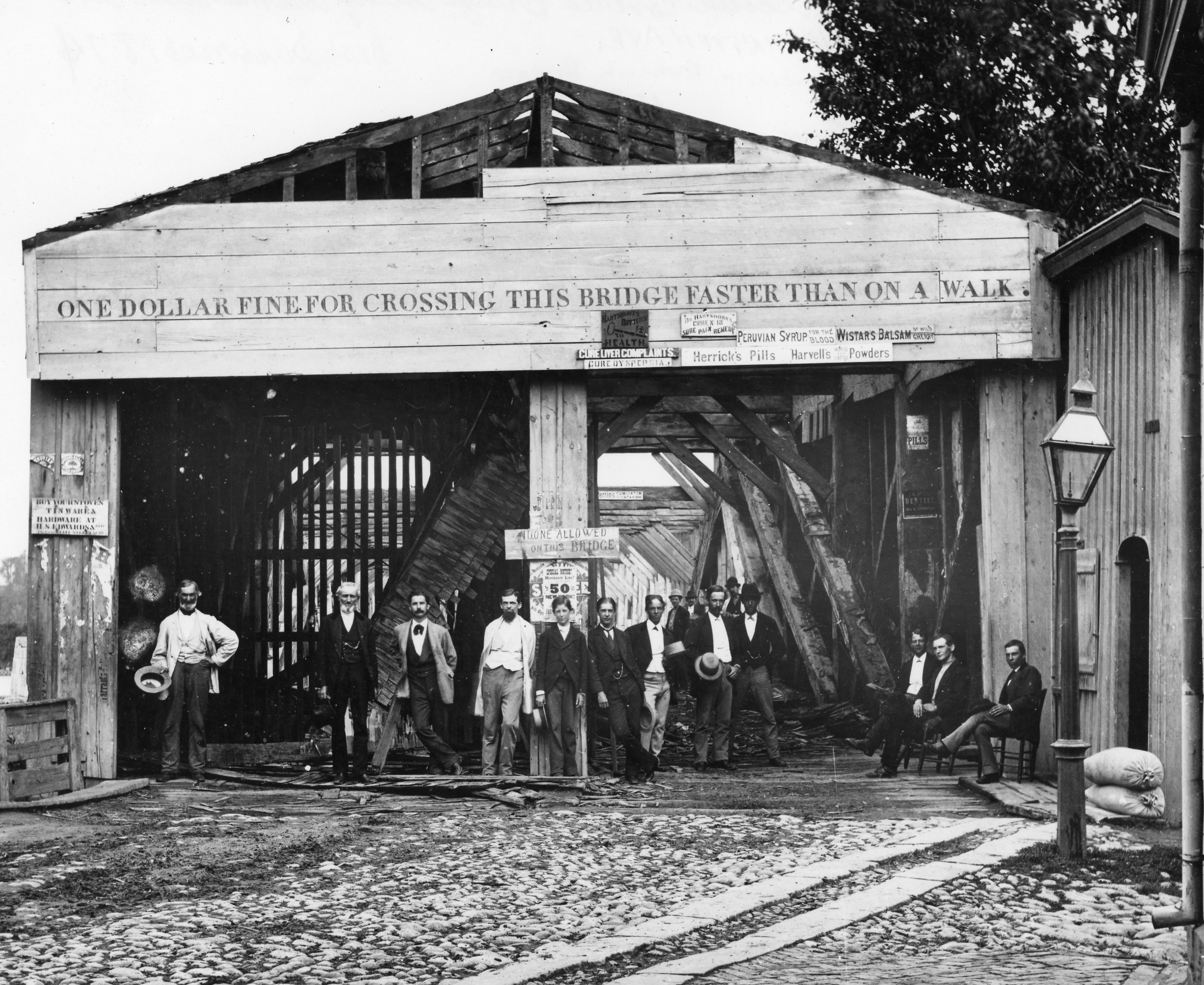
As the bridge continued to deteriorate due to weather and lack of maintenance, public opinion of the bridge began to change. According to the Schenectady Union Star, “there were not many who mourned the removal of the old covered bridge,” because the condition was becoming dangerous. One example of weather affecting the bridge came from the Schenectady Reflector in 1857. There were reports of floating ice hitting the bridge and causing damage to some of the arch timbers. It caused pieces of the bridge to break off and float along the river. It was no longer seen as a marvel like Larry Hart described. Instead, it was beginning to lean and become crooked over the years. It was impossible to see the other side of the bridge when standing at the entrance because of how much the bridge had shifted. The bridge was also impossibly dark because it was covered and only lit with torches attached to the walls. The planks made loud creaking noises every time people went across.

A group of men stand on a cobblestone street at the entrance of the covered bridge. “One dollar fine for crossing this bridge faster than on a walk,” is written across the top in all capital letters.
The entrance for the bridge as it was being dismantled in 1874. The writing at the top of the bridge references the prices for the toll.

The state of the bridge caused so much concern amongst the people of Schenectady and Scotia that the state of New York decided to sue the Mohawk Bridge Company in 1872, alleging that the bridge was a public nuisance and the company had failed to uphold its contractual obligations to maintain it. Along with that, the suit claimed the company didn’t keep the toll booth running consistently which was also part of their original agreement for this bridge. Austin A. Yates was the district attorney for this case while E.W. Paige was the defendant’s attorney. 

Witnesses for the defendant who lived in Glenville and Schenectady believed there was nothing wrong with the bridge. They testified the bridge had been there their whole lives, and it leaned just as much as it did they first time they saw it, so there’s no reason it should be condemned now. Witnesses for the state described the bridge as leaning and the wood as rotten; one of the witnesses even brought in pieces of the rotten wood from the bridge to show the jury. Testimony from bridge builders and engineers agreed the bridge was unsafe; it could potentially be used for local traffic, but putting too much weight on the bridge could be risky. 

One notable story about the bridge was the time a circus came to town. There were elephants and hippopotamuses that were to cross the bridge. A witness for the defendant, Harmannus Van Epps, a toll collector for the bridge for many years, claimed the hippopotamus made it across the bridge with no hitches – clearly a testament to the bridge’s strength. When questioned about the elephants, he claimed, “I recollect the elephant that swam the river but he did it from choice,” not because he was too big to fit on the bridge. The jury found the Mohawk Bridge Company guilty of letting the bridge deteriorate to this state. The trial and verdict led to the bridge being dismantled soon after in 1874. A new bridge was built in 1874 made out of iron which lasted until 1939. Construction began in 1922 on the concrete bridge, the Western Gateway Bridge, which is still standing today.

Hand drawn map showing Schenectady on one side and Scotia on the other side of the Mohawk River. At the bottom of the map there is a bridge labeled, “Old Toll Bridge.” Not far above that is a bridge labeled, “Great Western Gateway Bridge,” showing the locations of the old bridge and the new one. The Old Toll Bridge is outlined in a thick black line to show the longer route people had to take in order to get from Schenectady to Scotia and vice versa.
Map showing where the old bridge was in relation to where the new bridge. The change in location was meant to accommodate the amount of traffic expected to cross the bridge.

Bibliography:

“Burr Bridge was an Engineering Marvel of its Day” by Larry Hart
“Covered Bridge Topics – Official Magazine for the National Society for the Preservation of Covered Bridges”
“First Mohawk Bridge had many names but served public well,” by Larry Hart
“History of the Mohawk Valley: Gateway to the West 1614-1925”
“How the Great Western Gateway Will Remove Danger and Traffic Congestion in Schenectady,” 1919.
Chapter 83: Mohawk River Bridges” from Schenectady Digital History Archive
History of Schenectady County, NY by Hon. Austin A. Yates
Schenectady Reflector February 13, 1857
“Tales of Old Dorp” by Larry Hart
The Century Illustrated Magazine vol. 12, 1876
The People of NY vs. Mohawk Bridge Company court case

Thursday, November 10, 2022

The Last Man’s Club of Schenectady: Local Heroes of World War I

This post was written by library volunteer Diane Leone.

Men and women who serve in the military together, particularly during wartime, form a tight bond that often lasts a lifetime. One way that veterans have maintained those bonds is through what are called Last Man’s Clubs--also called Last Man Clubs--which have a long history. Meeting annually to maintain their connection, these groups often continue a custom of purchasing a bottle of wine, which is saved and passed through the group, to be opened and drunk only by the last surviving member of the club.

Company E (top) and F (bottom) of the 105th Infantry of the 27th Division. From "Schenectady's Part in the World War, 1918," SCHS Grems-Doolittle Library Documents Collection
 

One such club of World War I veterans was located in Schenectady. The organization may have started in 1921 -- although one source says 1933 -- with a membership of 98 men from the 105th Infantry Regiment, which served in Belgium and France. These local veterans were primarily from Companies E and F, as well as Headquarters and Machine Gun Companies. They met yearly at a restaurant as close as possible to April 6, the date on which the United States declared war on Germany. At each meeting they called the roll, commemorated the members who had died during the year, and elected a new head man whose responsibility it was to safeguard the Burgundy wine -- which had been purchased in France by one of their commanders, Lieutenant George E. Ramsey and presented to club members at the club’s inaugural meeting.
 
Several newspaper articles reporting on the club’s later meetings identify some of the members whose names are listed below along with many of their ranks and companies during the war. This information can be found on the website of the New York State Military Museum and Veterans Research Center.  
 

Known Club Members:
Leslie Brooks
Keyes (K.T.) Davis, Corporal, Company E
Kenneth S. Greenough, Wagoner, Supply
Milton H. Hallenbeck, Sergeant, Company F
Earl (E.D.) Hamilton, Stable Sergeant, Machine Gun Company
Herbert H. Horstmann, Corporal, Headquarters Company
Frank Jutton, 1st Class Private, Machine Gun Company
John Kubes, 1st Class Private, Headquarters Company
Theodore (T.M.) Kuhlkin, Private, Company E
Albert Lange, 1st Class Private, Headquarters Company
Edward Long, Private, Company E
T. S. Mabie
Joseph Memelo, Private, Machine Gun Company
George E. Ramsey, 1st Lieutenant, Company E
Ira M. Schermerhorn, Wagoner, Supply Company
John Shepard, 1st Class Private, Machine Gun Company
Edward Smith, 2d Class Musician (equivalent to Private), Headquarters Company
John R. Walsh, 1st Class Private, Company E


Time has blurred the memory of World War I, but that conflict had a great impact on the world. These local servicemen, who participated in some of the most significant battles of the war, were originally part of the New York State National Guard, designated the 6th Division. After serving on the Mexican border in 1916, its members were called up for active duty by President Woodrow Wilson on July 12, 1917, along with all National Guard units in the US. After completing their training at Camp Wadsworth in South Carolina, the men shipped out to Europe in the spring of 1918.

In streamlining the military, the New York troops were re-designated in October 1917 from the National Guard’s 6th Division to the federal system’s 27th Division, commanded by Major General John Francis O’Ryan, the army’s youngest major general. Comprising the 27th was the 53rd and 54th Brigades. The original 27th had a total of 991 officers and 27,114 enlisted men.
 
The 53rd Infantry Brigade consisted of Brigade Headquarters, the 105th and 106th Regiments of Infantry, and the 105th Machine Gun Battalion. The men of the 105th, in which the Schenectady club members served, were called “apple knockers” because the recruits were primarily from the rural areas of Upstate New York, with many having worked in apple orchards. One of the commanding officers of the 105th’s Company E was a local, 1st Lieutenant George E. Ramsey (see photo below). As part of the 53rd Brigade, the 105th participated in the Ypres-Lys Offensive in Belgium, an area of major contention, as well as the Battle of the Somme, one of the most significant of the war. Their objective in that battle was to help break the Hindenburg Line, the sole remaining network of German defenses on the Western Front, which the Allies penetrated on September 29, 1918. 

Members of the 105th Machine Gun Battalion at the Yelverton summer home, circa 1917. From the Larry Hart Collection, SCHS Grems-Doolittle Library.

On October 22, 1918 the 105th received a letter of commendation from John F. O’Ryan, commanding general of the 27th Division, for their “valor, skill and endurance,” not only in helping crack that major line of defense, but also for their performance in subsequent battles. As the general wrote of the former battle:
 

During the battle for the breaking of the Hindenburg Line, the mission of the regiment was peculiarly difficult. The character of the operation assigned made it impossible for the regiment to have the assistance of a barrage. The enemy operating from a flank position at VANDHUILLE held back the division on our left and delivered repeated hurricanes of fire and strong counterattacks against our flank. It was against such fire that the regiment rendered such valuable service in assisting in the shattering of these counterattacks.


By the end of the war, the 105th Infantry saw 253 of its men killed, 1,284 wounded, and 72 who subsequently succumbed to their injuries. The survivors of the 105th returned to civilian life after the war and settled down, some in the Schenectady area, including club members George E. Ramsey, Joseph Memelo, John Kubes and Frank Jutton.
 
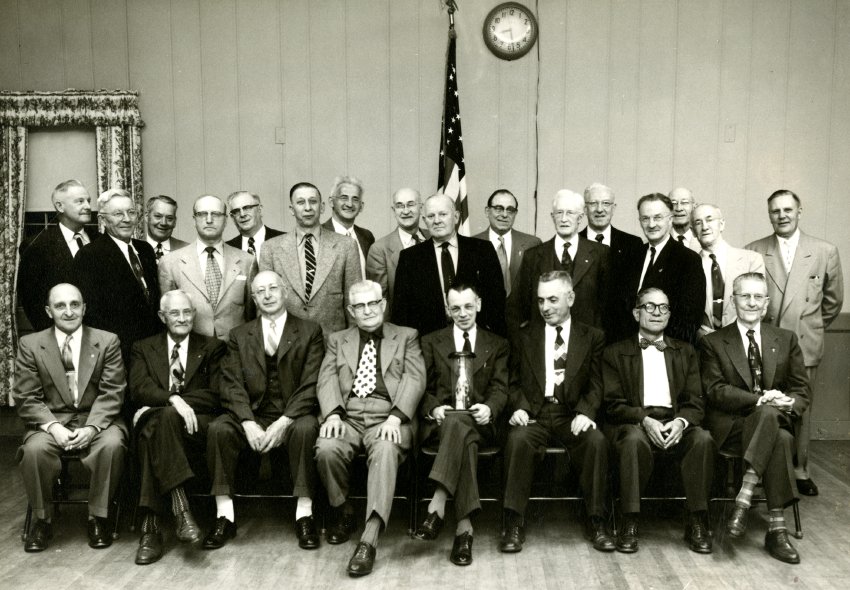
The annual meetings of the club, which started with nearly 100 members, inevitably saw a dwindling number of survivors as the years went by. A photograph of a meeting around 1955 includes 24 members, with head man Leslie Brooks (fifth from the left) holding the bottle of Burgundy.

Members of the Last Man's Club post at the American Legion Hall, circa 1955. Photograph from the Larry Hart Collection, SCHS Grems-Doolittle Library.


Years later, a Gazette article, likely from April of 1971, mentions 15 survivors, 12 living locally. A total of 13 attended the annual meeting at the Carlton Restaurant on Becker Street. Surrendering the bottle was head man Edward Long. The other men who held positions of responsibility were John Kubes, assistant head man; Herbert Horstmann, chaplain; Kenneth S, Greenough, secretary-treasurer; and T. S. Mabie, permanent dinner chair.
 
Toward the end of the decade, probably 1978, the group of five out of nine survivors met at the Mohawk Club. Joseph Memelo was the head man. The other attendees were Frank Jutton, Albert Lange, Edward Smith and John E. Walsh, who came from California to attend. Three years later, on April 4, 1981, the club met at the American Legion Post 21 headquarters. Walsh surrendered the bottle of burgundy to Memelo (second from the left), the head man for 1981. The group met until 1987, when Joseph Memelo was the only member left.
 

Lt. Ramsey of Company E, 105th Infantry, and member of Schenectady Last Man's Club. From "A Short and Illustrated Roster of the 105th Infantry, United States Army: Col. James M. Andrews Commanding, 1917." SCHS Grems-Doolittle Library.


The following are brief biographies of a few of the club members, taken mostly from newspaper articles and obituaries:
 
George E. Ramsey was born in 1872 in Luzerne, New York. He had a long and exemplary military career in both the US Army and New York State’s National Guard. He served in the Spanish-American War, re-enlisting in 1916, when he was sent to the Mexican border and the next year to Europe as a lieutenant in the 105th. He was promoted to captain in 1918. After the war he held several civic positions, including deputy sheriff of Schenectady County (1920), police court clerk (1923), and Schenectady’s commissioner of public safety (1925), while ultimately attaining the rank of major in the National Guard. He died in 1936 and is buried in Vale Cemetery in Schenectady.
 
A Schenectady native, Frank Jutton was born in 1896 and worked for 42 years as an inspector in the Large Motor and Generator Division at General Electric, from which he retired in 1958. He died in 1983 and is buried in Memory Gardens Cemetery and Memorial Park in Colonie.
 
John Kubes, born in 1890, lived most of his life in Schenectady, although he hailed from New York City. After the war he served for 30 years as a firefighter, being promoted to lieutenant in 1947 and ending his career in 1961 as a captain. He died in 1985 and is interred in Most Holy Redeemer Cemetery in Niskayuna.
 
Joseph Memelo was the baby of the club. Born in Schenectady in 1899, he was a 16-year-old high school student who lied about his age to join the National Guard in 1916. After the war he worked in the printing trade, first as a salesman, later as a co-founder of the Schenectady Printing Company, from which he retired in 1975. He died in 1993 at the age of 93 and is buried in St. Anthony’s Cemetery in Glenville.
 
Mr. Memelo had the bittersweet distinction of being the last man standing from a group of American heroes.
Pvt. Joseph Memelo of Machine Gun Company, 105th Infantry, and last member of the Schenectady Last Man's Club. From "A Short and Illustrated Roster of the 105th Infantry, United States Army: Col. James M. Andrews Commanding, 1917." SCHS Grems-Doolittle Library.


Bibliography


Tuesday, November 1, 2022

What happens to donated archival materials at SCHS?

Over at the Grems-Doolittle Library, we love everything about October. What’s not to love? There’s peak leaf peeping, sweater weather, apple everything, and of course, National American Archives Month! This October, the Grems-Doolittle Library staff and volunteers were busy preparing for our new shelving system and looking forward to many more years of collecting the documentary heritage of the county once the system is in place! However, many librarians and archivists across the country celebrated National American Archives by pulling back the curtain and revealing some of the behind-the-scenes work that goes into making archival materials available and accessible for current researchers and future generations of researchers. While I'm little late to the party, I wanted to join in the spirit by talking a little about what happens when people donate their personal papers, family archives, or organizational records to the Grems-Doolittle Library.


The first step in any archival donation is reviewing the materials with the donor. At SCHS, we use our Donation Questionnaire and Donation Guidelines to get the conversation started. For example, I need to know how much material is currently in the possible donation, what types of materials are included (e.g. documents, photos, framed items), how the material is currently stored or organized, and how the material came to be in the donor’s possession. I’ll ask follow-up questions to figure out how the material relates to Schenectady history, the materials we already have in the collection, and our ability to care for the materials long-term. Our Collection Development Plan informs and guides the decisions we make about what donations to accept. If I decide to accept the donation and add the materials to our collection, the donor needs to sign a deed of gift and we’ll then need to set up a date and process to transfer the materials.

When the donated collection arrives, I evaluate it for preservation/intellectual property/privacy concerns and create a processing plan. The processing plan explains what work needs to be done so the collection can be safely stored, properly documented, and easily accessed by future researchers. It includes the decisions that I make as the SCHS archivist and my rationale so that future archivists and curators can build on those choices or use the collection for exhibits and special projects. The library's highly skilled volunteers help with this processing, but we may also engage a library science/archives/history intern, depending on the season and the amount of work involved.

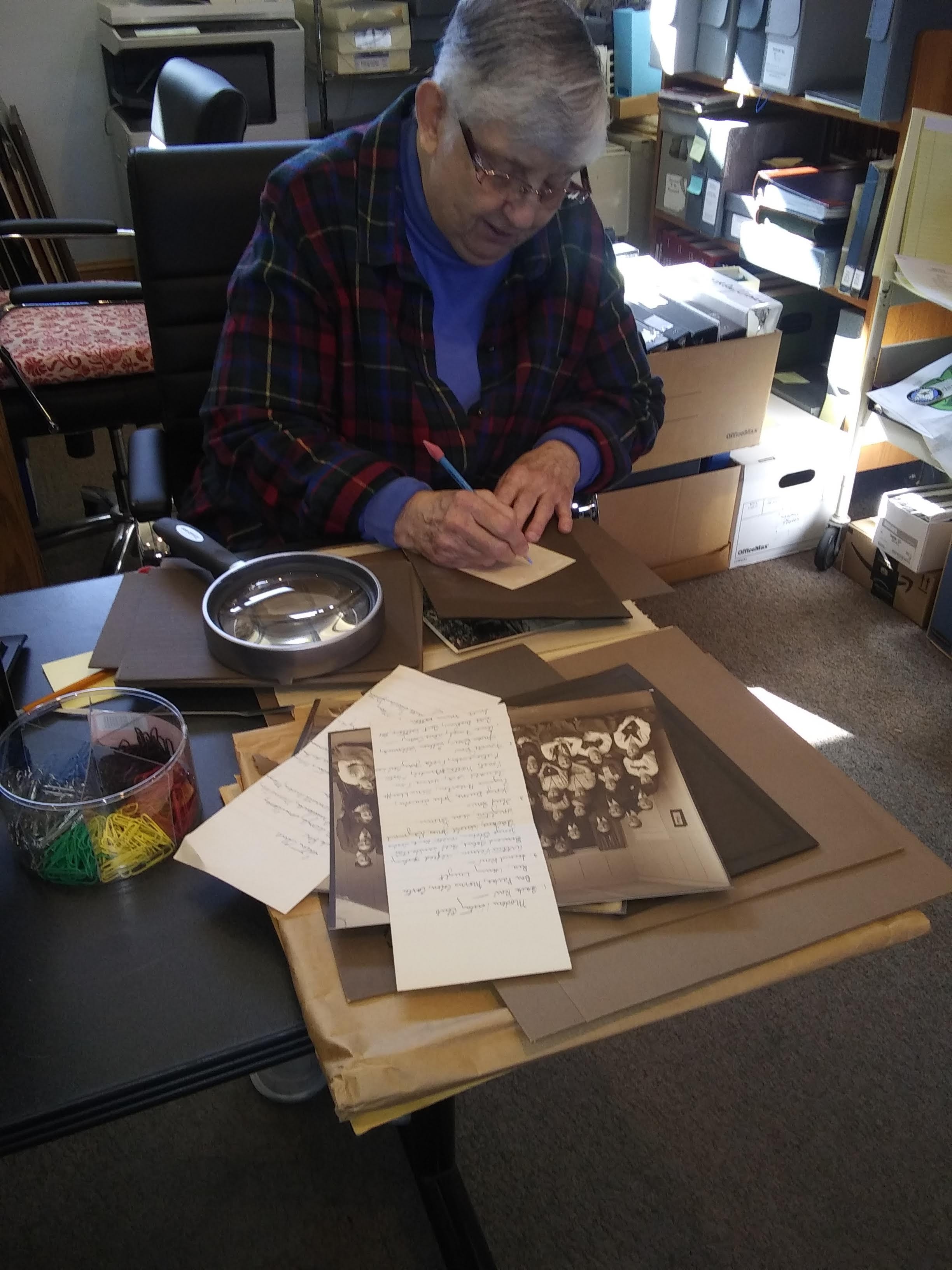
An older woman sits at a desk writing notes about the historic photos spread out in front of her. A magnifying glass sits on the desk to her right.
Carol, a retired librarian and one of the library's longest-serving volunteers, works on researching and describing materials in a donated collection.
 

For every accepted donation, we catalog the collection in our online catalog. The materials often need to be arranged for best preservation and ease of use by future researchers. Sometimes this means maintaining the original order used by the collection creator (scrapbooks, for example), but it often means creating a logical order out of something that seems like chaos. Information provided by the donor can be helpful in determining the arrangement, especially if there are any privacy or intellectual property concerns. For example, a collection of photographs could be organized by the contents of the photos (e.g. all of the portraits together) or by photographer if there is more than one. If the intellectual property is held by the photographer and not the donor, it often makes more sense to organize the photos by photographer so that we can more easily answer questions about copyright, digitization, and duplication. Finally, we describe the collection in a finding aid. Finding aids provide information about the collection to help researchers identify relevant materials and navigate access and use of the collection. They are usually more detailed than the entries in the online catalog, and they follow a format that most other archival repositories use. In addition to our online catalog, researchers can find our collections using EmpireADC, a state-wide finding aid discovery platform. 

After the initial cataloging, we transfer the materials into archival/preservation housing such as acid-neutral folders, photo sleeves, and specialized archival boxes. While we work on processing the collection, the library volunteers and I implement necessary preservation solutions such as creating digital copies of at-risk media like VHS tapes, copying newsprint materials, isolating materials that may have mold or pest damage, flattening rolled or folded materials, and stabilizing oversized/fragile/damaged materials. Once the collection is processed and stabilized, the materials are stored with the other archival collections in our climate controlled vault. We regularly monitor the area for preservation concerns such as changes in heat/humidity or the presence of damaging agents such as pests and water. 

A young woman with curly hair stands next to a table, bending over and holding a camera, taking a photo of a scrapbook. The scrapbook sits on a table with lights and gray foam blocks to make photographing it easier.
Brynn, one of our newest library volunteers and soon-to-be library science student, photographs a donated scrapbook. Scrapbooks often present a variety preservation concerns, so photographing is one way we can preserve the content.
 

Researchers who want to view or use the collection can make appointments in the library. The finding aid will note if any materials are restricted due to privacy, intellectual property, or preservation concerns. As the collection is used, we may need to update the finding aid and catalog record with any new additions to the collection from the donor or new information that comes from researchers using the collection in the future. Materials in the collection that appear to have significant research value (e.g. something unique to Schenectady's history or a person with a regional/national/international impact/reputation) and clear intellectual property rights will be evaluated for potential digitization and future blog posts or other promotional activities. We add digitized collections to our NY Heritage site.

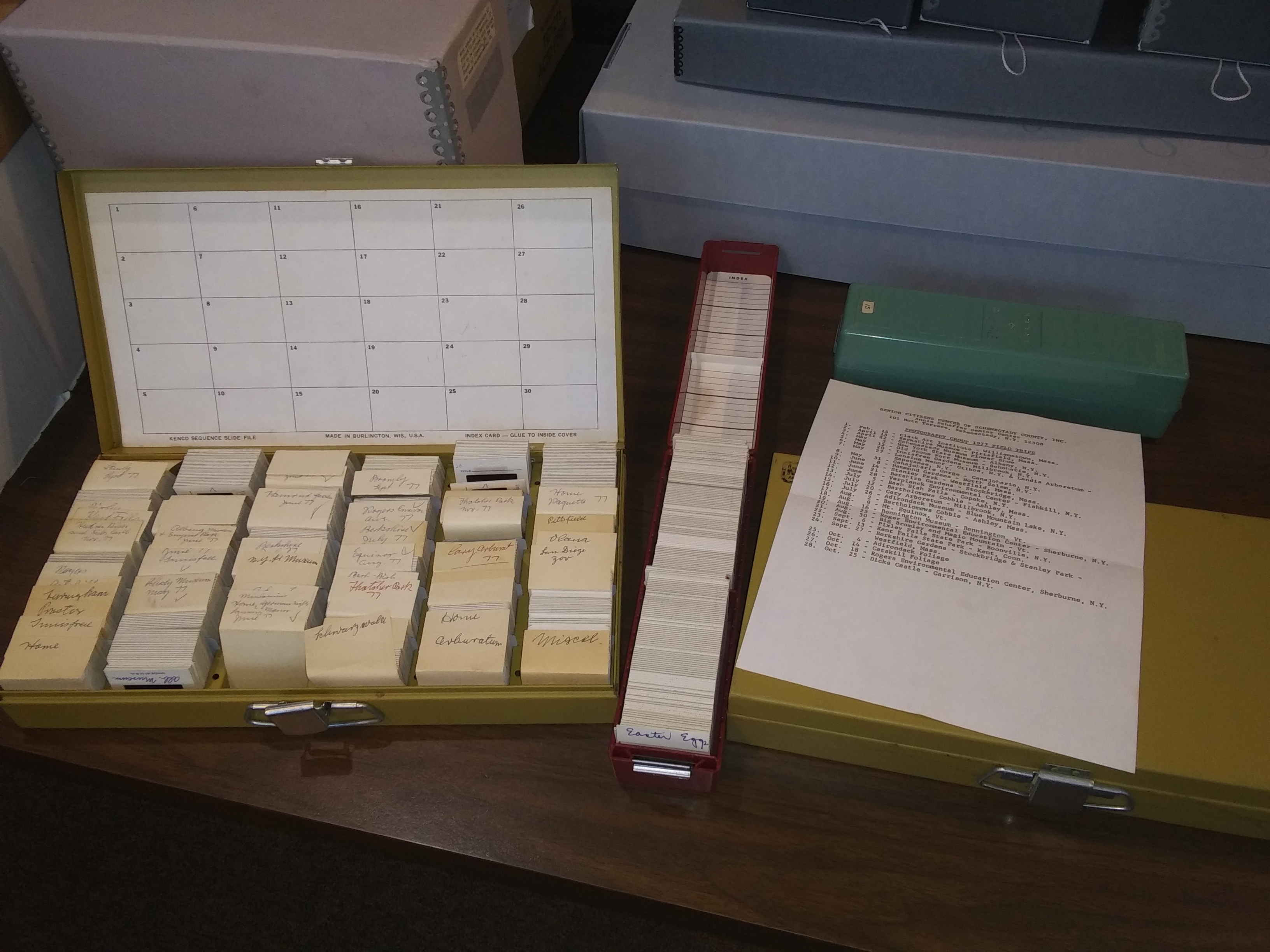
Part of a newly donated collection of slides from the Annie Schaffer Senior Center Photography Club, ready to be processed.


Friday, October 7, 2022

Archival Storage System Upgrade

It’s an exciting time for the library! We are preparing to upgrade the shelving in our archival collections area. The new shelves are a much-needed improvement which will increase our storage capacity by 65%! This upgrade will ensure our ability to continue collecting historic documents, photos, maps, videos, and music of Schenectady County. 

Installation is scheduled for mid-November, so we’ve spent the summer and early fall preparing, including inventorying collections, rehousing materials, and stabilizing fragile materials. The next step in our preparations is to move approximately 860 linear feet of archival materials from the vault into the library research room to make space for the new storage system and keep the materials safe during the installation. Once the materials are safely moved, we can remove the old storage shelves and prepare the vault for installation. After the installation, we can return the materials to the vault. Because the archival materials will take up all of the available space in the research room, the library will be closed to the public starting October 10th. The library will reopen December 12th.  


We've started moving the boxes from the vault up to the library research room. All available space on the shelves, tables, and floor will be used for temporary storage.

Please contact the librarian, Marietta Carr, if you have questions or if you would like to help move boxes: librarian@schenectadyhistorical.org or 518-374-0263 x3.