This post was written by library volunteer Diane Leone.
In recent years, historians have taken an
interest in community cookbooks as valuable primary sources for understanding
not only foods and cuisine over time, but also the larger life of the
communities from which these texts originated.
Community cookbooks, also called charities, have a history stretching back to the Civil
War, when Maria J. Moss assembled recipes for what became A Poetical Cook-Book (1864), which was sold to raise funds for
wounded soldiers. Her brainchild became
so popular that, according to Feeding
America, from 1864 to 1922 a variety of community groups produced over
3,000 charity cookbooks (Stoller-Conrad). Charitable causes included helping wounded
veterans, widows and orphans. Still others
were motivated by social and political issues such as temperance, poverty, and
suffrage. Almost exclusively run by
women, many, though not all, of these groups were religious in nature. The
development of cheap printing techniques in the first half of the twentieth
century led to greater popularity of the community cookbook, defined as follows
in the McIntosh Cookery
Collection at the University of Massachusetts Amherst: “The typical
community cookbook was a profoundly local affair, produced by church or
community groups, fraternal organizations, or charities using recipes submitted
by members, and edited and published locally, aimed almost exclusively at a
local audience” (“Community Cookbooks”).
The five texts under consideration
(see insert above) are community cookbooks produced by local groups—four
church-affiliated—in the city of Schenectady.
Of the group, the Tabernacle Housewives’Guide is the only title not in the Grems-Doolittle Library collection,
although available online, as is the 1903 text.

These texts reveal considerable information about
food, recipes, and cooking techniques over a period of eighty-nine years, from
1890 to 1979. One of the most obvious
features of the recipes is the manner in which they are presented. In the earliest books, each recipe is laid
out in paragraph form. An example is a
recipe in the Schenectady Cook Book (1903): “Muffins. — One pint sweet milk,
two eggs, one tablespoonful of melted butter, three cups flour, pinch of salt,
three teaspoonfuls baking powder. — 0. B.” Both the 1890 and 1903 texts (see
photo above) follow this paragraph format, which sometimes omits instructions,
and at other times includes them. The 1913 text, however, is transitional; while
it features some recipes in paragraphs, it also includes those which list
ingredients first, followed by preparation instructions. This is the format used today. This change
was influenced by the rise of cooking schools, and particularly by Fanny Farmer
– author of the Boston Cooking-School Cook
Book (1896) – whose scientific approach to teaching cooking had a major
impact on its future direction.
A review of the books also reveals a change in
the foods consumed over the years. One of
a number of notable differences is in the popularity of oysters in the early
cookbooks. Recipes for this popular
shellfish abound in the 1890 and 1903 cookbooks. Other recipes from 1890 include tripe
(stomach lining, often of a cow) and sweetbreads (thymus and pancreas, usually
of a calf or lamb), which are not popular today. An
assortment of puddings is found in the earlier texts. The 1903 cookbook contains 69 puddings, many with
ingredients such as suet and bread crumbs, which contemporary Americans do not
associate with their conception of pudding as a sweet and creamy milk-based
dessert
Another major feature of the three early
cookbooks is the prevalence of recipes for catsups (the term “ketchup” is more
often used today) ; pickles; and jellies and preserves. While most households around the turn of the twentieth
century had access to a wide variety of store-bought comestibles, food
preservation was still popular among housewives of means. The recipes are varied, including plum
catsup, cucumber catsup, mustard dressing, and other items not currently
thought of as catsup. The variety of
pickles is also quite varied. Although
Americans are familiar primarily with pickled cucumbers, earlier cookbooks
include recipes for items such as pickled string beans, oyster pickles, and
mustard pickles.
The more recent cookbooks, from 1948 and 1979,
reflect culinary changes resulting from new food technology. One example is a 1979 chicken and rice
recipe, which calls for “1 can celery soup, 1 envelope dry onion soup, 1.5 cups
minute rice, 1 can mushroom soup.” It
was not until 1897 that Campbell introduced condensed soups, which were widely
distributed by 1911. Kraft began marketing Minute Rice only in 1946. A recipe for Spinach Torte required 3
packages of frozen spinach, available only in 1930, when Clarence Birdseye introduced
frozen food to consumers.
Later cookbooks also include recipes that
reflect changes in society. World War II
exposed American GIs to exotic foods overseas, which influenced post-war
cuisine. Furthermore, decades of
immigration led to greater familiarity with ethnic foods. The GE cookbook
offers recipes for Pizza Sauce, Chop Suey, and Italian Spaghetti. Filling the “International Fare” chapter in the
1979 text are recipes such as Chicken Kiev, Tamale Pie, Flank Steak Teriyaki,
and Chicken Orientale. The chapter on
“Meatless Main Dishes” reflects the rise of vegetarianism in the 1960s and 70s,
given impetus by Frances Moore Lappe’s 1971 groundbreaking book, Diet for a Small Planet. Another post-war change was the growing popularity
of the cocktail party, made fashionable by renowned American chef James Beard,
author of Hors D'Oeuvre and Canapes: With
a Key to the Cocktail Party (1940). The 1979 book includes appropriate chapters
titled “Appetizers” and “Cooking for Crowds.”
The introduction of the gas stove around the
turn of the 20th century changed the way food was cooked. The early cookbooks, probably written with
coal-burning ovens in mind, do not include oven temperatures, which would have
been very difficult to determine. Instead, instructions include statements such
as the following, in The First Reformed
Church Cook Book (1903): “Have a hot oven at first, then decrease the
heat,” “Bake 35 minutes or until rhubarb
is done,” “Bake in slow oven,” and “Place in an oven of moderate heat.” Some recipes omit oven instructions
entirely. The 1948 and 1979 cookbooks
include cooking temperatures for gas and electric appliances.
Measurements changed over the years as well. Prior
to the twentieth century, people often used everyday utensils to measure food quantities. Thus, occasionally sprinkled among the
recipes in the early books are quantities such as “one gill of melted butter,”
“one teacup of molasses,” “one coffee cup of sour milk,” and “butter size of an
egg.” With the publication of Fanny Farmer’s cookbook in 1896, exact
measurements became the norm. The three early cookbooks reflect the growing importance
of these new standards in their “Weights and Measures” sections, which convert
commonly used utensils into the newly accepted measures. Thus, we learn the following: 4 salt spoons
equals 1 teaspoon, four gills equal 1 pint, and 12 tablespoons equal 1
teacupful. The above photo shows both a
gill and a ½ gill measure (Joshknauer at English
Wikipedia).
 |
| Examples of the types of ads in our community cookbooks. From the 1890 Schenectady Cook Book. |
Full-page advertisements pepper the three
early texts. The growth of packaged
foods, combined with the expansion of the railroads toward the latter part of
the nineteenth century, led to the widespread distribution of new products
around the country. Sales were bolstered
by ads, which are often seen in community cookbooks, sometimes helping offset
the books’ production costs. Royal Baking Powder was one of the largest
advertisers. The Schenectady Cookbook (1890) features a full page ad for this
popular leavening agent. Another favorite
product was Knox Gelatine, created by Charles Knox, who revolutionized the
time-consuming gelatin-making process.
This new packaged item made it easy for any cook to create molds and
aspics. The top of almost every page of
the Tabernacle Housewives’ Guide
features a catchy phrase, such as the following, acclaiming the value of this
product: “For dainty delicious desserts use Knox Gelatine.”
Advertising also crept into the recipes. The 1903 recipe for clear bouillon includes
“Durkey's or Bell's mixed seasoning,” and the 1913 publication cites Quaker Oatmeal
as an ingredient for oatmeal bread and Coleman’s Mustard for salad
dressing. The later books, which do not
include advertising space, feature even more brand names in their recipes: Uncle
Ben’s Wild Rice, Wesson Oil, Crisco, Miracle Whip Salad Dressing, Campbell’s
Soup, La Choy Soy Sauce, and Velveeta Cheese.
While community cookbooks offer glimpses into
culinary habits, they also provide insight into society. The three early texts
are directed toward women of means, as many of the ads suggest. Among those offering goods and services are
jewelers, piano teachers, picture framers, hotels, photographers, homebuilders,
and other providers of what would be considered luxuries for the average
working class family at the time. That
many of these women employed hired help is indicated by two 1903 ads which
feature cooks, one an African-American woman stereotyped in the most racist
way.
Unlike cookbooks today, their earlier
counterparts include sections which contain “recipes” for a wide variety of
domestic chores. The 1890 Schenectady Cook Book offers in its “Miscellaneous”
section instructions on how to blanch almonds, remove ink stains, make laundry
detergent, and whiten one’s hands.

Interestingly,
these early books also advise the woman of the house—generally the caretaker—on
coping with a variety of ailments. This
information would have been useful at a time when infant and childhood
mortality rates were much higher than today, and people convalesced at home. Included in the 1890 and 1903 books are recipes
for the following: cough syrups; preventing cholera; curing felon (infection of
the fingertip); and treating dizziness, scrofula (a tuberculosis infection of
the neck’s lymph nodes), and erysipelas (a streptococcal skin infection). The Tabernacle
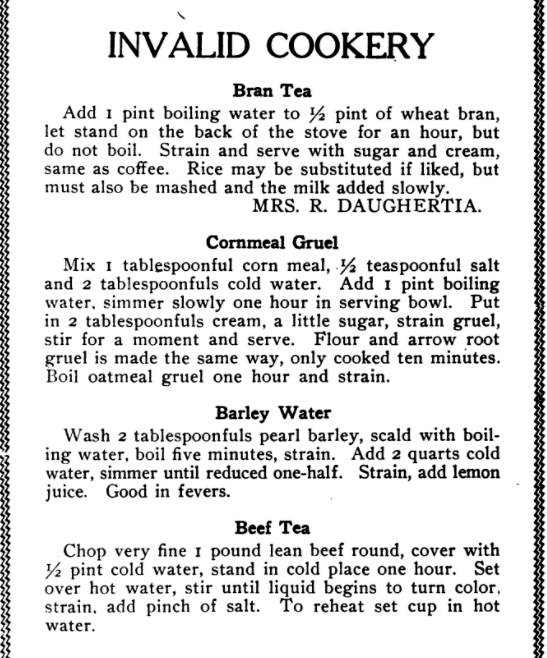
Housewives’ Guide features a section titled “Invalid Cookery,” with recipes
for bran tea, beef tea, cornmeal gruel, and barley water. The other two earlier books offer “Eggs for
Invalids,” which the 1903 cookbook points out, “…will not distress even
sensitive stomachs.”
Earlier cookbooks are often strewn with
literary quotations. As Janet Theofano writes
of the cookbook authors in Eat My Words:
Reading Women’s Lives through the Cookbooks They Wrote, “Primarily
conscientious and busy housekeepers attending to the needs of their families,
they displayed their education and their knowledge of elite culture even in
cookery books” (142). The 1890 and 1914
texts preface many chapters with quotations, often Classical or Shakespearian,
generally related to the genre of food being introduced. For example, the soup chapter in 1914 is
begun with an excerpt from Cicero: “Hunger is the best seasoning,” and a
Longfellow couplet adorns the chapter on pies.
The salad chapter in 1890 begins with a passage from Shakespeare’s Antony and Cleopatra: “My salad days
when I was green in judgment.”

Religion played an important role in
women’s lives in the nineteenth and early twentieth centuries. They were
expected to be models of correct behavior for their husbands and children. Although the early cookbooks in this survey do
not contain many overt references to religion, the 1890 and 1903 texts feature
a recipe for Scripture Cake, a common item at the time, mixing ingredients with
specific biblical passages, so that the lady of the house can study scripture
while cooking. The recipe, as presented in 1903, begins as
follows: “One cup butter, Is. 7:15; three cups sugar, Jer. 6:20; three and
one-half cups flour, I. Kings, 4:22.” Although written much later in the
century, The Episcopal Church Women’s
Cook Book of 1979 was also compiled by a church-affiliated group, and
states at the outset that “Hospitality is one form of worship.” It lovingly
incorporates religion into the text, with a section on a history of foods from Bible
lands (see photo above), including recipes, and a story of wheat and grapes,
commemorating the Eucharist.
Women of a century ago were expected to behave
as good wives and mothers. Typical of period cookbooks are life recipes, which
advise women on upholding one’s role as the moral center of the household. The 1914 text includes the recipe, “How to
Grow Meek and Patient: Take two small, irrepressible boys to your heart, and
home. After ten years, if you are not meek as Moses and as patient as Job, it
will be because you have not improved your opportunities.” One of the more
common “recipes” often featured in early community cookbooks is titled “How to
Preserve a Husband.” Interestingly, this
appears only in the 1948 text, placed before the table of contents, perhaps as a quaint reminder of
earlier times. It reads:
"Be
careful in your selection. Do not choose
too young and take only such varieties as have been reared in a good moral
atmosphere. When once decided upon and
selected, let that part remain forever settled and give your entire thought to
preparation for domestic use. Poor
varieties may be made sweet and tender by garnishing them with patience well
sweetened with smiles and flavored with kisses to taste; then wrap them well in
a mantle of charity, keep warm with a steady fire of devotion and serve with
peaches and cream. When thus prepared
they will keep for years."
 These women were also expected to manage a
household efficiently. Many ads promoted
this belief. The Van De Carr Spice
Company’s 1890 ad tells potential customers that “Economy is wealth.” According to a 1903 ad for The Schenectady
Trust Company, “Modern women of intelligence and standing find a bank account
absolutely necessary for their personal and household affairs.” A knowledge of
cooking was essential for any lady of the house. Gracing the inside cover of the same cookbook
is a bookstore ad, featuring a poem, “She Could not Cook.” The bride in the poem “…went to a book-store
and bought a cook-book as every wife ought.”
Another company, Barhyte & Devenpeck, purveyors of baking flour,
will “Guarantee light bread/And pastry, and light-/hearted women.” Another
important aspect of running a home is the subject of an ad in the 1914 cookbook by Guarantee Polishing & Plating:
“Look over your silver. – Would you feel ashamed of it if you were entertaining?”
Community cookbooks also reveal information on
local society. In the five texts under
consideration, the names of the recipe contributors and in some cases, the
cookbook committee members, are indicated; this can be an aid in examining the activities
of Schenectady citizens. In the earlier
books, the numerous ads provide insight into the variety and locations of
businesses operating in Schenectady and other localities over a specific time
period. The most interesting source for
local history is the Episcopal Church
Women’s Cook Book of 1979, which offers a brief overview of inns, taverns,
breweries and bakeries operated by parishioners throughout the history of the church. It also traces the role of the St George’s Ladies
Industrious Society in raising funds, since 1833, for a variety of projects,
including a church, Sunday School, a new church tower, a parish house, and
church restoration.
Community cookbooks are a wonderful resource
for tracing the evolution of food trends, as well as the life of society at
both national and regional levels. Today,
online kits have made self-publishing easier than ever. Perhaps future readers will comb them for
historical gems, as we do today.
Works Cited
"Community Cookbooks." Special Collections and University Archives UMass Amherst
Libraries, 2017, http://scua.library.umass.edu/cookbooks/?page_id=202.
Stoller-Conrad, Jessica. "Long Before Social Networking, Community Cookbooks Ruled The
Stove." Northeast Public Radio, 20 July 2012, http://www.npr.org/sections/thesalt/
2012/07/18/156983942/long-before-social-networking-community-cookbooks-ruled-the-stove.
Theofano, Janet. Eat My Words: Reading Women’s Lives Through the Cookbooks They
Wrote. Palgrave, 2002.