Showing posts with label Mohawk River. Show all posts

Thursday, April 11, 2019

Glenotia Park

This post was written by library volunteer Diane Leone

In the early decades of the twentieth century, a recreational gem sat just on the doorstep of downtown Scotia. In 1907, a tiny island in the Mohawk River, once called the Isle of the Mohawks, was leased by the newly created Scotia Athletic Association from the Sanders family, owners of a riverfront home, now the Glen-Sanders Mansion. The lessees hoped to create a sports and recreational venue, which they named Glenotia Park, for Glenville and Scotia. The lease was granted with the proviso that there would be no disorderly conduct, hard liquor, or late-night carousing. Although the athletic association lost its lease after five years, the park continued to operate under different proprietorship. Until its closure in the early 1930s, Glenotia was the scene of many picnics, swimming lessons, ballgames, dances, and other forms of entertainment.

Idyllic scene of Glenotia Park in 1920. Courtesy of the Larry Hart Collection in the Grems-Doolittle Library & Archives.
Over the years, Glenotia was a favorite summer gathering place. Clara Wege McGuire recalled riding the Crane Street Trolley over the Washington Avenue Bridge, and walking from the stop near the Sanders residence down to the park. The island was accessible via a portable pontoon bridge that spanned the Mohawk’s narrow inlet, called Sanders Creek, at the end of S. Ballston Avenue. The association built a baseball diamond and a one-eighth mile track to accommodate athletic events. Crowds came to cheer on a variety of locally formed baseball teams that vied against each other. Scotia High School’s first track meet on May 22, 1909 was a big event, with the community participating in a parade that marched down Mohawk Avenue. The team defeated Altamont, Rensselaer, and Schoharie. In the fall of 1924, while a football field was being constructed at nearby Collins Park, the Glenotia ballfield was the practice site for Scotia High’s first official team, which played games against opponents from Catskill, Little Falls, and Johnstown.
The pavilion at Glenotia park. Courtesy of the book Glenville, NY: Images of America.
Young people enjoyed Saturday night boating, as well as dances, held in the upper part of a two-story wood pavilion built on stilts to protect it from the ravages of winter ice and spring floods. The structure featured a concession stand and a lower level for picnickers. While most people were respectful, the constables and deputies on duty had to deal with occasional troublemakers. One man who attempted to instigate trouble at a dance was thrown into the river by Deputy Phil Kline, to the delighted cheers of everyone.

Other forms of evening diversion were traveling shows and movies. One show, titled Ten Nights in a Bar Room (1910), was based on the 1854 pro-temperance novel. The accompanying advertisement was for Kickapoo Indian Juice and Body Purifier, a well-known patent medicine of the era. A park patron noted that fight movies were shown for adult males inside a tent. Young boys were relegated to the outside, where they had to peek into the tent to watch the the “flickers.” One controversial film was the 1910 heavyweight bout, at the time dubbed “The Fight of the Century,” in which Jack Johnson knocked out James J. Jeffries, becoming the first African American heavyweight champion. As a result of racist attitudes, the film was the subject of censorship in many places, including Scotia. Since Glenotia was outside the village boundary, the film was shown there. The 1915 Johnson-Jess Willard bout, in which Johnson lost his title, was also shown.

Billboard advertising the Mohawk Swimming School. Courtesy of the
Larry Hart Collection in the Grems-Doolittle Library & Archives.
Many area residents had fond memories of traditional summer pastimes, such as picnics and swimming. One woman, reminiscing years later about Saturday church picnics, recalled that while the men worked at GE from 6 am to noon, the women would transport and prepare the food, anticipating the arrival of their husbands and male relatives. As she describes a childhood memory of soaring over the water in a swing, “I can feel the breezes now as they blew up my petticoats and dress revealing the Hamburg ruffle on my ‘short drawers.’” 1
Swimmers at the Mohawk Swimming School.
Courtesy of the Larry Hart Collection in
the Grems-Doolittle Library & Archives.
Swimming was a popular activity at Glenotia. Launching into the river from long ropes attached to trees was a favorite pastime. As Clara Wege McGuire pleasurably recalled: “Once at the river, what a day it would be! As a child there was no way to describe it, except that it was worth a whole year in school to look forward to it.”2

Dredging for the Barge Canal deepened the river, leaving a gravel beach area. In 1915, after Claude and George Chrisman’s brief unsuccessful stint at running a swimming school, German immigrant Werner Gewecke leased the island, opening the Mohawk Swimming School, which was incorporated into the park. He promoted it widely, and even arranged with the Schenectady Railway Company for a bargain fare for trolley riders bound for Glenotia. One ad for the school promised a “Large Bathing Beach — Big Diving Tower & Floating Tables. Swimming Taught in Scientific Way.” He charged $ .05 for park admission and $.10 for swimming. To attract customers, he constructed bathhouses, fortified the beach with extra sand, and built a movable multi-level diving platform. A refreshment stand sold ice-cream. Gewecke’s technique was to suspend students from harnesses attached to the side of his boat so that they would learn to swim safely. Aspiring swimmers were assured that they would learn by the end of the summer. As the sign on Gewecke’s boat read: “We guarantee you will swim or your money back!”3
Courtesy of the book Glenville, NY: Images of America.
Glenotia’s popularity waned as the years brought social and economic changes. The growing accessibility of the automobile made it easier to travel to recreational sites that were farther away. Radio became a household fixture, opening up a new entertainment format that kept some people at home. With the 1929 stock market crash and the onset of the Depression, disposable income dried up. Sadly, on top of all these developments, the pollution of the river made swimming hazardous. According to Gewecke’s daughter Ruth, her father closed the swimming school in 1927, although the Schenectady County Historical Society’s book on Glenville gives 1930 as the closing date. The pontoon bridge was removed, as was the pavilion, whose wood beams were incorporated into a home near the river. The once-popular park closed in 1931-32, meeting the same fate as Rexford’s Luna Park and Forest Park in Ballston, two local amusement parks from the same period.

For years, Glenotia remained unused and forgotten, with ownership changing several times since the park’s closure. It was returned to the public’s awareness in 2012 when the 19 acre island was placed on the market for $91,900, as reported in the Daily Gazette. Since the land is designated as a conservation zone, usage is limited. However, the island could be utilized for recreational or educational purposes. Today, it remains just offshore, overgrown, a deserted piece of the past.

Quotations were taken from newspaper articles on file at the Schenectady County Historical Society under “Glenotia Park.”
1. "More of Ruth O's Memories," Scotia-Glenville Journal, April 14, 1976.
2. “Little-Known Glenotia Park Was Popular Spot,” Schenectady Gazette, June 23, 1979.
3. Hart, Larry. “Glenotia Park Was a Popular Place,” Scotia-Glenville Journal, April 22, 1993.

Monday, November 9, 2015

Larry Hart News Negatives Part I

It always feels nice to finish a large project. One such project was the scanning of the Larry Hart News Negatives from our Larry Hart Collection. Volunteers Victoria Bohm and Robert J. Jones digitized almost 5,000 negatives from this collection in order to make them more accessible for researchers. Larry Hart was a photographer and reporter for the Union-Star as well as a reporter for the Schenectady Daily Gazette where he remained a columnist until his official retirement in 1980, although he continued to write freelance. He was mainly a political reporter but, is probably best known for his historical column, “Tales of Old Dorp” which first appeared in the local section of the Daily Gazette on May 14, 1974, and ran through the 1990s.

This collection is a compilation of both black and white and color negatives in a variety of sizes. The subject matter of the negatives varies widely and there are negatives of accidents, fires, building openings, and demolitions (as seen in this previous blog post: http://gremsdoolittlelibrary.blogspot.com/2012/11/accidents-fires-openings-and_19.html).  As well as images of sports and recreation, construction, farm life, parades, and street scenes all throughout Schenectady County. The photos below are some of my favorites, and since it was tough to pick out so few, a second blog will be posted next week that features some more of these great scenes of life in Schenectady.

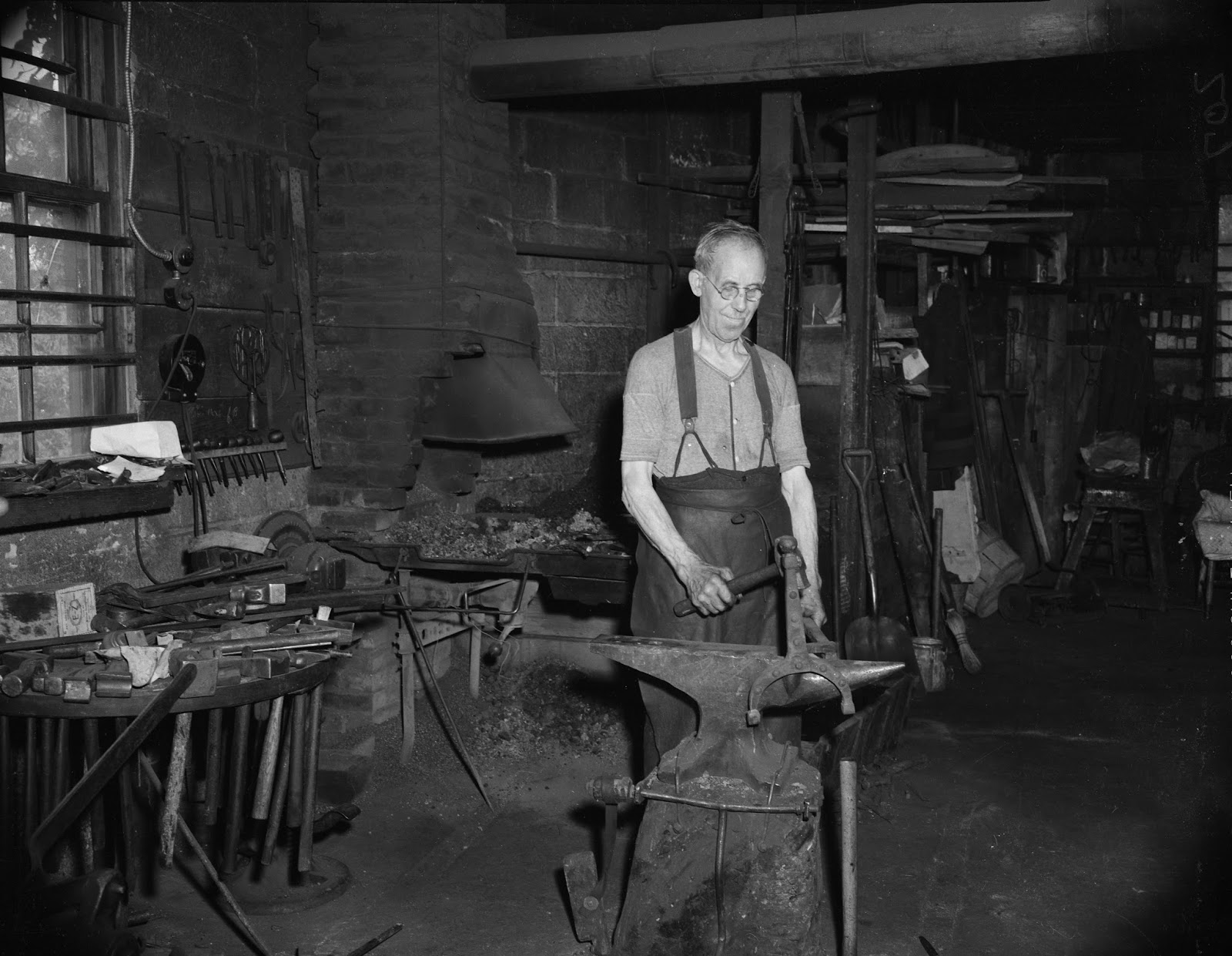
This photo from July, 1948 shows Freihofer's blacksmith making horseshoes for their delivery horses. Freihofer's ended delivery by horse and wagon in 1962


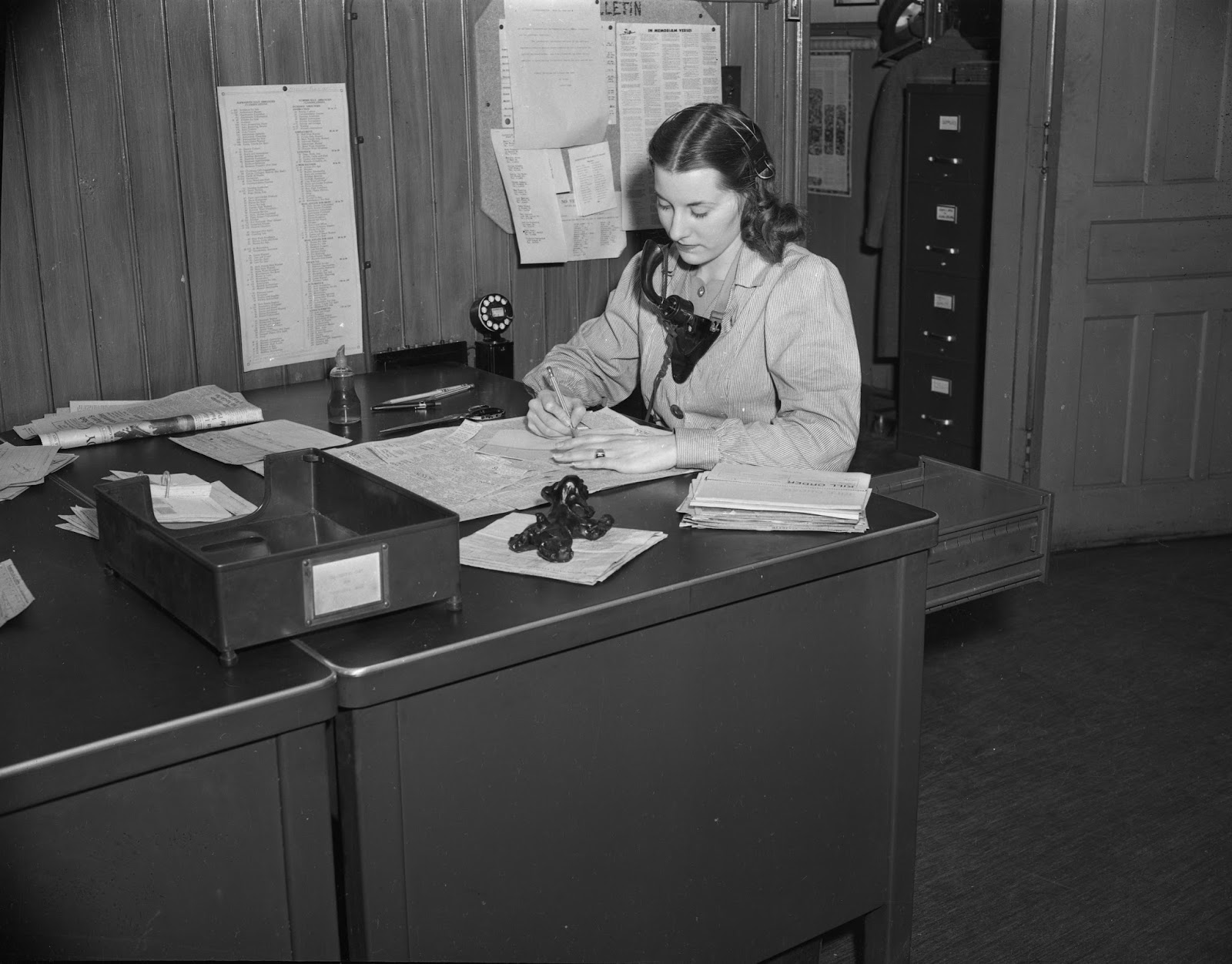
The News Negative Collection features behind the scenes photos of the Daily Gazette. In this photo, a copy reader for the Gazette is working at her desk, wearing what looks to be a hands-free Dictaphone.
Construction worker showing his patriotic spirit.
Think this young fisher by the Mohawk River caught anything? 
This rather adorable photo was taken in the old headquarters of Schenectady's fire department on State and Veeder. It was opened on July 1, 1900 and used as a fire house until the new central station on Erie boulevard was opened. After it closed as a fire station, the Schenectady Police Department used it as the headquarters for its traffic division and it became known as the traffic barn. The building was condemned in 1950 and razed in 1956.


Up to his neck in pumpkins!
The testing of a tank (Possibly an M48?) made by ALCO. This photo was most likely taken at the U.S. Army Reserve Center in Niskayuna where they had a testing ground for new tanks. Comment below, or email Mike at librarian@schenectadyhistorical.org if you know what type of tank this is.


Ever wonder what the inside of the clock tower in City Hall looks like? This photo from the 1950s shows a man repairing the clock mechanism.
This amazing night time shot taken from Broadway highlights Schenectady's industrial side. 
 
-Mike Maloney

Friday, July 4, 2014

Summer Fun in Schenectady's History

Swimming revelers play at "Tempting Father Neptune" in the Mohawk River in this photo circa 1910. Image from Larry Hart Collection. 


Summer is here! Celebrate the season with these photographs of summertimes of yesteryear in Schenectady. They are best enjoyed with an ice-cold glass of lemonade, a slice of watermelon, and a breeze coming through a window screen.

Interested in learning more about Schenectady County's past in photographs? Visit our Library or contact our Librarian.

Schenectadians congregate in Blesser's Grove, a park which once existed at Albany Street, near where Notre Dame-Bishop Gibbons School now stands. Image from Grems-Doolittle Library Photograph Collection. 

Children swim in Schenectady's Central Park in this photo taken during the 1920s. Image from Larry Hart Collection. 


This 1899 photo depicts golfers on the Mohawk Club golf course. Incidentally, the man putting is Willis T. Hanson, Jr., who would later author the book History of Schenectady During the Revolution. His father, Willis T. Hanson, Sr., best known as the promoter of Dr. Williams' Pink Pills for Pale People, stands at right. Image from Larry Hart Collection. 


Enjoying a picnic lunch along the banks of the Mohawk River, ca. 1905. Notice the boat pulled up to the bank at left. Image from Larry Hart Collection. 


Swimmers frolic at the Grout Park pool in Schenectady in this July 1941 photograph. Image from Grems-Doolittle Library Photograph Collection. 

Spectators watch as two children have a footrace in Central Park in 1909 during a picnic outing. Image from Larry Hart Collection. 

Swimmers pose in caps and suits in front of the Mohawk Swimming School building in Glenotia Park, ca. 1915. The Mohawk Swimming School operated out of Glenotia Park from 1912 to about 1928. The park was located on the island off the Scotia shore alongside the Glen Sanders Mansion. The 10-acre park began to be developed in 1907 and also included a picnic area, baseball diamond, and a pavilion for dances. Image from Larry Hart Collection. 

Crowds gather in Crescent Park (now Veterans Park) for a celebration following a July 4th parade on State Street in 1880. Image from Grems-Doolittle Library Photograph Collection. 

A family enjoys a picnic meal during a car camping trip in July of 1927. Image from Larry Hart Collection. 

Children play in the old fountain in Crescent Park (now Veterans Park) in Schenectady in 1946. Image from Larry Hart Collection.  

Wednesday, June 18, 2014

Schenectady Boat Club

Postcard of Schenectady Boat Club clubhouse on the Scotia side of the Mohawk River, opposite present-day Riverside Park, ca. 1910. Image from Grems-Doolittle Library Postcard Collection.

"The vigor of manhood which has guided the club's activities during eight years of unfailing success is unabating and as succeeding years find new faces in its executive councils and wearing its insignia in athletic events, the same daring and unconquered spirit of their predecessors is dominant."
         -- The Periscope v. 1, n. 1 (December 1915)

As spring turns to summer, more and more boats can be seen traveling along the Mohawk River near our library in Schenectady's Stockade neighborhood. In a salute to the spirit of the season, we are featuring some images related to the Schenectady Boat Club.


These images from The Periscope showcase events at the Schenectady Boat Club's annual regatta. Image from the collections of the Grems-Doolittle Library. 

The Schenectady Boat Club was first established after a general interest meeting in 1907. The group originally met in the old city pumping station in present-day Riverside Park, on the Schenectady side of the river. They soon raised $15,000 to purchase and and build a clubhouse. By 1909, the Boat Club had erected its clubhouse on the Scotia side of the Mohawk, located just a few hundred feet east of the bridge that ran from the foot of Washington Avenue in Schenectady to Scotia. The spacious two-story clubhouse included offices, a meeting room, lounge and pool room, showers, restrooms, and lockers on the first floor, while the second floor was a large ballroom used for dinners and dances. Fireplaces, a victrola and piano, and places to play cards provided a convivial atmosphere. The club's grounds also included a dock and a boat storage shed. Within a few years tennis courts and a rifle range were added to the grounds.


Officers of the Schenectady Boat Club in 1920. Front row, left to right: Noel E. Bensinger (Treasurer), Winfield D. Bearse (Vice President), Walden D. Brough (President), Floyd T. Smith (Secretary), Donald K. Frost (Captain). Back row, left to right: John W. Randall, Guy M. Jones, J. Wiggins Collamer, Stuart J. Knight, Charles A. Simon, Eugene Johnson. Image from Larry Hart Collection.

The cover of the constitution and by-laws of the Schenectady Boat Club. The cover features an image of the club's official flag. Image from the collections of the Grems-Doolittle Library. 


Although the primary purpose of the Schenectady Boat Club was devoted to boat recreation -- including motorboating, canoeing and canoe sailing, river cruising, inter-club competitions and their annual regattas -- the club offered plenty of other social, athletic, and recreational opportunities, including suppers, lectures, smokers, dances, ski trips, automobile cruises, and card tournaments. Members of the club organized their own tennis and bowling leagues, went swimming and ice-skating, and opted to create a golf course on their property in 1922. With the addition of the golf course, membership increased from 300 to 500, and the focus switched from boating to a general country club. In accordance, the Schenectady Boat Club changed its name to Schenectady Country Club in January 1925.


This fanciful vision of the Schenectady Boat Club's future on the Mohawk River is depicted in a cartoon that appeared in The Periscope, the newsletter of the Boat Club, in 1916. The Grems-Doolittle library holds a run of The Periscope from the inaugural issue in December 1915 through the February 1926 issue. Image from the collections of the Grems-Doolittle Library. 

In 1978, only the foundation of the old Schenectady Boat Club clubhouse was still in existence. The building was razed after a fire in 1941. Harold N. Hyde, a former member of the Schenectady Boat Club, lays his hands on the remains of the foundation. Image from Larry Hart Collection.