Showing posts with label World War I. Show all posts

Thursday, November 10, 2022

The Last Man’s Club of Schenectady: Local Heroes of World War I

This post was written by library volunteer Diane Leone.

Men and women who serve in the military together, particularly during wartime, form a tight bond that often lasts a lifetime. One way that veterans have maintained those bonds is through what are called Last Man’s Clubs--also called Last Man Clubs--which have a long history. Meeting annually to maintain their connection, these groups often continue a custom of purchasing a bottle of wine, which is saved and passed through the group, to be opened and drunk only by the last surviving member of the club.

Company E (top) and F (bottom) of the 105th Infantry of the 27th Division. From "Schenectady's Part in the World War, 1918," SCHS Grems-Doolittle Library Documents Collection
 

One such club of World War I veterans was located in Schenectady. The organization may have started in 1921 -- although one source says 1933 -- with a membership of 98 men from the 105th Infantry Regiment, which served in Belgium and France. These local veterans were primarily from Companies E and F, as well as Headquarters and Machine Gun Companies. They met yearly at a restaurant as close as possible to April 6, the date on which the United States declared war on Germany. At each meeting they called the roll, commemorated the members who had died during the year, and elected a new head man whose responsibility it was to safeguard the Burgundy wine -- which had been purchased in France by one of their commanders, Lieutenant George E. Ramsey and presented to club members at the club’s inaugural meeting.
 
Several newspaper articles reporting on the club’s later meetings identify some of the members whose names are listed below along with many of their ranks and companies during the war. This information can be found on the website of the New York State Military Museum and Veterans Research Center.  
 

Known Club Members:
Leslie Brooks
Keyes (K.T.) Davis, Corporal, Company E
Kenneth S. Greenough, Wagoner, Supply
Milton H. Hallenbeck, Sergeant, Company F
Earl (E.D.) Hamilton, Stable Sergeant, Machine Gun Company
Herbert H. Horstmann, Corporal, Headquarters Company
Frank Jutton, 1st Class Private, Machine Gun Company
John Kubes, 1st Class Private, Headquarters Company
Theodore (T.M.) Kuhlkin, Private, Company E
Albert Lange, 1st Class Private, Headquarters Company
Edward Long, Private, Company E
T. S. Mabie
Joseph Memelo, Private, Machine Gun Company
George E. Ramsey, 1st Lieutenant, Company E
Ira M. Schermerhorn, Wagoner, Supply Company
John Shepard, 1st Class Private, Machine Gun Company
Edward Smith, 2d Class Musician (equivalent to Private), Headquarters Company
John R. Walsh, 1st Class Private, Company E


Time has blurred the memory of World War I, but that conflict had a great impact on the world. These local servicemen, who participated in some of the most significant battles of the war, were originally part of the New York State National Guard, designated the 6th Division. After serving on the Mexican border in 1916, its members were called up for active duty by President Woodrow Wilson on July 12, 1917, along with all National Guard units in the US. After completing their training at Camp Wadsworth in South Carolina, the men shipped out to Europe in the spring of 1918.

In streamlining the military, the New York troops were re-designated in October 1917 from the National Guard’s 6th Division to the federal system’s 27th Division, commanded by Major General John Francis O’Ryan, the army’s youngest major general. Comprising the 27th was the 53rd and 54th Brigades. The original 27th had a total of 991 officers and 27,114 enlisted men.
 
The 53rd Infantry Brigade consisted of Brigade Headquarters, the 105th and 106th Regiments of Infantry, and the 105th Machine Gun Battalion. The men of the 105th, in which the Schenectady club members served, were called “apple knockers” because the recruits were primarily from the rural areas of Upstate New York, with many having worked in apple orchards. One of the commanding officers of the 105th’s Company E was a local, 1st Lieutenant George E. Ramsey (see photo below). As part of the 53rd Brigade, the 105th participated in the Ypres-Lys Offensive in Belgium, an area of major contention, as well as the Battle of the Somme, one of the most significant of the war. Their objective in that battle was to help break the Hindenburg Line, the sole remaining network of German defenses on the Western Front, which the Allies penetrated on September 29, 1918. 

Members of the 105th Machine Gun Battalion at the Yelverton summer home, circa 1917. From the Larry Hart Collection, SCHS Grems-Doolittle Library.

On October 22, 1918 the 105th received a letter of commendation from John F. O’Ryan, commanding general of the 27th Division, for their “valor, skill and endurance,” not only in helping crack that major line of defense, but also for their performance in subsequent battles. As the general wrote of the former battle:
 

During the battle for the breaking of the Hindenburg Line, the mission of the regiment was peculiarly difficult. The character of the operation assigned made it impossible for the regiment to have the assistance of a barrage. The enemy operating from a flank position at VANDHUILLE held back the division on our left and delivered repeated hurricanes of fire and strong counterattacks against our flank. It was against such fire that the regiment rendered such valuable service in assisting in the shattering of these counterattacks.


By the end of the war, the 105th Infantry saw 253 of its men killed, 1,284 wounded, and 72 who subsequently succumbed to their injuries. The survivors of the 105th returned to civilian life after the war and settled down, some in the Schenectady area, including club members George E. Ramsey, Joseph Memelo, John Kubes and Frank Jutton.
 
The annual meetings of the club, which started with nearly 100 members, inevitably saw a dwindling number of survivors as the years went by. A photograph of a meeting around 1955 includes 24 members, with head man Leslie Brooks (fifth from the left) holding the bottle of Burgundy.
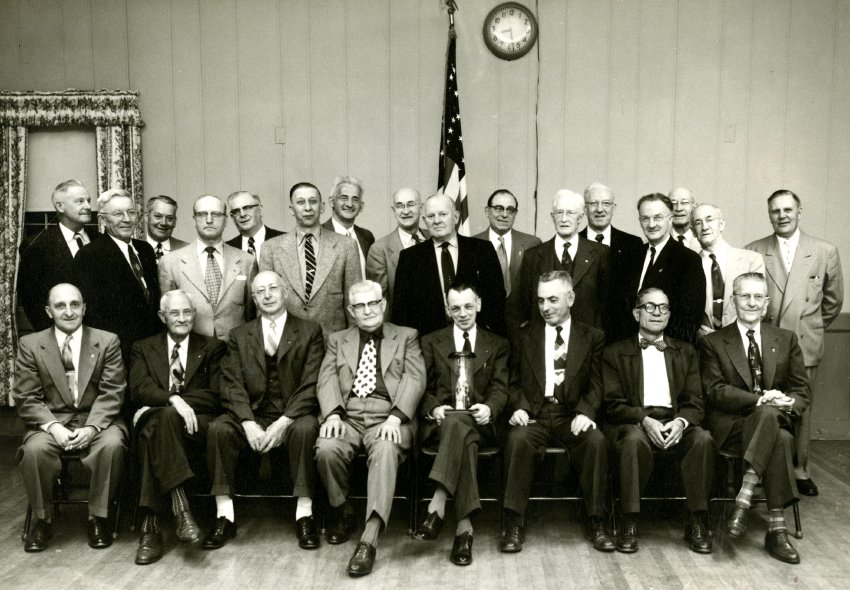
Members of the Last Man's Club post at the American Legion Hall, circa 1955. Photograph from the Larry Hart Collection, SCHS Grems-Doolittle Library.


Years later, a Gazette article, likely from April of 1971, mentions 15 survivors, 12 living locally. A total of 13 attended the annual meeting at the Carlton Restaurant on Becker Street. Surrendering the bottle was head man Edward Long. The other men who held positions of responsibility were John Kubes, assistant head man; Herbert Horstmann, chaplain; Kenneth S, Greenough, secretary-treasurer; and T. S. Mabie, permanent dinner chair.
 
Toward the end of the decade, probably 1978, the group of five out of nine survivors met at the Mohawk Club. Joseph Memelo was the head man. The other attendees were Frank Jutton, Albert Lange, Edward Smith and John E. Walsh, who came from California to attend. Three years later, on April 4, 1981, the club met at the American Legion Post 21 headquarters. Walsh surrendered the bottle of burgundy to Memelo (second from the left), the head man for 1981. The group met until 1987, when Joseph Memelo was the only member left.
 

Lt. Ramsey of Company E, 105th Infantry, and member of Schenectady Last Man's Club. From "A Short and Illustrated Roster of the 105th Infantry, United States Army: Col. James M. Andrews Commanding, 1917." SCHS Grems-Doolittle Library.


The following are brief biographies of a few of the club members, taken mostly from newspaper articles and obituaries:
 
George E. Ramsey was born in 1872 in Luzerne, New York. He had a long and exemplary military career in both the US Army and New York State’s National Guard. He served in the Spanish-American War, re-enlisting in 1916, when he was sent to the Mexican border and the next year to Europe as a lieutenant in the 105th. He was promoted to captain in 1918. After the war he held several civic positions, including deputy sheriff of Schenectady County (1920), police court clerk (1923), and Schenectady’s commissioner of public safety (1925), while ultimately attaining the rank of major in the National Guard. He died in 1936 and is buried in Vale Cemetery in Schenectady.
 
A Schenectady native, Frank Jutton was born in 1896 and worked for 42 years as an inspector in the Large Motor and Generator Division at General Electric, from which he retired in 1958. He died in 1983 and is buried in Memory Gardens Cemetery and Memorial Park in Colonie.
 
John Kubes, born in 1890, lived most of his life in Schenectady, although he hailed from New York City. After the war he served for 30 years as a firefighter, being promoted to lieutenant in 1947 and ending his career in 1961 as a captain. He died in 1985 and is interred in Most Holy Redeemer Cemetery in Niskayuna.
 
Joseph Memelo was the baby of the club. Born in Schenectady in 1899, he was a 16-year-old high school student who lied about his age to join the National Guard in 1916. After the war he worked in the printing trade, first as a salesman, later as a co-founder of the Schenectady Printing Company, from which he retired in 1975. He died in 1993 at the age of 93 and is buried in St. Anthony’s Cemetery in Glenville.
 
Mr. Memelo had the bittersweet distinction of being the last man standing from a group of American heroes.
Pvt. Joseph Memelo of Machine Gun Company, 105th Infantry, and last member of the Schenectady Last Man's Club. From "A Short and Illustrated Roster of the 105th Infantry, United States Army: Col. James M. Andrews Commanding, 1917." SCHS Grems-Doolittle Library.


Bibliography


Friday, November 9, 2018

Armistice Day in Schenectady


Today marks the 100th anniversary of the very first Armistice Day parade in Schenectady. Armistice Day was originally a commemoration of the ceasefire on the Western Front of World War I. The act that made Armistice Day a national holiday was approved on May 13, 1938. It stated that November 11 was to be  "dedicated to the cause of world peace and to be hereafter celebrated and known as Armistice Day." In 1954, after two wars that the United States were involved in, Armistice Day was changed to Veteran's Day to honor American veterans of all wars. Armistice Day is scarcely remembered today, but the relief and joy Schenectadians felt when the armistice was announced should not be forgotten.

The Armistice Day Parade on Dock Street. Courtesy of the Grems-Doolittle Library & Archives.
Schenectady was alight with activity starting with the Schenectady Gazette's announcement that the armistice was signed on November 11, 1918 at 5:00 am in Paris (2:50 am EST), stating that the end of hostilities would occur at 11:00 am (6:00 am EST). The celebrations were to began early in the morning and would end up going through midnight. With a population nearing 90,000 people, the Armistice Day celebration was the biggest the city had ever seen. An impromptu parade began at 3:30 am when a young man collected a group of people and started the parade. This group snowballed and soon enough, hundreds of people joined in on the festivities. The Newsboy Association's bugle, fife, and drum corps. kept the marchers in line. As the group marched along the canal down Dock Street, they decided to make a stop at General Electric to try and entice some GE workers into joining. Their plan worked, and the group grew even larger. By 9:00, the group was so large that little progress could be made down the streets.

This 1916 photo shows the members of the Schenectady Newsboys' Association Fife and Drum Corps. The Fife and Drum Corps was first organized in April 1916 with 35 boys from the Newsboys' Association. By the following year, the group had grown to 58. During World War I, the Schenectady Newsboys' Association Fife and Drums Corps marched in uniform in patriotic and military parades. Image from the Larry Hart Collection. 
 Small groups would make their way downtown as well. Children grabbed pots, pans, whistles, and anything they could make noise while older teens whitened their faces with feather dusters and talcum powder. All sorts of vehicles were enlisted into the parade and groups of Union students were seen driving an ash collectors truck. The Gazette wrote about a young boy that they dubbed "The modern Paul Revere." This young boy rode a horse through the streets of downtown blowing a bugle and yelling at people to wake up.

Yet another parade was formed in the afternoon. This parade was just as wild and raucous as the early morning parades, although this one was slightly more organized according to the Gazette. The paraders marched through dinner time and those too exhausted to march stood to the side to anxiously wait for the troops to arrive. The Gazette commented upon "the new position of women acquired during the war" as the women of the Schenectady Motor Corps. arrived "khaki-clad with bright brown leather belts and straps and military caps places at just the right angle."

Merrymakers celebrating in the streets of Schenectady. Courtesy of the Grems-Doolittle Library & Archives.
Shortly after the Schenectady motor corps. passed, the Schenectady County soldiers of World War I marched down State Street. They stood "straight and staunch" and the first to arrive were the warehouse corps, then the New York State Guard. The Army Depot also brought its trucks and ambulances down State Street to show off. The greatest applause was held for the black troops as they marched together without a break in their lines. Next in line were the Red Cross nurses to which the crowd yelled "You've done your share and we're proud of you." Other notable members of the parade was Major John E. McKerracher. McKerracher was in charge of the warehouses in South Schenectady/Rotterdam and was responsible for housing and moving troops as well as transporting equipment. 

The celebrations weren't just for early risers though and a massive nighttime parade formed around 8:00 pm. Marchers organized at Jay and Union and were led over to Washington Ave, back up State, up Albany Street to Hulett and finally disbanding at Nott Terrace. This parade included many bands, including the inexhaustible newsboys' association who were some of the first marchers of the day. Thirteen different military units joined the parade as well as the police, firemen, and just about every fraternal and ethnic organization in the area. Other features of the parade included many large American flags, a poster carried by the Jewish organization which read "Jewish Flag Recognized by the Allies", the Kaiser's coffin which read "The Kaiser is dead," and an armor clad Schenectadian with a sign that read "To Hell With The Kaiser."

The parade marching down State Street in 1918. Courtesy of the Grems-Doolittle Library & Archives. 
The festivities carried on with only only a few cases of "misguided energy." Throughout the day, people placed "torpedoes" on the trolley tracks that would explode when the trolley car ran over them. A piece of steel struck a spectator waiting by the side of State Street, causing a large gash in her cheek. More mischievous members of the crowd found pleasure in throwing talcum powder and other powdery substances in the faces of spectators. The Gazette also expressed displeasure at the late-night intoxicated crowds who contributed to much of the bad behavior. Despite this mischief, the police reported that there were no more arrests than on an average day and most of the work of Schenectady's police force consisted of confiscating talcum powder.

The all-day armistice parade was a release from the stress caused by four years of worldwide uncertainty and fear from the largest war up until that point. As the war went on, neutrality became more and more difficult to maintain and many men and women from Schenectady County joined to help with the war efforts. World War I was a war unlike any other before it, but unfortunately it was not "the war to end all wars." The sentiment expressed by the Schenectady Gazette that "such a day only comes once in the history of a nation" proved to be false as many of the people who celebrated Armistice Day in 1918 would still be alive during V-E Day just 27 years later. 

Thursday, November 9, 2017

Photos of Schenectady's Army Depot during World War I

Former Rotterdam town historian Dick Whalen's home and collection was severely damaged during Hurricane Irene. Former SCHS librarian Melissa Tacke, along with SCHS volunteers worked to salvage as much of his collection as they could (see: http://gremsdoolittlelibrary.blogspot.com/2012/08/a-first-look-at-dick-whalen-collection.html). His collection was a treasure trove of photos and documents from Rotterdam and Rotterdam Junction. Part of the photo collection shows soldiers during WWI at the former army depot in Rotterdam/South Schenectady. The photos mainly show the depot during 1917, but by 1918 it had become a hotbed for the Spanish Flu. By October 1, 1918, 40 men at the depot had caught the flu with 3 dying from it. These photos are an interesting snapshot of what life was like at the depot during World War I.

After the war, the depot was involved with receiving returned material from overseas bases and posts, often being sold through surplus sales. From 1933 to 1940, the base was a headquarters for supplying 55 Civilian Conservation Camps. This new function of the depot allowed it to transition for greater expansion during the outbreak of World War II. Expansion happened again during the Korean War  when 1,300 additional employees were utilized and several more buildings were constructed. The land that the depot was on changed hands a few times after the Korean War and is now part of the Northeast Industrial Park.


Friday, November 11, 2011

Celebrating Veterans Day

In honor of Veteran's Day, we would like to share just a few of the photographs and memorabilia related to local veterans and Veterans Day in our collections:

The first page of a letter from Edna Pilling, a teacher living in Scotia, to Private Joseph Memelo, written on Armistice Day, November 11, 1918. Pilling describes the celebration in Schenectady. "At 3 or thereabouts this morning, bells and whistles made things lively - and things have been lively ever since," Pilling writes. "Stores, schools, shops, everything closed. The streets crowded. Parades as early as 8 o'clock this morning, and still more parades. The Italian parade was especially fine . . . It has been a beautiful November day - full of sunshine and warmth - a fitting day for so much joy" (Letter from the Larry Hart Collection). After World War II, the name of the holiday was changed to Veterans Day and its purpose changed to honor all United States veterans.

Civil War veterans from the Horsfall Post of the Grand Army of the Republic, ca. 1930s.
From the Grems-Doolittle Library Photograph Collection.

David H. Coulter of Schenectady, one of the last surviving veterans of the Spanish-American War, displays a medal he received for his service in the Philippines. In 1978 Coulter, at age 98, led the annual Veterans Day parade. "I never got above a buck private," said Coulter during a 1978 interview. Photograph from the Larry Hart Collection.

Local servicemen celebrate Victory in the Pacific Day on August 14, 1945 in Schenectady.
From the Grems-Doolittle Library Photograph Collection.

Members of the Last Man's Club, a World War I veterans' organization in Scotia, pose at the American Legion Hall around 1955.
Photograph from the Larry Hart Collection.

Program for the first annual ball of the Schenectady Washington Continentals in 1855. The unit, formed in 1839, served in the Mexican War. It was disbanded during the Civil War, but reformed afterwards. From the Grems-Doolittle Library Documents Collection.