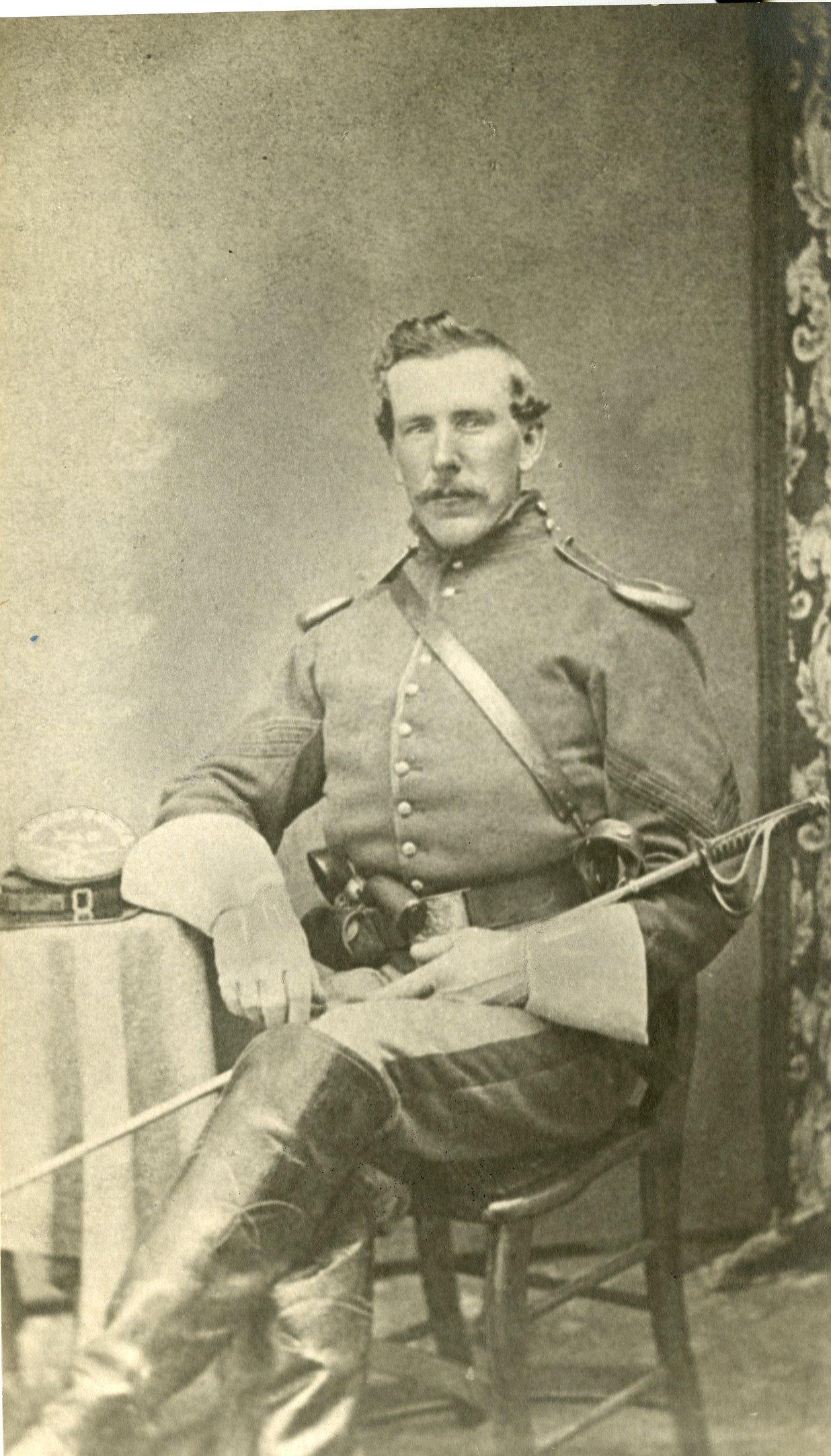
This post was written by library volunteer, Robert Baldwin.
The Schenectady County Historical Society maintains fifteen ledgers of John L. Turnbull's Duanesburg store (1875 to 1896). Who was this man? Where was this business located? What type of business was it? John L. Turnbull was the principal owner (partner) of the "O'Neill Store", beginning in 1878. Apparently, most sources have attributed the ownership and operation to John L. Turnbull. However, other family members were involved in the business. For example, John's partner and younger brother William, also was instrumental in the store's success by running errands and his outright physical labor. [1]
An anecdote worth telling…October 1878 William went out on an errand, leaving John to close shop at his usual time, 9:00 pm. When William later returned, he noticed that one of the sleighs was missing from the spot that it was previously propped against the corner of the building. He dismissed this, thinking he might have been mistaken. Later that night, William heard a "dull explosion". So he grabbed his gun and ran to the store where he discovered that the safe was blown open with nitroglycerin and putty that appeared to have been put in a soup cup. Upon discovery, the burglar found no money there, but did escape with $175 from the till. The town speculated as to who was capable of performing this dastardly task, but no arrests nor convictions were made.[2]
Moving on…the above mentioned meticulously maintained ledgers included great details. While tobacco, sugar, matches, salt and kerosene were the hottest items in his store, he had a significant array of merchandise. For example: baking supplies, sewing supplies, meats, fish, candy, sperm oil, oil lamps and parts, farrier supplies, gun powered and shots, cleaning equipment and supplies, produce, textiles, hygiene needs, tallow; you name it, he had it to sell. He also benefitted from sale of high-ticket items such as plows, reapers, mowing machines, and raking machines. Not everything was sold with cash. For example, he bartered with farmers for produce and various cash-crop items.
All of Turnbull’s ledger transactions included customer account names accompanied by corresponding account numbers. Whether it was someone stopping by just to buy some crackers or candy, names and numbers were recorded. As time passed, and by 1885, unit price entries diminished. Below is an early example from 1876 (column titles not included in ledgers):

If you think these prices were awesome, think again. The inflation calculator[3] notes that the 1876 one dollar inflation value today is $30.38. We think that a dozen of eggs price at $4.89 today is outrageous; but, in 1876 the inflation value of a dozen eggs was equivalent to $9.11 in 2024. The total sale above was not “chicken feed”; inflation value today would be $397.98. Wow, money was hard to come by in those days; and, purchases were generally not frivolous!
Most of the ledgers' last pages maintained lists of high-ticket items by customer, type and prices. For example:

It appears that inflation was an issue between 1892 and 1893. Inflation values of the dollar for 1892 and 1893 today were $35.79 and $36.20 respectively.[4] Keep in mind that average daily non-farm wages in the late 1800s was between $1.00 and $1.50.[5] Imagine taking 13 days of hard work to pay Wm Dunning’s grocery bill. Farm equipment was not cheap! A mowing machine inflation value today would have been between $1,432 and $1,448. Fortunately, farm labor was in greater demand where daily wages ranged from $11.70 to $13.90 per day. Farming had its advantages.
Mr. Turnbull not only bartered and made cash sales for merchandise, he also was involved in loaning money. Many 1882-83 ledger entries included loans to accounts 162 and 225; $15 and $2 respectively. Written in the last pages of the same ledger indicated a couple account balances were “left to collections.” Turnbull had to resort to legal action. Apparently, he was successful in recovering said debts, as the account balances were satisfied.
The practice of maintaining ledgers in the 19th century: pencils, pens, and paper were the tools to calculate transactions. The ink of a fountain pen would be the final and permanent medium in Turnbull’s ledgers. Sure, there were corrections. That is, errors were crossed out and replaced with new calculations.
A short history of the store, the building…Mr. Turnbull was not the first owner/operator of said store. About 1826, James E. O'Neill built the store, a quaint building located in the Village of Duanesburgh (at the western point between Route 7 and Great Western Turnpike[6]) and hung his sign advertising "O'Neill's Store." There, he first sold items on commission on behalf of two men, Brodwick and Duane, of Schenectady. Shortly afterwards, O'Neill began his own business selling general merchandise in Duanesburg. Legend says that the sign also read, "If you don't see what you want, ask for it."[7] O'Neill died in February 1878, and shortly after Turnbull purchased and operated the store.[8] Yet, Turnbull owned/operated his business from 1875 to 1896 according to his detailed ledgers, which appears to be a conflict of dates since he gained owners/operation after O'Neill's passing. It might be that Turnbull operated his business elsewhere until acquiring O’Neill's building in 1878.
After Turnbull's ownership, the store did continue to operate into the early 1900s by Wesley and Ralph McDougall. Later, it was sold to Mott and Schrade.[9] In May 1903, Robert M. Kelly became the Postmaster. The post office was previously located in the home of William Osterhout; and, soon after, was moved to the O'Neill store (John Turnbull's establishment).[10] As of early 1920s, the building was removed and placed at Route 7, where it was often used in the evenings as a place where men played cards.[11] By 1924, Robert M. Kelly converted the building into a house; and by 1948, was the home of Mrs. Annie Kelly.[12] There appears to be some confusion between being a residential building and the Post Office. I recently visited the four corners in Duanesburg where it was difficult to envision placement of building as they were during the nineteenth century.
 |
| Two images of the building which housed Turnbull's business. |
The man, John L. Turnbull, Personal And Public Life…Records indicate that he served as the Town Clerk of the Town of Duanesburg as well as the Town of Duanesburg Supervisor.[13] The 1863 Civil War Draft Registration indicated that John, age 25, was married and lived in Duanesburg. Military records indicated that there were two men named John Turnbull (no middle initials) who served.[14] The first John Turnbull mustered and served in the 71st State Militia Company C, organized in New York City; but, existed only three months in 1861. The second John Turnbull mustered and served in the 83rd Infantry Company H, another militia organized in New York City. It would be highly unlikely that John L. Turnbull, from Duanesburg, would have served in either. John's brother, George A. Turnbull, did serve as a captain in the 134th Infantry Company F,[15] organized in Schoharie, New York.
Census records tell a little about the transient personal life of John L. Turnbull. In 1860 John was living with wife Rebecca A. Turnbull and three inferred children: Andrew, Isabella, and William J.[16] During 1870, John was age 33, living with his mother, Isabell Turnbull and inferred wife Rebecca age 29.[17] Five years passed and John was no longer married.[18] By 1905, John was living with his siblings Isabell and Wylie.[19] In 1910, John was age 72, single and living with his sister Margaret I Turnbull, age 59.[20] An undocumented source indicated that a John Turnbull was born 1837 and died 7 June 1914.[21]
John L. Turnbull's Family Tree…The first mention of the Turnbull line in Duanesburg was William Turnbull, John's great-grandfather.[22] William was born in Scotland, as well as the next generation, George Turnbull. William and his family settled in Duanesburg, leasing 100 acres of land. George was born about 1759 and eventually married Jane Kennedy, also born in Scotland about 1765. The next generation in line to John was his father, James, who was born 1798 and died 1858. James married Isabel MacIntosh, the daughter of Alexander MacIntosh. James and Isabel had nine children.[23] John's brother and business partner, William, was married to an Alice Jarvis.[24]
Epilog…It seems to be that John L. Turnbull maintained a busy life, at least until 1896. As reflected in thousands of ledger entries, business was good for him as well as those who were his customers. During these hay days, John and his brother, William, were integral to surrounding businesses and families of Duanesburg, New York. Thereafter, John apparently led an unassuming and passive existence. The general store was gone, he no longer was married, and lived from household to household until his demise in obscurity.
Citations:
- History of the Township of Duanesburgh (as excerpted from History of Albany and Schenectady Counties, New York, by Howell and Tenney 1609-1886), p.67.
- Remembering the Town of Duanesburg, Volume 3-2012, Duanesburg Historical Society, Compiler Pat Van Buren, pp. 67-68.
- https://www.measuringworth.com/dollarvaluetoday/?amount=500&from=1876# Rates for 1892 and 1893 were recalculated for said dates.
- Ibid.
- https://www.nber.org/system/files/chapters/c2486/c2486.pdf, Trends in the American Economy in the Nineteenth Century, by Stanley Lebergott, 1960, Princeton University Press, p.462. The wages were gender based. That is, comparatively, women were paid about 1/16th to 1/6th the amount that men were paid.
- Images of America Duanesburg and Princetown, Duanesburg Historical Society, Arcadia Publishing, p.10.
- Article from the October 1948 Duanesburg Historical Bulletin, Vol. IV, p.24.
- Howell and Tenney, p.185.
- Town of Duanesburg, by William T. Avery, p. 76.
- Town of Duanesburg, A Look At Its Past, Scott's Printing Company, 2004, compiled by William Tiffany Avery, p. 94.
- Images of America Duanesburg and Princetown, Duanesburg Historical Society, Arcadia Publishing, p.10.
- Article from the October 1948 Duanesburg Historical Bulletin, Vol. IV, p.24.
- Howell and Tenney, p.166.
- The Roster of Union Soldiers 1861-1865, New York, Janet B. Hewett, editor, Broadfoot Publishing Company, Wilmington, NC, 1998, p.266.
- Ibid.
- 1860 United States Census.
- 1870 United States Census.
- 1875 New York State Census.
- 1905 New York State Census.
- 1910 United States Census.
- "Turnbull Genealogy" by Barbara Jeffries, a family file, Schenectady County Historical Society, indicating b.c.1837, and notes in pencil for date of death. According to the Reformed Presbyterian Church of Duanesburgh records, John L. Turnbull died 8 June 1915 at the age of 77 years.
- Howell and Tenney, p.166.
- Ibid.
- Ibid.