Showing posts with label Correspondence. Show all posts

Tuesday, August 16, 2016

Elizabeth V. Glen, The "Little Woman"

This post was written by library volunteer, Gail Denisoff

Much is known about Henry Glen, the great-great grandson of Alexander Lindsay Glen, the first settler of Scotia.  Henry was born in Schenectady in 1739 and served the public in many capacities.  He was a successful trader, along with his brother John, and a member of the first Committee of Safety for Schenectady.  During the Revolutionary War he served as Deputy Quartermaster, in charge of all supplies for the region.  He was a representative of the 1st, 2nd and 3rd Provisional Congress, Commissioner of Indian Affairs and a member of the 3rd, 4th and 6th Congresses of the United States from  1793-1802.  He also served as a judge and a member of the State Assembly in 1810.  Despite a successful career as a trader and many government positions, Henry Glen became impoverished after the Revolutionary War and spent most of the remainder of his life unsuccessfully trying to obtain payments he felt he was owed by the federal government for his war duties. 
Not as much is known about his wife, Elizabeth Visscher.  She was born in Schenectady, the daughter of Johannes Visscher and his wife Catharine Van Slyck, part of the large extended Visscher family of Dutch heritage.  She was baptized on October 9th 1743. 
Elizabeth (sometimes spelled Elesebat) married Henry Glen at the Schenectady Dutch Reformed Church on December 9th, 1762.  Between 1763 and 1785 she gave birth to seven children.  At least one child died in infancy.  Due to his many duties, Henry was away from home during much of their marriage.  According to records, Henry was a slave holder until at least 1802 so Elizabeth most certainly had help tending to the children, house and property.
What we can ascertain of Elizabeth’s life and personality comes from the one letter she wrote to her husband that is part of the collection of Henry Glen letters held in the Grems Doolittle Library. She was obviously well educated, with a quick wit and astute understanding of politics.  In the letter, written on Christmas Day 1800, she gently chides Henry for forgetting about “the little woman”, as she calls herself, and sarcastically gives him some political advice.  In reading her comments it seems that nothing much has changed in the way politics works!  (Spelling and punctuation are as they appear in the original letter)

Last page letter from Elizabeth to Henry, December 25, 1800.
From the Glen Family Letters Collection at the Grems-Doolittle Library.
                                                                  December 25th 1800
I am very happy my good friend.  You have at last concluded to write to me.  I heard amidst the multitude of new acquaintainces the little woman had been forgot but from the melancholy tenor of your letter you are not engaged in so large a circle as I had imagined.  I fear most gallant Judge you are in a bad way.  Polliticks day and night will never agree with you.  For Heaven’s sake then take the first opportunity of laying your case before the House.  I once heard you make or second a motion very ably before the Honorable body.  Try to again, something in the following manner I would recommend.  …as I am so much interested I cannot refrain from intruding my ideas upon this momentous occasion.  Suppose then my good Judge you rise give a stout hem, and begin with , -
Thursday 1801
I must for a few moments claim the attention of his Honorable body, in behalf of one of its most distinguished Members (never mind puffing yourself a little they all do it) who from change of air, diet, and want of proper associates, feels himself enervated to such a degree as to be perfectly inadequate to either public or private business.  I do therefore recommend, as a preservation for the whole body politick, that we immediately adjourn, to meet in Phila on the 15th of Jan’y in the year 1801.  I fix this early removal Gentlemen, as I have but a short time to remain with you; having devoted my best days to my Country’s service I shall soon withdraw myself from the noise and tumult of a publick life and in a peaceful domestic retirement pass the last hours of this scene of mortality.
If you find freedom, you can in your own expressive language tell the Honorable Gentlemen how much ground you have gone over, taking care to conduct them over only the clean paths you have trod, as some of them might perhaps offend the delicacy of the pure body of your address.  A speech so consonant with the general feelings and wishes of the House will doubtless be received with universal applause, and the business will be done with all legislative dispatch that is to say, your motion will be seconded, referd to a general committee, turned over to a special one, reported upon in about a year; the report amended and referrd back to the same committee, who not agreeing on the proposed amendment, are discharged, a new committee is appointed who after a proper time report something quite foreign to the subject which gives rise to new debates.  If you live to be a good old age you may probably hear of its being laid upon the table which may be considered as a tolerable state of forwardness.  In the mean time ask leave of absence and visit your friends in Philadelphia who most ardently desire to see you.
All your friends and acquaintainces are well.  Miss Peters getting better.  We had a large party to supper last night .  we fairly saw the new year introduced wished each other the compliment of the season (as I now do you) and broke up in very good time. 
Dear, dear Judge what shall we all be about the first day of the new Century.  It makes me creep to think about it.  Some of us may not be in in a chilly condition neither. 
I have made this letter so long you will never wish for another as long as you live from the
Little Woman
Because of Henry’s financial situation and many debts, he was forced to sell the house where they lived for many years on the south corner of Union Street and Washington Avenue as well as most of their furnishings in 1802.  They moved to a house on Front Street that was partially owned by Elizabeth, left in her father’s will.  Elizabeth died on May 17th, 1809.  In a letter to Henry dated May 21st 1809, their son, Cornelius, writes of Elizabeth’s death “By the will of the Lord (which must be obeyed) you have been deprived of an affectionate Wife & I of a dear & Loving Mother.  Words can scarcely express my feelings.  I feel down hearted & am very sorry.  Oh what shall I say what can I do.  She is no more.  May She be received into the Society above then to enjoy eternal happiness.  Oh She was near & dear to me a Loving & Affectionate Mother.” 
Henry’s brother, Cornelius, died the following year, leaving him a trust that eased his financial difficulties substantially before his death on January 6th, 1814.                   
                                                           

Tuesday, January 19, 2016

The Brothers Glen

Thanks to volunteer Diane Leone for research assistance.

The Glen surname is attached to a couple different places around New York. Glenville in Schenectady County is named after Alexander Lindsay Glen and Scotia was named by Alexander after his home country Scotland. The Glen Sanders Mansion in Scotia was originally built by Alexander, and expanded by his son John Glen. Its name comes from the marriage of Alexander’s great-granddaughter Debra Glen to John Sanders. Glens Falls is named after John Glen Jr., confusingly not the son of John Glen, but of John's son Jacob. Like many of the Glens before them, John Jr. and his brother Henry were quite prominent throughout Schenectady. The brothers were also held in high esteem with many with many people of national historic significance and were acquainted with the likes of William Johnson, Governor George Clinton of New York, Alexander Hamilton and George Washington.
Furniture from the Glen Sanders Mansion is on display at the Schenectady County Historical Society. Courtesy of the Grems-Doolittle Library photo collection.
The brothers Glen were born in Albany to Jacob Glen and Elizabeth Cuyler, John was born in 1735 and Henry in 1739. Their father Jacob was a merchant and trader who owned a house on Steuben Street in Albany. He was also closely affiliated with Albany city government as he was elected assistant alderman to the second ward in 1734 and 1735 and appointed firemaster in 1741. Their mother Elizabeth Cuyler was also well connected in Albany. Her father was Johannes Cuyler who served as assistant alderman, and eventually alderman for Albany’s second ward in the early 1700s. Johannes was also elected as a representative to the New York General Assembly and a number of other public offices, including mayor of Albany in 1725. After Jacob died in 1746, Elizabeth continued to raise their children at the “Glen House” till her death in 1785.

Both Henry and John started off as merchants in Albany. According to the website “The People of Colonial Albany,” John may have been a business partner with the venerable fur trader Hendrick Bleecker as he was identified with Glen as the occupants of a second ward house in a 1767 tax list. Starting in the 1760s, John started buying land in Schenectady, Fort Edward, and what would become Glens Falls. The acquisition of this land by John Glen is suspect to local legend and he acquired it either through a debt that was owed to him, by a card game, or in exchange for hosting a party for mutual friends. Henry also became interested in real estate and owned houses in Albany and Schenectady.

The brothers were also heavily involved in military affairs and the family’s affiliation with William Johnson during the French and Indian War resulted in John being appointed quartermaster general with Henry as his assistant. John was also the captain of the Second Battalion of Militia of Schenectady which included Jacob Schermerhorn as 1st Lieutenant, John’s brother Henry as 2nd Lieutenant, and other prominent Schenectady residents.
Letter to Henry Glen from Jonathan Mix, telling of suspending any further preparations for transporting garrisons & stores to western posts from Gen. Washington. Courtesy of the Grems-Doolittle Library Collection

During the American Revolution, Henry continued to serve in the army as Assistant Deputy Quartermaster for the northern department of the army where his role was to gather and facilitate the distribution of military supplies for northeastern New York. He supplied provisions and transportation for the five forts in the Mohawk Valley and also managed the construction of new barracks in Schenectady, where he was stationed. Often funding these projects and buying supplies with his own money as was the case in the spring of 1781. The frontier towns were desperately in need of supplies, troops were deserting, and it was feared that Schenectady might be attacked. Boats were being built in Schenectady to transport materiel to Fort Stanwix and Henry Glen used his own credit to build 16 bateaux for the military. Henry was extremely devoted to the cause of the Revolution, but disheartened that his fellow countrymen did not feel similarly in a letter to Colonel Hugh Hughes Henry Glen writes that “…no man longs more to make an end of the War than I do by carrying it on with Vigour, I am and always was willing to pledge my Life and little Property for the support of the war but am sorry to find the Virtue and Exertions of the People are lost throughout the whole Country.” In addition to his duties as quartermaster, Henry was the captain of the local militia.


Partial letter from Henry Glen to New York's Board of Treasury from 1788 regarding
his payment as Commissioner of Indian Affairs. This letter is an example of
some of the financial woes that Henry encountered after the Revolution.
Courtesy of the Grems-Doolittle Library Collection
There wasn’t much mentioned about John Glen during or after the Revolutionary War. Some sources mention that he was also a quartermaster during the Revolution, but I haven’t been able to accurately verify this. He was a friend of George Washington and may have even hosted Washington at his house at 58 Washington Avenue in Schenectady’s Stockade on Washington’s first visit to Schenectady in 1775. John Glen was listed on the roster of the 2nd Albany Militia, and on July 25, 1778 he was also called to appear before the Commissioners of Conspiracies on July 25, 1778 and signed an oath of allegiance four years later in 1782. Unfortunately, significant debt forced John from his home in 1810 and he was supported by friends until his death in 1828 at the age of ninety-three.


John Glen Jr.'s house at 58 Washington in Schenectady. A New York State historic marker was placed in front of this house, but has since deteriorated to the point where only the signpost remains. Courtesy of the Grems-Doolittle photograph collection.
For Henry Glen, the end of the Revolutionary War brought about a continuation of the public service that he started as clerk of Schenectady County in 1767. He served as a state assembly member from 1786-1787, then as a representative in the U.S. Congress from 1793-1801. He also continued his position as deputy quartermaster and was involved with the movement of supplies and troops throughout New York State. Shortly after the war Henry fell into debt which was caused partially by his personal expense during the war. This debt stayed with him for most of his life and he was met with much difficulty in trying to recover payment from the government for the multiple positions he served in during and after the war. Henry’s fortunes were never completely recovered, and as Chris Hunter states in his paper A Slave to the Army: Henry Glen and Public Service in the Early Republic, “he died January 6 1814, ending his adulthood as he had begun it, in the service of the government.”

The Grems-Doolittle Library at the Schenectady County Historical Society holds the Glen Family Letters follow this link for an index to the letters: http://schenectadyhistorical.org/admin/wp-content/uploads/2010/07/Historic-Manuscripts-Collection-Glen-Letters.pdf. 


Friday, December 11, 2015

Wayne Tucker Postcard Collection

Before the rise of Email and Facebook, postcards were a quick and easy way to keep in touch with friends and relatives. Postcards really became popular at the turn of the 20th Century and postcard collecting, uncommonly known as Deltiology, followed soon after. One such collector was former Glenville resident, Wayne Tucker. Mr. Tucker passed away recently and  graciously willed his postcard collection to the Schenectady County Historical Society. Mr. Tucker was an avid collector of postcards and the donated collection comprises 19 binders filled with thousands of postcards, trade cards, and other ephemera. The majority of the postcards relate to the City of Schenectady, but they also cover many of the towns and villages in Schenectady County. The collection is quite comprehensive and will often have postcards of the same place or landmark from different years, showing how it developed over time. Since there are postcards from various time periods, the collection also shows how postcards evolved over time. Below is a sample of the collection, but be sure to visit the Grems-Doolittle Library at the Schenectady County Historical Society to view the whole thing.

Illustrated postcards of city scenes were very popular and are some of the most common. This one shows the Van Curler Hotel from the Scotia side of the Great Western Gateway Bridge.


Freed's Big Liquor Store was founded in 1898 on Broadway in Schenectady. Herman Freed operated the store until prohibition hit the U.S. He then temporarily retired from the liquor business to open Schenectady's first used car dealerships. In 1934, Mr. Freed opened another liquor store at 111 Broadway. 
Schenectady after the blizzard of February 14, 1914. This is an example of a real photo postcard. This type of postcard is often unlabeled as any extra printing required more money than many postcard printers were willing to spend.
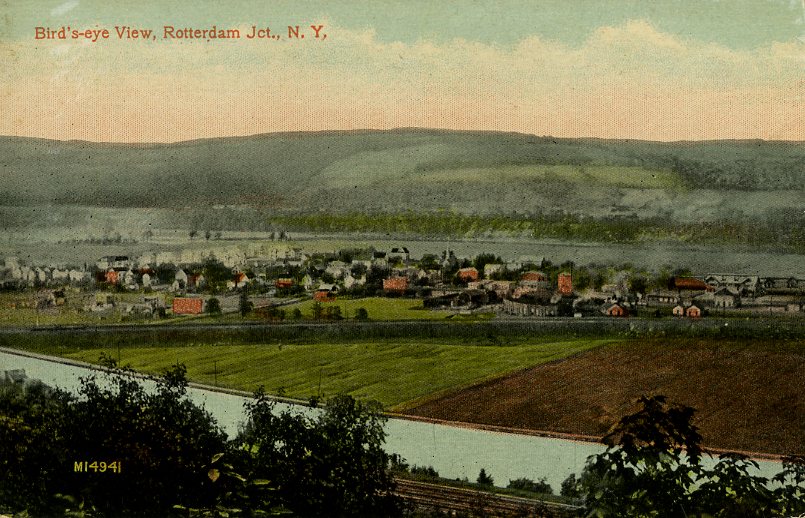
This postcard shows the bird's-eye view of Rotterdam Junction.  
 

Many of the real photo postcards show scenes from everyday life. The first postcards features the Scotia Fire Department, along with the baby of  one of the firefighters. The second shows men working on Mariaville Road/State Route 159.

 
Along with postcards, this collection also has quite a few trade cards. By the 1880s, many businesses used trade cards to advertise their goods. This card advertises the rejuvenating powers of Burdock Blood Bitters.


 Similar to modern advertisements, businesses used cute animals and kids in their advertisements. I'm not sure what a cat playing with a sword has to do with H.F. Smith's One-Price Clothier, but I would shop there after seeing this card.

Staff and volunteers have started indexing this collection and the index should be on our website in the next few months. A big thanks goes out to Wendy LeBlanc and the family of Wayne Tucker for facilitating the donation.

Friday, June 12, 2015

Band of Brothers: The Correspondence of Charles and Douglas Snell

Envelope of a letter from Charles Snell to his parents.
The envelopes in this collection have a variety of different stamps. 
The 71st anniversary of D-Day was on Saturday, June 6th 2015. Although I’m a little late writing this blog post I would like to highlight a part of our collection that commemorates World War II, the Charles and Douglas Snell Collection. This collection comprises letters that were written by Charles and Douglas to family and friends during the last two years of World War II.


Diagram of Charles' living quarters in the South Pacific which he calls his "home".

Charles and Douglas Snell were the sons of William A. and Kathryn Snell of 418 Plymouth Avenue, Schenectady, NY.  Both Charles and Douglas enlisted in the Army in 1943, but they were sent to different theaters. Charles was sent to California and fought in the South Pacific while Douglas was sent to England. While the bulk of this collection is correspondence, there are also a few political cartoons, newspaper articles, postcards, and pictures.
The letters are usually short on specific combat information as they were heavily censored by the government. Some of the letters have pieces cut out of them due to this censorship or words redacted. The brothers often “self-censor” their letters and an example of this can be seen in Charles’ correspondence. In the heading of his letters he will describe his location as “Somewhere in the Pacific Ocean Area.” Both brothers were vague in saying exactly where they were located as this information would definitely be censored. There is some general information about what the brothers are working on, they mention classes or lectures that they go to and in the letter displayed below Charles states that he “heard his first radar today.”


Letter from Charles Snell to his parents.
The letters also contain a lot of information about military life. They talk about training routines, food, entertainment, inspections, life on the home front and items they might need from their family. Charles goes into great detail about his time spent in the California before he was deployed. He gives descriptions of national parks, talks about his love of gardening and classical music and his work with the Chaplain. Douglas describes his time in England and discusses the people, places and things he encountered there. Douglas’ sense of humor is also on display in the correspondence. Accompanying the newspaper clipping below was a note from Douglas stating that he “wasn’t as bald as the picture made him out to be.” He also calls notice to a particularly painful pun that he uses in one of his letters by saying he was “short on shorts (ouch).”

Clipping from the Schenectady Union-Star showing Douglas Snell in the jeep
 that he drove for the chaplains in his unit.
There is also some discussion about political views and the 1944 presidential election between Franklin Delano Roosevelt and Thomas Dewey. Charles, a Roosevelt supporter writes to his parent that “I suppose you heard about the election by now Ha! The Dewey men on ship made a lot of noise but won’t bet a cent on the election.” Douglas also mentions that he supports Roosevelt and was happy when he was elected.

Many of the letters in this collection were written using “V-Mail”. These letters were written on small sheets of paper and after going through the mail censors they would be photographed onto microfilm and transported. When the microfilm arrived, the letters would be blown up and printed.
Example of a V-Mail letter sent by Douglas.
These letters give us a very personal connection to the authors as the brothers write about their family and friends in Schenectady. After returning from his tour in the Pacific, Charles married Julie Kamerer and moved to Silver Spring, Maryland. Douglas enrolled in Union College and eventually moved to Norristown, Pennsylvania. Both brothers died in 1997 and are buried at Arlington National Cemetery.

A finding aid for the Charles and Douglas Snell Collection can be found here.

Thursday, February 13, 2014

"If This Paper Trembles When You Read It:" A Mysterious Love Letter

Incomplete love letter written by unknown woman, ca. 1790 (M-Letters-4).  Image from Mabee Family Papers, Grems-Doolittle Library. 


There are very few love letters in the collections of our library; one of the few in our collections is a very interesting one from the Mabee Family Papers. It is not clear whether this letter was ever sent; it may possibly be an incomplete draft. We do not know the identities of the letter writer or the intended recipient. This letter was written from a woman to a man, and may have been written in the late 1700s (a clue given by the use of the long s). The letter includes a rare glimpse into how the woman regards herself, saying she is neither a "tawdy gay thing" useful only for making bone lace nor "bed [lain] old," but, rather, what the world calls "a good agreeable woman."

The woman who wrote the letter was very frank in expressing her desire for her beloved, telling him that his form "strikes the eyes of your beholders with ideas more moving and forcible than ever were inspired by music, painting, or eloquence." Having not heard from the man for some time, she reaches out to him overcome with emotion and pleading for him to reply. "Pray, Sir, speak peace to a troubled heart," she writes. "Be pleased to excuse my blushes, for if this paper trembles when you read it, it then best expresses its author." In closing, she reveals "at this rate I am panting" and hopes to hear from him, "otherwise I am inevitably lost."

The original letter is fully transcribed below, with the line breaks, punctuation, and underlining of the original maintained.


Sir
it is now along time as I account it Since you and I have had any
mututal Converse by letters or any other way. which to me is a great
uneasyness but possybell you might not no where I am for to direct
any letter or wrighting and on that account I Shall not insist
on your infringment of frind Ship. Sir I formerly had avery
good Opinion of my Self but it is now withdrawn and plased on
you for whom I am not ashamed to declare and I am not without
hopes be Caus I am not like the tawdy gay thing that are fit only
to make bone Lace I am nither bed lani old nor yet yong and
Childish, but as the world Says a good agreable woman
pray Sir speak peace to a troubled heart. troubled only for you
be pleas'd to Ex Cuse my blushes for if this paper trembles when
you read it. it then best expresses its author for a Smile Set on
your lips prefaces your expressions before you utter them and
your aspect prevented you all you Can say tho you have an infinant
deal of wit is but a repitition of what is expressed by your form
which Strikes the eyes of your beholders with ideas more moveing
and forcable than ever were inspird by musick painting or eloquince
at this Rate I am panting who expeels Som Sivil thing
in retirn otherwise I am inevitably lost

Wednesday, February 13, 2013

"A Mutual Flame:" The Love Letter of John Van Rensselaer

First page of Gen L 2, a love letter which is fully transcribed below. From the collections of the Grems-Doolittle Library. 


In celebration of Valentine's Day, we'd like to feature one of the love letters in our collections. Although we cannot be certain, we believe the letter may have been written by John S. Van Rensselaer, a 1810 graduate of Union College. John S. Van Rensselaer went on to become a lawyer in Albany and married Ann Dunkin of Philadelphia, not the "Miss Getty B." addressed in the letter below. The letter was written when Van Rensselaer was a teenager, likely around the age of 16, and it expresses the sentiments expected in a letter of courtship -- longing for his beloved, cherishing her lock of hair, and vowing to hold her intimate thoughts and tender feelings close to his chest. The original letter is fully transcribed below, with the line breaks, punctuation and underlining of the original maintained.


Miss Getty B............

A Love Letter


Union College Dec 27, 1807

My amiable friend,

At length my doubts have ended,
at length my charmer has condescended to con-
fess to her Van Ransalaer a mutual flame.
Imagination alone can paint to your mind
my sensations at present. With unfeigned
delight I am anticipating the pleasure of
again beholding you, of again pressing you
to my bosom which sighs for you alone.
How shall I express my gratitude for the lovely
lock of hair you sent me. The form of it was
so congenial to pleasure I felt on reading your
letter, that I unintentionally imagined that
our harts were united in one. Forgive me my
lovely friend, if in the warmth of my expres-
sions I have intimated any thing repugnant
to that delicacy to which I would rather sacrifice
my own happiness, than offend. You desired
me in your last letter to send you a lock of
my hair as I valued your affection, "need I again
mention how much I value it." still circum-
stances oblige me to confess that the unrelenting
Barber has unfortunately sheered it so close,
that it is altogether impossible to say properly
that my head is in possesssion of a single lock
of hair intire. You have requested me so often
not to shew your letters to any one, that if it
is possible I am almost offended with you.
Can my dear girl suppose that I can be
so mean and ungenerous as to betray an af-
fection which she has deigned to bestow on me.
Banish such ideas, and know my charming
angel I am selfish enough to imagine that if
another was to participate with me in reading
your letters. I would not be sensible of that
pleasure which I now derive in perusing
them. Present my sincere respects to my
dear Peggy G... and tell her I shall wear her
chain to my watch as a sacred momento of
her friendship. My respects to all enquiring
friends. I subscribe myself with pleasure
Your devoted
JS Van Rensala

P.S. Inclosed I send you
a list of the students
of Union College

Monday, December 17, 2012

"I Was Present at Some Warm Work, It's True": Schenectady's William Duane Witnesses France's July Revolution

This painting, Liberty Leading the People by Eugène Delacroix (1830) commemorates the July Revolution in France. The  original painting is part of the collections of the Louvre.


In the General Letters in the collections of the Grems-Doolittle Library is a gem of a letter written by William N. Duane to his sister, Maria Bowers (Duane) Jones that gives his eyewitness description of the July Revolution, a three-day revolt in France that overthrew King Charles X  in 1830 and gave rise to what would become known as the July Monarchy. In 1832, Parisians again revolted in an uprising known as the June Rebellion, which has been immortalized in Victor Hugo's Les Misérables. The July Monarchy remained unpopular and was ultimately overthrown in 1848. A tip of the hat is due to researcher John Gearing, who recently came across this letter while researching another subject.


Page of letter from William N. Duane to his sister Maria Jones describing events during the July Revolution in France (Gen L 131). 

William N. Duane (1804-1871) was the son of James Chatham Duane and Mary Ann Bowers. Born and raised in Schenectady, he graduated from Union College in the class of 1824. He married Frances Eliza Prince Walton in 1835; the couple had one son. William Duane became a physician and worked from his home on Union Street, where he lived until his death in 1871.


Image of Dr. William N. Duane, ca. 1860.
From Duane surname file. 

From sources in the library, it is not clear why Duane was in France in 1830. The letter offers a number of interesting details recorded by Duane in November 1830, a few months after the July Revolution. He discusses that a rumor was spread that he had died during the uprising, and admits that while he did no fighting, he did help to build barricades and took some gilt paper crowns that had once decorated King Charles X's table from the ransacked palace. He also comments on the role of women in the uprising as combatants and nurses, noting that "no one was more active than they were in forming the barricades." A full transcription of this fascinating letter has been included below. The original spelling, punctuation, and line breaks have been preserved.


To: Mrs. Samuel W. Jones
Schenectady
New York
United States America

From W.N. Duane 16th Nov 1830

Paris November Nov 16
Rue d'arrjon au Marian
Boulevart de Tample

on the twelfth of this month my Dear Maria
I received my first and as yet, my only
letter from Home. its date was September
the fourth and written by our Dear Father on his
arrival from his wonderful jaunt through the Northern
Country. I happened by accident to extend my visit one
morning who was anxious to call on an American
who had been residing fr some years at Paris on am
leaving him he desired an address after looking at
my Card he told me he was certain he had a letter
for that name and some papers which had been
in his possession for six weeks. they were left at his
House. he gave them to an American who promised
to find me if in Paris but after keeping them a
fortnight he returned them with the report that
I was killed during the late glorious string gleanor (?)
of course all further enquiring ceased. three different
families sent during the revolution to my Hotel to
see if the report was true. I was present at some
warm work its true by was merely a spectator as
relates fighting although I did lend a hand
in making the barricades. I has since the late
struggle been a little frightened I must confess
when I reflect upon some of the risks that I ran
I saw many a poor fellow bite the dust on both
sides and heard the whiz of a stray bullet
occasionally but I now no more wish than
many a one of your sex for the streets waere
Herranged with them during the midst of the
warmest engagements and no one was more active
than they were in forming the barricades they brought
out old trunks and barrels and in short every thing
they could lay their hands upon. there were several
killed during the second day in the opposite corner
but on the same side of the street I saw one poor
woman shot. she was exciting the people to
make them stand to their barrier while a body of
the royal guards were coming down a little
street immediately opposite to it. at the first fire
she was among the victims. there was also another
killed by a cannon shot fired from the arch (by the)
palace she was setting in her room nearby a
quarter of a mile from the Palace the ball
entered the window and struck exactly in
the middle. but the most affecting sight that
I saw was the young woman as soon as poor
fellow dropped three or four would sally out
regardless of the fire and carry him in and
dress his wounds and minister to his comfort
and before any door you might see them
making bandages lint ti ti at as number of
the barricades the stood behind to load the
guns as soon as fellow would drop they would
run and get his gun and ammunition and
load and hand to the men. and many a swiss
was shot from the windows by woman
the swiss were the poor fellows who sufferd the most
they were the kings guards and of course detested
by the people and received no quarters. just at the
termination of the last engagement we went up
to the Tuilleries and on our way we heard a sharp
firing in a little street very near our route we were upon
as it was not far to follow the people who were hurrying in wards
when we arrived we found that a body of the royal guards
in [illegible] about 20 had been firing from an hotel all
day upon the people. who had just succeeded in forcing
the doors they rushed in and pushed the guards with
they bayonetts to the windows and the people below
were shooting them ina few moments they killed
the whole and threw their clothes guns et to the people
below, them then sacked the Hotel reds pictures [hole in paper]
tables and in short every thing that was movable
at the [hole in paper] bishops palace they made a bon fire
it was [hole in paper] they burned and destroyed for him
300,000 francs the whole of his library they threw
in the river not an article was touched by the people
but the Kings palace was lawful plunder and
what they could not carry off they broke to pieces
in the duchess deBerry appartments they had a fine
haul. I got three little gilt paper crowns that were made
to ornament his majesties dinner table. but the englishman
that was with me filled his pockets with preserves & liqueur
at Present as you will see by the papers which
I shall send to Father that we are all very quiet at
present. the exaministen are not to be tryed until the
last of January two of them at present are very ill but
from the state of the public feeling at present it will impossible
to save them foreign powers are making [illegible] in their favor
It is said in the papers that Gen Lafayette has recv'ed
the Embassy for America I saw the General yesterday
tell Father he desired particularly when I wrote to
be remembered to him. He gives a soiree this evening
and our minister on Wednesday. Mr. Hamper our
ambassador from Md has resigned his office on account of ill
health and gone to Winter in Italy. I saw M____ [?]ieves on Sat
and from his talk I should judge that is to be suspended or expects him
to resign as he talkes of going to study farming in England I sent
by the Packet of the first some seeds a letter and my miniature
directed to T.H. Fumiss give my respects to all our Friends
the McC____, Mumfords, Waltons, Kanes [illegible] kiss all. the children
give my love Father Mrs Jones and Elvira R_____ and kiss the
little Rec'd for your affectionate Brother William

Friday, August 3, 2012

An Interesting Discovery

First page of Glen Letter 455, a letter from Richard Duncan to Gov. Joseph Yates regarding a debt Duncan owed to Yates.


This blog entry is written by Chris Carney, an intern at the Schenectady County Historical Society.

            My name is Chris Carney, and I am one of three summer interns here at the Schenectady County Historical Society. As someone who is not originally from New York, this internship has provided an amazing opportunity to learn about New York and Schenectady history. Initially, the project I was given was simple enough: select a letter from a collection of general papers and correspondence and research/write about it. I chose a letter from one Richard Duncan of Schenectady to Joseph C. Yates, the Governor of Schenectady. Dated the 16th of April, 1815, Richard Duncan is asking for leniency concerning debts he owes to Joseph Yates. While Joseph Yates is a common name where Schenectady history is concerned, Richard Duncan was an unknown to me.
            As it turned out, Richard Duncan was quite the man himself. His date of birth is unknown, but in 1755 he came to America from Berwick-upon-Tweed, England with his father, a merchant by the name of John Duncan. Richard is most notable for being a British loyalist, also known as a “Tory.” To that effect, in June of 1776, he assisted Adjutant General Allan Maclean in escaping to Canada and the following year he joined John Burgoyne’s army at Saratoga (Schuylerville, NY). After their surrender on the 17th of October, Richard traveled to the province of Quebec.[1] There, he was commissioned captain in the first battalion of Sir John Johnson’s King’s Royal Regiment of New York, also known as “The King’s Royal Yorkers”.[2] Despite his political and territorial connections in Canada, Duncan returned to Schenectady in 1791 after the death of his father to care for his father’s estate known as the Hermitage, an 800-acre parcel of land in Niskayuna.
            Initially when researching, I was unsure if the Richard Duncan who wrote the letter I was looking at was the same Richard Duncan detailed above. The piece of information that confirmed my suspicions was found at a Canadian reenactment website dedicated to the regiment Duncan was Captain of, The King’s Royal Yorkers. The site has a page dedicated to Richard Duncan’s powder horn. It had just crossed the auction block, and as a result, there are a number of highly detailed images of the powder horn. One of the images shows the intricate carving of a house from Niskayuna, his father’s property at the Hermitage![3] His letter to Yates also mentions his father’s former property. Between Richard and his father, a debt of £3,000 had been jointly accrued, and after John Duncan’s death, Richard began selling parcels of the Hermitage. One buyer mentioned in Duncan’s letter to Yates was Harmanus P. Schuyler. Schuyler built a large brick estate for his family, and that house is now known as the Stanford Home. If you take a drive down Rt. 5 toward Mohawk Commons, you’ll notice a brick house in the midst of being moved. That is the house built by Schuyler on land originally purchased from Richard Duncan. It is too cool how history and today intersect sometimes. The letter itself is dated April 16, 1815, and Richard died four years later in 1819.
            This research into the background of Richard Duncan helped to impart a newfound curiosity into other Tory sympathizers during Colonial America’s time under England. Every city has their own interesting characters, but to have found such an interesting person on accident, simply because I picked a letter with a printed transcription was a surprise. I’d be interested in how many British sympathizers lived in and around Schenectady and upstate New York in general. I’d also be interested to know what life was like for a Tory after American independence was achieved. All in all, it was an interesting piece about a surprisingly interesting person in Schenectady history.


[1] University of Toronto. Dictionary of Canadian Biography Online. University of Toronto. http://www.biographi.ca/009004-119.01-e.php?&id_nbr=2383 (accessed July 27, 2012).
[2] The King’s Royal Yorkers. The Regiment. The King’s Royal Yorkers. http://royalyorkers.ca/regiment.php (accessed July 27, 2012).
[3] The King’s Royal Yorkers. Captain Duncan’s Horn. The King’s Royal Yorkers. http://royalyorkers.ca/duncan_horn.php (accessed July 27, 2012).

Wednesday, May 16, 2012

Civil War Letter of William Caw of Scotia


This photograph of William Caw, taken ca. 1861, appeared in the Schenectady Union-Star newspaper on April 30, 1912. From Caw family file.

"It's a long story, youngster; so tell me when to quit when you get tired," said William G. Caw as he was interviewed about his Civil War service for a 1912 article that appeared in the Schenectady Union-Star newspaper. "In the fall of '61 Abram Cramer and myself made up our minds that the salvation of the country depended on us, so we took French leave of our homes at Scotia . . . we walked to a station called The Branch (now Ballston Lake) and there we took the cars, finally landing in Saratoga Springs. There we enlisted for Company H for three years, and we were sure then that the Union's fate rested in safe hands."

Caw mustered in as Corporal of Company H, 77th Regiment, New York Volunteers, on October 17, 1861, at the age of 19. He was promoted to Sergeant in 1863 and re-enlisted as a veteran in 1864. He was wounded in action at Spotsylvania, Virginia, in May of 1864. He was promoted First Sergeant, Company D, in November of 1864, and mustered in as Second Lieutenant of Company B in January of 1865. He mustered out with the rest of his company on June 27, 1865.

It was during his service as a second lieutenant that Caw wrote a letter to E.Z. Carpenter, also of the Scotia/Glenville area, while Caw's company was on provost duty in Danville, Virginia.


2 pages of letter from William Caw to E.Z. Carpenter, dated May 5, 1865 (Mil 480).

Below is a transcription of the letter in its entirety. All original spelling, capitalization, and punctuation has been maintained. The original letter is part of the military documents category of our historic manuscripts collection and is numbered Mil 480.

Danville, Va.
May 5th 1865
E.Z. Carpenter

Dear Sir

I received your Letter some time ago and as I have not had much spare time I could not answer it befor this Ult. I saw Job [likely Job Carpenter, brother of E.Z. Carpenter] as we was going through the 2nd Corps on our way to this Place. he is well but is pretty poor.

We marched from Burksville to Danville in 4 Days & 4 hours and the Distance is 100 miles. oh how we did Hopp it down, but all things must have an End and when we got to this City we was about as tired a Lot of men as you Could find. I think Gen Wright was just trying our metel in the marching line. We got in as advance Guard (that is our Brigade) we are doing Provost Duty it is Easy but we have to go on pretty often.

The Rebels did not Distroy any thing of any account, and they left an immense Quantity of Government Property. The cars were all in Runing order and we sent a Train of cars into Greensboro the Head Quarters of Johnsons Army. Col Selkirk went and awoke Gen Beauregard and the next day Beau-d took him to Johnsons Head Quarters the Rebels were Guarding the Town and the Colonel was halted by the Rebel Sentry but when the Colonel told him that he was a Yankee they Passed him by with the Remark that they had no Orders to Stop Federl Officers.

The Rebel Soldiers are more willing to give up the Ship then those men that Have Stayed at home this is an awful Secesh Place but but they are a beginning to find out that the Yanks are men & not a Parcel of Ruffians as they have bin made to beleive all along. Why some of the whit folks thought we were agoing to Kill them all. One white woman worked herself up to Such an Excitement that She gave up the Gost and was Layed under the Sod. the female Portion of this City keep mighty Dark we Very seldom See one of them on the Street, but a Negro that I was talking to the other Day Say they look at us through the Curtains. I Expect our Regiment will be ordered to New York Some time this month to get mustered out. I would like to get Home by the 4th Day of July or 1st of Augt with many Regards to you all I Remain as Ever

Wm Caw
Lieut Co B Batt.n 77th
NYS Vols

Drawing of Caw, a builder and sheriff,
that appeared in Just For Fun, a collection
of caricatures of prominent Schenectady
men that was published ca. 1910.
After the war ended, Caw returned to Scotia and began work as a carpenter, builder, and contractor. He moved to Schenectady and became one of the largest building contractors in the city; he was responsible for the supervision of the building of the Van Curler Opera House, the Union Street school at the corner of Union and College Streets, the original Wallace Company building, and the Scotia Baptist Church, among many others. Caw also served as assessor for the city in 1894 and served as sheriff of Schenectady County from 1896-1898. He was also active in the Horsfall Post of the G.A.R., the Schenectady Building Loan and Savings Organization, St. George's masonic lodge, the Mohawk Club, and the Emmanuel Baptist Church. He died on April 20, 1919, at the age of 76. He is buried in Vale Cemetery.

Wednesday, April 4, 2012

Historic Manuscripts Collection - Politics


Announcement of meeting of Republican electors of the first ward, city of Schenectady, 1828. (Pol 53)

Our collection of historic manuscripts comprises a number of categories, from broadsides to commissions to deeds to wills. One of the categories of historic manuscripts that is less often consulted is our collection of documents related to politics. Most of the documents pertain to local, regional, and New York State politics, and most date from the nineteenth century. The collection includes voter lists, election results, political ephemera, and correspondence and notes regarding politics.


The collection includes several undated notes written by E.Z. Carpenter,
including this note written about Yates (first name not given). (Pol 74)

This collection of documents amply illustrates the contentious nature of politics. The collection includes a number of undated, informal notes written by E.Z. Carpenter (1835-1917), a Glenville historian and genealogist, that are at times incendiary in tone. He refers to two local political figures, Hill and O'Dell, as "demagogues," and writes that another man, Yates, "prides himself on his own unbelief, but no one ever gave him credit for exceptional reason and all admit his shaky balance."

Carpenter is typically known as a gossipy source of information -- historian Neil Reynolds noted that Carpenter "chose to specialize in the seamy side of life" -- but the critical, satirical tone that runs through this collection is by no means confined to the content Carpenter created. An unattributed parody of New York State Governor William C. Bouck, written in a "German accent" English (Bouck was known for his heavy German accent), is entitled "Sour Krout Messitch."  The message addresses abolitionism, the enlargement of the Erie Canal, and other topics. The ersatz Bouck is agreeable to railroads "so lonk as der suddern peebles pe willing to kif us der fodes, watefer we to." Another unattributed piece, "Those Sheriff Bills," insinuates that the county sheriff's deputies "siez[e] as tramps every stranger they can catch" to enrich the sheriff himself, who received 17 cents for each vagrant housed in the jail.

List of voters in School District 10, Glenville, 1865. (Pol 57)
Other documents in the collection are less editorial in content and are more a recording of the processes of political activity, such as voter lists, election results, and the like. Other sources document local political activity outside of traditional electoral politics. A 1915 certificate admitting the Schenectady Economics Club, a local organization that hosted speakers and discussions about socialism, to the Intercollegiate Socialist Society (ISS) features the names of some of the ISS Schenectady chapter, including George Lunn and Charles Steinmetz.

A complete listing of the documents in the Historic Manuscripts Collection - Politics category can be found here. Library holdings of local government records, organizational records, clipping files, voter registration lists, scrapbooks, local histories, and other sources are available for researchers interested in local politics.

Tuesday, February 14, 2012

The Love Letters of Joseph Clements, Jr. and Bertha Platt


Happy Valentine's Day! This valentine comes from the newly-acquired Mynderse Collection.
"Never have I been so perfectly contented as I have been in your society. You have even caused me to turn from the ever practicable and dream of seeing new faces and new sights to-gether . . . So often have I wished for your companionship when I have heard splendid things said or seen funny things occur when others were there to see but who could not see." - Joseph Clements, Jr. to Bertha Platt, January 2, 1906.

In an apartment building at 22 Washington Avenue in 2005, building owner Marty Colangelo found two black tin cash boxes full of letters. The letters - approximately 250 - were written during the courtship of Bertha Platt and Joseph Clements, Jr. The two met in October of 1905 and soon began corresponding by mail. The first letter, dated November 24, 1905 and written from Joseph to "Miss Platt," was warm and polite. A month later, his letters had become lightly and humorously flirtatious; he drafted a mock contract regarding their plans to attend a New Year's dance. Very quickly, Bertha and Joe began to write each other almost daily, and the content of the letters rapidly shifted from flirtation to earnest declarations of caring. By spring, the couple was engaged.

Bertha was from a wealthy family, and Joseph was concerned that he would be able to provide a lifestyle for her that was was accustomed to. Bertha, on her part, reassured Joe of her love and her desire to be with him above all else. "I think I have seen the serious and all possible bad signs to getting married quickly," Joe writes on November 4, 1906. "And now, I don't see that anything could make me look terribly serious again. You see what annoyed me was that I could not give you all you had. Now I know and have known ever since your declaration that you'd go South with me that it was just me you wanted." As the year 1906 began to draw to a close, the letters made more frequent mention of the couple's impending marriage. "You and I, together!" Bertha wrote in mid-November. "Can you realize how fine it will be? I do want to help you, I do want to be everything to you - I do want that you may never be disappointed when you look to me."

After over a year of long-distance courtship, Bertha and Joe were married on January 12, 1907, in New Britain, Connecticut. They went on to live in Schenectady, where they had a son, McMillan, in 1909, and a daughter, Diantha, in 1918. The couple moved into 22 Washington Avenue, a property that Clements had purchased in 1909, in 1937. Joe died there in 1945; Bertha sold the property to Nicolas Colangelo in 1956. Bertha continued to live in the apartment until her death in 1960. The couple is buried at Fairview Cemetery in Princetown, their graves marked by a single stone, linked for eternity.

The letters that are left behind from their courtship serve not only as a rich document of their developing romance and commitment to one another, but also record Bertha and Joe's thoughts about events, document their activities, record impressions of the people in their lives, and serve as a window into social life and customs in the area at the turn of the century. The original letters are in the possession of Marty Colangelo. Elinore Schumacher, who lives in the building where the letters were found, worked to transcribe the letters and to conduct research about the couple. The transcribed letters and supporting information are available in the library.