Showing posts with label Recreation. Show all posts

Saturday, July 30, 2022

History of Collins Park

 This blog post was written by library volunteer Diane Leone.

Any resident of Scotia or the surrounding area is familiar with Collins Park, a recreational gem visible to anyone approaching the village of Scotia from the Western Gateway Bridge. Having served the community for approximately one hundred years, the park’s origins are inextricably linked to the founding of Scotia itself. 

One of the founding fathers of the village of Scotia was Alexander Lindsay Glen (called by the Dutch Sander Leendertse Glen), from the Scottish noble house of Lindsay. According to his descendants, in 1655 he purchased 100 acres of land from the Mohawks, members of the Iroquois confederacy. Lindsay was also one of the original fifteen men who held land from the Schenectady patent of 1664. The house he built, which he called Nova Scotia in honor of his homeland, was unfortunately too close to the river’s edge, with erosion weakening the foundation.  As a result his son, Johannes, built what is now called the Glen Sanders Mansion in 1713. Upon his death, his son Jacob inherited the home with the proviso that he construct a house for his brother Abraham. That structure, the Abraham Glen House, currently houses the Scotia branch of the Schenectady Public Library. 
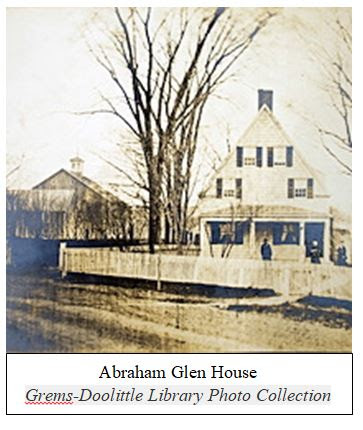
In 1842 Theodore Sanders, a descendant of Jacob’s daughter Deborah and husband John Sanders (who consolidated all of the family’s holdings in the Sanders name), sold the Abraham Glen property, including the home and 78 acres, for $11,925 to two brothers from Ireland, James and Charles Collins. The land included what was first called Glen Lake, then Sanders Lake, and later named Collins Lake, where the brothers ran an ice business, cutting ice from the lake and distributing it in a wagon advertising “Collins Ice.” 

In 1895 the brothers created a private park that sported trees for shade, as well as seating, a baseball diamond with bleachers, tennis courts, and a pavilion for dancing. The park offered recreational activities in summer, as well as winter. The J. C. baseball team, named for James Collins, played at the park. 


Visitors also enjoyed the lake, where they could rent flat-bottomed boats from the lake house for 10 cents an hour, and also pick pond lilies for 2 cents per lily.  The winter offered tobogganing, a wildly popular sport in the latter part of the 1800s. The photo below, from the 1870s, shows the toboggan slide, which ran north from Dyke Road, now Schonowee Avenue. 

The background to the creation of Collins Park is not entirely clear. The private park closed in 1905 after James Collins’s death. In 1922, with the death of his daughter Anne, the Abraham Glen home was bequeathed to the Daughters of Wisdom nuns, who ran a children’s home. Since the house did not meet their needs, Anne Collins’s executors offered the land to the village, which acquired the Abraham Glen house—it became the Scotia Free Library in 1929— and the attached land, including the western rim of the lake, for $30,000, with the proviso that the land be designated a public park named after the Collins family. Fund-raising activities helped defray the cost, $5,000 of which was donated by General Electric. In 1924, Collins Memorial Park consisted of 26 acres maintained by the Collins Park board. That board handed the park over to the village in April of 1928, with Scotia now responsible for completing the payment for the property. The deed was executed that July. 

The rest of what came to be Collins Park was acquired separately. A man named Neil Ryan owned property to the east of the park, including the remainder to the lake. His proposal to sell the land to the village for $65,000 came before the village board in November of 1928. Unfortunately, no further documentation is available on the actual vote, or how that section of land was incorporated into the park. Interestingly, the deed for that section of the park is dated 1937, with a different seller. 

Thus was born Collins Memorial Park. It provided a variety of activities, including tennis, baseball, horseshoes, swings, toboggan slides, and skating equipment for children, as well as individuals to oversee the playground. 

In Scotia 100 Years...Memories of a Village, lifetime resident Marion Gilgore recalls the warning system for ice-skaters on Collins Lake. 

“There was a building right behind the library with a flagpole. If the flag was blue—the ice was safe and if the flag was red—the ice was too thin to skate on. Of course there was always someone who would try to skate when the flag was red and fall through the ice. Then they would call the fire department."

After World War II, the state undertook a project to deepen the Erie Canal network and needed a site to deposit the excess dredging material. Scotia mayor, Bill Turnbull, made an arrangement with the State Waterways Maintenance Department to have this material fill in the lower part of Collins Park, thus expanding it. In 1946 more than 1 million cubic yards of fill was added to a marsh area currently inside the park and on the side of Schonowee Avenue abutting the Mohawk River. The community—both individuals and groups—assisted with donations of trees, as well as the creation of a Little League park and beach area and the construction of additional tennis courts. 

Around the same time, the now famous Jumpin’ Jacks had its start. Jack Brennan purchased land along Schonowee Avenue from the Sanders family to build what was initially called Twin Freeze, and then Jumpin’ Jacks, where he would sell soft ice-cream, a newly popular treat. 
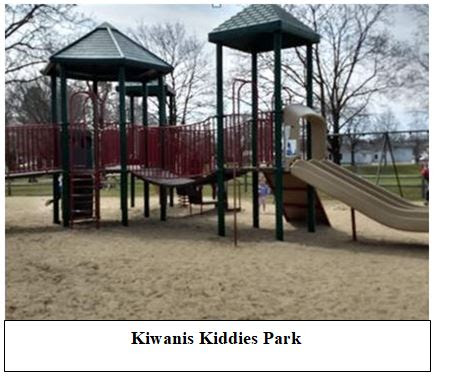
Over the years, facilities have been added or improved, thanks to service organizations such as the Kiwanis Club (which funded the Kiddies Park) and the Rotary Club. In the 1960s, the swimming area and beach were moved to the current area. The park was a popular venue for baseball, basketball and even Scotia-Glenville High School football games. As Alan Hart so fondly reminisces about the Tartans in Dear Old Scotia: 

Before the new field behind the school was laid out, however, I remember going to home football games on the old field at Collins Park in the 1950s. It was a blast! The field was laid out east to west in the bowl behind the library, and if you were a kid like I was, it was pretty easy to sneak in and watch the game without paying. The entrance was sectioned off with ropes, but if you waited for an opportune moment once the game had begun, you could duck under the ropes when the man tending the entrance was watching the action on the field. Then you could use that money your mother gave you for your ticket on an extra hotdog or two! (2) 

A wonderful recreational area on the river side of Schonowee Avenue next to Jumpin’ Jacks is Freedom Park, which was created in 1976 as part of the state’s Bicentennial celebration. It has picnic tables, an amphitheater/stage area where free summer concerts draw large crowds, and a small dock called Scotia Landing. Quinlan Park is a popular fishing area located on Washington Avenue on the eastern edge of Collins Lake. 

The lake is a 55 acre oval-shaped body of water located in the park’s center. Residents use it for fishing, ice-fishing and boating. Unfortunately, the lake is filled with invasive aquatic species, such as water chestnuts, milfoil and pondweed. To remedy this situation, dredging was performed in 1977-78 and again between 1988 and 1992, when the unearthing of Native American artifacts forced the town to stop. To make matters worse, the 2011 tropical storms Irene and Lee deposited river sediment into the lake, closing this popular spot for swimming. In June of 2021, the town of Glenville put into effect a plan to eliminate milfoil. It is hoped a water herbicide treatment in the spring of 2022 and 2023 will help rid the lake of water chestnuts. 

Some interesting stories are associated with Collins Lake. On November 20, 1857 a local newspaper reported the strange tale of a sea serpent spotted by broom corn workers as well as two other men. This frightening beast was described as “a most hideous monster; it was variously reported to be from seven yards to a half mile long and was said, when in an angry mood, to lash the waves with a gigantic tail until the lake was one sheet of foam.” Its actual appearance, when caught, did not quite live up to expectations. It was said to be on display at Schenectady’s Anthony Hall. The creature apparently put in another appearance on March 28, 1934, as reported by Scotia resident Dr.Wilber D. Rose in a rather sardonic tale printed in Scotia, 100 years 1904-2004: Memories of a Village. The “monster” was said to be displayed in the State Education Building. The reader will have to decide on the veracity of these stories. 

Another incident in the lake’s history occurred in 1948, when four boys borrowed a rowboat without permission and proceeded to the island in Collins Lake. The quite irritated owner swam to the island to recover his craft, leaving the culprits stranded. In the afternoon, the father of one of the boys saw the quartet on the island, gesturing and shouting. Recognizing his son, he went to the police station, where the boat owner was persuaded, rather reluctantly, to rescue the group.

Today, Collins Park continues to draw the community throughout the year. In winter, families enjoy sledding down the hill behind the library (the former Abraham Glen House), and hardy souls can be seen ice fishing on the frozen lake. During the warmer months the park comes alive with a variety of activities. The tennis courts are popular, and there is always at least one baseball game going on, with friends and families rooting for their teams and players. Walkers and joggers fill the park paths, and picnickers at Freedom Park enjoy the waterfront view. People flow between the park and Jumpin’ Jacks, where they can grab a quick bite or maybe a refreshing ice cream. On certain summer evenings, people bring lawn chairs to enjoy the musical entertainment in Freedom Park’s amphitheater. In July and August the US Water Ski team holds daily practices and weekly performances along the Mohawk shore, where large, enthusiastic onlookers crowd the shoreline behind the restaurant and in Freedom Park. 

The Collins family left the village of Scotia a wonderful legacy.


Special thanks to Village of Scotia historian Beverly Clark for her help in locating and gathering information for this blog.


Bibliography:

Armstrong, Shirley. "Boys 'Marooned' 4 Hours on Collins Lake Island." Schenectady Gazette,  June 26, 1948, 6.  

Briere, Shenandoah. "Village of Scotia Weeding out Collins Lake." Daily Gazette (Schenectady,  NY), August 8, 2021, 15.

Campbell, Ned. "Familiar Summer Story: Collins Lake Beach Closed." Daily Gazette (Schenectady, NY), June 5, 2014, A1.

Hart, Alan. Dear Old Scotia. Scotia, NY: Old Dorp Books, 2004.

Hart, Larry. "'Deal Struck 51 Years Ago Influenced Park's Growth." The Gazette (Schenectady,  NY), September 7, 1997, B07.

Schenectady County Historical Society. Glenville. Charleston, SC: Arcadia, 2005. Scotia, 100 years 1904-2004 : Memories of a Village. N.p., 2004.

"Settlers at Schenectady, 1661-4." In History of the Mohawk Valley: Gateway to the West 1614- 1925, edited by Nelson Greene. Chicago: S. J. Clarke, 1925. 

Sloan, Frances Anderson. "History Walks with Scotians" columns in the Scotia-Glenville Journal.

Weatherwax, Bonnie, Heritage Coordinator. Scotia-Glenville American Revolution Bicentennial  Book of Remembrances, June 18-26. 1976. N.p., 1976. 

Collins Park clippings files at the Schenectady County Historical Society 


Saturday, December 21, 2019

Fun in the Snow Long Ago


This post was written by library volunteer Diane Leone. 
 
The thick blanket of snow that recently fell in the region reminds us that the Schenectady area has always seen a good deal of the white stuff.  It is fascinating to look back at earlier days, when people were more inconvenienced by the inclement weather than we are today, yet managed to find ways to thoroughly enjoy themselves. There is no better guide to Schenectady’s past leisure activities than the late Larry Hart (1920-2004), noted local reporter and freelance writer whose long-running Daily Gazette columns paint a wonderful picture of long ago winters, often drawing on his own childhood memories.
 
Up until the early 20th century, the arrival of snow meant a change in the seasonal mode of transportation from wagons to sleighs.  Large horse-drawn cylindrical snow rollers, weighted with dried sand, compacted and smoothed snow in the street for travel by sleigh.  These vehicles varied in size, ranging from two-seaters to the large conveyances used for commercial purposes and pulled by draft horses. To warn people of their approach, sleighs were legally required to have sleigh bells, which were attached to a strap fastened loosely to the horses.
 
Pedestrians had to travel, sometimes long distances, while negotiating snowbanks on the sidewalks.  In the days before mechanized snow removal, people sometimes walked through tunnels dug into the huge mounds of snow; at other times they trudged along the tops of the heaped up snow piles, termed “walking the mountain.” Schools were not often closed, but when they were in pre-radio days, families were alerted by a predetermined number of GE whistles. Hart reflects on the frigid days of his own youth, in this 1985 Christmas Eve column:

It seemed that those winters of the early Thirties, when the Great Depression may have been at its worst, were about the coldest we had ever endured.  Consistent cold, that is, with some heavy snowfalls thrown in for good measure.  There were many reports of people being treated for frostbite at the GE or Alco infirmary, many of them women who had waited for buses or trolleys on cold mornings (which was before the ladies wised up and started to wear pants or snow suits in the raw winter).  Car radiators froze up, too, because drivers forgot to empty the water overnight or else used adulterated alcohol. 

Snow piles on State Street after the Blizzard of 1888
Schenectady County Historical Society

Ice skating was a popular pastime. Hart’s father recalled using skates attached to his shoes with a clamp that was tightened with a key. People skated on the Mohawk River, the Erie Canal, Iroquois Lake in Central Park and various other lakes and ponds. While snow on the river was generally swept away by the winter wind, making it smooth for skating, the canal had to undergo some preparation. As winter approached the canal was drained, leaving approximately two feet of water for freezing. Any fallen snow had to be cleared for skaters.

The most popular site on the canal—paved over in 1925—was just south of the State Street Bridge, an area referred to at the time as “Canal Park.” While gliding on the ice, people could enjoy refreshments, such as wieners, as well as hot and cold drinks.  On weekend evenings, skaters sailed along to the glow of Japanese lanterns mounted on poles, with an oompah band adding to the festivities.  Hart reminisces about skating on Iroquois Lake in Central Park, noting that he spent quite a bit of his time drinking hot chocolate in the casino.


Skating on the Erie Canal, looking toward the State Street Bridge
Grems-Doolittle Library Photograph Collection
In the 1920s it was common for men to wear fedoras or caps while skating.
Grems-Doolittle Library Photograph Collection


Children enjoyed games on the ice. Two that Hart mentions are statue and snap the whip.  In the first, one skater twirls another skater, who, after being released, falls in the snow and must remain absolutely still as a statue until everyone in the game is frozen.  Some played snap the whip, which involved a group of skaters, all holding hands, being whipped around by one person, or pivot, at the head of the line.  The object of the pivot was to dislodge those at the end of the chain, who were moving at a much greater velocity than those toward the center.

Ice skating races were frequently held in the 1930s and 1940s. One major contest was the North American Outdoor Speed Skating Championships, a three-day event beginning on January 31, 1941, and held in conjunction with the city’s Winter Carnival in Central Park.  Featuring sprints and long distance events, the highlight was the 5 mile race, with 20,000 onlookers watching Minneapolis native Ken Bartholemew come in first.

Before the advent of modern refrigeration in the 1930s, ice harvesting from the river and other bodies of water presented potential dangers for skaters, who sometimes drifted into areas of weak ice and fell into the freezing water, despite the many caution signs.  This danger was exacerbated for skaters, tobogganists, and others who used sails to increase their speed. Apparently, even Charles Steinmetz was fond of ice sailboating on the Binnekill.

Children years ago enjoyed sledding, as do young people today.  Hart names several hills popular in his father’s youth, including Balltown Hill heading to Craig; Hillhurst Park in Bellevue; Glengarry Hill in Carman; and Crane Street’s Engine Hill in Mont Pleasant.  His father sledded down Hamilton Hill on a wooden sled with metal runners.  When he had no access to a sled, he improvised with coal shovels, carboard boxes and even unstable baking tins.  The coal shovel provided quite a ride, as Hart relates in his December 24, 1985 column:

They were deep and wide, easy for a kid to sit upon, bow up his knees and grasp the handle forward.  A good kick would send the apparatus on the downgrade in a hurry.  It picked up speed and went even faster as the handle was tilted upward. Dad said the ride usually ended in the lot opposite Hamilton later to become the market square, but they could veer either right or left by leaning in that direction in case a big horse-drawn sleigh was coming along Broadway.

Larry Hart tried this makeshift sled as a kid and found it very fast but impossible to stop without toppling off in the snow.  He had his own second-hand Flexible Flyer and his brother had a Lightning Glider, which they prepared by rubbing the runners with a cut potato, and finishing up with some sealing wax.  He also recalls less than successful attempts at skiing down Glengarry Hill with the simple barrel stave skis he and his siblings received for Christmas.

When horse-drawn sleighs were still used for transportation in winter, a popular, although dangerous, form of entertainment enjoyed mainly by boys was to grab onto the runners of delivery vehicles, getting a free ride along the snow-packed streets.  Drivers were not always aware of their extra freight until four or more boys slowing down the vehicle caused them to yell at the culprits to unhitch themselves.

Long forgotten is the sport of bobsledding, called “bobbing,” an exciting diversion popular in the later years of the nineteenth century.  On any cold night sledders would compete, flying down “College Hill” in vehicles sometimes 30 feet in length carrying up to 1,000 pounds. The contests began at Nott Terrace and Union Street, and ended at the railroad tracks below what was then named Center Street (now Broadway).  Bales of hay were stacked just beyond the Yates Street finish line, in case of brake failure. 

Hart writes of the February 8, 1888 Schenectady Carnival, when 47 teams from different cities competed in the bobbing championships.  Squads with colorful names such as Snow Queen, The Big Six, and Hurricane first paraded down State Street in their splashy costumes, after which they participated in several preliminary runs in their large wooden vehicles, which must have been quite a sight, described by Hart in Schenectady’s Golden Era:

With a roar, the monster sleds hurtled down the ice runway and within a minute approached Center Street, at which point the brakeman would release the heavy chains suspended beneath the bob.  The chains, dropping under the iron runners, then threw off a mass of sparks as the bobs ground to a halt over the cobblestone pavement now devoid of ice” (236). 

Part of the”Snow Queen” team of 1888 in their unique costumes
(Preserved by team member Henry A. Kerste)
From Grems-Doolittle Library Bobsledding File
  
Teams did not compete head to head, but rather raced against the clock.  Bigger sleighs that could carry more weight were considered more competitive, since they had greater speed.  The early rounds in 1888 produced a tie between the Big Six and Snow Queen, which was broken when the Big Six won by lowering its time by four seconds.

Looking back at winters of the past reminds us that, while modern conveniences certainly make life more comfortable, they do not necessarily make it more enjoyable. 

Sources
Hart’s Daily Gazette (Schenectady) Columns: 1/22/81, 1/29/81, 11/17/81, 12/22/81, 1/19/82, 12/24/85, 1/5/88, 2/23/88, 1/5/98, 2/23/98, 12/31/01, 12/15/03, 1/5/04, 12/17/07, 12/24/07
Hart’s Niskayuna Journal Column: 2/18/88
Hart, Larry. Schenectady's Golden Era: (Between 1880-1930). Scotia, NY: Old Dorp Books, 1974.
Rosenthal, Susan N. Schenectady. Images of America. Charleston, SC: Arcadia Publishing, 2000.