Showing posts with label Military history. Show all posts

Thursday, November 10, 2022

The Last Man’s Club of Schenectady: Local Heroes of World War I

This post was written by library volunteer Diane Leone.

Men and women who serve in the military together, particularly during wartime, form a tight bond that often lasts a lifetime. One way that veterans have maintained those bonds is through what are called Last Man’s Clubs--also called Last Man Clubs--which have a long history. Meeting annually to maintain their connection, these groups often continue a custom of purchasing a bottle of wine, which is saved and passed through the group, to be opened and drunk only by the last surviving member of the club.

Company E (top) and F (bottom) of the 105th Infantry of the 27th Division. From "Schenectady's Part in the World War, 1918," SCHS Grems-Doolittle Library Documents Collection
 

One such club of World War I veterans was located in Schenectady. The organization may have started in 1921 -- although one source says 1933 -- with a membership of 98 men from the 105th Infantry Regiment, which served in Belgium and France. These local veterans were primarily from Companies E and F, as well as Headquarters and Machine Gun Companies. They met yearly at a restaurant as close as possible to April 6, the date on which the United States declared war on Germany. At each meeting they called the roll, commemorated the members who had died during the year, and elected a new head man whose responsibility it was to safeguard the Burgundy wine -- which had been purchased in France by one of their commanders, Lieutenant George E. Ramsey and presented to club members at the club’s inaugural meeting.
 
Several newspaper articles reporting on the club’s later meetings identify some of the members whose names are listed below along with many of their ranks and companies during the war. This information can be found on the website of the New York State Military Museum and Veterans Research Center.  
 

Known Club Members:
Leslie Brooks
Keyes (K.T.) Davis, Corporal, Company E
Kenneth S. Greenough, Wagoner, Supply
Milton H. Hallenbeck, Sergeant, Company F
Earl (E.D.) Hamilton, Stable Sergeant, Machine Gun Company
Herbert H. Horstmann, Corporal, Headquarters Company
Frank Jutton, 1st Class Private, Machine Gun Company
John Kubes, 1st Class Private, Headquarters Company
Theodore (T.M.) Kuhlkin, Private, Company E
Albert Lange, 1st Class Private, Headquarters Company
Edward Long, Private, Company E
T. S. Mabie
Joseph Memelo, Private, Machine Gun Company
George E. Ramsey, 1st Lieutenant, Company E
Ira M. Schermerhorn, Wagoner, Supply Company
John Shepard, 1st Class Private, Machine Gun Company
Edward Smith, 2d Class Musician (equivalent to Private), Headquarters Company
John R. Walsh, 1st Class Private, Company E


Time has blurred the memory of World War I, but that conflict had a great impact on the world. These local servicemen, who participated in some of the most significant battles of the war, were originally part of the New York State National Guard, designated the 6th Division. After serving on the Mexican border in 1916, its members were called up for active duty by President Woodrow Wilson on July 12, 1917, along with all National Guard units in the US. After completing their training at Camp Wadsworth in South Carolina, the men shipped out to Europe in the spring of 1918.

In streamlining the military, the New York troops were re-designated in October 1917 from the National Guard’s 6th Division to the federal system’s 27th Division, commanded by Major General John Francis O’Ryan, the army’s youngest major general. Comprising the 27th was the 53rd and 54th Brigades. The original 27th had a total of 991 officers and 27,114 enlisted men.
 
The 53rd Infantry Brigade consisted of Brigade Headquarters, the 105th and 106th Regiments of Infantry, and the 105th Machine Gun Battalion. The men of the 105th, in which the Schenectady club members served, were called “apple knockers” because the recruits were primarily from the rural areas of Upstate New York, with many having worked in apple orchards. One of the commanding officers of the 105th’s Company E was a local, 1st Lieutenant George E. Ramsey (see photo below). As part of the 53rd Brigade, the 105th participated in the Ypres-Lys Offensive in Belgium, an area of major contention, as well as the Battle of the Somme, one of the most significant of the war. Their objective in that battle was to help break the Hindenburg Line, the sole remaining network of German defenses on the Western Front, which the Allies penetrated on September 29, 1918. 

Members of the 105th Machine Gun Battalion at the Yelverton summer home, circa 1917. From the Larry Hart Collection, SCHS Grems-Doolittle Library.

On October 22, 1918 the 105th received a letter of commendation from John F. O’Ryan, commanding general of the 27th Division, for their “valor, skill and endurance,” not only in helping crack that major line of defense, but also for their performance in subsequent battles. As the general wrote of the former battle:
 

During the battle for the breaking of the Hindenburg Line, the mission of the regiment was peculiarly difficult. The character of the operation assigned made it impossible for the regiment to have the assistance of a barrage. The enemy operating from a flank position at VANDHUILLE held back the division on our left and delivered repeated hurricanes of fire and strong counterattacks against our flank. It was against such fire that the regiment rendered such valuable service in assisting in the shattering of these counterattacks.


By the end of the war, the 105th Infantry saw 253 of its men killed, 1,284 wounded, and 72 who subsequently succumbed to their injuries. The survivors of the 105th returned to civilian life after the war and settled down, some in the Schenectady area, including club members George E. Ramsey, Joseph Memelo, John Kubes and Frank Jutton.
 
The annual meetings of the club, which started with nearly 100 members, inevitably saw a dwindling number of survivors as the years went by. A photograph of a meeting around 1955 includes 24 members, with head man Leslie Brooks (fifth from the left) holding the bottle of Burgundy.
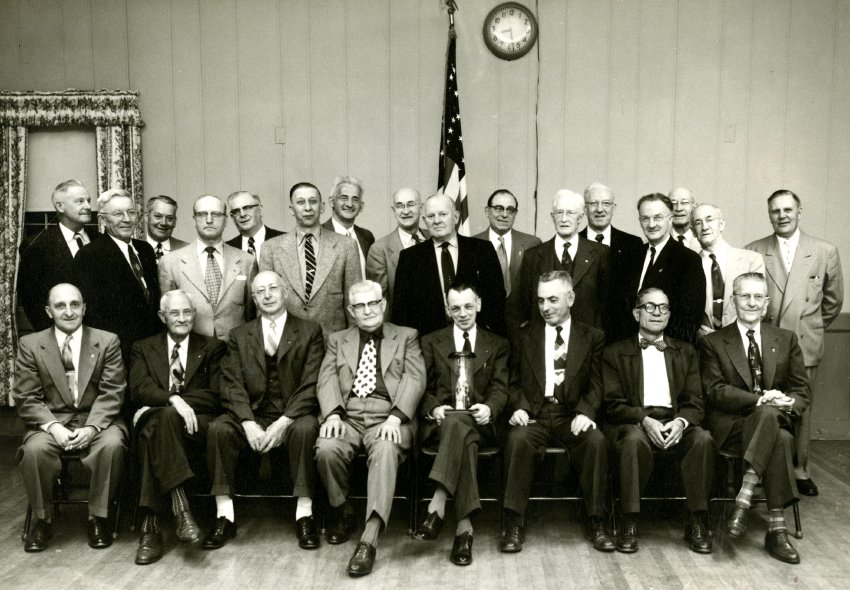
Members of the Last Man's Club post at the American Legion Hall, circa 1955. Photograph from the Larry Hart Collection, SCHS Grems-Doolittle Library.


Years later, a Gazette article, likely from April of 1971, mentions 15 survivors, 12 living locally. A total of 13 attended the annual meeting at the Carlton Restaurant on Becker Street. Surrendering the bottle was head man Edward Long. The other men who held positions of responsibility were John Kubes, assistant head man; Herbert Horstmann, chaplain; Kenneth S, Greenough, secretary-treasurer; and T. S. Mabie, permanent dinner chair.
 
Toward the end of the decade, probably 1978, the group of five out of nine survivors met at the Mohawk Club. Joseph Memelo was the head man. The other attendees were Frank Jutton, Albert Lange, Edward Smith and John E. Walsh, who came from California to attend. Three years later, on April 4, 1981, the club met at the American Legion Post 21 headquarters. Walsh surrendered the bottle of burgundy to Memelo (second from the left), the head man for 1981. The group met until 1987, when Joseph Memelo was the only member left.
 

Lt. Ramsey of Company E, 105th Infantry, and member of Schenectady Last Man's Club. From "A Short and Illustrated Roster of the 105th Infantry, United States Army: Col. James M. Andrews Commanding, 1917." SCHS Grems-Doolittle Library.


The following are brief biographies of a few of the club members, taken mostly from newspaper articles and obituaries:
 
George E. Ramsey was born in 1872 in Luzerne, New York. He had a long and exemplary military career in both the US Army and New York State’s National Guard. He served in the Spanish-American War, re-enlisting in 1916, when he was sent to the Mexican border and the next year to Europe as a lieutenant in the 105th. He was promoted to captain in 1918. After the war he held several civic positions, including deputy sheriff of Schenectady County (1920), police court clerk (1923), and Schenectady’s commissioner of public safety (1925), while ultimately attaining the rank of major in the National Guard. He died in 1936 and is buried in Vale Cemetery in Schenectady.
 
A Schenectady native, Frank Jutton was born in 1896 and worked for 42 years as an inspector in the Large Motor and Generator Division at General Electric, from which he retired in 1958. He died in 1983 and is buried in Memory Gardens Cemetery and Memorial Park in Colonie.
 
John Kubes, born in 1890, lived most of his life in Schenectady, although he hailed from New York City. After the war he served for 30 years as a firefighter, being promoted to lieutenant in 1947 and ending his career in 1961 as a captain. He died in 1985 and is interred in Most Holy Redeemer Cemetery in Niskayuna.
 
Joseph Memelo was the baby of the club. Born in Schenectady in 1899, he was a 16-year-old high school student who lied about his age to join the National Guard in 1916. After the war he worked in the printing trade, first as a salesman, later as a co-founder of the Schenectady Printing Company, from which he retired in 1975. He died in 1993 at the age of 93 and is buried in St. Anthony’s Cemetery in Glenville.
 
Mr. Memelo had the bittersweet distinction of being the last man standing from a group of American heroes.
Pvt. Joseph Memelo of Machine Gun Company, 105th Infantry, and last member of the Schenectady Last Man's Club. From "A Short and Illustrated Roster of the 105th Infantry, United States Army: Col. James M. Andrews Commanding, 1917." SCHS Grems-Doolittle Library.


Bibliography


Thursday, June 30, 2016

Louis Kortmann in the Wild and Wooly Country of Cuba

Most archives and cultural institutions have hidden collections, these are collections or items that, usually due to time restraints and a large backlog, haven't been cataloged or described yet and are hidden by researchers and staff. One of the perks of working in a place like the Grems-Doolittle Library and Archives at SCHS is finding these collections. We recently found a small hidden collection of postcards and photos dealing with Louis W. Kortmann Jr. and his relatives. Kortmann was the president of the Schenectady Trust Company and a rather prominent citizen of Schenectady, judging by the contents of this collection. Kortmann Jr.'s father, Louis Kortmann Sr., served in the Spanish-American War and the postcards are mainly correspondence from Kortmann Sr. to his wife Kate who was staying at the Madison Barracks in Sackets Harbor.

Louis and Kate Kortmann at their home in Madison Barracks at Sackets Harbor, NY.
Courtesy of the Louis W. Kortmann Collection at the Grems-Doolittle Library and Archives.
The correspondence from Kortmann Sr. is particularly interesting because they document his time serving in the Spanish-American War in 1898. Kortmann enlisted as a private in the Ninth infantry unit at Sackets Harbor, NY. The correspondence to Kate begins on April 20, 1898 as he is traveling from Washington D.C. to Cuba, making stops in Lynchburg, Virginia,  and Rocky Ford, Georgia until he reaches Tampa Bay, Florida on April 22, 1898. Kortmann's unit camped out at Port Tampa for a while and in one postcard he describes the camp as having "sand knee deep and good and hot," with the only trouble being that he can't get enough to eat. The orders to ship out to Cuba came on June 13th and Kortmann writes that there are around 850 men on his ship (the USS Santiago) and that it is "quite a task to breathe." The USS Santiago was among the first ships to arrive at Cuba on June 22, despite this, they were actually forgotten during the disembarking process and ended up having to wait three days till the men were able to leave the humid, cramped ship.

There is a gap in the correspondence between June 26th and July 12th, but we can fill some of
The flag of the 9th Regiment. Courtesy of the
New York State Military Museum
the unit's activity and what Kortmann would have been going through thanks to the website www.spanamwar.com/9thusinfantry.htm. The troops had to march about 12 miles to Santiago in intense heat while carrying their blanket rolls and ammo. The Ninth eventually reached San Juan Hill, but found themselves in the valley between the American artillery and the Spanish troops. As the unit tried to make sense of the battle, their colonel was killed and two lieutenant colonels were wounded leaving Lieutenant Colonel Ezra P. Ewers as the senior officer, which he did not even know until after San Juan Hill was captured.

"We are here at last in the City (Santiago de Cuba) and quartered in the Theater...A great many of our men are sick from exhaustion and malarial fever. - Louis Kortmann


Postcard from Louis to Kate stating that Santiago
has surrendered. Courtesy of the Louis W. Kortmann
Collection at the Grems-Doolittle Library and Archives.
Between the intense heat, sickness, and lack of cooking equipment, camp at San Juan was brutal. By the time the Spanish surrendered San Juan, the Ninth had lost one officer and four enlisted men with 27 enlisted men wounded. The Ninth had more to worry about than the Spanish forces as Kortmann writes, "We have plenty of sickness in our camps." By July 22, 132 men out of the regiment's 433 were reported sick and 5 men would die of various illnesses before they reached Camp Wikoff on Long Island. Despite being back in the states, sickness still ran rampant throughout the Ninth. Kortmann writes that "This place (Camp Wikoff) is not a fit place for a camp for sick men. We have to lay on the ground and most of us have only one blanket." In a later postcard he states that the Camp is worse than being in Cuba and that they average six deaths a day.

Doctor William Wallace Walker was stationed at Camp Wikoff and wrote an account of the conditions at the Camp. Walker wrote that “Right here in 100 miles of New York I cannot get medicines for typhoid fever, or chlorinated soda to wash out the bowels in typhoid fever and dysentery, the two principal diseases killing our boys…There is gross mismanagement somewhere and it is costing many lives. Too many politicians and rich men’s sons are appointed to office.” Walker complained of other doctors not visiting sick men till 10 a.m. while he had been working since 5:30 a.m. He was sickened and disturbed by these conditions and requested a transfer back to his regular regiment in San Antonio.

Company E of the 9th Infantry reading newspapers during the Spanish-American war. 1898. Black & white photoprint, 8 x 10 in. State Archives of Florida, Florida Memory. <https://www.floridamemory.com/items/show/29886>, accessed 30 June 2016.
Telegram from Nelson A. Rockefeller to Louis W. Kortmann.
Rockefeller asks Kortmann to meet to discuss the effectiveness
of state programs. Courtesy of the Louis W. Kortmann
Collection at the Grems-Doolittle Library and Archives.
Kortmann made it back to his wife and ended up playing for the United States Military Academy Band. In 1905, their son Louis W. Kortmann Jr. was born. The Kortmann’s eventually settled in Schenectady and Louis Jr. started his banking career as a teller at the Schenectady Trust Company. Kortmann would work his way up to become president of the bank. This collection doesn’t contain too many personal details about Louis Jr.’s life, but from its contents, we see that he dealt with some very important people. There is an invitation to John F. Kennedy’s inauguration, a letter from Robert F. Kennedy, and a telegram from Nelson A. Rockefeller. Unfortunately, I haven’t been able to find much more about Kortmann Jr.’s life. The bits and pieces that are there mostly deal with his time as president of the Schenectady Trust Company. This collection gives a glimpse into his life, and I hope to dig up a bit more about him in the future.

Tuesday, February 9, 2016

The Journey of Jared Jackson, Civil War Soldier

This blog post was written by library volunteer Diane Leone


African-American Ancestral Burial Ground
at Vale Cemetery in Schenectady. Courtesy
of Diane Leone.
Within Schenectady’s Vale Cemetery lies the African-American Ancestral Burial Ground.  Among the interred is Jared Jackson, a Civil War soldier whose story was uncovered only in recent years, through the efforts of social studies teacher and local historian Neil Yetwin. (See this article in The Gazette from May 3, 2003 for more information).  Jackson’s story is not only that of an individual, but is also representative of the many African-American soldiers who served honorably in the Civil War, and whose lives were shaped by the pernicious forces of slavery and racism.


Veterans Plaque in Vale cemetery. Courtesy
of Diane Leone
Jared Jackson was born in Bethlehem, New York on May 20, 1840, the son of George and Jane Ann Jackson, who migrated from New York City after New York State abolished slavery in 1827.  They worked as tenant farmers.  Jared too was a farmer, and only twenty-three years old when he enlisted to fight for the Union.
Efforts to include African-Americans in the Union military bore fruit after Abraham Lincoln passed the Emancipation Proclamation in January of 1863.  On May 22 of that year, the War Department issued Order 143, which established the United States Colored Troops (USCT).  After enlisting in Albany on December 14, 1863 Jackson became a soldier in Company N of the New York 20th Regiment of the USCT.
New York’s three regiments--the 20th, 26th, and 31st—comprised 4,125 troops.  Apparently, most of the 20th received basic training at Riker’s Island in New York City; the rest at the Elmira Military and Draft Rendezvous.  On March 5, in a racially charged New York City, two groups convened as the 20th Regiment and were given a rousing send-off in Union Square, where the one-thousand recruits marched past an enthusiastic crowd, before being conveyed to the USS Ericsson on their way to New Orleans. 

Presentation of colors to the 20th United States Colored Infantry in New York City.
Courtesy of the National Park Service
Although African-American men were now serving in the military, not everyone agreed on what their role should be.  Even some whites who supported freedom for blacks viewed them as intellectually inferior and lacking in the discipline needed for soldiering.  Racism was a factor within the US military as well.  Black soldiers were disproportionately given garrison duty, and forced to serve as cooks and laborers, as was Jackson.  Furthermore, in contrast to their white counterparts, who received $13 per month plus a clothing allowance, African-American recruits were paid $10 per month--whether they served as laborers or soldiers--minus a $3 clothing allowance.  As noted by William Seraile, author New York’s Black Regiments During the Civil War, members of the 20th Regiment would have paid $24.50 for clothing and supplies prior to their first posting in New Orleans.  In June of 1864 Congress granted equal pay to black troops, with certain restrictions.  Finally, on March 3, 1865, Congress passed a sweeping law approving equal pay for blacks.  Seraile points out however, that pay was quite irregular, many men going for months without compensation.
While information on Jackson is limited, we can flesh out the 20th Regiment in which he first served.  According to Seraile’s study of government records, of the 1,325 recruits, over half (712) were born in New York State, as was Jackson.  Farmers like Jackson made up the second largest contingent (340), surpassed only by laborers (616).  The twenty-three year-old was part of the majority age cohort; 52% of the men were in their twenties. 
We know that USCT regiments were led by white officers.  Very few black men were appointed to the rank of commissioned officer, the most notable exceptions being the regimental chaplains.  In New York State, there were no black commissioned line officers.  On the other hand, blacks did serve as non-commissioned officers, often replacing whites in these positions as time went on.  Jackson, in fact, was made a corporal.  In his African-American Soldiers in the Civil War: USCT 1862-1866, Mark Lardas notes that training brought out qualities needed in NCOs, such as literacy, leadership potential, and intelligence.  We can assume that Jared Jackson must have distinguished himself to merit this promotion.

Prison Camp in Elmira, New York. Courtesy of the
New York State Archives
Jackson’s regiment was sent to Louisiana to do menial labor.  William Seraile explains that many soldiers became ill, the combined results of subtropical conditions, poorly cooked food, lack of proper nutrition, and unsanitary conditions, exacerbated by inadequate health care.  Two hundred of these men, including Jackson, were sent to Elmira Prison Camp, newly created from what had previously been a military depot where recruits like Jackson underwent basic training.  Made to hold five thousand prisoners, in its one-year existence it housed over twelve thousand in abysmal conditions that resulted in a 24% death rate, primarily from diseases, malnutrition, and exposure to the elements.  Among its inmates, the prison came to be known aptly as “Hellmira.” Michael Horigan offers a fascinating account of the prison in Elmira: Death Camp of the North.  For a brief overview of this facility, see “When Hell Was in Elmira: Civil War Prison Camp 150 Years Later,” by Keri Blakinger.
Member of the U.S.
Colored Troops
Guarding a Confederate
prisoner at Elmira. Courtesy
of the Chemung County
Historical Society.
Jackson’s group, which arrived in mid-July, was tasked with guarding the Confederate prisoners, who showed their resentment by spitting, and hurling insults, including racial slurs in the guards’ direction.  In spite of these circumstances, the guards carried out their duties professionally.  In October 1864, ten prisoners managed to escape via tunnel, in one of the most amazing breakouts in the war.  According to Neil Yetwin, although white guards who had fallen asleep on duty were actually responsible, the 20th was blamed.  As a result, they were sent to South Carolina and Louisiana as laborers. Corporal Jackson at this point was transferred to Company H of the 26th Regiment, based in Beaufort, South Carolina.  Although primarily involved in skirmishes, they did participate in several battles, including the Battle of Honey Hill on November 30, 1864.  Records indicate that Jackson hurt his back while unloading a naval vessel on November 1, 1864.   He was discharged from the military on August 28, 1865.
 
William Seraile refers to a homecoming celebration reported in the Albany News at the time. On September 19, 1865, two hundred black residents of the city met with soldiers discharged from the 54th Massachusetts Colored Volunteers and the 26th Regiment of the USCT. One wonders whether the young corporal attended the reception held in the soldiers’ honor.
In his new civilian life, Jackson returned temporarily to his family in Bethlehem, then moved to Schenectady and married Hannah E. Wendell in 1866.  After trying his hand at running a stable near Fonda, he settled down as a laborer in Schenectady.  He and Hannah purchased a house and had a daughter, Lucrecia.  She and her husband, Theodore Springstead, gave Jared and Hannah four grandchildren. 

In spite of having served the Union honorably, Jackson, along with many veterans—particularly African-Americans—were deprived of their disability pensions for many years.  In Sven E. Wilson’s insightful article, “Prejudice & Policy: Racial Discrimination in the Union Army Disability Pension System, 1865-1906,”he states that the application process was burdensome and expensive, which automatically put many poor, uneducated blacks at a disadvantage.  Even when they applied, many African-Americans had difficulties.  Despite a higher mortality rate due to disease, during the war they were not hospitalized for illness as frequently as their white counterparts; consequently, they often could not provide the certification needed to verify their claims. Complicating the situation was the tendency of pension bureau employees to more frequently give white applicants the benefit of the doubt in cases of uncertainty. 
At last, in September of 1888, after many years of waiting, Jackson received the $12 monthly payment to which he was entitled. It is possible that he applied based on his back injury mentioned earlier.  In an unkind twist of fate, Jackson expired soon after, on November 21, 1888, of “consumption and liver disease,” as listed on his death certificate.  He was laid to rest on November 25.
African-American Civil War Memorial
in Washington, DC. Courtesy of Peter Fitzgerald.
Jared Jackson is only one example of the thousands of African-Americans who served their country in the Civil War. As Marsha Mortimore notes in her pamphlet, The Early African American Presence in the City of Schenectady (June 2014), three other Schenectady soldiers from the 26th Regiment have been identified: William Childers, John Dickenson, and Peter Sampson.  Although no details are available for two of these men, Childers served in Company H of the 26th Regiment, as did Jackson.  He saw action at the Battle of Bloody Bridge, St. John’s Island, in South Carolina.  He too lived in Schenectady after the war, but, unlike Jackson, Childers lived to the ripe old age of 90. 
All of these veterans’ names are listed on the African-American Civil War Memorial in Washington, DC.  We owe a debt of gratitude to them, and to all of the approximately 200,000 black soldiers and sailors who heeded the call of Frederick Douglass:
Who would be free themselves must strike the blow....I urge you to fly to arms and smite to death the power that would bury the Government and your liberty in the same hopeless grave. This is your golden opportunity.

Tuesday, January 19, 2016

The Brothers Glen

Thanks to volunteer Diane Leone for research assistance.

The Glen surname is attached to a couple different places around New York. Glenville in Schenectady County is named after Alexander Lindsay Glen and Scotia was named by Alexander after his home country Scotland. The Glen Sanders Mansion in Scotia was originally built by Alexander, and expanded by his son John Glen. Its name comes from the marriage of Alexander’s great-granddaughter Debra Glen to John Sanders. Glens Falls is named after John Glen Jr., confusingly not the son of John Glen, but of John's son Jacob. Like many of the Glens before them, John Jr. and his brother Henry were quite prominent throughout Schenectady. The brothers were also held in high esteem with many with many people of national historic significance and were acquainted with the likes of William Johnson, Governor George Clinton of New York, Alexander Hamilton and George Washington.
Furniture from the Glen Sanders Mansion is on display at the Schenectady County Historical Society. Courtesy of the Grems-Doolittle Library photo collection.
The brothers Glen were born in Albany to Jacob Glen and Elizabeth Cuyler, John was born in 1735 and Henry in 1739. Their father Jacob was a merchant and trader who owned a house on Steuben Street in Albany. He was also closely affiliated with Albany city government as he was elected assistant alderman to the second ward in 1734 and 1735 and appointed firemaster in 1741. Their mother Elizabeth Cuyler was also well connected in Albany. Her father was Johannes Cuyler who served as assistant alderman, and eventually alderman for Albany’s second ward in the early 1700s. Johannes was also elected as a representative to the New York General Assembly and a number of other public offices, including mayor of Albany in 1725. After Jacob died in 1746, Elizabeth continued to raise their children at the “Glen House” till her death in 1785.

Both Henry and John started off as merchants in Albany. According to the website “The People of Colonial Albany,” John may have been a business partner with the venerable fur trader Hendrick Bleecker as he was identified with Glen as the occupants of a second ward house in a 1767 tax list. Starting in the 1760s, John started buying land in Schenectady, Fort Edward, and what would become Glens Falls. The acquisition of this land by John Glen is suspect to local legend and he acquired it either through a debt that was owed to him, by a card game, or in exchange for hosting a party for mutual friends. Henry also became interested in real estate and owned houses in Albany and Schenectady.

The brothers were also heavily involved in military affairs and the family’s affiliation with William Johnson during the French and Indian War resulted in John being appointed quartermaster general with Henry as his assistant. John was also the captain of the Second Battalion of Militia of Schenectady which included Jacob Schermerhorn as 1st Lieutenant, John’s brother Henry as 2nd Lieutenant, and other prominent Schenectady residents.
Letter to Henry Glen from Jonathan Mix, telling of suspending any further preparations for transporting garrisons & stores to western posts from Gen. Washington. Courtesy of the Grems-Doolittle Library Collection

During the American Revolution, Henry continued to serve in the army as Assistant Deputy Quartermaster for the northern department of the army where his role was to gather and facilitate the distribution of military supplies for northeastern New York. He supplied provisions and transportation for the five forts in the Mohawk Valley and also managed the construction of new barracks in Schenectady, where he was stationed. Often funding these projects and buying supplies with his own money as was the case in the spring of 1781. The frontier towns were desperately in need of supplies, troops were deserting, and it was feared that Schenectady might be attacked. Boats were being built in Schenectady to transport materiel to Fort Stanwix and Henry Glen used his own credit to build 16 bateaux for the military. Henry was extremely devoted to the cause of the Revolution, but disheartened that his fellow countrymen did not feel similarly in a letter to Colonel Hugh Hughes Henry Glen writes that “…no man longs more to make an end of the War than I do by carrying it on with Vigour, I am and always was willing to pledge my Life and little Property for the support of the war but am sorry to find the Virtue and Exertions of the People are lost throughout the whole Country.” In addition to his duties as quartermaster, Henry was the captain of the local militia.


Partial letter from Henry Glen to New York's Board of Treasury from 1788 regarding
his payment as Commissioner of Indian Affairs. This letter is an example of
some of the financial woes that Henry encountered after the Revolution.
Courtesy of the Grems-Doolittle Library Collection
There wasn’t much mentioned about John Glen during or after the Revolutionary War. Some sources mention that he was also a quartermaster during the Revolution, but I haven’t been able to accurately verify this. He was a friend of George Washington and may have even hosted Washington at his house at 58 Washington Avenue in Schenectady’s Stockade on Washington’s first visit to Schenectady in 1775. John Glen was listed on the roster of the 2nd Albany Militia, and on July 25, 1778 he was also called to appear before the Commissioners of Conspiracies on July 25, 1778 and signed an oath of allegiance four years later in 1782. Unfortunately, significant debt forced John from his home in 1810 and he was supported by friends until his death in 1828 at the age of ninety-three.


John Glen Jr.'s house at 58 Washington in Schenectady. A New York State historic marker was placed in front of this house, but has since deteriorated to the point where only the signpost remains. Courtesy of the Grems-Doolittle photograph collection.
For Henry Glen, the end of the Revolutionary War brought about a continuation of the public service that he started as clerk of Schenectady County in 1767. He served as a state assembly member from 1786-1787, then as a representative in the U.S. Congress from 1793-1801. He also continued his position as deputy quartermaster and was involved with the movement of supplies and troops throughout New York State. Shortly after the war Henry fell into debt which was caused partially by his personal expense during the war. This debt stayed with him for most of his life and he was met with much difficulty in trying to recover payment from the government for the multiple positions he served in during and after the war. Henry’s fortunes were never completely recovered, and as Chris Hunter states in his paper A Slave to the Army: Henry Glen and Public Service in the Early Republic, “he died January 6 1814, ending his adulthood as he had begun it, in the service of the government.”

The Grems-Doolittle Library at the Schenectady County Historical Society holds the Glen Family Letters follow this link for an index to the letters: http://schenectadyhistorical.org/admin/wp-content/uploads/2010/07/Historic-Manuscripts-Collection-Glen-Letters.pdf. 


Wednesday, April 23, 2014

Schenectady's Armories


Schenectady's second armory building, looking very inch the architectural bastion of strength and security. Image from Larry Hart Collection. 


This blog entry is written by Library Volunteer Victoria Bohm. 

There is a list of the arsenals and armories built in the State of New York from the Republican era through the Antebellum and Civil War eras in N.L. Todd’s book on New York’s Historic Armories. Albany had already two arsenals (1799, 1858) and Troy had the Fulton Market Armory (1830s) before the construction of Schenectady’s first armory. The first Armory was finished in 1868 for the 5th Division after the Civil War. Schenectady’s second Armory was built in 1898/99 for the 36th and 37th Companies. The third Armory, built in 1936, was used by both companies and the National Guard until it was sold in 2012.


Schenectady's first armory, constructed in 1868. Image from the Grems-Doolittle Library Photograph Collection. 


Plans and fund-raising efforts for the construction of new arsenals/armories in New York State was interrupted by the Civil War. Following the Civil War, Schenectady’s first Armory was authorized in 1866. The name of the architect is not known. Constructed to house Schenectady’s “Washington Continentals,” which, from 1859 through the Civil War was part of the 83rd Regiment, the first Armory found its champion in post-Civil-War Company Commander and State Assemblyman Robert Furman. He convinced the State to finance an armory for the Schenectady with $30,000 (a little less than half a million dollars in today’s account) approved on January 19, 1866. Furman, along with John W. Veeder and Judson S. Landon, were appointed commissioners to choose the site and get the armory built. They chose the rise above Crescent Park (now Veterans’ Park) near Nott Terrace and bought up the property of Civil Engineer Henry Ramsey in the process. The Schenectady Armory, completed in 1868 with its red-brick walls and slate roof, in overall design resembled the Utica 1862 Armory. In 1873/4, the Washington Continentals/83rd Regiment were joined by the new Citizens’ Corps; during the 1880s, both units were disbanded, separately mustered into the National Guard, and renamed the 36th and 37th Companies. They shared the Armory until its demolition for a new Armory, built in 1898.

Lobbying for a new, larger Armory began around 1880 and continued through the 1890s. State Assemblyman and then Commander of the 36th and 37th Companies, Austin A. Yates, managed at first to obtain only $5,000 for repairs to the existing Armory, but by 1897, he was granted $60,000 for a new Armory to be constructed by Barnes, Butts & Ingalls with architect Isaac G. Perry, who designed twenty-six arsenals and armories during the 1890s throughout New York State. This Armory was completed by 1898 and accommodated the troops from the Spanish-American War, specifically the 36th and 37th Companies, which had again been re-formed and re-named this time as Companies E and F in the 2nd Regiment (re-named the 105th Regiment). The building was also used for community activities, exhibitions, concerts, clothing and furniture sales, sports events such as wrestling, auto shows, and Boy Scout-o-ramas through the 1920s and 1930s. As early as 1913, there were recommendations from Federal Offices to demolish this second Armory for a third, even larger construction. However, nothing was realized until 1936.


The 1936 Armory under construction. Image from Larry Hart Collection.

Schenectady’s third Armory, the cornerstone of which was laid at 125 Washington Avenue in 1936, was completed in the Art Deco style and was 65,000 square feet. The interior was designed in what was them termed the “Tudorbethan” style. The Armory was designed by William E. Haugaard (1889-1948), New York State Architect from 1924-1944. Haugaard designed eleven other armories in the 1930s and 1940s. It was the headquarters for Companies E and F and the National Guard. The Armory was listed on the National Register of Historic Places in 1995. Eventually the Washington Street Armory was closed, given over to the State Office of General Services. It was purchased by Legere Restorations in 2012. The company hopes to give the historic building a new life as a venue for concerts, trade shows, expos, and sporting events.

Aerial view of the third Armory, ca. 1980. Image from the Grems-Doolittle Library Photograph Collection.

Wednesday, May 30, 2012

Military Documents in the Grems-Doolittle Library

The library's collection of military documents, part of our historic manuscripts collection, includes military commissions, bounty and pension documentation, enlistment and discharge papers, receipts, orders, correspondence, muster rolls, notes, articles, petitions, and lists. The collection includes documents from 1690 through World War II. A complete list of documents in the collection can be found here. Scroll down to see a few highlights from this collection.

If you're interested in military history related to the Schenectady area, or want to find information about the military service of a local ancestor, we also have in our holdings books, photographs, clipping files, and documents that may be of interest to you -- stop in to the library, give us a call, or send us an email to learn more.

Mil 236 - Dutch-language note stating advice from the people of Schenectady as to what ought to be done against the French. A translation of the Dutch, made in 1980 by Ferdinand Jantzen, reads:

"Schenectady, April 9, 1690

Advice from the inhabitants of the village of Schenectady and its dependent areas concerning the common wealth of this land.

Firstly, that it is advisable to march to Canada with six hundred or more christians and as many savages as may be obtained, together with appropriate war ammunition and provisions, and this as soon as possible in order to do much damage to the enemy as possible.

If there is occasion and feasibility, six guns together with cannon balls and other materials, and hand grenades to be taken along. In order to bring this design into effect it is also very much required to have six well equipped ships for establishing the main locations, also very soon.

That it will also be necessary to erect near the lakes a (rendezvous) small fort (fortified log cabin?) for helping those who arrive (recruits?) That also at this location it is very necessary to have a small barrel with powder and three to four guns.

Advised by those from
Schenectady
quod attestur
Ludovicus Cobes clerk"

Mil 545 - Certification that William Childers, "a colored recruit," mustered into the Union army and was credited to the 5th Ward of the city of Schenectady. Childers served with Company F of the 26th Regiment, U.S. Colored Infantry. He later returned to Schenectady and worked as a hostler until his death in 1890 at the age of 49. He is buried at Vale Cemetery. His name is included on the African American Civil War Memorial in Washington, D.C.

Mil 325 - Original order to Ryer Schermerhorn to furnish garrison at Schenectady with firewood for the winter of 1700, signed and sealed by the Earl of Bellomont, Governor of the Province of New York (Richard Coote).

Friday, November 11, 2011

Celebrating Veterans Day

In honor of Veteran's Day, we would like to share just a few of the photographs and memorabilia related to local veterans and Veterans Day in our collections:

The first page of a letter from Edna Pilling, a teacher living in Scotia, to Private Joseph Memelo, written on Armistice Day, November 11, 1918. Pilling describes the celebration in Schenectady. "At 3 or thereabouts this morning, bells and whistles made things lively - and things have been lively ever since," Pilling writes. "Stores, schools, shops, everything closed. The streets crowded. Parades as early as 8 o'clock this morning, and still more parades. The Italian parade was especially fine . . . It has been a beautiful November day - full of sunshine and warmth - a fitting day for so much joy" (Letter from the Larry Hart Collection). After World War II, the name of the holiday was changed to Veterans Day and its purpose changed to honor all United States veterans.

Civil War veterans from the Horsfall Post of the Grand Army of the Republic, ca. 1930s.
From the Grems-Doolittle Library Photograph Collection.

David H. Coulter of Schenectady, one of the last surviving veterans of the Spanish-American War, displays a medal he received for his service in the Philippines. In 1978 Coulter, at age 98, led the annual Veterans Day parade. "I never got above a buck private," said Coulter during a 1978 interview. Photograph from the Larry Hart Collection.

Local servicemen celebrate Victory in the Pacific Day on August 14, 1945 in Schenectady.
From the Grems-Doolittle Library Photograph Collection.

Members of the Last Man's Club, a World War I veterans' organization in Scotia, pose at the American Legion Hall around 1955.
Photograph from the Larry Hart Collection.

Program for the first annual ball of the Schenectady Washington Continentals in 1855. The unit, formed in 1839, served in the Mexican War. It was disbanded during the Civil War, but reformed afterwards. From the Grems-Doolittle Library Documents Collection.