Showing posts with label Politics. Show all posts

Monday, April 5, 2021

Book Review: America’s First Freedom Rider: Elizabeth Jennings, Chester A. Arthur, and the Early Fight for Civil Rights by Jerry Mikorenda

This post was written by volunteer Martin Strosberg.


One hundred years before Rosa Parks ignited the modern civil rights movement by refusing to move to the back of a Montgomery, Alabama, bus, Elizabeth Jennings refused to leave a segregated New York City horse-drawn streetcar. She was thrown off and roughed up by the conductor and driver. She sued. Arguing on her behalf was 24 year-old Chester Alan Arthur, future President of the United States. As a result of the landmark 1854 case, Elizabeth Jennings vs. The Third Avenue Railroad, the New York City public transit system was desegregated. Jerry Mikorenda tells this story of this momentous court decision. But it is only a small part of his book: an account of the epic struggle for civil rights and dignity among the African-American population of New York City in the 19th century.

Elizabeth Jennings (1827-1901), 27 years old at the time, was a member of a prominent New York African American family long active in the civil rights and women’s rights movements. Her forcible removal from the streetcar received wide-spread attention in Frederick Douglass’s newspaper. Given the publicity and the prominence of the family, it is not that surprising that her father, Thomas Jennings, filed a lawsuit. What is more surprising is how Chester Arthur became the attorney arguing his very first case.

Chester Arthur (1829-1886), a genteel but impoverished 1848 graduate of Union College, chose the law as his profession. He started at the State and National Law School in Ballston Spa but left because of financial difficulties. Through connections of his father, an ardent abolitionist minister, he received an apprenticeship clerking at the New York law offices of Culver and Parker, a firm specializing in defending African Americans from the Fugitive Slave Act. When Culver, the partner who originally took the Jennings’s case, was elected to a judgeship, young Arthur was thrust into the role as trial attorney before the New York State Supreme Court in Brooklyn.

The Third Avenue Railroad argued that it was not responsible for the actions of its employees (i.e., the conductor and driver) albeit they were carrying out racist company policy. The neophyte Arthur won the case by citing an 1824 law that showed that common carriers like the Third Avenue Railroad were in fact responsible for heinous actions of their employees. The court awarded damages to Elizabeth Jennings for her pain and suffering. With that outcome, the Third Avenue Railroad decided to desegregate its line. For years afterward, in the African American community, February 22, 1855 was celebrated as “Elizabeth Jennings Day.” Arthur became a hero to the African American community.

The account of the trial is mostly based on newspaper reports. Unfortunately, two days before his death in 1886, Arthur burned his voluminous collection of private papers. These papers might have given us greater insight into the case. Although his presidential administration was whistle-clean, apparently he did not want his Tammany Hall activities to see the light of day. But that loss to the historical record could only delay but not stop the Elizabeth Jennings story from being told.

In 2007 New York City named a block of Park Row "Elizabeth Jennings Place" because of her many achievements on behalf of the African American Community, as ably documented in Mikorenda’s book. As for President Chester Arthur (1881-1885), a statue of him was erected in 1899 in New York’s Madison Square Park. And, of course, we know of the statue of Arthur on the Union College campus in Schenectady.

Jerry Mikorenda, America’s First Freedom Rider: Elizabeth Jennings, Chester A. Arthur, and the Early Fight for Civil Rights, Guilford, Conn.: Lyons Press, 2020, 241 pages.

Statue of Chester A. Arthur on Union College campus. Union College File, Grems-Doolittle Library Photo Collection.


Saturday, February 22, 2020

Schenectady in the election of 1860

This post was written by library volunteer George Wise.

This election year of 2020 seems unprecedented in its turmoil and polarization, but there was at least one more turbulent and polarized precedent: the election year of 1860. How did that one play out in Schenectady?

Slavery was the main polarizing national issue, but what did that mean locally in the city? Slavery had been abolished in New York decades previously, and the Schenectady's African American population had fallen from nearly 10% of the city's population, almost all slaves, in 1800, to less than 2% of the population, all free, in 1860.

In the Schenectady of 1860 that central national theme of slavery was overshadowed by a list of issues surprisingly similar to a list for 2020: the impact of new information technologies, immigration, race, and the power of corporations.

The new information technologies included the engine-powered high-speed printing press. By 1860, Schenectady, like other cities, used this new type of printing press to turn out daily newspapers in place of the previous weeklies. This greatly shortened a citizen's political response time.

Schenectady had helped pioneer this new technology. The city's Clute Brothers Machine Works was a principal manufacturer of a low cost competitor to the steam engine that was used for running those new high speed printing presses. This was the hot air engine invented by the Swedish American engineer John Ericson. Though important in 1860, its use would soon fade. However, the connection between the Clute Brothers and Ericson would have a more important sequel a few years later when the Clute Brothers supplied an important mechanism for Ericson's most famous invention, the ironclad warship Monitor.

Advertisement for Clute Brothers, circa 1868. Grems-Doolittle Library Collection.

Schenectady's Democrats, the city's party of wealth and prestige at the time, got the technological  jump on rivals by controlling the city's first daily newspaper, the Daily News. This enabled an 1860s version of a flash mob, sending the Democrats' political young men's club, the "Little Giants" (a reference to the nickname of Democratic Presidential candidate Stephen Douglas), on impromptu torchlight processions through the city, in numbers reported (probably with some exaggeration) as in the "thousands." Republicans responded with their own marchers, the "Wide Awakes." They were, however, at a disadvantage due to the lower frequency of their newspaper, the Weekly Republican.

In Schenectady, in the 1850s, both of those familiar parties lagged behind a competitor that made opposition to immigration its main issue. This was the American or "Know Nothing" party. In Schenectady that party's anti-Catholic message was largely directed at the rapidly growing Irish-born  population. Their nativist message succeeded. The Know Nothings won almost all of Schenectady's local elections from 1854 until 1860.

Nationally, the Know Nothings peaked in 1854, and were in serious decline by 1860. Schenectady, however, bucked that trend. It served as the site of the 1860 New York State Convention of the Know Nothing Party. The Weekly Republican reported on 31 Aug 1860 that “the political waters of the state were troubled yesterday, and the vilest maddest eddy of all seemed to center and whirl its political filth in our city.” The Know Nothing Party's chairman, General Gustavus Scroggs of Buffalo, opened proceedings protected by what the paper described as his “motley gang” of thugs. Suspecting a plot by Scruggs to turn the convention to support of the Republicans, members of the audience charged the stage, routed Scruggs' bodyguards, and tried to turn the party's support to the Democratic candidate, Douglas.

Some of the convention, however, led by Schenectady's most prominent Know Nothing, ex-mayor  Abel Smith, retreated to a local hotel where they nominated Tennessee's John Bell of the Constitutional Union Party for president. Meanwhile, another Know Nothing faction retired to another hotel and nominated Texas war hero and ex-governor Sam Houston.

This splintering of parties in the city mirrored party politics across the nation. Among Schenectady Democrats, the most recently elected Democrat mayor (and first Jewish mayor), Mordecai Myers, supported the Southern Rights Democrat nominee, John Breckinridge of Kentucky. The city's venerable Democrat leader, former state senator and current State Supreme Court Justice Alonzo Paige, supported the organization Democratic candidate Stephen Douglas. Paige was, in turn ambushed by his own brother-in-law Platt Potter, who switched to the Republican party and then defeated Paige for his elective Supreme Court post.

Meanwhile, a third prominent Democrat, former U.S.Representative Peter Rowe, successfully urged Democrats to fuse locally with the Know Nothings. Four parties took part in the April 1860 local elections: Republican, Citizens, Democratic-Know Nothing Fusion, and Independent Know Nothings. The Democratic-Know Nothing Fusion Party swept all the local offices except mayor. The Republicans won that post when the Citizens Party withdrew its own candidate and endorsed the then victorious Republican.
Arthur W. Hunter, mayor of Schenectady 1861-1863. Hunter Family Photos, Grems-Doolittle Library.
Further adding to the partisan confusion, while foreshadowing today, was the issue of big money and corporate influence. In those days that money and influence was wielded by the Democrats. The Weekly Republican condemned  the Democratic Party’s "New York Central candidates." Chauncey Vibbard of Schenectady, Superintendent of the New York Central railroad, was running for U.S. Congress in Schenectady County. His boss, New York Central chairman Erastus Corning, was the Democrats' Congressional candidate in Albany County. The Weekly Republican described them as “running while they hold in their hands the immense patronage and power of our state’s greatest and richest corporation.”

Amid all these issues, splits, and fusions, the national issue of slavery was, locally, subdued. The Democrats did not defend slavery, but instead accused the Republicans of promoting racial equality.

A local Democratic newspaper urged voters to “ask your neighbor if he is in favor of aiding unprincipled politicians in their ambitious designing for office and power by continuing the agitation on the slavery question either in reference to the states or territories when there is in fact no practical open issue remaining on the subject, short of insurrectionary abolition toward the slaveholding states.”

The territorial question, the article continued, “is substantially settled in favor of freedom.” Republicans were accused of the “placing of the black population upon a political and social level with the white descendants of the men who achieved our National Independence” and of “negro diffusing doctrines.”

Lincoln was denounced as  a radical abolitionist: “How can a man supporting such views take the oath to support the constitution  .... he hates what that instrument upholds... it is a wonder that he was not in the expedition of John Brown against Virginia” Continuing this theme, Schenectady's Daily News accused the local Republican candidate for Congress of favoring the giving “to every negro in New York the right to vote, the right to sit as a juror, the right to hold office.”

In response, the Republicans did not so much attack slavery or defend African American rights as position themselves as the party of moderation. “The Republican party is the only truly conservative and national party of the country, standing between the ultraists of the slave extending Democracy on the one hand, and the abolitionists on the other.”

Schenectady's Weekly Republican  dismissed abolitionists Wendell Phillips and Theodore Parker as “lunatics” and described female abolitionists as “strong minded women whose platform has sunk lower and lower until it is almost under the mire of vice and sensuality.” The presidential election, the Weekly Republican said, was "an uprising of Northern freemen against the tyranny of southern domination," not a contest for “negro rights." Republicans were here responding to a general lack of sympathy in Schenectady County for the political rights of New York's free African Americans. An 1860 state wide referendum aimed at removing property requirements from New York's African- American voters lost in Schenectady County by the landslide margin of 2215 to 552. This was even  higher than the 2-to-1 margin by which the measure lost statewide.

After all the chaos, accusations and enthusiasm of the campaign, the local presidential balloting in November was anticlimactic. By then, Lincoln's nationwide victory was assured.  The city of Schenectady, however, remained contrarian, with the Democrat and Union Party candidate Stephen Douglas edging Republican Abraham Lincoln 998 to 965. This reversed the Schenectady County result, a victory by a 5% margin for Lincoln, and the 2-to-1 statewide  Lincoln victory. Democrat-plutocrats Vibbard and Corning won their races for Congress.

The Democrats would retain their city edge throughout the Civil War, winning again in 1864 for Democratic candidate George McClellan. The Know Nothings in contrast, would disappear after 1860, leaving the Republicans as the city's second party.

In conclusion, in Schenectady the election of 1860 was far from a referendum on the subject of slavery, or even of slavery in the territories. Instead it was a chaotic mixture of political realignment, negative stereotypes of immigrants, abolitionists, and African Americans, and hinted at the emerging importance of communications technologies and corporate power in politics.

Thursday, November 16, 2017

George H. Fort: The Ex-Governor's Biggest Fan

Headline from the August 13, 1913 issue of the Rome Daily Sentinel. Courtesy of fultonhistory.com.
Tammany Hall boss "Silent Charlie" Murphy once said that "It is the fate of political leaders to be reviled." Former New York Governor, William "Plain Bill" Sulzer was certainly reviled, although it seemed like he was hated more by Murphy and Tammany Hall than by the public. Sulzer was elected Governor of New York in November, 1912. He was not Governor for very long as he would become the only New York Governor to be impeached and removed from office. A common belief was that Sulzer's impeachment was caused by his break from Tammany politics shortly after taking office. After being impeached in 1913, Sulzer stayed in politics and ran for Governor once again in the 1914 New York State Election under the Prohibition Party. Some saw injustice in Sulzer's impeachment and over 10,000 people came to bid farewell to Sulzer at his last night in the Executive Mansion in Albany. Despite his impeachment, he still had many fans locally, one such fan was Schenectady's George H. Fort, an employee at General Electric.

Photo of William Sulzer courtesy of  http://www.nysl.nysed.gov/mssc/sulzer/index.html.
As we all know, politics can often be extremely personal and this was the case for George Fort. Fort had quite a bit of faith in Sulzer and fully believed that Sulzer's impeachment was due to the involvement of Tammany Hall. A collection of correspondence in our library between George Fort and William Sulzer shows just how much Fort cared for the causes that he and the former governor shared. The correspondence mainly deals with a speech that Sulzer agrees to give to the Brotherhood of the Albany Street Methodist Episcopal Church, a group that Fort was heavily involved with. In addition to the correspondence between Fort and Sulzer, the collection also includes some personal material from George Fort. This material gives us an idea of who George Fort was and what he cared about.

George Fort's Watcher's Certificate for the Prohibition Party. Courtesy of the Grems-Doolittle Library Collection.

Fort was deeply religious and involved with the Prohibition Party. He taught adult Sunday School
The Methodist Church's
endorsement for Sulzer.
Courtesy of the
Grems-Doolittle
Library Collection.
(referred to as the Win One Class) at the Albany Street Methodist Church and a couple of his lessons are included in this collection. Fort's religious involvement seems to be tied directly to his political beliefs. A page from the Methodist Church's newsletter titled "The Church In Action Against The Saloon On Election Day" serves as a guide for Methodist Church supported political candidates. William Sulzer is represented on this page as "The Only Candidate Who 'Rings True' on Prohibition." Fort followed this cause and became a poll watcher for the Prohibition Party. A letter dated October 31, 1914 from Sulzer to Fort encouraged Fort to "Impress upon all our friends that the fight has narrowed down to a contest between Whitman and myself -- Glynn is hopelessly beaten -- and if the Sulzerites throughout the State will not be mislead by the political canards of the Republican and the Democratic campaign managers, I will beat Whitman by at least 75,000 votes." Sulzer was right about one thing, Glynn did get hopelessly beaten, but it was by Whitman. Sulzer came in third and did not even manage to get 75,000 votes.

The bright side to this election for Sulzer was that Tammany backed Martin Glynn lost! Sulzer saw this as a "moral victory" and an end to Democratic Machine politics. Fort also saw the positive in Sulzer's loss and rejoiced in the defeat of Martin Glynn. In this same letter, Fort compares Sulzer's impeachment to the trial of Jesus in Pontius Pilate's court stating that "The parties on trial in both instances were innocent of the accusations with which they were charged." Fort would compare Sulzer to Jesus again later in this same letter writing that,

"Though our Hero has been twice crucified by his enemies, he is still outside the tomb and very much alive and the probabilities are, that in the days to come, many more grafters will be taking up their residences in other countries, if they are fortunate to escape justice."


Sulzer's platform for his second run for Governor.
Courtesy of the Grems-Doolittle Library Collection
Most of the letters describe Fort's wishes to have Sulzer as a guest speaker at the Albany Street Church and Sulzer's acceptance. The speech took place on March 24th, 1915 where Sulzer would speak about "Timely Topics." Although there isn't a transcript of Sulzer's speech, we do have George Fort's introduction of Sulzer which was quite fiery. He used some of the same rhetoric and comparisons to Jesus as seen in a previous letter stating that "neither crucifixion nor money can check his influence for good or bar them from going where God opens the way."

Shortly after his success with getting Sulzer to speak at his church, Fort wrote a letter to Theodore Roosevelt. Fort writes that "We should love to hear from his lips a description of the narration of some of the perilous adventures of the man who had the courage and spirit to face the terrors of the African Jungles hunting its wild and ferocious beasts..." There was no response to this letter in our collection.

Fort's last letter to Sulzer was written on November 12th, 1915. Fort inquires about Sulzer being the Prohibition Party's "Armour Bearer in the Presidential Campaign of 1916" as well as another invitation to speak in Schenectady. It's apparent that his admiration for Sulzer had not diminished, even months after Sulzer's speech in Schenectady. Fort's enthusiasm for Sulzer was not contagious across the Prohibition Party though. Sulzer ran in the 1916 Prohibition Party primary, but was defeated by Indiana Governor Frank Hanly.


"My dear Mr. Sulzer: It has been a long while since I have received a letter from you, but there is scarcely a day goes by but that I think of the great man whom I love to claim as my friend."

Wednesday, October 11, 2017

Mayor Ellis' Excellent Adventures

Schenectady native Malcom Ellis was mayor of Schenectady throughout the 1960s and into the early 1970s. Judging by a collection of Ellis' publicity photos in our library, he sure seemed to have a good time during his run as mayor. Prior to his political career, Ellis had management experience at several Grand Union Company locations. He was also a partner at the Jewell and Ellis Funeral Home which he bought in 1950s, changing the name to Ellis Funeral Home. Ellis was first elected mayor in 1960, 5 years after a short stint on the Schenectady County Board of Representatives.

Accomplishments that were made during Ellis' run as mayor included computerizing assessments, taxes, payroll, and parking tickets, completing the 22-block urban renewal project, upgrading housing code enforcement, and developing downtown Schenectady. He also had a pretty good publicity department. It wasn't all positives for Ellis, but as Art Isabel and Larry Hart wrote in their April 9th, 1971 column The Art and Hart of Politics "Ellis is a good campaigner; he photographs well both for newspapers and the tube; he shows up at as many social events as possible and has probably cut more ribbons, issued more proclamations and named more patroons than any mayor in Schenectady's history." Our photo collection of Ellis prove this statement to be true.

Ellis was mayor during the time when there was both a city manager and a mayor, which he felt gave the mayor responsibility for fixing things, but little authority. Unfortunately, this wouldn't change until the late 1970s when Schenectady city government changed from a City Manager and Mayor to a Strong Mayor.

Despite his problems with the city manager/mayor system in Schenectady, Ellis seemed to have a good sense of humor with his job. As shown in the photos below, Mayor Ellis was rarely seen without a smile. This collection takes us around Schenectady to see ribbon cuttings, Patroonships, declarations, proclamations, and even inside City Hall to visit Ellis and his staff. Unfortunately, many of the photos are unlabeled. So besides Mayor Ellis, we don't know who is in the photos, or in some cases, where they were taken. Still they're a fun tour through early 1970s Schenectady and show the lighter side of what must have been a stressful job.

Mayor Ellis (in full suit) trying out his skills at a local dojo.
The back of this photo reads "It's that time again." Our detective skills indicate that "that time" refers to Christmas time. Ellis is second from the right.
Ellis at the ribbon cutting of the Golden Dragon Restaurant and Cocktail Lounge.

Shucking corn at the Glenville Sesquicentennital with Scotia Mayor John Ryan (second from right)

Hey! That building looks familiar and I think we can name everyone in the photo. From left to right: Gertrude Naylon, Ann George, Mary De Julio (Former Executive Director of SCHS), Wayne Harvey (Former President of SCHS), Larry Hart (Schenectady City and County Historian), and Mayor Malcom Ellis.
Mayor Ellis hanging out with Schenectady's youth and attempting to hold a reluctant looking baby.

Probably the best photo in the whole collection. Did Mayor Ellis eat this sandwich himself, or did he bring it back to staff? We'll never know!
A nice shot of Ellis and his staff.
This photo ran in the April 28, 1971 edition of the Schenectady Gazette. It was captioned "12 Years is Enough" In the accompanying article, Ellis stated that after his last meeting as mayor, he would like to "devote more time to my business (Ellis Funeral Home, golf, bowl and some curling."

Wednesday, August 2, 2017

The Mayor and the Aurora Borealis

Image of Samuel W. Jones.
This blog entry was written by library volunteer Bob Emery.

The Schenectady County Historical Society owns the diary, 1821-1855, of Samuel W. Jones (1791-1855), mayor of Schenectady in 1837-1839.  Jones came from a prominent Long Island family, noted for its legal accomplishments (his uncle Samuel Jones, for instance, was Chancellor of the State of New York).  After graduation from Union College in 1810 and admission to the bar in 1813, Jones located in Schenectady.  He cemented his position in the community by his 1816 marriage to Maria Bowers Duane (1793-1858), granddaughter of James Duane, a member of the Continental Congress and mayor of New York City, locally best known as founder of Duanesburg and owner of a big chunk of the eastern Mohawk Valley.
        
Jones had a career of some minor distinction.  Prior to his service as mayor of Schenectady he overcame local “Dutch prejudice” to achieve election in 1833 as a city alderman, as well as appointment to the county Court of Common Pleas; after his mayoral term he was elected County Court judge and county Surrogate.  In addition, he was a longtime vestryman of St. George’s Church and a leader in such local civic projects as the Schenectady African School Society, founded in 1829 to educate Schenectady’s newly emancipated African-American residents.  Jones was, in short, a solid citizen of the superior sort.

Jones’s “diary” might better be described as a journal, containing random notes on things that interested him, including some information on the Jones and Duane families that might be of interest to genealogists.  These random notes ranged from criticisms, as an old alumnus, of the way Union undergraduates pronounced Greek to the derangement and dismissal of the Presbyterian Church’s minister, and everything in between.  One of Jones’s main interests, however, was transportation improvements.  In the 1820’s he was a devoted supporter of De Witt Clinton, particularly of Clinton’s efforts to promote the Erie Canal.  Throughout his diary, Jones was careful to note when the canal closed for the winter and opened in the spring, and any untoward events that affected its operation.  In his later years, he was involved in turnpike and railroad development.  Another of Jones’s major interests was politics.  After Clinton’s death, Jones moved into the conservative wing of the Democratic Party, becoming a strong follower of Martin van Buren and Andrew Jackson.  As early as the Compromise of 1820, he had expressed his suspicions concerning the expansionistic ambitions of the slave states; if he had lived long enough he may well have followed other van Buren Democrats (like B.F. Butler) into the Republican Party.


Weather for the week of December 21, 1840.
If there was any sign of the Aurora Borealis
in Schenectady, then Samuel Jones noticed it
and wrote about it in his journal.
Jones’s primary interest, though, seems to have been meteorology, and in particular the Aurora Borealis, the Northern Lights.  The Aurora Borealis seems to have been much more visible in Jones’s time than it is now.  Like his contemporary Professor B. F. Joslin of Union College (whom Jones knew), Jones regarded the Northern Lights phenomenon more as a weather-based than as an astronomical event.  Hence, he carefully recorded meteorological data surrounding each appearance of the Aurora Borealis.  He devoted page after page of his diary to the Aurora, noting such things as extent and duration as well as careful descriptions to the shifting colors of each appearance.  If one is to judge by the attention Jones paid to the Aurora Borealis in his diary, it was his main interest, even surpassing politics.

"Last evening another more brilliant display of the Aurora Borealis. It concentrated in the zenith from all directions it was first seen in the South East and in the course of the evening presented every shade of colour from bright red to white-  sometimes it would hand from the zenith over the whole south part of the sky-  sometimes to the north and sometimes to every point-  it continued until late in the night as I heard-  it was brilliant at Eleven when I went to bed." - Entry from Samuel Jones Diary dated September 4th, 1839.


Jones’s diary is by no means a significant source for Schenectady history.  It is, however, a useful record of the interests of a prominent local citizen who might, not altogether unfairly, be described as an Aurora Borealis fanatic.

Friday, September 23, 2016

Chester Arthur and the Birther Scandal of 1881

Chester A. Arthur as a young lawyer.
Courtesy of the National Portrait
Gallery at the Smithsonian.
The early 1880s were a turbulent time for American politics. In 1880, President Rutherford B. Hayes declined to seek re-election leaving the task to James Garfield who took office on March 4th, 1881. Five months later, Garfield would be shot by assassin Charles Guiteau. Garfield lingered until September 19th when his health took a turn for the worst and he passed away. This left the presidency open to Garfield's vice-president, Chester Arthur. One year with three presidents. Surprisingly, this had happened once before in 1841 with a similar situation when Martin Van Buren was defeated by William Henry Harrison. Harrison died shortly after his inauguration and vice-president John Tyler took office. As a former supporter and benefactor of the spoils system, Chester Arthur did not instill the most confidence in people. His bad political reputation aside, one other thing caught the eye of his critics, Chester's birthplace.

Although Chester Arthur lived in Schenectady, he wasn't born there. His father, William Arthur was an Irish immigrant, Baptist minister, and a teacher who often traveled from his home in Fairfield, Vermont over the border to Canada to teach and preach. Malvina Arthur, Chester's mother, also had family in Canada who she stayed with often. This, combined with the fact that his family frequently moved created problems for Chester during his nomination for vice-presidency.

Chester lived at this house on the corner of Liberty and Yates
while attending Union. Later on, the building would
become the Jersey Ice Cream Factory. Courtesy of the
Grems-Doolittle Photo Collection
By 1832, the Arthurs left Fairfield and eventually made their way over to Schenectady, New York. The family lived on the corner of Liberty and Yates Street in a house that would eventually become the Jersey Ice Cream Factory. Chester enrolled at Union College in 1845 and remained there until his graduation in 1848. Arthur's first foray into politics came during his teenage years. Chester firmly supported the Whig Party and even threw a few punches for them when he got into a brawl with students who supported James K. Polk. In addition to his schoolyard political melees, young Chet also helped throw the Union school bell into the Erie Canal as a prank.

After his education at Union, Chester Arthur moved around New York and Vermont where he taught and studied the law at State and National Law School in Ballston Spa. Chester moved to New York City to work at the law office of Erastus D. Culver who was an abolitionist lawyer and friend of the Arthur family. After being admitted to the bar, Arthur joined the firm which became Culver, Parker, and Arthur where he worked on several anti-slavery cases. One of the most notable was the case of Elizabeth Jennings Graham who was denied a seat on a trolley because she was black. Winning this case resulted in the desegregation of New York City streetcar lines.

The Chester A. Arthur statue at Union College.
Courtesy of the Grems-Doolittle Library Photo Collection.
During the Civil War, Arthur was commissioned as a brigadier general in the New York State militia's quartermaster department where he excelled at the position and was promoted to quartermaster general. After the Civil War is when Arthur really began getting involved in politics. Arthur became good friends with Utica's Roscoe Conkling who assisted Arthur in getting lucrative positions. Arthur would be appointed to the Collector's position at the Customs House at the Port of New York where he made over $50,000 a year, which was more than the President and more than enough to fund Arthur's growing pants collection.

While Arthur had many friends in Washington, President Rutherford B. Hayes was not one of them. Hayes pledged to reform the spoils system that directly benefited Arthur, Conkling, and the like. Arthur was able to survive in the political arena by campaigning for politicians who would turn a blind eye to Hayes' attempted reforms and appoint Conkling's men.

Campaign poster for the Garfield and Arthur ticket. Courtesy of Wikipedia.

By 1880,  Hayes had declined to enter the presidential race which left the Republican ticket open. James Garfield was the popular choice for the Republican nominee and Levi P. Morton was his first choice for VP. Morton consulted with Roscoe Conkling who convinced him to decline the position. Garfield's supporters then went to Arthur who accepted against Conkling's wishes. After Garfield's assassination by Charles Guiteau, Arthur was sworn in as President of the United States where he exceeded both parties expectations by reforming Civil Service.

"I may be President of the United States, but my private life is nobody's damned business." - Chester A. Arthur to a temperance reformer.

Back to the birther controversy! Republican bosses reportedly wanted proof of Arthur's birthplace before he was sworn in, which he either could or would not produce. The Democrats caught wind of this and hired a lawyer and political opponent of Arthur named Arthur Hinman to investigate Chester's birth. At first, Hinman accused Chester of being born in Ireland and immigrating when he was 14 years old. This was proven to be untrue and easily disproven. Hinman wasn't done with Arthur yet, though

He dug a little more into this created controversy and found Arthur family acquaintances who claimed that Chester was born in Canada. While hearsay from some friends doesn't seem like the best evidence, it was good enough for Hinman who wrote a short book called How a Subject of the British Empire Became President of the United States. Neither of Hinman's claims gained traction in the public eye, nor did they seem to affect the Garfield/Arthur ticket. Chester Arthur always insisted that he was born in Fairfield, Vermont.  As may be expected, Vermonters claim Chester A. Arthur as the first president from Vermont, while some Canadians think Chester was the first Canadian president. A 2009 article in the Boston Globe looked into this controversy and found no record of Chester Arthur's exact birthplace so we may never know exactly where Arthur was born.


Thursday, May 12, 2016

Dirty Business: Campaigns and Elections in Schenectady

This post was written by SCHS curator Mary Zawacki.

How do we tell the story of politics in Schenectady?
 
We asked ourselves this question last year, as we began putting together the grant proposal for our “Vote Here! Vote Now!” project. How do we tell the story of politics in Schenectady, especially during such a major year in national politics? How can we take the enormous, complex, and sometimes controversial political history of Schenectady, and make it an engaging, vibrant narrative?
We thought about this, and came up with a list (you wouldn’t believe how long) of possibilities. Exhibits, speakers, events, games, and more. Many of these we flushed out, and developed into programs you’ll see this year at 32 Washington and Mabee Farm. But then we realized something that changed our approach to the project. The story of politics – in Schenectady and beyond – isn’t one, linear, objective story. It is instead a tale formed by opinions, ideals, and the voices of thousands of Schenectadians. And the best way to dig into this history is to go to the source – the primary sources, let them speak for themselves, and then encourage our visitors speak to each other about their own political opinions.

Though we have excellent primary political sources in the library and archives, as we began this project, our tangible collections in the museum were lacking. Sure, we could examine scrapbooks from socialist mayors (looking at you, George Lunn), pour over the records of the Dialogue Café (donuts with your discourse, anyone?), and discover the insecurities of Governor Joseph A. Yates in his letters from friends. Yet, something tangible to hold, display, and to inspire dialogue was missing. And then, serendipity struck!
As we were developing this project, Donald Ackerman, the longtime leader of the Schenectady County Democratic Party and a former county legislator, reached out to us. He had a large collection of political memorabilia, and wondered if we interested in acquiring it. Hundreds of buttons, bumper stickers, signs, and more needed a new home. Ackerman’s collection was unparalleled, made up of everything from matching Roosevelt and Hoover license plates to a Mayor Stratton bobblehead.  Here was our story, we realized. Centuries of political history documented in our archives, and then brought to life through our new Ackerman political collection. The perfect collaboration between our sites.


So we displayed our story. It’s on view now at the Schenectady History Museum at 32 Washington Ave. We selected a variety of pieces from Ackerman’s collection and on loan from the Schoharie County Historical Society to help us visually narrate politics, campaigns, and democracy in Schenectady and beyond. The artifacts are colorful and vibrant. They make you think about the tactics politicians use to shape our opinions of them, and the way campaigns play out. And, hopefully, they encourage you to consider your own opinions and those of your community members, as we move through another messy campaign season!

Included on display are artifacts that document just how complicated politics and campaigns can be. Take, for example, the election of 1840, one of the first truly messy ones in American history.
President Martin Van Buren narrowly defeated by William Henry Harrison, running on the Democratic and Whig Party lines, respectively. Van Buren’s first term had been plagued by an economic depression, and the campaign of 1840 saw him branded as a wealthy, out-of-touch snob. Meanwhile, this was the first time that the Whig Party had coalesced its full support behind a single candidate. Harrison was also wealthy and well-educated, but he was a war hero and enjoyed wide popularity as a result.

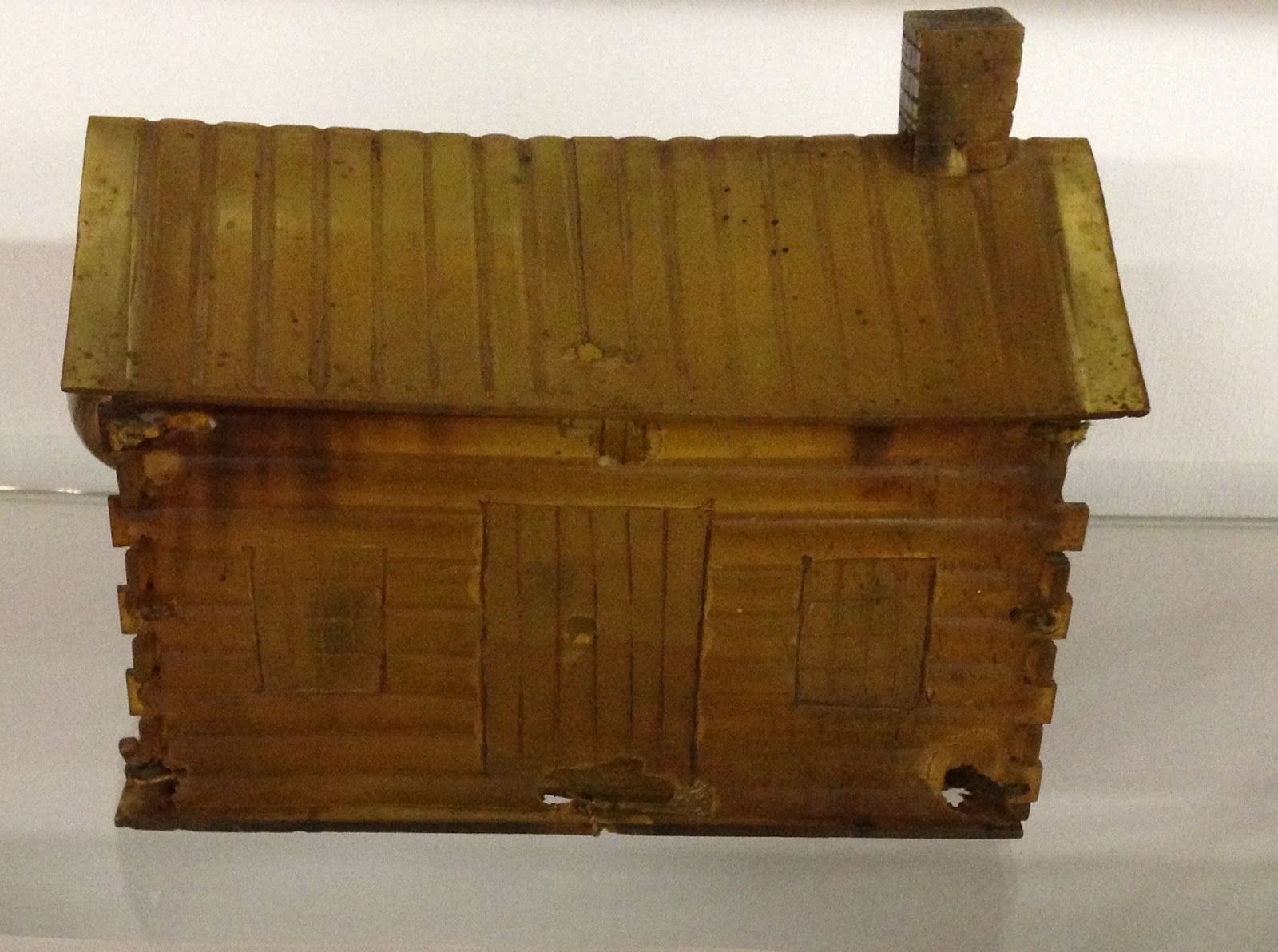
Harrison was also the oldest President up to that time, and Democrats mocked him for this; one newspaper quipped that if given a barrel of hard cider and a pension, he would “sit the remainder of his days in his log cabin”. The Whigs co-opted this detraction, however, declaring Harrison the “log cabin and hard cider candidate”, a moniker that swept the nation and gave him an image as a man of the common people. Log cabin dances were held in support of his campaign, miniature log cabins were built, and even jewelry was designed around the theme. Harrison was able to ride this image to victory, along with disapproval of Van Buren due to the poor economy.

How politicians speak to us through their campaigns is just as relevant today as it was in the 1840s. Consider what words politicians say -- or don't say -- to swing our votes in their favor. Do they use simple language, or are they verbose? What about rhyme and repetition? Are politicians vague or specific? At times, politicians use a bit of all of these. Carefully crafted campaigns strategize and determine which voice to use, and when.

It’s our hope that, as we move toward November, that participants in the “Vote Here! Vote Now!” project will be inspired to engage in political discourse, consider campaign tactics, and voice their opinions. And, if our participants elect to elect, that they consider the options. It’s important to speak out, to make your voice heard, and to vote. But it’s also important to understand, completely, what the issues are

Fortunately, there are many nonpartisan organizations and websites that can help determine which candidate represents your voice best. Locally, the Schenectady League of Women Voters runs vote411.org, which publishes voting guides to candidates. Other sites, such as isidewith.com can help you determine which candidate is most closely aligned with your ideology.

Your vote is your voice. This election season we’re choosing state and national leaders, whose decisions and policy will have great effect on our lives as Americans. Why not take a stand voice your opinion?

Friday, March 11, 2016

Speaker of the Assembly, Ozzie Heck

This post was written by library volunteer Hannah Yetwin.

Photo of O.D. Heck in the January
3, 1945 issue of the Union-Star
Oswald D. Heck, a native of Schenectady, was a lawyer and politician and perhaps New York State’s most influential legislator of the 20th century. The name “O.D. Heck” may be familiar to area residents as the name of the now closed center for developmental disabilities on Balltown Road in Niskayuna, a target of tragic controversy in recent years, but its namesake, Oswald D. Heck, had a longstanding career as an assemblyman filled with positive social impact throughout New York State. As a liberal Republican, he served as Speaker of the House under four governors. Heck’s actions throughout his tenure redefined Republicans as moderate liberals and progressives, in line with Republican governors Thomas Dewey and Nelson Rockefeller. He described his philosophy as a conservative attitude in economics and a gentle, understanding attitude in human relations, and had an impressive ability to build support for controversial measures. He is also the longest-tenured Assembly speaker in New York State history; the only other speaker who came close to surpassing his tenure was Sheldon Silver, who was found guilty of federal corruption charges and was forced to forfeit his Assembly seat in 2015. Heck served as Assembly speaker until his death in 1959.

Heck was born in 1902 in Schenectady, NY, to Magdalena Wurster Heck and Oswald E. Heck. His father was the editor of Schenectady’s German language newspaper as well as a poet who published Leben und Weben, or Life and its Weavings, in the early 1920’s which was a collection of poetry on moral, religious and philosophical problems (Check out previous post Newspapers of Schenectady's Immigrants for more on Oswald E. Heck). Oswald Jr. was a graduate of Union College and attended Albany Law School but left in a dispute with a school official who considered him to be too liberal. He completed his legal education by educating himself, and was admitted to the state bar in 1928.
Heck and his wife Beulah studying the results of the 1950 Assembly race.
Courtesy of the Grems-Doolittle Library clippings file. 
Heck began his unprecedented tenure as speaker in 1937. No one had held the post for more than 10 years at that point, and at the time of his election in office, he was only 34 – the youngest to hold the position in 30 years. During his inaugural year as Speaker, he rallied fellow Assembly Republicans to overthrow the incumbent speaker who blocked the necessary legislation to qualify the state for federal funding of programs passed through Social Security. From 1937 to 1941, he led a successful battle against Democratic governor Herbert Lehman to achieve legislative control over the state budget. In 1942, he worked towards state financial assistance for education in Schenectady County, increasing from $1,220,000 in 1942 to an estimated $5,495,000 in 1958-59. In addition, he created 30,000 scholarships and a student loan fund which broadened the opportunity for higher education for students of Schenectady. During World War II, Heck headed the state’s childcare program that provided childcare for mothers employed in defense plants, and at its height in 1945, more than 10,800 children were enrolled throughout New York State.
Closing of Ettore Mancuso's speech on his radio program "The Italian Hour".
Mancuso was very influential with Schenectady's Italian-American community and was
heavily in favor of Heck over Samuel Stratton in the 1950 Speaker of the Assembly race.
Courtesy of the Grems-Doolittle Library Collection
In 1944, a bill to replace a supervisor’s board with a single superintendent of education in New York City appeared near the end of the last day of that year’s session. Governor Thomas Dewey insisted on passage, but the teachers union opposed it. Republican assemblymen tried to duck out of the chamber to avoid going on record, but Heck ordered the sergeant at arms to round up the missing legislators, closed the door, and called for a vote. The bill was passed after one assemblyman was discovered hiding under his desk and reluctantly voted for the bill after Heck discovered him.
Left to right: Sheriff Ernest Blanchard, Lieutenant Governor
Thomas W. Wallace, and Speaker of the Assembly Oswald Heck.
Courtesy of the Grems-Doolittle Library Photo Collection.  
He was also instrumental in making New York the first state to enact an important civil rights legislation; in 1945, when the Assembly debated Ives-Quinn Anti-Discrimination Bill instituted by Thomas Dewey to ban employment discrimination on the basis of race, creed, color and ethnicity, Heck left the speaker’s podium and went to the floor to make a powerful appeal for passage. New York became the first state to enact this legislation, and it also became the first state to establish permanent agency to enforce such legislation, now known as the State Commission against Discrimination. In 1968, the Ives-Quinn Anti-Discrimination Law was renamed the Human Rights Law, and the State Commission Against Discrimination was renamed the New York State Division of Human Rights. The Law has been expanded over the years to stay current with changing American culture and the evolving needs of New Yorkers.

In 1958, Heck made a drive for his party’s gubernatorial nomination. Heck dreamed of running for governor himself, was driven by the less-than-noble partisan moves of Averell Harriman and Herbert Lehmen, and was mentioned frequently as a potential nominee to oppose Harriman’s bid for re-election. However, he was disabled by a circulatory ailment in his feet, and he threw his support to Nelson Rockefeller who was nominated and elected.  
Photo of Nelson Rockefeller and Thomas E. Dewey as they enter Heck's funeral. Courtesy of a May 26, 1959 Daily Gazette article found at Fulton New York Postcards.
Oswald D. Heck served as Speaker of the New York State Assembly until his untimely death by heart attack in 1959, and was buried at Vale Cemetery. His funeral took place at the Nott Memorial at Union College, and was attended by Nelson Rockefeller and Thomas Dewey, as well as hundreds of the top legislators and leaders of the state and local citizens. Based on his history of willingness to compromise and reach across party lines to come up with solutions to problems, the state Legislature could learn a lot from Heck’s leadership style. Citizens tend to judge the legislature by what they read or hear about its leaders; the legal, ethical and moral standards exhibited by legislative leaders set the tone for how legislators approach their public responsibilities. During Heck’s tenure, scandals were rare and public confidence was high. The principles he supported – cost efficient but responsible government, avoiding impasse and moving legislation along, and partisanship aligned behind public good – are valid and timely today.