Showing posts with label Early Settlers. Show all posts

Tuesday, July 21, 2015

Taverns and Inns of Schenectady, Part I

The 1698 Romer Map of Schenectady shows many important landmarks and buildings in Schenectady. The Brewhouse is outlined in yellow. Courtesy of Grems-Doolittle Map Collection


The 1698 Romer Map is one of the earliest and most detailed maps of Schenectady. This map shows some of the more important buildings and features in Schenectady, including the church, the mill, the King’s Fort, and the brewhouse. Beer and heartier beverages were an important part of Colonial life and some of the more prominent original settlers of Schenectady brewed and sold these beverages in their taverns and inns. Alcohol was not just limited to the men in New Netherlands, women and children were also known to drink. Early Dutch settlers were so fond of imbibing that when Peter Stuyvesant became director-general of New Netherland, he passed several restrictions on drinking and selling alcohol. Stuyvesant believed that excessive drinking “causes not only the neglect of honest handicraft and business, but also the debauching of the common man," and set out to try and create some order among the Dutch settlers. Among the restrictions were rules on reporting bar fights, the banning of the sale of alcohol to Indians, and rules against “unseasonable night tippling”. Despite these restrictions, the tavern remained very important part of colonial life and served several functions for the settlers in Schenectady. In addition to the obvious function of quaffing beer and harder drinks, taverns allowed people to gather and spread news, discuss and debate politics, trade furs and other items, and provided means of entertainment.

Dutch artist Jan Steen painted many scenes of drunken revelry. This painting from 1654 titled "Peasants before an Inn" shows Dutch farmers dancing and drinking outside of a tavern. Similar scenes would probably take place in Schenectady and throughout New Netherland. Courtesy of the Toledo Museum of Art, Toledo, OH.
One of the first innkeepers in Schenectady was Douwe Aukes De Freeze who settled here in 1663. His inn was located on the corner of Mill Lane and State Street, close to the first church in Schenectady. The first licensed tapster on record in Schenectady was Jacques Cornelise Gautsch Van Slyck who was licensed in 1671. The exact location of Van Slyck’s tavern is unknown, but is suspected to be between State and Water Street.  Van Slyck’s rival tapster was Cornelis Cornelise Viele. Viele applied for his license in 1672. The root of their rivalry was that Van Slyck believed he was given privilege to be the only innkeeper in Schenectady, and that Viele’s license would interfere with the business of his tavern. It was decided by the Executive Council that both men could have a license as long as “one should not in any way molest or hinder the other.” A third license was given to Antonia Van Curler, the widow of Schenectady founder Arendt Van Curler, in 1673. Governor Lovelace granted her the license partially in order to quell the quarrels between Viele and Van Slyck, but also for the loss of her husband and for the fire which destroyed her house and farm. The selling of liquor to Indians was normally forbidden, but Antonia’s license allowed her to sell a limited amount of rum to Indians, which neither Van Slyke nor Viele had.
Not to say that the law always dissuaded tavern owners from serving local Indians. Maria Du Trieux settled in Schenectady later in life and was quite familiar with the laws against selling liquor to Indians, having violated them a few times. Maria, along with husband Jan Peek, operated a popular inn in New Amsterdam that was known for late night and Sunday tappings. These tappings cost Jan Peek his license for a short time, his license was reinstated in November 1654 on account of being “burdened with a houseful of children.”  After Jan died, Maria was prosecuted for selling liquor to Indians. She was sentenced to pay 500 guilders and was to be banished from the island of Manhattan. Maria requested that her fine be forgiven on the grounds that she was “one of the oldest inhabitants of New Amsterdam.” Her request was granted and she ended up moving to Albany. From Albany, she moved to Schenectady to live closer to her children on the corner of Front and Church Streets.
Anna Kendall's house on North Ferry Street. Missing from the house is the "Cakes and Beer" sign. Courtesy of the Historic American Buildings Survey
Women in 17th Century New Netherland had some freedom compared to their counterparts in New England. Dutch Women were allowed to engage freely in business and wives of innkeepers, like Maria Du Trieux, would often continue the business after their husband had died. This practice seemed to continue even after the British took control of New Netherland in 1664. Innkeeper Caleb Beck died in 1733 and his widow Ann continued to run the hotel and dry goods shop on Church and Union Street. Other female tavern owners included Anna Kendall who owned a shop on North Ferry Street. A sign outside of her shop advertised “Cakes and Beer”, with an image of a bottle behind the lettering. When Anna’s second husband George Kendall died, she continued to run the shop. In addition to selling beer, she would partake in drinking and when she drank too much her son would bundle her up and take her home.

Captain Arent Bradt’s house was an important meeting place for many of Schenectady’s residents. Arent Bradt was a brewer and a member of the Provincial Assembly in 1745. Arent owned a lot of land bounded by State, Washington, Union, and Church Streets in Schenectady. It was on this lot that he opened a tavern. Schenectady's town government would sometimes hold meetings at Bradt's tavern. According to Ona Curran’s article “Tapsters and Taverns” in the June 1963 issue of the Schenectady County Historical Society's newsletter, records for April 1751 show that “the town of Schenectady paid two pounds to Bradt for troubles in his house and board for councilmen.” 
View of State Street from the late 1800s showing J.W. McMullen Marble Works, formerly the Bradt Tavern. This building was located on the site of the former YMCA at 13 State Street. Courtesy of the Grems-Doolittle photo collection.

Halfway between Albany and Schenectady on the King’s Highway was the “Halfway House”, which was owned by Isaac Truax. Truax was described as a “jolly good tavern keeper and a good friend,” but his inn may not have been the safest. The King’s Highway was notorious for smugglers, thieves and others of ill repute. It was so dangerous that in 1756, a group of militiamen would escort travelers to and from Schenectady. A rumor of guests being murdered at Truax’s inn cropped up, and many years later an excavation at the site of the inn revealed human skeletons under the floor.
Painting of Issac Truax's Halfway House by K.C. Reynolds. Courtesy of the Schenectady History Museum.
As Schenectady’s population continued to rise during the mid-1700s, so does the number of taverns in the town. The taverns also become increasingly more political as tensions between the colonists and British heat up. Find out more in our next blog post on the taverns and inn of Schenectady.


Thursday, November 6, 2014

Barracks, Brewhouses, and Burial Grounds: The Jonathan Pearson Street Books


This undated hand-drawn map by Lawrence Vrooman is an example of one of the rare original documents pasted into the Street Books. The map illustrates the intersection of Front Street, Ferry Street, and Green Street in Schenectady. Image from Jonathan Pearson Street Books, Book 3, portion of Page 7, in the collections of the Grems-Doolittle Library.


The Jonathan Pearson Street Books are a wonderful resource for anyone who is interested in the history of Schenectady from the early Dutch settlement through the mid-nineteenth century, or in researching genealogy and people of Schenectady from that time period. The Street Books are also a valuable resource for people researching the history of homes in the Stockade Historic District and in or near downtown Schenectady.


This page from the Street Books includes notes from an 1816 deed and illustrates property owned at the intersection of Washington Street and Water Street south of Mill Creek. Mill Creek, which ran off of the Binnekill, was piped in the 1880s. Image from Jonathan Pearson Street Books, Book 3, Page 150a, in the collections of the Grems-Doolittle Library.


The Jonathan Pearson Street Books consist of four scrapbook volumes of notes and sketch maps regarding property ownership in Schenectady, created and compiled by nineteenth-century Schenectady historian Jonathan Pearson. Pearson was born in New Hampshire, but moved to Schenectady as a young man and attended Union College. After graduating, Pearson taught at Union and served as the college's librarian for nearly fifty years. He developed a keen interest in the history of his adopted city and became a prominent historian of Schenectady. Pearson wrote a number of works about the history of Schenectady, including Contributions for the Genealogies of the Descendants of the First Settlers of the Patent and City of Schenectady, 1662-1800 (1873), History of the Reformed Protestant Dutch Church of Schenectady (1880), and History of the Schenectady Patent in the Dutch and English Times (1883). Pearson also learned Dutch to be able to translate early records that documented the history of Schenectady and Albany.


The historical notes that Pearson makes about the history of how streets were named or referred to is a particularly interesting feature of the Street Books. The images included here is one of two pages about names once used to refer to Ferry Street, including "New Street," "Market Street," and "The street that leads directly up to the Fort Gate." Image from Jonathan Pearson Street Books, Book 3, Page 2a, in the collections of the Grems-Doolittle Library.


The Street Books focus primarily on Schenectady’s original settlement area, now defined as the Stockade Historic District; to a lesser extent, the Street Books also cover the areas east and south of the original settlement. Source records referenced in Pearson’s handwritten notes include deeds, mortgages, wills, and other documents. Some notes appear to refer to documents held in private ownership. Occasionally, Pearson includes full transcribed copies of documents in addition to his notes. He also includes notes relative to the history of particular streets and alternate names the streets may have been known by before Schenectady streets were first given official names in 1799.


The Street Books occasionally include original documents pasted in among Pearson's note, such as this broadside advertising Jay Street properties up for auction in 1871. Image from Jonathan Pearson Street Books, Book 3, Page 82, in the collections of the Grems-Doolittle Library. 


The original arrangement of the Jonathan Pearson Street Books has been maintained. Each volume contains a section dedicated to a specific street. Streets covered by the Street Books include Amanda Street (now Chapel Street), Barrett Street, Church Street, College Street, Ferry Street, Fonda Street (now the portion of Jay Street north of Union Street), Front Street, Green Street, Jay Street, Jefferson Street, Liberty Street, Maiden Lane (now Broadway), Mill Lane, North Street, Pine Street, Rotterdam Street (once a portion of Washington Avenue south of State Street), State Street, Union Street, Washington Street (now Avenue), and Water Street (now the closed portion of street between Washington Avenue and South Church Street that runs just south of present-day Liberty Park).


This page from the Street Books includes Pearson's notes from the will of Harmanus Peek and a sketch map based on information from the will. Image from Jonathan Pearson Street Books, Book 3, Page 72b, in the collections of the Grems-Doolittle Library.


The physical volumes of the Jonathan Pearson Street Books are very fragile, as they are often composed of very thin paper pasted in layers on acidic scrapbook paper. To minimize damage to the original volumes, volunteers in the Grems-Doolittle Library have created high-quality digital scans of each page of the Street Books for general access.


Although small sketch maps are usually included at the bottom of a page of notes, some of Pearson's sketch maps are more elaborate, such as this piece of a map showing property ownership near the intersection of Liberty Street and College Street. Pearson also indicates how the construction of the Erie Canal transformed the interection. Image from Jonathan Pearson Street Books, Book 4, portion of Page 84, in the collections of the Grems-Doolittle Library.


Volunteers also indexed all instances of names of people, street names, landmarks, waterways, and other features found in the Street Books. The index to the Street Books makes it possible to quickly and easily find references to a variety of pieces of information. Genealogy researchers can locate where their ancestors owned property in Schenectady. Researchers of military history and fortification in Schenectady can quickly find references to forts, garrisons, palisades, and blockhouses. Researchers interested in occupations and industry can easily find references to mills, taverns, breweries, blacksmiths, hotels, restaurants, and tanneries. Those interested in transportation can find information related to bridges, ferries, railroads, and the Erie Canal. There are myriad possible research uses of this information-rich resource.

Some images from the Jonathan Pearson Street Books are included here. Researchers can gain full access to the scanned images of the Jonathan Pearson Street Books by visiting our Library or contacting our Librarian. A master index and guide to the Jonathan Pearson Street Books can be found by clicking this link.

Monday, August 27, 2012

The Mabee Family Papers

The original 1705 deed for what is now know as the Mabee Farm. In this deed, dated Jan. 22, 1705, Daniel Johnson conveys to John Pieterse Mebie a certain piece of land eight miles above the town of Schenectady on the South side of the Mohawk River containing 63 acres and 79 rood. This document is number M-Deed-06 in the Mabee Family Papers.

The Mabee Family Papers, a gift of George Franchere of Dunedin, Florida, consists of almost 600 items, including deeds, wills, correspondence, inventories, legal documents of many kinds, bills of sale for slaves, student exercises, and receipts for a wide variety of purchases. As a part of Mr. Franchere’s larger gift of the Mabee Farm, the Mabee Family Papers provide a wealth of information about the Mabee Farm and family. The wide breadth of materials in the collection are of interest to genealogy researchers as well as researchers interested in the history of the area. The documents in the collection give researchers a lot of information; not only about the Mabee family specifically, but also more broadly about commerce, farming, education, slavery, colonial Dutch language, cookery, war, and many other aspects of life and community. The personal correspondence, handwritten poems, and the elaborate calligraphy included in the student exercises provide a unique look into the personal lives, aesthetics, and personality of the people who created them.

The Mabee Family Papers are arranged and numbered by categories, in a style that parallels the system used for the Library's main Historic Manuscripts Collection. This introductory notebook begins with a listing of the categories used, followed by a categorized numerical list of the documents with an abstract summary of the contents of each item. See a complete finding aid for the collection here.

Below are just a few examples of some of the interesting documents included in the Mabee Family Papers.

This sketch map of an unidentified piece of land includes an interesting representation of scale information. “For Jacob Mabee, Esq.” is written on back of the map. Document number M-Misc-25 in the Mabee Family Papers.

Order by Col. John Bradstreet dated May 1, 1760, for “Jacob Mabie or a Sufficient Driver with a span of Horses, Harness and Waggon” to be “employed in his Majesty’s Service.” Document number M-Mil-05 in the Mabee Family Papers.


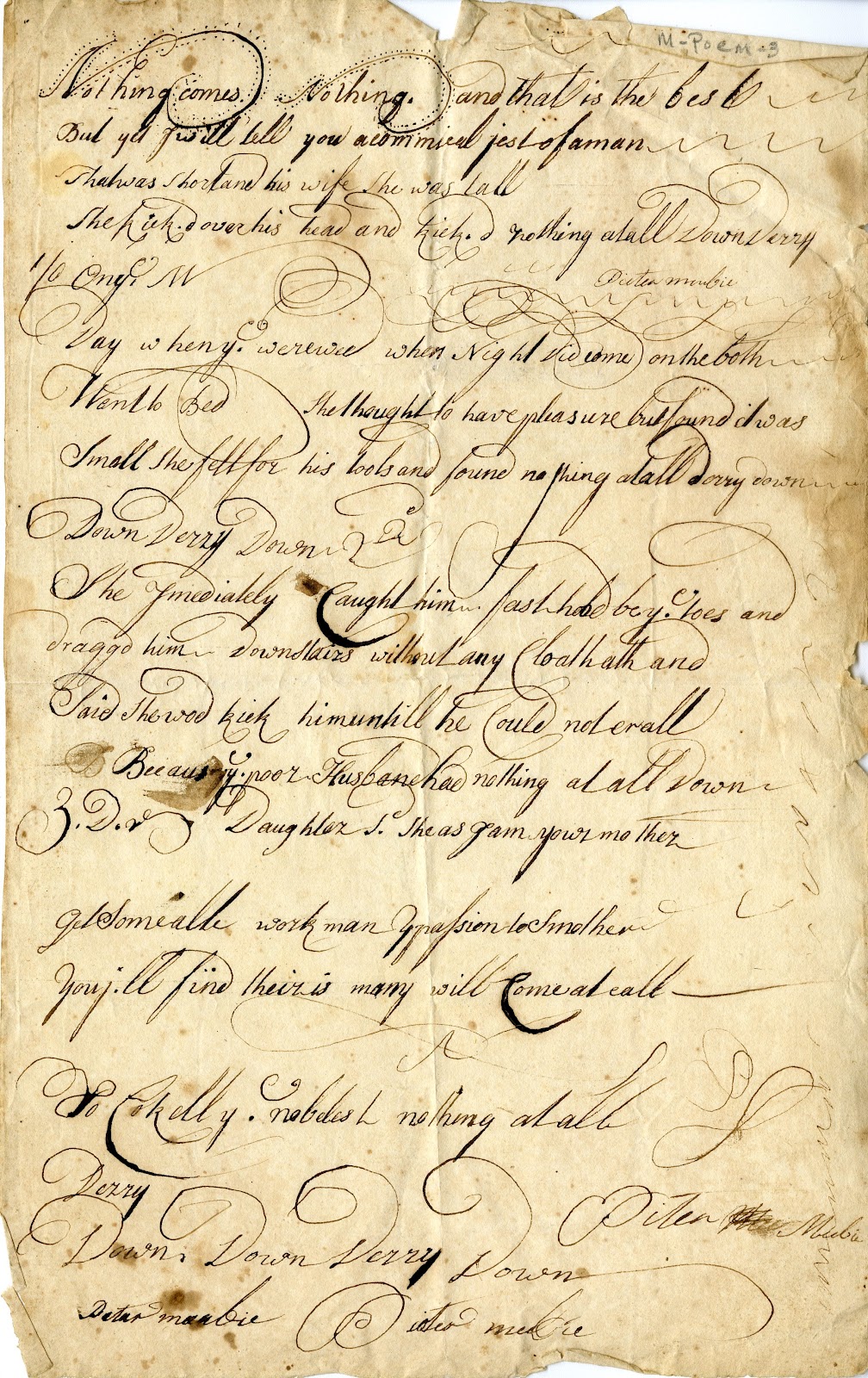
This slightly bawdy poem appears to have been written out by Pieter Mabee. “She thought to have pleasure but found it was small, she fell for his looks but found nothing at all.” M-Poem-03 from Mabee Family Papers.


Portion of a letter written by John V.P. Mabee to his cousin, Jacob Mabee, written while John was at Camp Vogdes, Fort Ringgold, Virginia in 1864 during the Civil War. John Mabee writes to his cousin for honey and beeswax and details the hardships of camp life. "I hope and pray I will see the day that I can meet Lieutenant Edward Smith in the streets of Schenectady when my term of service expires," he writes. "you can bet high he will either whip me or I will him[.] he is a very over bearing officer indeed." M-Letters-32 from Mabee Family Papers.


Bill of sale for a male slave named Cato, dated January 27, 1800. He was sold by Peter Conyne, Henry Funda, Peter Mabee & Simon Mabee to Jacob Mabee, for the sum of eighty-five pounds. M-Slaves-3 from the Mabee Family Papers.


Wednesday, August 31, 2011

Dutch-language documents in the Grems-Doolittle Library

Land agreement signed by the Mohawks ceding land
in Schenectady, 1670. A translation of the original
document is printed in Jonathan Pearson's History of
the Schenectady Patent.
Given Schenectady's founding as one of the northernmost parts of the New Netherland colony and the longevity of Dutch-speaking settlements in the area, it should come as no surprise that the Grems-Doolittle Library has in its holdings a significant number of Dutch-language documents. There are 550 Dutch-language documents in our collections, including family correspondence, land records, account books, poetry, and other materials. Our holdings of Dutch-language materials date from 1661 to 1909; the bulk of the documents date from the late seventeenth through the late eighteenth century.

Many of the documents have not been translated, although three new translations have been added this year. As interest in the history of Dutch settlement in the area grows, we hope to be able to generate more interest in these materials and translate them so that a broader range of researchers can access the information that these documents contain. Click here to see a complete list of Dutch-language documents in our collection.

Tuesday, June 7, 2011

Who was Ots Toch?

In conducting genealogical research using secondary sources, it can sometimes be difficult to sort out fact from myth. One such case is the parentage of the Mohawk woman Ots Toch, wife of Cornelius Antonissen Van Slyck (Van Slyke).

The dominant traditional story that was published for many years in Van Slyck and Bradt genealogies is that a French trader named Hartell or Hertel came to the Mohawk valley around 1620, where he married a Mohawk woman who under the law of the Five Nations owned Hog Island in the Mohawk River. Hertel is said to have had two children with this woman. Nelson Greene, writing in History of the Mohawk Valley: Gateway to the West, 1614-1625, describes the two daughters, Ots Toch and Kenutje, who would later go on to marry Cornelius Van Slyck and "a Bradt," respectively: "Ots Toch was wild and savage like her mother while Kenutje was small and handsome and very white like her father, Hartell."
Another theory was published by Giles Yates in 1857 in his column in the Schenectady Reflector, where he compiled, in his own words, "segregated fragments and broken facts of unwritten traditionary history." Yates advanced the idea that the last native owner of Van Slyck's Island was an Oron [Huron] chief named Shononsise who married the daughter of a trader named Jacques Hartel and had two daughters, "Otstock" and "Kanudesha."
Cynthia Brott Biasca, in an article in the New York Genealogical and Biographical Record, promotes the theory that Van Slyck's wife was a full-blooded Mohawk and was not the daughter of a French trader. Biasca also discredits Yates' story based on the discrepancy in dates and in the absence of any recording of Shononsise or the Huron in the published Jesuit Relations. Biasca attempted to find the earliest recording of the Hertel/Ots Toch story, tracing back to the Paige Diaries and a footnote in Jonathan Pearson's History of the Schenectady Patent. Biasca also points to the Journal of Jasper Danckaerts, 1679-1680, which includes a passage where Danckaerts speaks with Hilletie, daughter of Van Slyck. Danckaerts describes her as a "half breed," the daughter of a Dutch father and an Indian mother.
Barbara Sivertsen, in Turtles, Wolves and Bears: A Mohawk Family History, acknowledges the identification of Hilletie's mother as a full-blooded Mohawk in Danckaert's journal, but writes that Hertel's Mohawk daughters Ots Toch and Kenutje "may have been adopted by their mother's parents, a practice not uncommon in the Iroquois; thus the tradition of their being daughters of a chief would coincide with their fathering by a Frenchman. This would probably account for their being thought of as full-blooded Mohawks. The fact that Ots Toch and Kanetis [Kenutje] married (at least in the Indian sense) white suggests however that they were half-breeds." Sivertsen notes that a trader Jacques Hertel is recorded in the early records of New France and she hypothesizes that he could have had contact with the Mohawks near Schenectady around the time of Ots Toch's conception. Further, she claims that the French name of Van Slyck's first son, Jacques, around 1840 in a Dutch family suggests that the Hertel legend is accurate.
Given the paucity of original records in this case, researchers are left with questions and controversy, but little documentation -- and must draw their own conclusions.
For additional information about the Ots Toch question, see the following materials, all in the holdings of the Grems-Doolittle Library: New York Genealogical and Biographical Record; Turtles, Wolves and Bears: A Mohawk Family History; Journal of Jasper Danckaerts, 1679-1680; Forts and Firesides of the Mohawk Country; History of the Schenectady Patent; Van Slyck family file; Paige Diaries.
Thank you to Grems-Doolittle Library volunteer Dianne Gade, who researched and compiled the sources outlined.

Thursday, April 28, 2011


One crest, labeled Henry Rough Junior


A second crest, drawn in 1790

In some cases a picture is worth a thousand words! These two drawings were among the Hanson collection papers, mixed in with legal documents and personal letters. They seem to have the same artist, a Caggarus J Rough. They probably come from the Montgomery or Tryon county area.

Thursday, April 21, 2011

An Interesting Discovery about Old Documents

One example of someone using initals as their mark
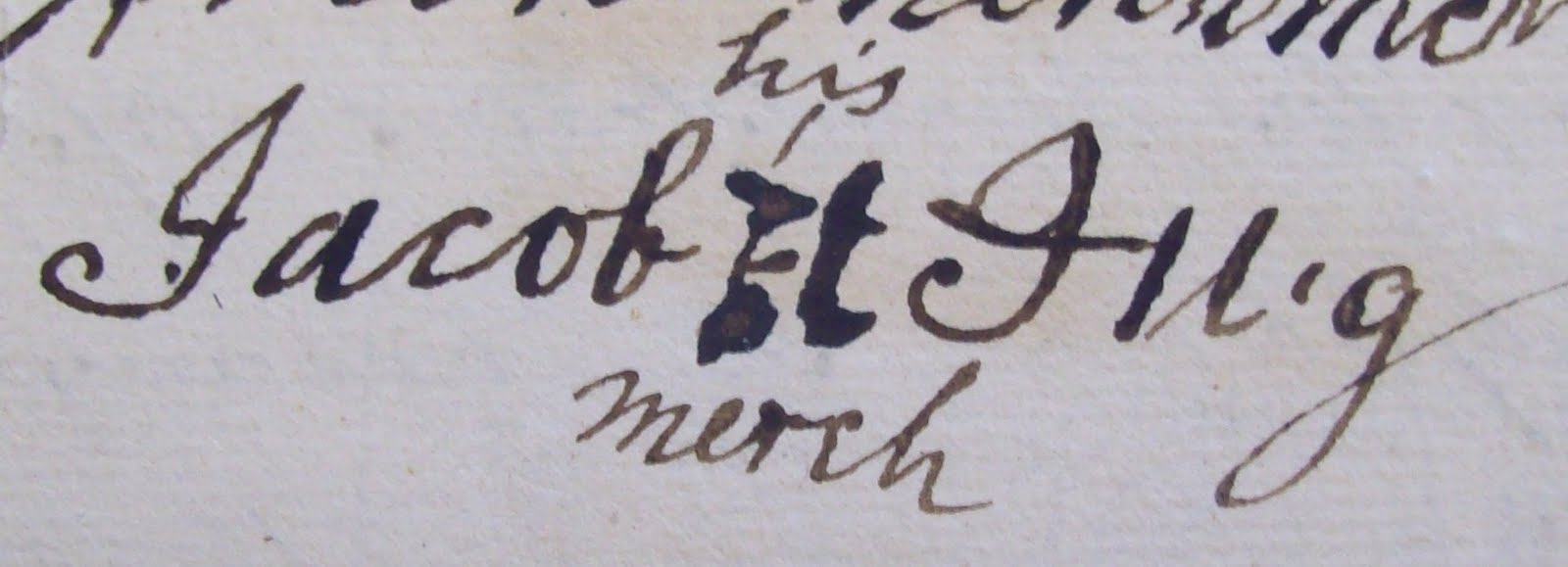
While working with a collection of legal documents from the 1730s to the 1820s I discovered something interesting about signatures in early America. Previously I had been familiar with the idea of someone making a mark when they are unable to write their name. However, I had always assumed that these marks are almost always simple x’s . Working with the Hanson collection, my assumption has been proved over-simplistic. While it seems that many people chose to make their mark with an X, others were able to sign their initials.
A woman was asked to witness,
despite her inability to write
Additionally, the way that marks were presented is different than I expected. I had thought that people made a mark on a document and that was that. However, when given more thought, how would anyone know to whom the mark belonged? Well it turns out that when someone signed a document with a mark, the scribe or court official would write that person’s name around the mark and indicate that the mark was indeed his or her mark. This practice may have created some confusion, because often beside the signatures of those who had signed for themselves was a bubble with the letters LS inside. After some musing I decided LS most likely stood for Legal Signature, as a way of distinguishing between those who could sign their own names and those who could only make a mark.
L S, most likely meaning Legal Signature


It would be interesting to make a closer study of these marks, to see if any patterns emerge, in terms of who can sign their names and who cannot. I think that such a study might provide interesting insight into literacy in Early America.

Monday, April 11, 2011

Treasures of the Hanson Collection

More work has been done with the Hanson collection and it is time for an update. The collection seems to include many documents from the late 18th and early 19th century and some interesting documents have surfaced. I have selected a few that I found particularly interesting or unique within the collection to highlight now.
The first interesting document was Samuel Jackson’s application to be a citizen of the US “that the said Samuel Jackson is as this deponent verily believes attached to the Constitution of the United States, and well disposed to the good order and happiness of the same; and that he has ever since he has known him behaved as a man of good moral character.” I thought this document was particularly interesting because of the way it is worded. I cannot image anyone today considering themselves “attached to the Constitution.”
The second document that I want to mention made me laugh a bit. It was a letter to Brigadier general Henry Fonda from a court-martialed soldier. This soldier is writing to convince Fonda that he was unjustly charged because the order that he ignored was given to him on the Sabbath, the day of rest for all Christians. He even goes so far as to quote a specific law to the general. Someday I would like to see if I could find out more about this particular soldier and what became of his case.
The  last interesting document from the collection is a letter written in 1812 by a federalist. He spends the whole three pages of his letter writing philosophically about American politics, about the two different parties and about the future of politics in the State of New York. I think this letter would prove an amazing source for historians interested in early American politics.
I am sure to come across more interesting pieces to his immense collection, so I will provide you with another update soon!
Library Assistant Heather Cunningham, reading through the Hanson Collection to create a detailed listing of the materials

Monday, April 4, 2011

The Original Settlers of Duanesburg

An interesting research question came across the librarian’s desk last week involving the original settlers of the town of Duanesburg. A researcher had read in a book on New York State history that in 1765 James Duane and twenty German families had made a contract and sixteen of these families moved up to Duanesburg, from where they had been living in Pennsylvania. Thus this book was claiming that these German families were the original settlers of Duanesburg. However, the researcher was questioning the accuracy of this piece of information because the book sourcing it was written in 1851.
I decided to investigate further, to see if other historians also indicated that German families were among the first settlers of the town. I determined that the best strategy was to see what past historians had said about German settlers in Duanesburg. I assembled the following list of “facts.”
·         A book published in 1886 stated that “about” twenty German families were invited to Duanesburg and sixteen actually moved
·         A history in 1906 only mentioned eleven families signing the agreement
·         A newsletter article by Lansing Christman from 1965 mentioned an agreement between Duane and nineteen German families
·         And in an article for the Gazette, Larry Hart seems to have agreed with the idea of about twenty families settling in Duanesburg
While everyone seems to be in agreement that German farmers were the first settlers, clearly there are many discrepancies in the facts, and particularly as to how many German families were involved in this agreement. This is not an uncommon snag for research relating to this period of study. Early historians rarely cited the sources of their information, therefore making it difficult for modern researchers to trace details back to the original.
However in this case we lucked out because, while compiling this list of historical opinions, I came across a piece of paper which solved the mystery. I found a transcription of part of the original agreement between Duane and twenty families (exactly twenty, not about twenty). The transcription only includes the names of the male heads of these twenty families, but it also lists those eight who actually signed the documents. So now, not only are we clear on the number of settlers, we also have their names.

Saturday, March 5, 2011

Rediscovering our own collections, a box at a time

Ideas of archival best practice have changed quite a bit in the last fifteen years or so and occasionally as we are trying to keep our records up to date we find things that have been forgotten for a while. Just a few weeks ago, while looking for something in our basement, several shoeboxes of documents were found, which are from the early 18th century. Many of these documents are linked to Reyer Schermerhorn and quite a few of them are in Dutch. While it is unfortunate that we were unaware of these documents existence, the good news is that they are being looked at in more detail now, re-boxed and listed.  Then they will be available for interested researchers.
There are some challenges to such a find though, for example where did these documents come from and what is their story. Luckily for this discovery we were able to trace the documents back to their donation and Katherine was able to contact the donor and gain more information about how they came to us.
Of course there are other challenges to the collection. Old documents that have been folded for a few hundred years don’t always appreciate being unfolded. The fact that so many of the documents are not in a language that any of us can actually read is yet another challenge. But don’t think we will let that stop us, it may take us a while, but we will get a better understanding of these documents in time.