Showing posts with label Theaters. Show all posts

Thursday, December 11, 2025

The Mohawk (then Hudson) Theater

This post was written by library volunteer Gail Denisoff.

A new theater joined the many entertainment venues in Schenectady in 1904. Originally built for musical theater and vaudeville productions, the Mohawk Theatre was built next to the Fire Department at 10-14 South College Street (now a parking lot between Burger King and Clinton's Ditch). The Mohawk Theatre Hotel and Rathskeller situated in front section of the theater and sharing the same address, housed many employees of the theatre and rathskeller. Described as a typical "Gay Nineties" theater house, it had "decorated ceilings, rococo moldings, gold leaf, crystal chandeliers and rich textured drapes. There were two boxes on either side of the big stage, an orchestra pit, balcony and a wide center aisle with narrow side aisles on the main floor." The theater had a capacity of 900 on the main floor and 1350 seats if the upper gallery was open.


1914 Sanborn Insurance map depicting Mohawk Theater and Hotel building at 10-12-14 S. College St.

By the summer of 1909, vaudeville gave way to burlesque, and the Mohawk billed its acts as "musical extravaganzas" to distinguish themselves from the bawdier and more risqué acts that could get a theater shut down. The theater added income when rented out for other uses. One such rental was by Reverend George Lunn, who would later become Schenectady's first socialist mayor. After resigning as the pastor of the First Reformed Church, he began his own non-denominational church called the People's Church. In 1910, he rented space at the Mohawk Theatre for Sunday night services, which he continued even after his election in 1912.

The theater changed managers frequently and continued to rotate between vaudeville, burlesque and stock theater companies. By 1916, the name of the theater changed to the Hudson Theatre thanks to an actor in one of the traveling stock companies who convinced the management at the time that the Hudson was a larger river so would be a more prestigious name. It continued as mainly a burlesque house until 1923 when A. Vedder Magee and some local backers bought the theater at foreclosure. In the fall of 1924, they decided take a chance and offer a season of "decent family entertainment" even though "girlie shows" were the most successful productions at the time. Magee brought The Harry Bond Players stock company to Schenectady after their successful run in Pittsfield, MA. The Bond Players reopened the Hudson Theatre on November 17, 1924, with a week's run of the successful New York City play, "Thank-U". The entire proceeds of the first two performances went to the Schenectady Crippled Children's Fund. 


The lighted sign marking the Hudson Theater sits directly below the original Mohawk Theater sign at the top of the building.
 

The new direction of the theater proved successful and soon the theater was showing a profit. Audiences flocked to the Hudson for a variety of plays that changed each week. A favorite was "The Night of January 16th" by Ayn Rand. Whenever it was performed, a new jury was chosen from the audience to sit in the jury box on stage and render a verdict. A popular thriller was "The Cat and the Canary" and the comedy "The Easy Mark" was also well received. When "Ming Toy" starring Harry Bond as an Asian merchant was performed, the usherettes dressed in Chinese costume and incense permeated the theater for effect.

The Hudson become popular not only with the more affluent members of the community but also with people from all walks of life. Faithful patrons would wait at the stage door after a show for autographs or to congratulate their favorite performers. The audiences felt a bond with the actors, enthusiastically applauding when each entered the stage for the first time during a performance and shows ended with multiple curtain calls. Harry Bond would often appear to thank the audiences and invite them to return for the next production.

The thirteen actors in the stock company worked hard. They learned lines and rehearsed daily from 10AM until noon, always a week ahead of the production in progress. The pit orchestra of about eight musicians practiced cue-ins and any background music. Some of the pit-men preferred dramas so they could play poker in the downstairs dressing rooms between acts. Harry Bond, well liked by his stock company, was encouraging and kind to his actors. One member he brought from Pittsfield as a character actress was Richie Clark Russell. She told Bond that she had misgivings about coming to Schenectady and doubted she would last more than one season. She ended up loving the area, married A. Vedder Magee and stayed until her death in 1971.

Mrs. Richie Magee, actress and wife of A. Vedder Magee, at her Schenectady home in 1960. Photo from the Larry Hart Collection.

 On Saturday night, May 22, 1926, the Bond Players performed "In Love with Love", which was the second to the last production of their second season. Harry Bond came out to thank the audience for their response to the show as well as the whole season and invite them to "Ice Bound" to be performed the following week. The audience was delighted when he announced the company would be back in September for a third season.

Tragedy struck the next afternoon. Harry Bond and Tedd Brackett, one of the actors in the company, were out for Sunday dinner with their wives. They dropped the women off at the Maywood Hotel before dinner at about 1:30 while the men drove off to try out Tedd's new Buick Brougham. Harry was driving when the car stalled on the tracks of the Schenectady Railroad Company at stop 15½ on Schenectady-Albany Road. He was trying to back the car off the tracks when the oncoming trolley crashed into them at approximately 50 miles per hour. Killed instantly, both men were thrown from the vehicle, parts of which were scattered 500 feet down the tracks. It was reported more than 10,000 people flocked to the crash site before the day was out. Tributes poured in from devastated theater patrons as well as public and civic leaders.

Hundreds gathered along the streets as services for Bond, 41, and Brackett, 45, took place two days later at Timeson & Fronk Funeral Chapel near the theater at 15 South Church Street. Tedd Brackett was later buried in his hometown of Cortland, NY, and Harry Bond was cremated. Harry's family sued The Schenectady Railway Company and won, but the decision was overturned on appeal.

While the crash marked the end of the Harry Bond Players, it did not end performances at the Hudson Theatre. A. Vedder Magee asked actress Richie Clark Russell if she would organize a stock company to produce a 1926-27 season. She agreed and her contract stated she had sole charge of the production and would appear in at least three plays a month. Audiences continued to flock to the theater and were treated to shows such as "The Gorilla", a thriller in which a man dressed in a gorilla costume ran up and down the aisles frightening patrons, "Seventh Heaven", "Charlie's Aunt", and Richie Clark Russell's personal favorite, "Smiling Through", a heartwarming story of a civil war veteran. A few of the Harry Bond Players remained with the new company.

Although Richie Clark Russell's company had two successful seasons at the Hudson Theatre, rising production costs forced the company to end its run. The Wilcox Players performed there for part of a season and The Abbey Theatre Irish Players also played briefly but economic uncertainty following the crash of 1929 closed the theater to stage shows for good. In 1934, the theater was leased to the Farash Theater Corporation. The interior was remodeled into a night club with the stage used as a dance floor. A fire of undetermined origin destroyed the theater on December 18, 1934 and it was torn down shortly thereafter.     

Private party held at the remodeled Hudson Theater, Feb. 16, 1934. Photo from the Larry Hart Collection.


Friday, December 2, 2016

Harry Houdini in Schenectady

When I think of Harry Houdini the first thing that comes to mind are his wild escape acts, mind bending illusions, and amazing feats of physical strength and stamina. A lesser known aspect of Houdini's life was that in the 1920s, he began to focus on debunking spiritualists and psychics. His training in sleight of hand and audience manipulation gave him a keen sense on how to expose frauds, although it didn't hurt that Houdini and his wife would use similar spiritualist tricks when they were strapped for cash.

Advertisement for Houdini's 3 Shows in 1. Courtesy of
the blog Wild About Houdini.
His most famous run-in with a spiritualist occurred during a séance with his friends Arthur Conan Doyle and his wife Lady Jean Conan Doyle, Arthur Conan Doyle's wife. The Doyle's were touring the United States to lecture about Spiritualism. Lady Doyle claimed to be a medium and wanted to conduct a séance to contact Houdini's mother. Houdini's wife, Bess, had previously warned him that Jean had been asking questions about his mother, but Houdini agreed to the séance anyway. During the séance, Jean appeared to fall into a deep trance and began to transcribe what Houdini's mother was transmitting from beyond the grave. Houdini immediately found problems with the sance. He was born in Budapest to a mother who did not speak English and a father who was a rabbi. The first thing that Lady Doyle drew when she went into a trance was a cross and then she proceeded to write everything down in English.

After the séance, Arthur told the press that Houdini had been converted to the religion of Spiritualism. A bit miffed at the untrue accusation, Houdini publicly stated that the séance made him even more skeptical of spiritualism. This exchange put a heavy strain on their friendship and Houdini decided to put on his own anti-spiritualism tour. This tour eventually evolved into Houdini's "3 shows in 1" tour that he would bring to Schenectady in mid-October, 1926. During his three day stay in Schenectady, he gave a lecture on anti-spiritualism at Union College, performed his magic act at the Van Curler Opera House, exposed a Spiritualist that he believed to be a fraud, and gave an address on WGY.
Photo of Harry Houdini from the October 13, 1926
issue of the Schenectady Gazette.Courtesy of fultonhistory.com

Houdini injured his ankle just days before in Albany while performing the Chinese Water Torture Cell at the Capitol Theater. The injury almost caused him to cancel the rest of his tour, but the Van Curler took out an ad ensuring that Houdini "will positively appear" at the theater. There was a clause in his contract stating that if Houdini was to cancel any show due to illness or injury, he would have to pay the theater $1,000 per day. The blog Wild About Houdini states that Houdini wrote an urgent letter to his manager from the dressing room of the Van Curler Hotel where he threatened to cancel the tour if his manager did not remove the clause.

"I am amazed any sensible manager would sign a contract with such a clause in it and I am perfectly willing to leave the road before I would take such a chance. [...] Am perfectly willing to continue if a new clause is inserted but under the present contract I retire gracefully."  -Houdini's letter to his manager, written from the dressing room of Schenectady's Van Curler Hotel.

The injury caused Houdini to switch up his act a bit and he couldn't not perform his best trick, presumably the Water Torture Cell, but ever the crowd-pleaser, he replaced it with five others. An article from the October 15, 1926 issue of the Schenectady Gazette stated that Houdini performed hundreds of tricks during his act and that while his magic show clever, the best part of the show was his performance exposing spiritualists and mediums. Houdini put on a fake séance and invited several audience members to join him on stage, revealed how spiritualists used their charms and interviewed a woman who had went to several mediums in Schenectady. According to the mediums, she had many deceased husbands and children in heaven. The audience got a kick out of the reveal that she had never been married and had no children. You can find the Schenectady Gazette's review of Houdini's show here at fultonhistory.com.

Houdini's stay in Schenectady was lively despite the injury that almost caused him to cancel the whole tour. The injury that he received in Albany is believed to be a direct cause of Houdini's death although there is debate as to whether he was suffering from acute appendicitis and did not realize the symptoms. Houdini would die just 16 days after his last performance in Schenectady due to complications from appendicitis.

Houdini on WGY radio on October 14, 1926. Courtesy MiSci -
Museum of Innovation and Science 
Thanks to the blog Wild About Harry , fultonhistory.com and Don Rittner's article on Albany's role in Houdini's death.

-Mike Maloney

Wednesday, July 11, 2012

Schenectady Goes to the Movies

Take a trip back in time to Hollywood's golden age, as experienced in Schenectady, through a sampling of images from our holdings. 
 
Entrance to the Art Theater – 1913. The Art Theater was one of the early movie theaters in Schenectady. It was located at 432 State Street, where Proctor’s Theater is now. The first movie shown in Schenectady was The Great Train Robbery, shown at the Crescent Theater in 1905. The first movie theaters were small. Some makeshift movie theaters were even set up in non-theater buildings, such as a fraternal organization hall. Early theaters were sometimes referred to as nickelodeons, because of the five-cent admission charge that was standard. Photo from Larry Hart Collection.


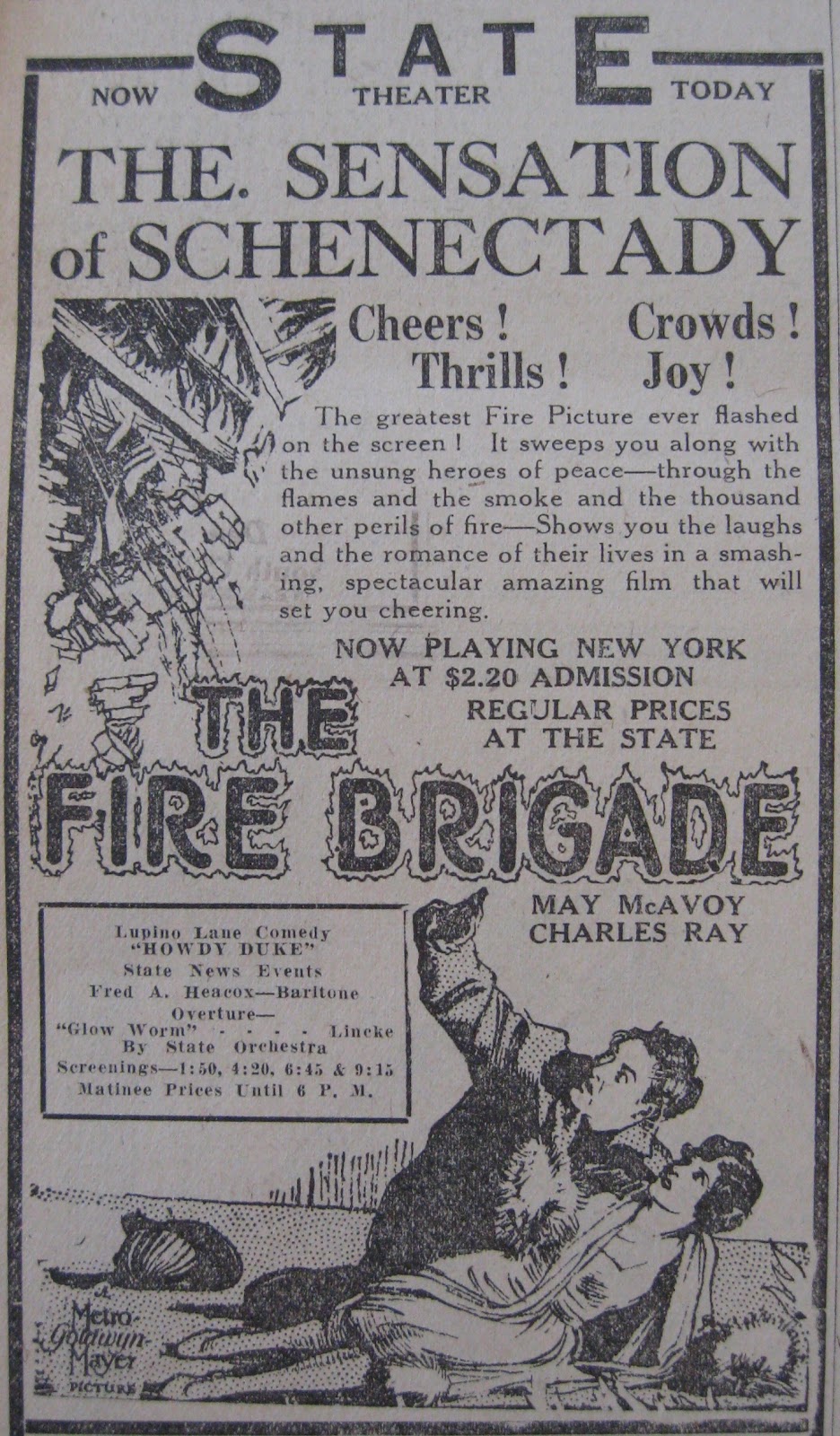
Advertisement for movie in Schenectady Gazette – 1927. Advertisements for movies were common in the newspaper during this period. This ad for the silent film The Fire Brigade appeared in February 1927, just a few months before sound movies, or “talkies,” became popular nationwide. Most movie advertisements in newspapers during this time featured drawings designed by the Hollywood production company; the State Theater put a local spin on this ad by calling the movie “the sensation of Schenectady.”


Entrance to Proctor’s Theater – 1936. The entrance to Proctor’s Theater in 1936 looks much the same as it does today (minus the "newsie" standing outside, of course), as the original look of the building has been preserved and restored. The first Proctor’s Theater in Schenectady was built in 1912 off Liberty Street by the Erie Canal. The present Proctor’s Theater, designed in an Italian Baroque style by architect Thomas Lamb, was opened in 1926. It is on the National Register of Historic Places and is a local landmark. Photo from Larry Hart Collection.


Actress Ginger Rogers visits Schenectady County – 1946. This photograph shows actress Ginger Rogers visiting Schenectady County to see the family of her then-husband, Jack Briggs, in Quaker Street. The couple visited on November 24, 1946, to celebrate the 60th wedding anniversary of Briggs' grandparents. Briggs, a Schenectady County native, was also an actor. The couple met when working on the set of Tom, Dick and Harry (1940) and married in 1943, divorcing in 1949. Many other famous musicians, actors, and entertainers have visited Schenectady over the years, including famous clown Emmett Kelly, jazz legend Duke Ellington, and then-actor Ronald Reagan, who was a spokesman for G.E. Photo from Larry Hart Collection.

Matinee crowd at Lincoln Theater – 1950. A crowd of moviegoers lined up at the Lincoln Theater on Brandywine Avenue. Visitors to the Lincoln Theater during the 1930s and 1940s often saw Edward Spellacy, known as “the popcorn man.” Spellacy sold hot, fresh-popped popcorn for 5 cents per bag from a cart with a steam-powered dancing metal clown on top. Photo from Larry Hart Collection.