Friday, June 7, 2013

A Sketch of the Life of Dora Jackson

Dora Jackson as a young woman. From Grems-Doolittle Library Photograph Collection. 


Visitors to the Schenectady County Historical Society are often curious about the history of the building that contains our Museum. For many years, the building has served organizations -- first the G.E. Women's Club, and, for over 50 years, the Schenectady County Historical Society. However, it was originally built and inhabited as a private home. It was the home of Dora (Mumford) Jackson, a widow who lived in Schenectady for much of her life.

Dora Astor Mumford was born in New York City on May 17, 1831, the daughter of Samuel Jones Mumford and Caroline Givens (Astor) Mumford. Dora's mother died in February 1834, when Dora was not yet three years old. Shortly afterward, Dora and her infant sister Caroline were sent to Schenectady to live with her paternal grandparents, Benjamin and Harriet Mumford. Dora's sister would die a few short months later, in July of 1834. During the nineteenth century, the wealthy and established Mumford, Bowers, and Jackson families clustered along Washington Avenue, creating an informal extended family network in the neighborhood. This support was likely vital to young Dora as she grew up; her family life was marked by loss. In addition to the early deaths of her mother and sister, two of Dora's stepmothers died during her childhood and early teenage years, and her father would die soon after Dora's marriage. Dora attended Emma Willard School in Troy, graduating in 1847 at the age of 16.

In 1850, in Prattsville, New York, Dora married Alonzo Jackson. Alonzo Clinton Jackson was born in 1823 in Montgomery County, New York, to Allen and Diana (Paige) Jackson. When Alonzo's father died in 1836, Alonzo's uncle, Alonzo Paige, took responsibility for the educations of Alonzo and his brother, Samuel. Alonzo graduated from Albany Academy. He was still a seventeen-year-old student at Union College when he was appointed as a midshipman in U.S. service. He served in the Pacific for five years, and entered the naval school at Annapolis, Maryland. He passed with honors and shortly after served in the Mediterranean, not returning until late 1849. After Dora and Alonzo's marriage in 1850, the 1850 Federal Census shows the couple living with Alonzo Paige and his wife, Harriet Bowers Mumford Paige. Harriet was also Dora's aunt (Harriet is also well-known to local history enthusiasts as a diarist who commented on prominent people and community life in nineteenth-century Schenectady). Alonzo Jackson continued in service with the U.S. Navy, earning the rank of Lieutenant. Tragically, his life was cut short in 1853, at the age of 29. According to his death notice, he died of "a disease of the brain, brought on by too arduous application to the scientific duties of his profession."

Photograph of Alonzo Clinton Jackson taken by N.S. Bowditch, U.S. Naval Academy, Annapolis, Maryland. This image is a copy of the original photograph, which is in private hands. From Grems-Doolittle Library Photograph Collection. 

By the age of 22, Dora Jackson had not only lost both of her parents -- she had lost her husband as well, and was the mother of a toddler and an infant. The couple's daughter, Helen, had been born in 1851, followed by a son, Jones, in 1852. The 1855 New York State Census shows Dora and her children living with Alonzo and Harriet Paige. The 1860 Federal Census shows Dora, Helen, and Jones living with Samuel Jackson, Alonzo Jackson's brother. By the 1865 New York State Census, Dora and her children had a home of their own. The family lived "at 32 Washington Avenue in the familiar little white house so many years a landmark in Schenectady," according to the obituary of Dora's daughter, Helen (Jackson) Mason, in 1915.

The small white house was razed and the present house was built on the site in 1895, after Dora had been a widow for over 40 years. The house was built for Dora by her son, Jones. The house is a Colonial Revival style reproduction of a transitional New England Georgian style house of the 18th century with Federal period detailing. It was designed by American architect William Appleton Potter. A glowing memorial of Dora Jackson published in the newspaper after her death in 1899 notes that Dora's home was "doubly dear to her, from the love that prompted its building, - to the 'House not builded with hands,' for which her whole life was a preparation, one whose life was so closely interwoven with all of the best and brightest of both the old and the new Schenectady." After Dora's death, her son lived in the house. He died in 1906 after suffering from sunstroke in the garden. The ownership of the house then passed into the hands of Dora's daughter, Helen. After her brother Jones' death, Helen built a bungalow at 30 Washington Avenue; she spent summers there with her daughter, Gertrude Franchot Mason.

When Dora Jackson died in December 1899, she was remembered as a kind, lively, and religious person. She was active in St. George's Church, and is buried in the church's burial ground, along with her husband and son. "It is seldom one finds combined in the same person social attraction of a high order and a deep religious nature," reads her obituary. "Mrs. Jackson possessed the two qualities in a remarkable degree. Her home was always the centre of a gracious hospitality, enjoyed alike by young and old. Her youthful heart and kindly ways endeared her to all ages. Her devotion to her church was unwavering. The church bell was a signal that she always responded to." Dora Jackson was also remembered fondly by the Episcopal Diocese in Albany. The journal of the proceedings of the Diocese's annual convention in 1899 includes a tribute to her. The tribute describes Dora Jackson as one "whose life was enriched with all those outward graces of Christian womanhood, hospitality, kindness, sparkling cordiality and cheerfulness, quick and keen sympathy with all human things, and all those outward graces had their source in the deep-down spring of earnest personal religion and a love, that was alike devout and devoted, of her Lord." Her service as Chair of the Missionary Committee of St. Mary's Guild, and preparation of the missionary boxes, was acknowledged. "Her work in this direction was just about finished for the year," the memorial states, "and all the boxes for which she had been arranging, have now been sent to their respective destinations."

The house at 32 Washington Avenue was acquired by the General Electric Company in 1918, and was used as the clubhouse for the G.E. Women's Club, an organization for the company's female employees. The Schenectady County Historical Society acquired the house in 1958 and has remained ever since. Dora's former home has been transformed into a museum that highlights the history of the area over four centuries. Today, a photograph of Dora Jackson stands on the mantel in one of the rooms, bearing witness to the changes of a house built in love.

Friday, May 31, 2013

Caricatures of Prominent Schenectadians

Real estate and insurance man A. Vedder Magee circles the planet in Just For Fun. From collections of Grems-Doolittle Library. 

Some time around 1908 or 1909, a cartoonist created scores of caricatures of men prominent in the local community. Those depicted were businessmen and merchants, doctors and dentists, lawyers and judges, political figures, police officers and sheriffs, artists and musicians. The heads of the men are all rendered realistically, as in a photograph, while the men's bodies and surroundings are drawn in a more cartoonish style. The artist also inserted little jokes into the the drawings -- men's clothing store owner Henry Stern is shown being approached by a man wearing a barrel, the general manager of the Schenectady Railway Company skis along on trolleys, and the sun mutters "I am jealous of him" as as it shines behind L. O. Ripley, manager of the Schenectady Illuminating Company. Many of the men in the book are shown with symbols of their hobbies -- such as bowling, fishing, or singing -- in addition to symbols of their vocations. In the excitement of the early age of automobiles, the cars of a select few men are also depicted in loving detail.

The drawings were reproduced and printed in the format of a book, bound between leather covers embossed with the words "Just For Fun." The book's origins are somewhat mysterious. According to a 1953 Union-Star article, the men were all drawn by an itinerant caricaturist: "the name of the artist and his whereabouts are not known. In the book he bound nothing but the caricatures and the names of the men he drew." Although the drawings all appear to be in the same hand, in flipping through the book, we came across two drawings that appear to be signed. One bears the name "Berryman," while another is signed "Thomson." Given the approximate year and the focus on the professional, business, and civic leaders of the city, it's possible that the drawings could have been produced for the Schenectady's Board of Trade's week-long "Skedaddle to Schenectady" fair in 1909. Or perhaps it was indeed produced "just for fun." A few of the images from the book are included below.


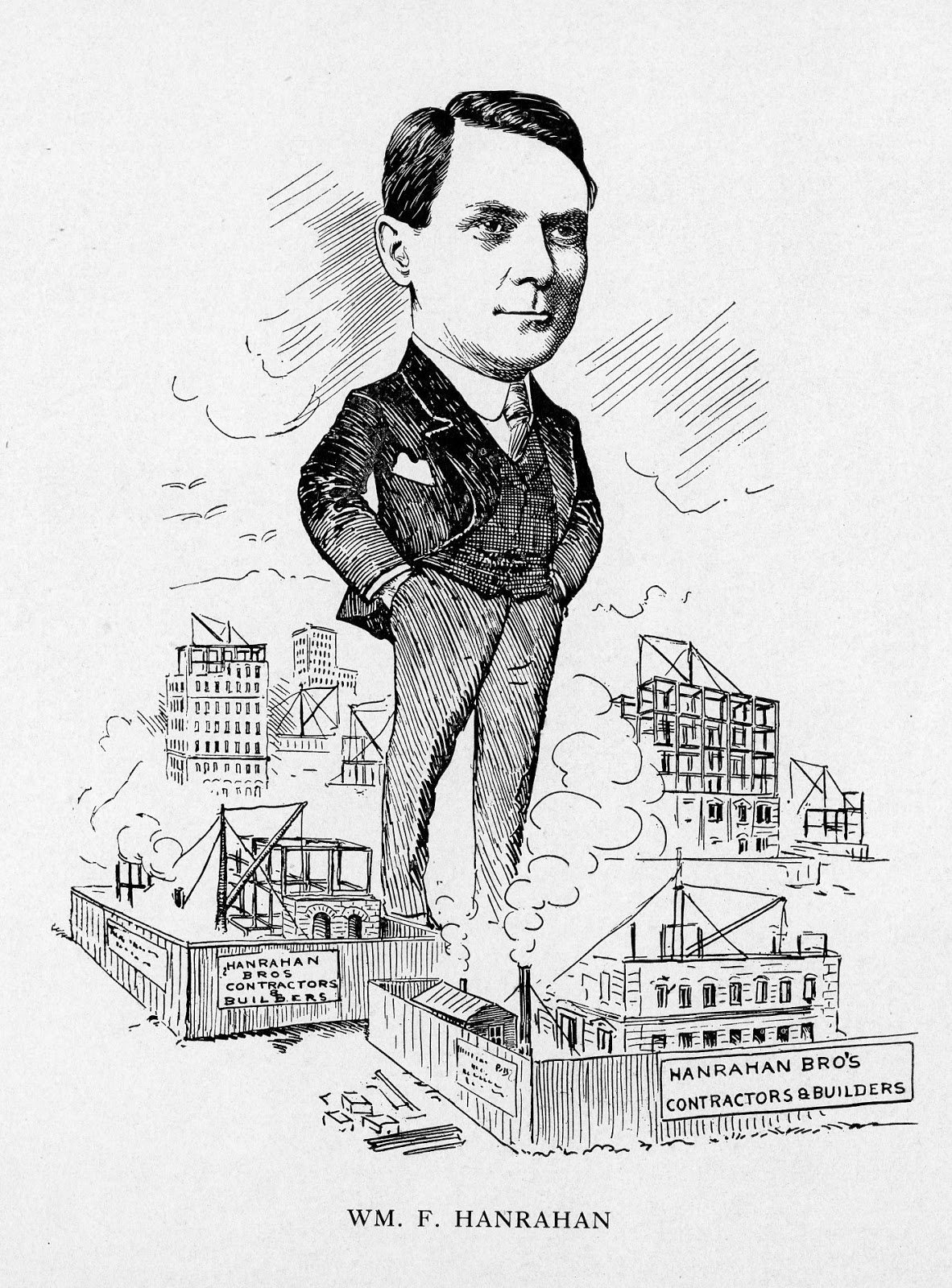
Builder William F. Hanrahan overlooks his Schenectady building empire in Just For Fun. Hanrahan was one of many builders depicted in the books, as Schenectady grew in leaps and bounds during the era. From collections of Grems-Doolittle Library. 

Caricature of Dr. George W. Bates from Just For Fun. From collections of Grems-Doolittle Library. 

Alderman Harry G. Ellis outlines his plans for public baths in Just For Fun. From collections of Grems-Doolittle Library. 

Bad guys tremble before Sheriff William H. Hathaway in Just For Fun. From collections of Grems-Doolittle Library. 

George William Slaght, manager of the Saul Clothing Store in the Lorraine Building in Schenectady.  In addition to his work, Slaght also had music as a hobby. Many of the men in the book are shown with symbols of their hobbies in addition to symbols of their vocations. From collections of Grems-Doolittle Library. 


Thursday, May 23, 2013

Early Educational Television: The Role of the Schenectady City School District


Anne Slack, modern language coordinator for the Schenectady City School District and host of the educational television program "Fun With French," on set with students from Schenectady public schools in 1955. Photograph from Schenectady City School District Records. 

Schenectady has served as a site for innovation in television since the origins of the medium. The first ever successful television broadcast was made by Dr. Ernst Alexanderson to the homes of four General Electric executives in Schenectady in 1928, and Schenectady's WRGB is one of the oldest television stations in the country. As the popularity of television soared during the early 1950s, both nationally and locally, it seems natural that educators would be drawn to the possibilities of this medium.

The origins of educational television in Schenectady began during the 1952-1953 school year. Robert Hanna, manager of broadcasting for all GE projects, including WRGB, offered the city's school district one hour of TV time per week for educational programming. Regional interest was building in educational television. By May 1953, 120 organizations had organized the Mohawk-Hudson Council for Educational Television. The Schenectady City School District became a member. The Council employed a producer, Angela McDermott, to handle programming. By 1954, all Schenectady schools had television sets.

Third-graders at Lincoln School sit down for TV Schooltime. Photograph from Schenectady City School District Records. 

In the beginning, Mohawk-Hudson produced educational programs on WRGB, many under the series TV Schooltime. Several local schools and universities, libraries, museums, and other organizations created programming, and educational TV programs were shown in classrooms as part of the curriculum. Schenectady's schools didn't just receive educational TV programming in classrooms -- the district also had a hand in creating programming, and students from Schenectady schools often participated. The Schenectady City School District was responsible for a number of programs aimed at students, including "Science Adventures," "Conservation Road," "Our Friends," "Copy Desk," and "Teen Talk." The district also created programming aimed at adults, such as "It's Worth Knowing," a program aimed at homemakers, and "Let's Talk It Over," a program based on the discussion of public issues. After several years of broadcasting educational television on WRGB, the Mohawk-Hudson Council decided to form a non-commercial educational television station of its own. The station, WMHT, went on the air in 1962, becoming the second educational television station in New York State.

Alfred Hulstrunk during a taping of the educational TV program "Science Adventures." Hulstrunk served as coordinator of the Schenectady school district's elementary science resource program. In addition to his work on "Science Adventures," he worked with schools in the district to enrich their science curriculum, bringing animals such as iguanas, flying squirrels, and bats into the classroom for visits, and helping to set up science programming in elementary schools, and creating a weekly "Elementary Science Topics" bulletin. Photo from Schenectady City School District Records.    

The district's most successful program -- and the one that received the most media attention -- was "Fun With French." The TV program was the first in the United States to provide foreign language instruction to children. The series was hosted by Anne Slack, modern language coordinator for the Schenectady City School District. The program debuted in September 1953. The first studio class consisted of six third-graders from Euclid School and an estimated TV audience of 200,000, including students tuning in at 16 local elementary schools. After viewing "Fun With French," teachers carried on the information learned through activities and by using conversational French as part of the regular school-day routine. To facilitate this process, 32 elementary-school teachers in the district took night courses at Union College in French and in the teaching of foreign language. Teachers reported that the TV programming helped to engage the students, as it used a means of entertainment the students were all familiar with. The students themselves were also enthusiastic; 9-year-old Muriel Furbeck claimed that "Fun With French" was "much more fun than the cartoons on television." Some children carried the language experience out of the classroom, counting in French while playing hide-and-seek in their neighborhoods or wanting to speak the language at the dinner table.

Euclid School principal Virginia Day observes first-grade students participating in a French-language classroom activity after watching the educational TV program "Fun With French." Photo from Schenectady City School District Records. 

Slack's enthusiasm and gift for engaging students was an immediate hit. Voice of America, impressed by the quality of the program, requested transcripts of the program for overseas broadcasting. "Fun With French" was also featured in a 1956 issue of Parade magazine. Parade reported that Slack "squeeze[d] the agony" out of learning a foreign language, noting "students have no grammar drills, conjugate no verbs, practice pronunciation not letter by letter but only as they meet it in words . . . they do not see a French word until late in fourth grade, often not until fifth. By that time, French accent is embedded so deeply that few trip over English accents." Taking notice of the success of "Fun With French," the Massachusetts Modern Language Project recruited Slack to relocate to the Boston area to present and help to direct "Parlons Français," a new television program for Boston's WGBH-TV, in 1959. The program went national. Following her television work, Slack taught advanced French courses at Boston University and Harvard University, served as president of the American Association of Teachers of French, and presented workshops throughout the country.

Cover of "Television: An Instructional Tool," produced for teachers by the Schenectady City School District.  The guide discusses the benefits and limitations of TV instruction, and provides tips for teachers in using TV in the classroom, from readiness and follow-up activities to the physical arrangement in the room when showing a TV program in class. From Schenectady City School District Records. 

In addition to the educational television programming on WRGB, the district also experimented with closed-circuit television (CCTV). under a $10,000 Ford grant, the district experimented with closed-circuit television programs at Mont Pleasant High School in 1956. The pilot program was the first of its kind in New York State. The system used a communication system so that students in the remote classrooms could ask questions of the teacher in the "studio" classroom. "We have the students to teach - in science we need more of them," said teacher Joseph F. Collins. "Is it better to have inexperienced, perhaps uncertified teachers, or to accept CCTV problems and have an experienced teacher keep the students on their toes and really learning?" CCTV courses were offered in mathematics, science, English, and French. Non-certified teachers, such as college students pursuing degrees in education, could serve as proctors in the remote classrooms.


Friday, May 17, 2013

Three Decades of Niska-Day


A glimpse of Niska-Day activities at Craig Elementary School in 2009.
Photo from the Daily Gazette (www.dailygazette.com). 


This Saturday is the 32nd annual Niska-Day in Niskayuna. Organized by the Niskayuna Community Action Program (N-CAP), the event serves to celebrate and foster a feeling of community in the town.

In the fall of 1981, N-CAP began planning the first Niskayuna Community Day (the name was soon changed to Niska-Day), sending a letter encouraging community organizations, schools, businesses, churches, and neighborhood associations to participate. The first Niska-Day was held on May 29, 1982. Organizer J. Daniel Tearno said that "people were skeptical" about Niska-Day initially, since the "bedroom community" had never before demonstrated community pride. However, the first Niska-Day proved to be a success. Rainy weather did not keep crowds away from the day-long festivities, which included a parade, a magic show, a "celebrity softball" game of television station WTEN versus radio stations WTRY and WPYX, tug-of-war, musical performances, craft and game booths, an art show, chess competition, a fun run, a tennis tournament, soccer scrimmages, and a dance contest. More than 70 groups participated in the first parade.


The crowd at the first Niska-Day in 1982 gather around Niskayuna High School students in tug-of-war. From Niska-Day clipping file.  

Cover of program for the first Niska-Day. From Niska-Day clipping file. 


Many of the features of Niska-Day have remained the same over the past 32 years, such as the parade, musical performances, craft and game booths, fireworks display, etc. Each year's celebration has had a theme, ranging from education and volunteerism to Mardi Gras and "going country" (this year's glitzy Las Vegas theme even features an Elvis impersonator as grand marshal). Festivities were generally held on the grounds of Niskayuna High School. In 2008, due to construction at the high school, events were held at Craig Elementary School. The decision was made to continue festivities at Craig due to the proximity to the Niskayuna Soccer Club Fields for extra picnic and family space. In addition to the standard Niska-Day activities, there have been a few highlights that stand out over the years. In 1987, students at Niskayuna Middle School constructed a float that operated as a working kazoo. Billed as the "World's Largest Kazoo," it was over 8 feet long. A snare drum head served as its resonator. In 1990, the Hometown Sprits, a basketball team made up of local politicians, teachers, and coaches, played against the Harlem Wizards. Niska-Day featured a Civil War encampment in 1991 and a re-enactment in 2003. The 1991 Niska-Day was reported to have drawn more than 20,000 people -- more than the population of the entire town at that time. Estimates of attendance for other years during the 1990s tended to range around 7,000-10,000.


Refreshment booth at Niska-Day in 2010. Photo from http://www.niskaday.org/. 


Niska-Day has also faced some challenges through its history. The 1986 Niska-Day was thought at the time to be possibly the last, due to liability insurance costs. A few years later, in response to reported cases of measles at Rosendale Elementary School, organizers encouraged pupils from that school not to attend (those who did attend Niska-Day would be required to present proof of immunization). Niska-Day has often fallen on rainy days, but, as Niska-Day Committee Co-Chair Denise Leader said in 2008, "we've come to realize that if you put the tents up, they will come." Only one Niska-Day has been cancelled due to inclement weather -- a snowstorm in May 2002. Niska-Day could not be rescheduled, but organizers created a Niska-Night on the Green celebration in July of that year on the grounds of Niskayuna Town Hall.

The annual Niska-Day celebration is the largest of its kind in the region. "This kind of thing is really essential to a community," said Elizabeth Kiffney, Niska-Day chair, in 1987. "It's a day for families and neighbors to be friends and neighbors - together." Niska-Day Committee Co-Chair Bill Leader said in 2011, "This event has been going on for 30 years. Kids that grew up with Niska-Day are now parents bringing their kids."

For more information about this year's Niska-Day activities, visit http://www.niskaday.org.

Friday, May 10, 2013

A Mother's Day Treat


Photographs of a Scotia mother and child: Nellie Reynolds and her baby, Neil Bailey Reynolds, 1903. Photographs from Grems-Doolittle Library Photograph Collection. 

Turn-of-the-century family photographs in our collections tend to be posed portraits. The people shown in them may look stern; even if they are smiling, they tend to capture the family as it wished to be presented to the world -- dressed in their finest clothes, all assembled together, giving the appearance of unity, abundance, and vitality. It is rare to see photographs of this era that capture the spontaneous moments of everyday life.

That is what makes the above photographs such a special treat in celebration of Mother's Day. The love, tenderness, and sense of playfulness between the mother and her baby are palpable. We see the mother's smile spread into a delighted grin as the baby rolls and kicks on her lap, and can almost hear the gurgling and babbling of the infant. The photographs are a rare glimpse of the connection between mother and child.

Tuesday, April 30, 2013

Building on the Farm: A Legacy of Architecture at the Mabee Farm

Drawing of buildings at Mabee Farm by Keith Prior. From Grems-Doolittle Library Collections. 


The Mabee Farm Historic Site in Rotterdam Junction is where visitors can find the oldest house still standing in the Mohawk Valley. The Jan Mabee House (also known as the Stone House) dates from around 1706 and remained in the Mabee family for almost three centuries. In 1993, George Franchere, last direct descendant of Jan Mabee, made a gift of the Mabee Farm property to the Schenectady County Historical Society. The three historic buildings on the farm -- the Stone House, Brick House, and Inn -- are examples of early Dutch American architecture and are unique in that there has been minimal change, remodeling, or reconfiguration of the structures. The Mabees also left behind a treasure trove of architectural artifacts, remnants, tools and documents which give us glimpses into the lives of Jan Mabee and his descendants. The surviving houses provide insight into early building techniques and skills and illuminate life along the Mohawk River over the course of three centuries. Study of the farm's architecture and artifacts continue to provide us with insights into the journey of the family and life on the early American farm.

Floor plan showing first floor of the Stone House (also known as the Mabee House).  The drawing was made in the 1930s as part of the Historic American Buildings Survey. The original blueprint drawings are collected in the Mabee Family Papers. This digital image can be found at the Library of Congress website (www.loc.gov). 

Many of the buildings on the farm date from the eighteenth century, including the Stone House (built ca. 1706; stone addition ca. 1755), the Brick House (built ca. 1750), and the Inn (built ca. 1790). Additionally, a Dutch barn built around 1760 was acquired by the Society in 1997, dissembled and moved from Johnstown, New York, restored, and re-erected on site. The sheer age of the Stone House is significant in the history of the settlement of the Mohawk Valley by Europeans, and it is truly the centerpiece of the farm. The Brick House is especially noteworthy as one of the earliest unaltered colonial buildings in the area; it has been referred to as "essentially a time capsule from the later half of the eighteenth century" for the lack of alteration over the years.

The architecture of the farm is heavily influenced by Dutch architecture, and the buildings are typical of the Dutch-influenced homes and agricultural buildings in the Hudson Valley and the Mohawk Valley. The exhibit explores the interior and exterior features of the farm's buildings that are typically Dutch, and what they can tell us about the lives of the people who lived there.


The Dutch Barn being reconstructed at the Mabee Farm. Photograph from Grems-Doolittle Library Photograph Collection. 

The exhibit also includes information about using techniques such as dendrochronology, reading architectural clues, and examining artifacts in finding information about the history of the buildings on the farm, how they have been altered over the years, how the uses of the buildings have changed over time, how the land on the farm has changed over time, and how principles of historic preservation and restoration have been used to preserve the buildings and to restore the look of the buildings as they were in earlier days.


The Stone House and Brick House. Undated print from a glass plate negative. Photograph from Grems-Doolittle Library Photograph Collection.  

Learn more about the architecture of the Mabee Farm by visiting the exhibit, Building on the Farm: A Legacy of Architecture at the Mabee Farm, at the George Franchere Education Center at the Mabee Farm Historic Site, 1080 Main Street (Route 5s), Rotterdam Junction, NY 12150. The exhibit opens on Saturday, May 4 at 10:00 a.m. and continues through July. Admission is free for members of the Schenectady County Historical Society and $5.00 for non-members. Call 518-887-5073 for more information about the exhibit.

We hope you will join us for the exhibit's opening on May 4, when artist Len Tantillo celebrates the public unveiling of Legacy, his new painting of the Mabee Farm finished this year. Trained as an architect, Tantillo uses modeling and historical research to make history come alive in his paintings. Legacy helps capture and reflect the spirit of the Mabee family and of life on the early American farm. Don't miss this special moment at 1:00 p.m. on May 4.

Shortly after the unveiling of Legacy, John Stevens, author and premier expert on Dutch architecture in early America, will give a comprehensive record of buildings constructed by the Dutch. The features of Dutch-American buildings will be compared with Old World prototypes. Stevens will also discuss the decline of Dutch characteristics in second half of the 18th century, as well as the persistence of Dutch timber-framing technology into the middle of the 19th century. Copies of Mr. Stevens' book, Dutch Vernacular Architecture in North America 1640-1830, will be available for purchase. His talk will be featured at 2:00 p.m.

Monday, April 22, 2013

Pink Pills for Pale People


Samples of advertisements for Dr. Williams' Pink Pills for Pale People, ca. 1912. The drawings for these advertisements were made by a Schenectady artist, Margaret Curran-Smith. From Collections of Grems-Doolittle Library. 


Patent medicines -- packaged drugs whose contents are incompletely disclosed -- were plentiful and profitable from after the Civil War through the early twentieth century. Before the first Pure Food and Drug Laws were passed, the manufacturers and promoters of patent medicines made millions of dollars from a credulous public eager for cures for a variety of ailments (and many of whom were unable to afford the regular care of a doctor). One of those patent medicines was Dr. Williams' Pink Pills for Pale People, which were manufactured, distributed, and marketed in part by W.T. Hanson in Schenectady.

Image of Willis T. Hanson from drawing in newspaper. From Hanson surname file. 

There was no "Dr. Williams" involved with the Pink Pills, but early on, there was a Dr. Jackson connected to the product. In 1890, a Canadian physician, Dr. William Jackson, sold the rights to his Pink Pills for Pale People, a "fatigue remedy," to George Taylor Fulford, a Canadian entrepreneur. Sometime soon after, W.T. Hanson, a Schenectady businessman and druggist, secured the sole distribution rights for Dr. Williams Pink Pills for Pale People in the United States. Hanson was at the center of three separate but seemingly connected companies: the W.T. Hanson Company, the Hanson-Fulford Company, and Dr. Williams' Medicine Company. The executive office, advertising department, factory, and shipping department of all three companies was located at 147 Centre Street (now Broadway). A number of prominent area men, including Edwin Conde of Schenectady and Dr. Alexander Duncan Langmuir of Albany, served on the Dr. Williams' Medicine Company's board of directors. Conde also served for a time as the publicity promoter for the company.
Package of Dr. Williams' Pink Pills for Pale People. Packages of 40 pills were sold for 50 cents from druggists or directly from the Schenectady manufacturer. Image from the Kansas Historical Society's  Kansapedia "Cool Things" topics (http://www.kshs.org/kansapedia/cool-things-pink-pills-for-pale-people/10240)

The advertisements for Dr. Williams Pink Pills for Pale People, like those for other patent medicines of the period, offered miraculous personal testimonies, crediting the Pink Pills with rescuing themselves or their children from the brink of death. Statements such as "I tried them and firmly believe that if I had not I should be in my grave right now" and "That Dr. Williams' Pink Pills saved my life is beyond doubt," were common. The medicine claimed to cure chorea, "locomotor ataxia, partial paralyxia, seistica, neuralgia rheumatism, nervous headache, the after-effects of la grippe, palpitation of the heart, pale and sallow complexions, [and] all forms of weakness in male or female." In one advertisement, the Pink Pills were even credited with curing paralysis, after a person took the pills for four months!


The notorious advertisement in which Dr. Williams' Pink Pills for Pale People  is credited with curing a  boy's paralysis.  From Hanson surname file.

Advertisements for Dr. Williams' Pink Pills for Pale People can be found in newspapers from across the country. In 1901, the advertising efforts of Dr. Williams' Medicine Company were the subject of a glowing article in the Omaha Daily News, which heralded the company as "an example of what can be accomplished by young men in this twentieth century of keen business rivalry and ceaseless competition."

As the twentieth century dawned, patent medicines came under increased scrutiny. In an article in Collier's entitled "The Great American Fraud," Samuel Hopkins Adams took on the patent medicine industry.  Adams listed Dr. Williams' Pink Pills for Pale People in a group of nostrums he referred to as "the most conspicuous of this kind now being foisted on the public," and noted the composition of the pills as "green vitriol, starch and sugar." Adams' articles led to the passage of the first Pure Food and Drug Act in 1906. The Act required more accurate labeling of medicines, and curbed some of the most misleading, overstated, or fraudulent claims that appeared on the labels of patent medicines.

In 1912, the Connecticut Agricultural Experiment Station conducted an analysis of Dr. Williams' Pink Pills for Pale People. The author of a subsequent report could not resist commenting: "in using the pills the patient is directed first to purge the bowels, then take the pills, bathe frequently, keep the bowels regular, and partake of a nutritious diet. The thought occurs that perhaps the desired result might well be secured by following all of this treatment except the taking of the pills." Dr. Pincus Rothberg, a chemist with the Bureau of Chemistry at the Port of New York, also analyzed the pills and found the composition of the pills to be more than 37 percent sugar, 13 percent iron sulphate, 11 percent potassium carbonate, 15 percent starch, and 17 percent vegetable substance, with traces of talc and a small quantity of strychnin. Rothberg's analysis was published in The Composition of Certain Patent and Proprietary Medicines in 1917. The examination of the Pink Pills led to a court battle; in 1917, the Dr. Williams Medicine Company was found guilty of misbranding its product.

Although the Dr. Williams Medicine Company continued to exist in Schenectady in the early 1920s, it was surely in its decline as the tide turned away from the patent medicine era. In 1922, popular rhyming syndicated columnist Walt Mason singled out Dr. Williams Pink Pills for Pale People in two different columns disparaging patent medicines. "And then at last we're ailing and getting worse each day, and pink pills, unavailing, seem made to throw away," he wrote in one, and "I take pink pills to cure my ills, my gout and flu and tetter; I swallow ten, and now and then I think I'm feeling better" in another. The terminology of the patent medicines began to be used as references to touted would-be panaceas that have little actual benefit; in 1926, a congressman derided a bill before the House of Representatives as being "pink pills for pale people." As early as the 1930s, patent medicines, including Dr. Williams' Pink Pills for Pale People, were being exhibited as artifacts of a bygone era.