Tuesday, February 7, 2017

The Battle of Beukendaal

Translated to English from Dutch, Beukendaal means Beech Dale and that area around Sacandaga and Spring Road in Glenville was known for the number of Beech trees growing. The area is notable for being the only battle of King George's War to occur in the Mohawk Valley, the Battle of Beukendaal in 1748. The Battle of Beukendaal is often referred to as the Beukendaal Massacre (I mistakenly referred to it as a massacre in the last post), but this gives the wrong image of what actually happened at Beukendaal. It was more of a failed Schenectady militia campaign than a massacre.

The main cause of the King George's war had to do with events that occurred in Europe, the War of Jenkin's Ear and the War of the Austrian Succession. The conflicts of the War would eventually spread to the colonies in the form of territorial disputes between the British and their Indian allies and the French and their Indian allies. It was the third of four French and Indian Wars and took place mainly in Massachusetts, New York, New Hampshire, and Nova Scotia.
The British siege of the French fortress at Louisburg in Nova Scotia was one of the hallmarks of King George's War. British forces captured the fort in 1745 after a six week siege. Courtesy of Wikipedia.
A precursor to the Battle of Beukendaal came dangerously close to Schenectady. On November 16, 1745 the settlement of Saratoga was raided by the French and their Indian allies. Over 100 inhabitants were either killed or captured during this attack. This attack caused many of the settlements north of Albany to be abandoned. The attack on Saratoga worried many in New York and a draft of 200 men were sent to Albany and Schenectady from the militias of Ulster, Dutchess, Orange, Westchester, Queens, and Suffolk.

Another scare came to Schenectady in 1746 when two slaves were captured by a party of French Indians.  A party of men from Albany and Schenectady pursued the raiding party and came upon the house of Simon Groot. The raiding party had set fire to Groot's house, taken a prisoner, murdered and scalped a boy, and shot a man who was attempting to escape. The militia was unable to further track the raiding party. The raid on Groot's house and the increasing amounts of violence in the area was likely a cause of Abraham Glen requesting permission to raise a company of 100 volunteers for the defense of Schenectady and the frontier. There wouldn't be any battles near Schenectady until July 18, 1748 when three Schenectady men were attacked by French Indians in Glenville. This would spark the events of the Battle of Beukendaal.

Much of what we know about the Battle of Beukendaal comes from a letter to William Johnson from Albert Van Slyck who who fought in the battle, but there have been several other accounts. Van Slyck wrote that a group of men gathered to raise the frame for a barn by the Mohawk River in Scotia on July 18, 1748. Three of the men, Captain Daniel Toll, Dirk Van Vorst, and Toll's slave, Rykert departed to gather some horses that wandered off. Shortly afterward, the others raising the barn heard gunshots and Albert's brother, Adrian, sent his slave to Schenectady to warn the residents there and to try to gather men.
The DeGraaf Barn that Toll, Van Vorst and Rykert were working on was eventually raised after the Battle of Beukendaal. Courtesy of the Grems-Doolittle Library Photo Collection.
A group of Connecticut Militia members were stationed at Schenectady and upon getting the news, immediately crossed the river. Others in Schenectady joined making the total around 60-70 to the 100 French and Indians who made the attack. Unfortunately, the Schenectadians were too unorganized and gathered in four small groups who attacked at separate times. The first group reached the Kleykuil, a clay pit lying between Sacandaga and Spring Roads, and found Daniel Toll propped against a tree waving to the group. As they approached Toll, they supposedly found him lifeless with a crow tethered to his arm (this story has been unverified and doesn't show up in Albert Van Slyck's letter). This group was then ambushed and fired upon from the nearby woods. The second group met up with the first and retreated to the nearby DeGraaf house to stage their defense.

Corn growing at the site of the Beukendaal Battle in 1997. Courtesy of the Grems-Doolittle Library Photo Collection.
The men in the DeGraaf House pried of the clapboards and fired on their enemies from the house. The attackers allegedly tried to set the house on fire a few times, but nothing succeeded in driving them from their defense. The third group eventually arrived, took a good look at the situation, and decided that battle wasn't for them so they turned around and retreated.  Those in the DeGraaf house managed to hold off the attack until the fourth group joined and drove off their attackers.

Photo of the DeGraaf house where the Schenectady Militia defended themselves against the French Indian attackers. The house was demolished in 1915. Courtesy of the Grems-Doolittle Library Photo Collection.
Twelve Schenectadians were killed along with seven Connecticut soldiers, including their commander Lieutenant John Darling. Thirteen others were captured and taken to Canada. Dirk Van Vorst had managed to escape captivity and joined up with the third group (Van Vorst's reluctance at being recaptured, or killed after escaping the first time may have played a role in the third group's unwillingness to join the battle.) With the battle over, the bodies of the dead were brought back to Schenectady and placed in Abraham Mabee's barn which was located at present day 10 and 12 North Church Street. The number of French and Indian casualties were never confirmed, but are thought to be minimal.

In 1929, the Schenectady Chapter of the Daughters of the American Revolution installed this monument to those who were killed during the Beukendaal Battle. Courtesy of the Grems-Doolittle Library Photo Collection
It's tough to visualize now, but Schenectady County was once on the frontier. Attacks like the Battle of Beukendaal highlight the danger that settlers were constantly in and how difficult it was to protect residents in the area.

Monday, January 30, 2017

Hardin's Crossing: What's in a Place Name

Finding the origin of place names can be a tricky business sometimes. In Schenectady County, the origin of some place names are more apparent than others. Glenville, Duanesburg, and Princetown were named after prominent people who lived there, namely Alexander Lindsay Glen, James Duane, and John Prince. Scotia and Rotterdam were named after places. Scotia, after the home country of Alexander Lindsay Glen, and Rotterdam after the port of Rotterdam in the Netherlands. Schenectady and Niskayuna are both forms of place names given to them by Native Americans in the area. Schenectady means "beyond the pines" or "over the pine plains" and Niskayuna means "extensive corn flats."

Checking out some of the hamlets in the area and we have Alplaus. Alplaus derived from the Dutch Aal Plaats which means place of the eels. Carman in Rotterdam was originally named Athens Junction after the junction of the New York Central and a railroad from Athens, NY. It was eventually renamed after Will Carman who opened a general store at the crossing. This all leads to a research question that I received recently. What was Hardin's Crossing, and where was it located? Was it a ferry or railroad crossing? Who was this enigmatic Hardin who had a crossing named after him? Some of these questions were easier to answer than others.


This map shows the lands of Hardin as well as the Fitchburg and New York Central railroads that crossed Sacandaga Road. Courtesy of the Grems-Doolittle Library Map Collection.
Specifics about Hardin's Crossing were difficult to come by. I quickly came to find out that it wasn't listed on any modern maps and articles that I found would refer to Hardin's Crossing, but often had no background as to why it was called that. We are lucky to have former Don Keefer's research files on Glenville and Scotia. Keefer was the Glenville town historian as well as the Schenectady County historian for a while and his research is very valuable when researching anything about Glenville.


Photos of the DeGraff House on what is now Sacandaga Road. The DeGraff House marked
the site of the Beukendaal Massacre where 20 men from Schenectady were killed and 13 were
captured by French and Indian attackers after a viscous battle.
Keefer's research binder on the Beukendaal Massacre had a few article on Hardin's Crossing. It turns
out that in 1915 both the schoolhouse and the area of Hardin's Crossing were changed to Beukendaal to commemorate the Beukendaal Massacre. The charge to change the name was led by none other than the Schenectady County Historical Society, little did they know that they would cause a bit of confusion to their librarian 102 years down the road. So that article solved the "where" of Hardin's Crossing which was very close to the site of the Beukendaal Massacre near Sacandaga Road.

I then went to our map files to see if there were any maps that might show the site so I could learn what the crossing part of Hardin's Crossing referred to. An undated map of the 10th School District of Glenville shows two railroads that cross Sacandaga Road, the Fitchburg and the New York Central Railroad. This map gave me some more definitive proof that an Hardin (unknown first name) owned property in the area and I also found out that the crossing was a railroad crossing.

This page from the  U.S., Selected Federal Census Non-Population Schedules, 1850-1880 shows the wealth of Sidney Hardin (outlined in yellow). He owned 200 acres of land and the cash value of his farm was $8,000 which would put it at over $200,000 today. This made him one of the more wealthy landowners in the area. A separate census page puts his personal estate at $2,166. Courtesy of Ancestry.com
The "who" was a bit more difficult to find out, I knew it was a Hardin, but finding out which one was tricky as none of the articles mentioned which Hardin the crossing was named after. The Hardins lived in Schenectady since the mid-1700s, but there weren't a ton of Hardins in the area. The Hardin family file in our library had a page from Cuyler Reynolds' Hudson and Mohawk Genealogical and Family Memoirs which gave a short history of the Hardin family and listed many of the Schenectady County Hardins. It turns out that there were two Hardins that had farms in Glenville, Sidney and Jonathan Tripp Hardin. The 1866 Beer's Atlas lists many of the property owners in Glenville and sure enough J. & S. Hardin were both shown on the map right near the crossing of Sacandaga Road and the New York Central Railroad. Jonathan Tripp Hardin would go on to live in Schenectady, but Sidney stayed in Glenville.

Sidney died in 1880 at the young age of 54. In a 1965 Raw Materials of History column from the Schenectady Gazette, Neil Reynolds states that even though the Hardin's Crossing was changed to Beukendaal, "the name Hardin's Crossing still persists." So Sidney Hardin's memory lasted a while after he died. Not being a native to Schenectady County, I wonder if anyone Glenville natives still call this area of Sacandaga Road Hardin's Crossing.

Thursday, January 12, 2017

22 Blocks in Schenectady

Over the past year, there has been a lot of new research on Albany's "neighborhood that dissapeared." The 98 acre area that was torn down in the early 1960s and replaced by the Empire State Plaza. In a recent blog post (http://tinyurl.com/z7ooqy3), I learned that Schenectady had it's own lost neighborhood during an urban renewal project in the 1940s and 50s, the 22-block urban renewal project. This project was named for the 22 blocks around City Hall that would potentially be redeveloped to create more off-street parking, new street arrangements, and areas for business and residential use. The reasons for redeveloping this area were similar to the reasons for redeveloping the Empire State Plaza. The area was seen as a slum with tenement housing that wasn't bringing the city enough tax revenue. According to Christopher Patrick Spencer's thesis Shovel Ready: Razing Hopes, History, and a Sense of Place: Rethinking Schenectady's Downtown Strategies, the project evolved over time. The city initially wished to get more tax revenue from downtown, but as time went on the project changed to adhere to state and federal grant programs that required the area to be used for business and restricted use on residential projects. 


The 1948 Comprehensive City Plan included maps of the suggested redevelopment
and existing development of the 22-block. The suggested redevelopment plan
shows a neighborhood that includes 3 story row apartments, an expanded
business district, and a plan for garden apartments. In order to get federal and state funding
the city decided to go with a plan that did not include any residential use in the neighborhood.
Courtesy of the Grems-Doolittle Library Collection.
An article in the May 24, 1946 issue of the Schenectady Gazette refers to a New York State survey on the needs of current residents of the 22-block area. They were looking at what sort of rent residents were paying, which businesses were located in the area, housing and family conditions. The survey was an attempt to see what sort of needs residents would want in a new housing development, but residents in this area did not want to be relocated or for their houses to be destroyed. In a meeting on February 26, 1947, residents of the fourth ward of Schenectady accused the city of lowering the assessed value of property in the 22-block. One resident stated that "We're not interested in the Town of Tomorrow--we're interested in this 22-block, our homes are in it. Our livelihood is in it." Director of traffic and city planning, Arthur Blessing, defended the 22-block plan saying that the plan was necessary in order to centralize Schenectady's business district and relieve traffic congestion.
Photo of the what used to be Johnson St. and Terrace Pl. in the 22-block area in 1956.
City Hall can be seen in the background. Courtesy of the Grems-Doolittle Library Photo Collection

Some of the buildings set to be razed in the ten-year urban renewal plan.
From the January 14, 1947 issue of the Schenectady Gazette.
Courtesy of fultonhistory.com.
By 1947, the plan for housing development in the 22-block was scrapped and Mayor Ten Eyck stated that "as soon as conditions permit, the substandard tenements and buildings in the 22-block area will be razed. The land will be sold to private industry with the covenant that the land may not be used for residential purposes." This land was to be left undeveloped for new businesses and industries to build and create taxable revenue for the city. It wasn't documented where all the residents of 22-block ended up, but some of them were relocated to Yates Village and other Municipal Housing Authority projects around the city, some of which was over two miles from their homes in downtown Schenectady.
Construction of Yates Village in 1949 where some of the 22-block residents
would end up relocating to. Courtesy of the
Grems-Doolittle Library's photo collection.

Demolition of a house on Terrace Place in the 22-block in 1957.
Courtesy of the Grems-Doolittle Library Photo Collection. 


Early Rendition of the Union Station Plaza included in the 22-Block Urban Renewal Plan.
From the January 14, 1947 issue of the Schenectady Gazette. Courtesy of fultonhistory.com.
Early renditions of the 22-block project (shown above included a plaza with a monument, green space, and tunnels underneath for traffic. The rendition bears a resemblance to the Empire State Plaza with City Hall on one side of the plaza, and a new train station on the other. Construction of the plaza never came to fruition and the land remained undeveloped for years. Only one developer came forward with a plan to develop the area in 1959, Lewis Empire-Plaza inc. They promised to put 10 million dollars into the development which included shopping areas, offices, and parking lots. Unfortunately, the company defaulted on its taxes and the City of Schenectady repossessed the land in 1963. There has been some development in the 22-block area since the initial razing of buildings and houses, but nothing like the initial renderings and hopes of those involved with the project. An article in the March 6, 1963 by Art Isabel stated, "Just about everything that could go wrong with an urban renewal and urban development project did in Schenectady."

There is a lot more to this story that can't be covered in a single blog post. For more information check out Christopher Patrick Spencer's thesis which you can find on the Schenectady Digital History Archive. http://www.schenectadyhistory.org/schenectady/shovelready/index.html.

Tuesday, December 20, 2016

Christmas in Schenectady

This post features a few festive photos from our collection showing Christmas over the years.

A svelte Santa was chosen for the 1970 Christmas Parade.

Santa stopped trimming his beard for the 1985 Christmas Parade

One of the floats in the 1986 parade. 

Going back a bit further to the 1949 parade which featured this large
inflatable train.

Christ Church on State Street all decked out for Christmas in 1896.
What better way to spend your Christmas than hanging
out in Vale Cemetery. 

The Salvation Army collecting toys to give out on Christmas. 

Surrounded by toys at the Schenectady County Historical Society.

Holding lanterns by the Stockade's Christmas tree.

A very Stockade Christmas at the junction of Green, Front and Ferry.

Young carolers in Schenectady's Stockade neighborhood.

Friday, December 16, 2016

From Saloons to Soft Drinks in Schenectady

While researching The Union Inn for a recent Daily Gazette story (https://dailygazette.com/article/2016/12/13/schenectady-s-union-inn-building-sold-to-local-businessman) I noticed that there were many (over 100) businesses listed under the soft drink section of the 1921 Schenectady City Directory business listings. "Schenectady sure loved soft drinks" I thought to myself, not immediately realizing the implication of the term soft drink in prohibition era Schenectady. I continued my research into 1919 where there were 110 saloons and cafes in the 1919 directory, and it all fell into place.
Anheuser-Busch released soda and
malt syrup to try and profit off of
prohibition. Grape Bouquet was
released in 1922.

When prohibition put the kibosh on alcohol sales, brewers, distillers, and saloons needed alternate products if they wanted to survive. Some of the largest breweries around today were the ones that found creative solutions to the prohibition problem. Coors started a ceramics business that surprisingly makes more money than the brewing side of the company. Yuengling made ice cream until about 1985, and then started back up again last year. Others large brewers made barley or malt syrup, low alcohol near-beer, and of course, soft drinks. It was the same story with brewers in the Capital Region many began making sodas, malt vinegar and syrup, and some breweries went into the bottling business.

One of the saloons turned soft drink shop was Schreck's Hall on 1118 Albany Street.
Courtesy of the photograph collection at the Grems-Doolittle Library.
With many of their main suppliers turning to soft drink production, saloons would soon follow suit and sell those products. Many of the saloon owners in 1919 Schenectady City Directory are the same selling soft drinks in the 1921 directory. Some of them were probably legitimately just selling soda such as the Schenectady Coca-Cola Bottling Company on Foster Avenue. Others, were definitely selling hard drink in addition to their soft drinks. These soft drink establishments were scattered throughout the city although the streets around lower Broadway seemed to have the most.

Schenectady City Directory advertisements for the
New York and Orange Crush Bottling Works as well as
the Saratoga Natural Carbonic Co. 
A letter to the editor in the February 18, 1925 issue of the Schenectady Gazette takes aim at these soft drink places, "If one has the inclination and the price he or she can easily obtain whiskey, alcohol, wine or beer. And this is prohibition Shades of-- somebody: "Soft drink places!" Oh yea. Please pass the salt." The writer goes on to say that "If Captain Funston or the police want to check crime, it might be well for them to look after places where crime is hatched and bred."Another letter to the editor by A Thirsty Schenectadian laments the quality of good soft drinks to be had in Schenectady, saying that he wouldn't miss alcohol or beer as much if there were better soft drinks to be had. He complains that he has gone to soda shops up and down Schenectady but has yet to "find a drink that doesn't need a cold glass of beer to destroy the awful taste." He goes on to compliment the soda shops of Richmond, Virginia where you could find a "10 ounce drink made from fresh fruit with an appetizing taste for 9 cents" where in Schenectady you get warm lime phosphate in a 5 ounce glass for 6 cents."

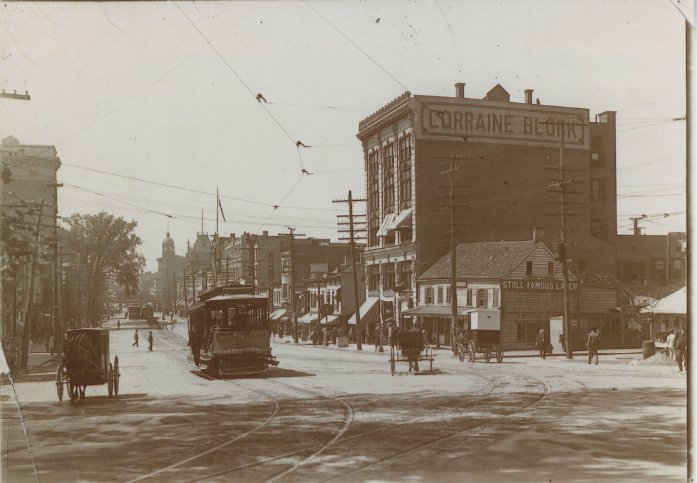
Soft drink shops on State Street were also popular places to quench your thirst. 
The building next to the Lorraine Block building with the "Stoll Famous Lager"
sign was the Oak Cafe. Courtesy of the photograph collection at the Grems-Doolittle Library.


This photo of State Street shows O'Connor's Tavern on the left which was previously The Holland Inn.
Courtesy of the photograph collection at the Grems-Doolittle Library.
By 1924, both Albany's Mayor William Hackett and Schenectady's Mayor Campbell were on to the "soft drink" game in their city's. Hackett had recently enacted a measure to close up the "undesirable saloons and so-called soft drink" places throughout the city and Campbell met with him on February 2nd to discuss the ordinance. I haven't been able to find evidence of a soft drink ordinance in Schenectady but similar ones were passed in other towns and cities in the area.

Over time, Schenectady's love of "soft drink" establishments had dwindled. The creation of the special service squad of the Schenectady Police Department helped put many these businesses. Created in 1927, they conducted 600 investigations into disorderly houses, gambling houses, and disorderly places in that year.  The end of prohibition further reduced the number of soft drink shops and only 8 of these soft drink shops were listed in the 1935 city directory

Friday, December 2, 2016

Harry Houdini in Schenectady

When I think of Harry Houdini the first thing that comes to mind are his wild escape acts, mind bending illusions, and amazing feats of physical strength and stamina. A lesser known aspect of Houdini's life was that in the 1920s, he began to focus on debunking spiritualists and psychics. His training in sleight of hand and audience manipulation gave him a keen sense on how to expose frauds, although it didn't hurt that Houdini and his wife would use similar spiritualist tricks when they were strapped for cash.

Advertisement for Houdini's 3 Shows in 1. Courtesy of
the blog Wild About Houdini.
His most famous run-in with a spiritualist occurred during a séance with his friends Arthur Conan Doyle and his wife Lady Jean Conan Doyle, Arthur Conan Doyle's wife. The Doyle's were touring the United States to lecture about Spiritualism. Lady Doyle claimed to be a medium and wanted to conduct a séance to contact Houdini's mother. Houdini's wife, Bess, had previously warned him that Jean had been asking questions about his mother, but Houdini agreed to the séance anyway. During the séance, Jean appeared to fall into a deep trance and began to transcribe what Houdini's mother was transmitting from beyond the grave. Houdini immediately found problems with the sance. He was born in Budapest to a mother who did not speak English and a father who was a rabbi. The first thing that Lady Doyle drew when she went into a trance was a cross and then she proceeded to write everything down in English.

After the séance, Arthur told the press that Houdini had been converted to the religion of Spiritualism. A bit miffed at the untrue accusation, Houdini publicly stated that the séance made him even more skeptical of spiritualism. This exchange put a heavy strain on their friendship and Houdini decided to put on his own anti-spiritualism tour. This tour eventually evolved into Houdini's "3 shows in 1" tour that he would bring to Schenectady in mid-October, 1926. During his three day stay in Schenectady, he gave a lecture on anti-spiritualism at Union College, performed his magic act at the Van Curler Opera House, exposed a Spiritualist that he believed to be a fraud, and gave an address on WGY.
Photo of Harry Houdini from the October 13, 1926
issue of the Schenectady Gazette.Courtesy of fultonhistory.com

Houdini injured his ankle just days before in Albany while performing the Chinese Water Torture Cell at the Capitol Theater. The injury almost caused him to cancel the rest of his tour, but the Van Curler took out an ad ensuring that Houdini "will positively appear" at the theater. There was a clause in his contract stating that if Houdini was to cancel any show due to illness or injury, he would have to pay the theater $1,000 per day. The blog Wild About Houdini states that Houdini wrote an urgent letter to his manager from the dressing room of the Van Curler Hotel where he threatened to cancel the tour if his manager did not remove the clause.

"I am amazed any sensible manager would sign a contract with such a clause in it and I am perfectly willing to leave the road before I would take such a chance. [...] Am perfectly willing to continue if a new clause is inserted but under the present contract I retire gracefully."  -Houdini's letter to his manager, written from the dressing room of Schenectady's Van Curler Hotel.

The injury caused Houdini to switch up his act a bit and he couldn't not perform his best trick, presumably the Water Torture Cell, but ever the crowd-pleaser, he replaced it with five others. An article from the October 15, 1926 issue of the Schenectady Gazette stated that Houdini performed hundreds of tricks during his act and that while his magic show clever, the best part of the show was his performance exposing spiritualists and mediums. Houdini put on a fake séance and invited several audience members to join him on stage, revealed how spiritualists used their charms and interviewed a woman who had went to several mediums in Schenectady. According to the mediums, she had many deceased husbands and children in heaven. The audience got a kick out of the reveal that she had never been married and had no children. You can find the Schenectady Gazette's review of Houdini's show here at fultonhistory.com.

Houdini's stay in Schenectady was lively despite the injury that almost caused him to cancel the whole tour. The injury that he received in Albany is believed to be a direct cause of Houdini's death although there is debate as to whether he was suffering from acute appendicitis and did not realize the symptoms. Houdini would die just 16 days after his last performance in Schenectady due to complications from appendicitis.

Houdini on WGY radio on October 14, 1926. Courtesy MiSci -
Museum of Innovation and Science 
Thanks to the blog Wild About Harry fultonhistory.com and Don Rittner's article on Albany's role in Houdini's death.

-Mike Maloney

Thursday, November 10, 2016

Ellis Hospital during World War II

This post was written by Grems-Doolittle Library Volunteer Gail Denisoff.

Aerial view of Ellis Hospital around 1944.
Courtesy of the Grems-Doolittle Library Photograph Collection.
In the early months of 1941, before the United States declared war on Japan, Ellis Hospital was already preparing for the possibility of war.  In The Hospital Courier, a newsletter Published by Ellis Hospital, more and more articles were being written about the role of the hospital in national defense.

The June 1941 issue described the problems hospitals were facing because of the National Defense Program.  Nurses and doctors were being called from hospital staffs to serve in Army and Navy camps and to fill positions in expanded industrial plants.  Defense industries were offering higher wages forcing hospitals to increase salaries to retain personnel.  Suppliers were increasing prices of medical supplies because of the demand by countries at war while delaying delivery of goods.  Ellis, like other hospitals, was feeling the pinch, especially since they weren’t fully recovered from the depression and needed community support.
Ellis Cadet Nurse Corps in 1944. From the Ellis Hospital Collection
at the Grems-Doolittle Library. 
By 1942 the problems intensified.  There was a shortage of nurses for both civilian and military hospitals. Nursing schools were increasing enrollment of students while giving more responsibility to nurses’ aides and other non-professional workers. Ellis began training their first group of 25 women for the Red Cross Volunteer Nurses’ Aide Corps which was to be ready for active service as of March 1, 1942.  By June, Ellis was training its third class although they were still short of the Schenectady quota for volunteer nurses’ aides.

The 38 students entering the Ellis Hospital School of Nursing in September 1942 was the largest in it's history.  These young women had “chosen a field of study where they can immediately meet the war time needs of the country."  At the same time, there were concerns.  Because of the increasing demands for doctors, nurses and hospital facilities there were suggestions to curtail hospitalization of maternity patients and eliminate courses in obstetrical and pediatric nursing from nursing school curriculum to prepare students more quickly for service with the Army and Navy.  Hospitals didn’t want to sacrifice gains made in lowering maternal and infant mortality rates and were actively fighting those proposals.
Ellis nurse being sworn in. From the Ellis Hospital Collection
at the Grems-Doolittle Library. 
By October 1942 forces serving overseas had their full quota of medical personnel according to the AMA but more physicians were needed for troops assigned to the US.  All able-bodied physicians under the age of 37 were being called for active duty and a high percentage of those under 45 were also being called.  The resulting shortage of doctors to care of the civilian population was hoped to be offset by redistribution of hospital doctors and the call for patients to visit doctors at their offices rather than having them make house calls, conserving time. 

On the home front, stepped up war production and the resulting rise in employment were factors in the sharp increase of accidents and deaths due to industrial accidents.  According to the National Safety Council, job related fatalities in the first year following Pearl Harbor totaled 46,500 while injuries topped 4 million putting a strain on hospitals.  Ellis was no exception to this trend.  With war production booming at the General Electric and American Locomotive plants, there were many work-related injuries resulting in hospital visits putting a strain on the reduced staff.

By mid-1943, food rationing greatly restricted the amount and variety of foods that could be purchased for patients.  Hospital menus became much less varied.  Fruits, vegetables and meats appeared on hospital menus less often.  Dietitians and Red Cross Canteen Corps workers tried to produce balanced diets for patients with what they had.  Patients in the hospital for more than seven days were required to surrender their ration books and the hospital was required to remove the proper number of stamps and turn them in to the local rationing board.  The hospital was not able to get extra food supplies for the stamps, however.  Hospital kitchens and individuals were also called upon to save waste fats when cooking.  When a pound or more was accumulated, they were to take it to a local meat dealer who would send it to a renderer as a material for glycerin, an essential ingredient not only in the manufacture of ammunition but also medicinal preparations such as surgical dressings, acid burn jellies, antiseptics and sulfa ointments.  New mothers were being instructed to breast feed their babies due to the shortage of milk.

Nursing professionals estimated that by the end of 1943, one in four graduate nurses would be needed by some branch of the armed forces both domestically and overseas.   Even more would be required to serve in industrial plants causing even more of a drain on hospitals.  Patients were encouraged not to request private duty nurses, which was common at the time. The School of Nursing enrollment was increased and a second class of students was set to begin in February of 1944.  Ellis was continuing to train Red Cross Volunteer Nurses’ Aides with over 85 in active service and 50 being trained by the fall of 1943. In addition, a new training program was being initiated for the US Cadet Nurse Corps.  It offered young women high school graduates an accelerated training course with all expenses paid and a monthly stipend.  In return, they would be available for essential nursing, civilian or military services for the duration of the war.

Unidentified serviceman at Ellis looking at a baby.
From the Ellis Hospital Collection at the Grems-Doolittle Library. 
The number of births recorded in 1943 was an all-time high for the United States.  As a result, Congress appropriated $20,000,000 in the 1944 fiscal year for the Maternal Care Program.  The program was intended to provide maternal and infant care for wives of servicemen who were earning below their civilian pay levels and couldn’t otherwise afford hospital care.  Ellis Hospital and their doctors cooperated with the Federal government in the local implementation of the program and care was equal to that given to non-military patients. 

Staffing concerns continued to be a critical issue.  The demand for 10,000 more graduate nurses in the armed services by July 1, 1944 was causing a strain on hospitals throughout the country.  Local and state authorities were pushing for an equitable distribution of civilian and military nurses to keep home front hospitals above the danger level in staffing.  All nurses between the ages of 21 and 45 who were physically fit and had no children under the age of 14 were classified as available for military service unless filling what was considered an essential nursing position in a hospital or public health agency. Even those nurses in essential positions, who were older, had families or not considered physically fit were classified as “essential for limited duration”.   The fall 1944 class of the nursing school was the largest in its history at 47, 42 of which were members of the Cadet Nurse Corps.  Ellis relied more and more on volunteers.  By early 1944, eleven classes of Red Cross Volunteer Aides had finished training programs and a new class had begun.  A new group, the Red Cross Dietitian’s Aides, were being trained to assist hospital dietitians with preparation of well-balanced patient meals, an ongoing challenge due to food rationing and limitations.  Civilians were being asked to find ways they could help their local hospitals function. Each Hospital Courier Newsletter ran banners asking readers to buy war bonds, volunteer with the Red Cross, conserve paper for war needs and enlist recruits for the Cadet Nurse Corps.

Volunteers from the Schenectady County Chapter of the
 American Red Cross setting up a food table from the
World War II photo collection of Hershel Graubart. 
Ellis joined the Red Cross and other hospitals around the country in collecting blood and plasma for use by the armed forces.  By the end of 1943 close to 6 million units had been collected with another 5 million units requested for 1944.  Civilians were encouraged to regularly give blood for both military and local use. In 1940, Ellis had opened the first blood bank east of Chicago and was essential in this endeavor.  Locally, there was a noticeable increase in accidents causing severe injury or death to children under the age of 14.  This was attributed to fathers being away and mothers not at home, working in war industries.  Traffic fatalities were down due to gas rationing but household and industrial accidents continued to rise.  Care for accident victims took a toll on hospitals in the form of unpaid bills and putting more of a strain on limited staffs and supplies.

The heavy influx of injured workers from GE and ALCO overtaxed the facilities of the hospital.  In 1944 alone, 14,657 patients were admitted to Ellis.  With the staffing shortages, it was sometimes necessary to close some floors and limit surgery to emergency cases.  The Red Cross volunteers proved invaluable during this time.

As the war continued to rage on in Europe, hospitals on the home front began to prepare for the post war challenges to come. Hospital services would need to be expanded to meet the needs of injured veterans.  It was expected that many hospitals would be building additions and updating facilities in the post war years.  Adequate care of wounded veterans and their families would be a major national concern and hospitals would need to work with the government to ensure veterans receive care in their local communities for both service and non-service related disabilities.  Even though mortality rates were dramatically down from previous wars due to the care received on the front, civilian hospitals were expected to receive an influx of war veterans with a wide range of injuries and special needs.  The Rehabilitation Act proposed using all existing hospital facilities for the treatment of returning military as well as civilians disabled by injury.  Federal and state funds were to be used for this program and civilian hospitals were expected to make every possible bed available when asked to do so by the Veterans Bureau. Cadet nurses were still being recruited to begin training so that they would be ready to serve in veteran’s hospitals and for postwar duties in civilian hospitals.  In total, 104 Cadet nurses were trained at Ellis Hospital.

Even with the war winding down in mid-1945, the increase in returning veterans and the depleted hospital staffs was causing some hospitals to curtail admissions.  By this time. Over 60,000 doctors, 54,000 graduate nurses and thousands of technicians were serving the military while civilian hospitals were treating more patients than any time in their histories.  Ellis was meeting the need of the community through the dedication of their staff and volunteers. 


At the end of the war, returning doctors and nurses were welcomed with open arms.  Hospitals slowly began rebuilding their staffs and changing to meet the needs of veterans.  Veteran nurses returned home with valuable skills and experiences, increasing their professional status. The Army had trained many nurses in specialties such as anesthesia and psychiatric care, and nurses who had served overseas had acquired practical experience otherwise unobtainable.  These new skills proved invaluable for Ellis and other hospitals as they continued to meet the challenges of post war America.