Former Rotterdam town historian Dick Whalen's home and collection was severely damaged during Hurricane Irene. Former SCHS librarian Melissa Tacke, along with SCHS volunteers worked to salvage as much of his collection as they could (see: http://gremsdoolittlelibrary.blogspot.com/2012/08/a-first-look-at-dick-whalen-collection.html). His collection was a treasure trove of photos and documents from Rotterdam and Rotterdam Junction. Part of the photo collection shows soldiers during WWI at the former army depot in Rotterdam/South Schenectady. The photos mainly show the depot during 1917, but by 1918 it had become a hotbed for the Spanish Flu. By October 1, 1918, 40 men at the depot had caught the flu with 3 dying from it. These photos are an interesting snapshot of what life was like at the depot during World War I.
After the war, the depot was involved with receiving returned material from overseas bases and posts, often being sold through surplus sales. From 1933 to 1940, the base was a headquarters for supplying 55 Civilian Conservation Camps. This new function of the depot allowed it to transition for greater expansion during the outbreak of World War II. Expansion happened again during the Korean War when 1,300 additional employees were utilized and several more buildings were constructed. The land that the depot was on changed hands a few times after the Korean War and is now part of the Northeast Industrial Park.
Thursday, November 9, 2017
Photos of Schenectady's Army Depot during World War I
Friday, October 27, 2017
Schenectady's Community Cookbooks
This post was written by library volunteer Diane Leone.
In recent years, historians have taken an interest in community cookbooks as valuable primary sources for understanding not only foods and cuisine over time, but also the larger life of the communities from which these texts originated. Community cookbooks, also called charities, have a history stretching back to the Civil War, when Maria J. Moss assembled recipes for what became A Poetical Cook-Book (1864), which was sold to raise funds for wounded soldiers. Her brainchild became so popular that, according to Feeding America, from 1864 to 1922 a variety of community groups produced over 3,000 charity cookbooks (Stoller-Conrad). Charitable causes included helping wounded veterans, widows and orphans. Still others were motivated by social and political issues such as temperance, poverty, and suffrage. Almost exclusively run by women, many, though not all, of these groups were religious in nature. The development of cheap printing techniques in the first half of the twentieth century led to greater popularity of the community cookbook, defined as follows in the McIntosh Cookery Collection at the University of Massachusetts Amherst: “The typical community cookbook was a profoundly local affair, produced by church or community groups, fraternal organizations, or charities using recipes submitted by members, and edited and published locally, aimed almost exclusively at a local audience” (“Community Cookbooks”).
The five texts under consideration
(see insert above) are community cookbooks produced by local groups—four
church-affiliated—in the city of Schenectady.
Of the group, the Tabernacle Housewives’Guide is the only title not in the Grems-Doolittle Library collection,
although available online, as is the 1903 text.
These texts reveal considerable information about food, recipes, and cooking techniques over a period of eighty-nine years, from 1890 to 1979. One of the most obvious features of the recipes is the manner in which they are presented. In the earliest books, each recipe is laid out in paragraph form. An example is a recipe in the Schenectady Cook Book (1903): “Muffins. — One pint sweet milk, two eggs, one tablespoonful of melted butter, three cups flour, pinch of salt, three teaspoonfuls baking powder. — 0. B.” Both the 1890 and 1903 texts (see photo above) follow this paragraph format, which sometimes omits instructions, and at other times includes them. The 1913 text, however, is transitional; while it features some recipes in paragraphs, it also includes those which list ingredients first, followed by preparation instructions. This is the format used today. This change was influenced by the rise of cooking schools, and particularly by Fanny Farmer – author of the Boston Cooking-School Cook Book (1896) – whose scientific approach to teaching cooking had a major impact on its future direction.
A review of the books also reveals a change in
the foods consumed over the years. One of
a number of notable differences is in the popularity of oysters in the early
cookbooks. Recipes for this popular
shellfish abound in the 1890 and 1903 cookbooks. Other recipes from 1890 include tripe
(stomach lining, often of a cow) and sweetbreads (thymus and pancreas, usually
of a calf or lamb), which are not popular today. An
assortment of puddings is found in the earlier texts. The 1903 cookbook contains 69 puddings, many with
ingredients such as suet and bread crumbs, which contemporary Americans do not
associate with their conception of pudding as a sweet and creamy milk-based
dessert
Another major feature of the three early cookbooks is the prevalence of recipes for catsups (the term “ketchup” is more often used today) ; pickles; and jellies and preserves. While most households around the turn of the twentieth century had access to a wide variety of store-bought comestibles, food preservation was still popular among housewives of means. The recipes are varied, including plum catsup, cucumber catsup, mustard dressing, and other items not currently thought of as catsup. The variety of pickles is also quite varied. Although Americans are familiar primarily with pickled cucumbers, earlier cookbooks include recipes for items such as pickled string beans, oyster pickles, and mustard pickles.
The more recent cookbooks, from 1948 and 1979,
reflect culinary changes resulting from new food technology. One example is a 1979 chicken and rice
recipe, which calls for “1 can celery soup, 1 envelope dry onion soup, 1.5 cups
minute rice, 1 can mushroom soup.” It
was not until 1897 that Campbell introduced condensed soups, which were widely
distributed by 1911. Kraft began marketing Minute Rice only in 1946. A recipe for Spinach Torte required 3
packages of frozen spinach, available only in 1930, when Clarence Birdseye introduced
frozen food to consumers.
Later cookbooks also include recipes that
reflect changes in society. World War II
exposed American GIs to exotic foods overseas, which influenced post-war
cuisine. Furthermore, decades of
immigration led to greater familiarity with ethnic foods. The GE cookbook
offers recipes for Pizza Sauce, Chop Suey, and Italian Spaghetti. Filling the “International Fare” chapter in the
1979 text are recipes such as Chicken Kiev, Tamale Pie, Flank Steak Teriyaki,
and Chicken Orientale. The chapter on
“Meatless Main Dishes” reflects the rise of vegetarianism in the 1960s and 70s,
given impetus by Frances Moore Lappe’s 1971 groundbreaking book, Diet for a Small Planet. Another post-war change was the growing popularity
of the cocktail party, made fashionable by renowned American chef James Beard,
author of Hors D'Oeuvre and Canapes: With
a Key to the Cocktail Party (1940). The 1979 book includes appropriate chapters
titled “Appetizers” and “Cooking for Crowds.”
The introduction of the gas stove around the
turn of the 20th century changed the way food was cooked. The early cookbooks, probably written with
coal-burning ovens in mind, do not include oven temperatures, which would have
been very difficult to determine. Instead, instructions include statements such
as the following, in The First Reformed
Church Cook Book (1903): “Have a hot oven at first, then decrease the
heat,” “Bake 35 minutes or until rhubarb
is done,” “Bake in slow oven,” and “Place in an oven of moderate heat.” Some recipes omit oven instructions
entirely. The 1948 and 1979 cookbooks
include cooking temperatures for gas and electric appliances.
Measurements changed over the years as well. Prior to the twentieth century, people often used everyday utensils to measure food quantities. Thus, occasionally sprinkled among the recipes in the early books are quantities such as “one gill of melted butter,” “one teacup of molasses,” “one coffee cup of sour milk,” and “butter size of an egg.” With the publication of Fanny Farmer’s cookbook in 1896, exact measurements became the norm. The three early cookbooks reflect the growing importance of these new standards in their “Weights and Measures” sections, which convert commonly used utensils into the newly accepted measures. Thus, we learn the following: 4 salt spoons equals 1 teaspoon, four gills equal 1 pint, and 12 tablespoons equal 1 teacupful. The above photo shows both a gill and a ½ gill measure (Joshknauer at English Wikipedia).
![]() |
| Examples of the types of ads in our community cookbooks. From the 1890 Schenectady Cook Book. |
Advertising also crept into the recipes. The 1903 recipe for clear bouillon includes
“Durkey's or Bell's mixed seasoning,” and the 1913 publication cites Quaker Oatmeal
as an ingredient for oatmeal bread and Coleman’s Mustard for salad
dressing. The later books, which do not
include advertising space, feature even more brand names in their recipes: Uncle
Ben’s Wild Rice, Wesson Oil, Crisco, Miracle Whip Salad Dressing, Campbell’s
Soup, La Choy Soy Sauce, and Velveeta Cheese.
While community cookbooks offer glimpses into culinary habits, they also provide insight into society. The three early texts are directed toward women of means, as many of the ads suggest. Among those offering goods and services are jewelers, piano teachers, picture framers, hotels, photographers, homebuilders, and other providers of what would be considered luxuries for the average working class family at the time. That many of these women employed hired help is indicated by two 1903 ads which feature cooks, one an African-American woman stereotyped in the most racist way.
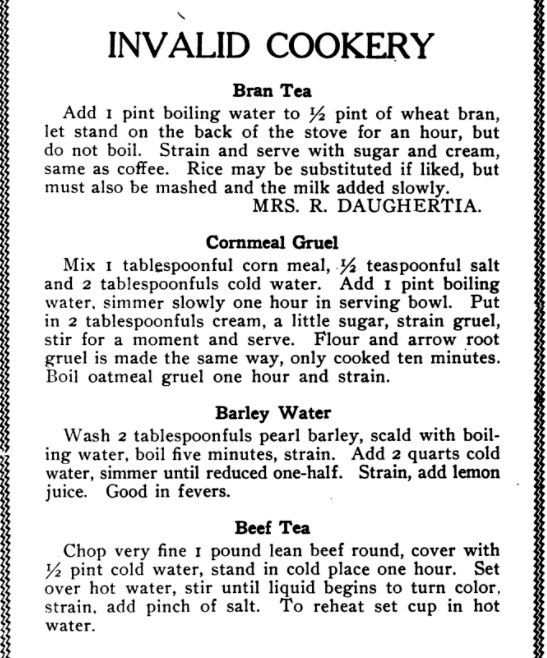
Interestingly, these early books also advise the woman of the house—generally the caretaker—on coping with a variety of ailments. This information would have been useful at a time when infant and childhood mortality rates were much higher than today, and people convalesced at home. Included in the 1890 and 1903 books are recipes for the following: cough syrups; preventing cholera; curing felon (infection of the fingertip); and treating dizziness, scrofula (a tuberculosis infection of the neck’s lymph nodes), and erysipelas (a streptococcal skin infection). The Tabernacle Housewives’ Guide features a section titled “Invalid Cookery,” with recipes for bran tea, beef tea, cornmeal gruel, and barley water. The other two earlier books offer “Eggs for Invalids,” which the 1903 cookbook points out, “…will not distress even sensitive stomachs.”
Earlier cookbooks are often strewn with
literary quotations. As Janet Theofano writes
of the cookbook authors in Eat My Words:
Reading Women’s Lives through the Cookbooks They Wrote, “Primarily
conscientious and busy housekeepers attending to the needs of their families,
they displayed their education and their knowledge of elite culture even in
cookery books” (142). The 1890 and 1914
texts preface many chapters with quotations, often Classical or Shakespearian,
generally related to the genre of food being introduced. For example, the soup chapter in 1914 is
begun with an excerpt from Cicero: “Hunger is the best seasoning,” and a
Longfellow couplet adorns the chapter on pies.
The salad chapter in 1890 begins with a passage from Shakespeare’s Antony and Cleopatra: “My salad days
when I was green in judgment.”
Women of a century ago were expected to behave
as good wives and mothers. Typical of period cookbooks are life recipes, which
advise women on upholding one’s role as the moral center of the household. The 1914 text includes the recipe, “How to
Grow Meek and Patient: Take two small, irrepressible boys to your heart, and
home. After ten years, if you are not meek as Moses and as patient as Job, it
will be because you have not improved your opportunities.” One of the more
common “recipes” often featured in early community cookbooks is titled “How to
Preserve a Husband.” Interestingly, this
appears only in the 1948 text, placed before the table of contents, perhaps as a quaint reminder of
earlier times. It reads:
"Be careful in your selection. Do not choose too young and take only such varieties as have been reared in a good moral atmosphere. When once decided upon and selected, let that part remain forever settled and give your entire thought to preparation for domestic use. Poor varieties may be made sweet and tender by garnishing them with patience well sweetened with smiles and flavored with kisses to taste; then wrap them well in a mantle of charity, keep warm with a steady fire of devotion and serve with peaches and cream. When thus prepared they will keep for years."

These women were also expected to manage a household efficiently. Many ads promoted this belief. The Van De Carr Spice Company’s 1890 ad tells potential customers that “Economy is wealth.” According to a 1903 ad for The Schenectady Trust Company, “Modern women of intelligence and standing find a bank account absolutely necessary for their personal and household affairs.” A knowledge of cooking was essential for any lady of the house. Gracing the inside cover of the same cookbook is a bookstore ad, featuring a poem, “She Could not Cook.” The bride in the poem “…went to a book-store and bought a cook-book as every wife ought.” Another company, Barhyte & Devenpeck, purveyors of baking flour, will “Guarantee light bread/And pastry, and light-/hearted women.” Another important aspect of running a home is the subject of an ad in the 1914 cookbook by Guarantee Polishing & Plating: “Look over your silver. – Would you feel ashamed of it if you were entertaining?”
Community cookbooks also reveal information on
local society. In the five texts under
consideration, the names of the recipe contributors and in some cases, the
cookbook committee members, are indicated; this can be an aid in examining the activities
of Schenectady citizens. In the earlier
books, the numerous ads provide insight into the variety and locations of
businesses operating in Schenectady and other localities over a specific time
period. The most interesting source for
local history is the Episcopal Church
Women’s Cook Book of 1979, which offers a brief overview of inns, taverns,
breweries and bakeries operated by parishioners throughout the history of the church. It also traces the role of the St George’s Ladies
Industrious Society in raising funds, since 1833, for a variety of projects,
including a church, Sunday School, a new church tower, a parish house, and
church restoration.
Community cookbooks are a wonderful resource
for tracing the evolution of food trends, as well as the life of society at
both national and regional levels. Today,
online kits have made self-publishing easier than ever. Perhaps future readers will comb them for
historical gems, as we do today.
Works Cited
"Community Cookbooks." Special Collections and University Archives UMass Amherst
Libraries, 2017, http://scua.library.umass.edu/cookbooks/?page_id=202.
Stoller-Conrad, Jessica. "Long Before Social Networking, Community Cookbooks Ruled The
Stove." Northeast Public Radio, 20 July 2012, http://www.npr.org/sections/thesalt/
2012/07/18/156983942/long-before-social-networking-community-cookbooks-ruled-the-stove.
Theofano, Janet. Eat My Words: Reading Women’s Lives Through the Cookbooks They
Wrote. Palgrave, 2002.
Wednesday, October 11, 2017
Mayor Ellis' Excellent Adventures
Accomplishments that were made during Ellis' run as mayor included computerizing assessments, taxes, payroll, and parking tickets, completing the 22-block urban renewal project, upgrading housing code enforcement, and developing downtown Schenectady. He also had a pretty good publicity department. It wasn't all positives for Ellis, but as Art Isabel and Larry Hart wrote in their April 9th, 1971 column The Art and Hart of Politics "Ellis is a good campaigner; he photographs well both for newspapers and the tube; he shows up at as many social events as possible and has probably cut more ribbons, issued more proclamations and named more patroons than any mayor in Schenectady's history." Our photo collection of Ellis prove this statement to be true.
Ellis was mayor during the time when there was both a city manager and a mayor, which he felt gave the mayor responsibility for fixing things, but little authority. Unfortunately, this wouldn't change until the late 1970s when Schenectady city government changed from a City Manager and Mayor to a Strong Mayor.
Despite his problems with the city manager/mayor system in Schenectady, Ellis seemed to have a good sense of humor with his job. As shown in the photos below, Mayor Ellis was rarely seen without a smile. This collection takes us around Schenectady to see ribbon cuttings, Patroonships, declarations, proclamations, and even inside City Hall to visit Ellis and his staff. Unfortunately, many of the photos are unlabeled. So besides Mayor Ellis, we don't know who is in the photos, or in some cases, where they were taken. Still they're a fun tour through early 1970s Schenectady and show the lighter side of what must have been a stressful job.
![]() |
| Mayor Ellis (in full suit) trying out his skills at a local dojo. |
![]() |
| The back of this photo reads "It's that time again." Our detective skills indicate that "that time" refers to Christmas time. Ellis is second from the right. |
![]() |
| Ellis at the ribbon cutting of the Golden Dragon Restaurant and Cocktail Lounge. |
![]() |
| Shucking corn at the Glenville Sesquicentennital with Scotia Mayor John Ryan (second from right) |
![]() |
| Mayor Ellis hanging out with Schenectady's youth and attempting to hold a reluctant looking baby. |
![]() |
| Probably the best photo in the whole collection. Did Mayor Ellis eat this sandwich himself, or did he bring it back to staff? We'll never know! |
![]() |
| A nice shot of Ellis and his staff. |
Tuesday, October 3, 2017
It's Not Easy Being Green's
This post is written by library volunteer Ann Eignor
There have been several songs written about Schenectady - "I Can't Spell Schenectady," It's Forty Miles From Schenectady to Troy," "Our Schenectady," and a few others. One of the most unusual is "Joe Green's Clothes Shop."
Credit for the music is given to Charles E. Benham, a local printer. The words are based on the text of the advertisement below which appeared in the May 22, 1924 issue of the Schenectady Gazette. Notice the ads for the two different Green's.
Lyrics to "Joe Green's Clothes Shop!"
It would seem that Joe Green was not pleased with this new competition who used a similar name, sold similar items, and was located just a block away. The words of the 1924 advertisement make Joe Green's dissatisfaction quite clear. Once the words became song lyrics in 1924, no one should have confused the two stores. The sheet music was probably given out as a "Souvenir of Schenectady" to Joe Green's customers, State Street pedestrians, and was available "at all music dealers." It was not a best seller.
In the battle of the Green's, Joe outlasted George. George Green's Clothing Store was no longer listed in the 1933 City Directory, but Joe's was still going strong. Was the song a deciding factor for Joe's success? We may never know. Joe remained in business until selling to his employee Jerome Oppenheimer in 1938. The store was renamed The Rochester Pants Company which continued in business for several years
There have been several songs written about Schenectady - "I Can't Spell Schenectady," It's Forty Miles From Schenectady to Troy," "Our Schenectady," and a few others. One of the most unusual is "Joe Green's Clothes Shop."
Credit for the music is given to Charles E. Benham, a local printer. The words are based on the text of the advertisement below which appeared in the May 22, 1924 issue of the Schenectady Gazette. Notice the ads for the two different Green's.
Lyrics to "Joe Green's Clothes Shop!"
Notice; statement to the public
Don't be fooled, there is only one Joe Green
One Store, No branch,
Look for the name Joe at the old established place
Look for the big number Four Hundred Twelve
State Street before you enter
Joe Green's Clothes Shop,
Over the Worthy Lunch,
Opposite the Wallace Company
Same block as Carl Company,
over the Worthy Lunch
Jooooeeeee Greeeeeennnn (editorial note)
In the battle of the Green's, Joe outlasted George. George Green's Clothing Store was no longer listed in the 1933 City Directory, but Joe's was still going strong. Was the song a deciding factor for Joe's success? We may never know. Joe remained in business until selling to his employee Jerome Oppenheimer in 1938. The store was renamed The Rochester Pants Company which continued in business for several years
"Don't be fooled - There is only one Joe Green!"
Monday, September 25, 2017
James Cuff Swits – Herbalist and Gentle Giant
This blog post was written by library volunteer Gail Denisoff.
Jim Cuff was a familiar figure on the streets of Schenectady. His lanky 6’7” frame and odd shuffling gait made him instantly recognizable. He looked even taller than he was because of his unusual clothing. He wore cast offs that were too short leaving his wrists and ankles exposed and an old “plug” hat that added to his height. He always wore a neckerchief fastened with a piece of carved bone and rubbers or galoshes year-round. He carried himself proudly and one of the presenters said of him “how pathetic a figure – such fierce pride coupled with such superb dignity”.
Jim’s heritage is a bit sketchy. He was born sometime after 1800 on the farm of Henry Swits located where Proctors now stands and the area beyond. By most accounts, his father was James Hartley, a black man, and his mother, according to Jim, was the last of the Schoharie (probably Oneida) Indians. Both of his parents worked on the farm as sharecroppers and one or both may have been a slave of Henry Swits. He was named James Hartley Swits but was referred to as Jim Cuff, Cuff being a "Negro name of significance" at the time.Jim made his meager living as an herb peddler, often called an "herb doctor or "medicine man" around town. Most mornings from early spring to late fall he roamed the Rotterdam Hills, now Coldbrook, as well as the river flats along the old Campbell Road collecting herbs, roots and bark. He peddled the "yarbs", as he called them, door to door to housewives who bought them to make their own remedies. His gaunt figure was a fixture standing in front of the Ellis Building on State Street selling watercress, wild mushrooms, spearmint, fox glove, sunflower and poppy seeds, milkweed and berries out of his huge basket.
A one room shanty in Cotton Hollow was what Jim called home. He built the shack himself from found materials and reportedly had just one piece of furniture, a cast off chair. Jim slept on the dirt floor near his only source of heat, a fire built in a hollow dug into the floor. The shanty is believed to have been located in the vicinity of the current Lincoln School, between State and Albany Streets.
Jim was a gruff but kind and gentle man who was welcomed into the homes of his customers. If
Jim Cuff standing in front of what is believed to be his
shanty.
Courtesy of fultonhistory.com
|
He didn't attend church, saying his clothes weren’t fine enough but Jim had his own kind of spirituality. He believed that there was a better place after death, often saying "Someday we shall all be in equal skies". In his declining years, he was destitute and relied on help from some of his friends and customers. When one of his customers didn't see him out with his herbs for several days he checked on Jim and found him in his shack, quite ill. An item in the Schenectady Gazette, dated February 26, 1893, stated “Schenectady’s big Indian, Jim Cuff, who has been ill of consumption and lung hemorrhages, was today removed from his hut to the county almshouse on Steuben Street”. He died there a few days later on March 4, 1893. Dr. William Clute signed the death certificate for "James Cuff Swits" noting the cause of death as pneumonia and giving an estimated age of 72 although many thought he could have been closer to 90. Jim was buried in the Potters Field section of Vale Cemetery in Schenectady.
![]() |
James Cuff Swits grave as it now appears in Vale Cemetery. Courtesy of Gail Denisoff.
|
Jim's story doesn't end with his death. His friend Tom Wallace carved Jim's likeness in bas relief on his headstone, the only such stone in Potters Field. Under his name and date of death, Wallace carved the words "Admitted to that Equal Sky". Forty years after Jim's death, a local physician, to alleviate his guilt, anonymously gave an account to the Schenectady Gazette regarding the placement of that headstone. The physician, a medical student in Albany at the time, decided that Jim's skeleton would be an exceptional specimen for study since Jim claimed to be the last of the Mohawks and was close to seven feet tall. When he got wind that other medical students had the same idea, the physician went to Potters Field at night and switched Jim's headstone with that of a woman who had died about the same time. A few nights later, he returned to dig up the grave. According to his account, the sight of the dead Cuff so unnerved him that he quickly refilled the grave and left the cemetery without the body or switching back the headstones. He claimed not to remember which was the other headstone he switched. Other accounts have Union College students removing Jim's body for autopsy. Whether either of these stories are true is the subject of speculation. Jim may not be lying beneath his headstone but he is not forgotten.
Photos and information for this blog from the Schenectady County Historical Society holdings and the Fulton History collection.
Monday, September 11, 2017
The Ghost Train of Mont Pleasant
We can't wait for Halloween over at the Schenectady County Historical Society, so when one of our volunteers found this letter about the "Ghost of the 9:15", we were thrilled and wanted to post it right away. There is not much backstory to it, so we've transcribed the letter below.
We could travel the Mont Pleasant area from yard to yard, alleyway to alleyway in the dark as well as in the daytime. Our schedule was to pick up the "Ghost" bed sheet attached to the fishing pole around 8:30. Wait until it was dark enough, then walk or run from the alleyways between Cutler and Davis Terrace, down to Park St. into the woods and down to 3rd Ave. We then would climb the tree, wait for the train, flip the bed sheet over to the white side, dangle it as the train passed, flip it to the black side, down the tree, through the woods, alleyways, and home. When the news about a ghost got out of control and crowds would gather to try to see him, we would not appear that night and eventually retired him for good.
December 28, 1992
To: Larry Hart
Larry, here is the real story of the "Ghost" Train.
As a teenager living in Mt. Pleasant in the early 1950s, entertainment for young teenagers was non-existent. The "flockey" as it was called was our playground, the wooded area between Mt. Pleasant and Bellevue. We explored and knew every inch of that land from Altamont Ave. to Lower Broadway Hill.
The "Ghost of the 9:15" was the actual name of the event.
The Ghost was a bed sheet attached to a fishing pole and dangled from a tree branch which was along side the railroad tracks. The white sheet was painted black on one side so as not to be seen when transporting our ghost to and from the tree. The sheet was reversed and the black side covered the fishing pole.
The original story that we had heard was that a hobo was killed in that location years before and that his ghost haunted the 9:15 train. We helped the story to be true.
![]() |
| You could probably see the ghost train pretty well from this vantage point of the Congress Street bridge. Courtesy of the Grems-Doolittle Library Photo Collection. |
That's the story of the "Ghost of the 9:15"
Yours truly,
One time member of the "Cutler St. Gang"
Thursday, September 7, 2017
A Brief History of the Abruzzese Society and Italian-American Fraternal Organizations in Schenectady
This post was written by Archives Assistant Angela Matyi. Angela processed our collection of Abruzzese Society records through a Documentary Heritage Program Grant provided by the New York State Archives.
![]() |
| Officers of the Abruzzese Society, undated. Courtesy of the Abruzzese Society Collection. |
In the late-nineteenth and early-twentieth centuries, the
city of Schenectady saw a massive influx of Italian immigrants. Like many immigrants to America, they came
seeking work and opportunities for economic and social advancement, things that
were not altogether difficult to find thanks to the dynamic presence of the General
Electric and American Locomotive companies which pulled in laborers by the
thousands. However, opportunity alone
does not an easy life make.
America was an unfamiliar country, with unfamiliar customs
and an unfamiliar language. Adaptation
to it all was difficult at the best of times.
It was not long before the Italian immigrants felt keenly the need to
establish some kind of organization that would provide immigrants and their
descendants a place to engage with fellow Italians, creating and reaffirming
bonds of fellowship and, later, providing financial assistance in the event of
illness or injury. The first of these
fraternal communities to be founded was the Societa’ Unione Fratellanza, in
1892. By 1900 it boasted forty members,
though these were mainly comprised of the “prominenti,” those men who had
already achieved some level of economic success, particularly in business.
The turn of the century also saw the founding of
Schenectady’s second Italian-American fraternal society, the Societa’ Giuseppe
Garibaldi. Though this organization was
a combination of a political (GOP) club and a mutual benefit society, there was
frequent crossover between it and the simpler Fratellanza, perhaps most
noticeably when the Fratellanza’s first president, Stephen Abba, went on to
become in the first president of the Garibaldi Society as well. He was not long for the post. The position of president in these societies
had become one of prestige within the Italian-American community, as well as a
vehicle for exercising a degree of true political influence; the result being
three leaders of the Garibaldi Society in as many years.
Contributing to this sudden prominence was the spike of
Italian immigration to Schenectady in the early twentieth century, which both
allowed for and necessitated a sudden motley assortment of region-specific
fraternal organizations. This was as
much a consequence of the geographical and social makeup of pre-1900 Italy
itself as the desire for community felt by the new Italian-Americans and their
children. For centuries, “Italy” was a
more abstract concept than a geopolitical reality; a vaguely understood
umbrella title used for the collection of the various kingdoms and city-states
that happened to call the Italian peninsula home. Though the “Kingdom of Italy” was officially
declared in 1861, it was not until 1870 that full political unification within
the borders of a geographically recognizable modern-day Italy was technically
complete. Even then, a few hundred years
of social habit was hard to break. For
decades afterwards, many people still identified themselves socially and
politically with a specific region rather than with the nation-state. With regional customs and, especially, dialects
slow to give way to pushes for standardization, cultural fragmentation was
still the Italian norm into and past 1900.
It was this mindset that the Italian immigrants brought with
them to Schenectady, preferring to refer to themselves as Calabresi
(Calabrians); Siciliani (Sicilians); or Napoletani (Campanians, or
“Neopolitans”). Although the Fratellanza
and Societa Garibaldi were open to all Italians regardless of origin, this wave
resulted in the founding of multiple regional fraternal societies. Curiously, none dedicated solely to peoples coming
from Campania were ever founded, despite their soon accounting for about 60% of
Schenectady Italians; though a society for immigrants from the Campanian town
of Alvignano, confusingly located in the province of Caserta, was formed, the
Society of the Laboring Men of Alvignano.
In any case, regional societies founded after 1900 included the
Benevolent Brotherhood of the Sons of Northern Italy (popularly referred to as
the “Alta Italia Society) in 1902, several organizations for Calabrians and
Sicilians in the 1920s, and the Societa Laziale for Roman Italians in 1930.
![]() |
| Members of the Abruzzese Society during an annual meeting, undated. Courtesy of the Abruzzese Society Collection. |
In this model,
members would pay a small monthly due so that, in the case of illness or
injury, they would be entitled to a certain amount of money per week for up to
twelve weeks, and a larger amount of money in the event of a death. During the Society’s earliest days, the due
was one of $0.50, the weekly payout of $6.
If a member of the Society did indeed die, a sum of $50 would be given
to the deceased’s family to cover the funeral costs. Furthermore, all other members would be
required to attend the funeral service, with a fine of $5 imposed for failure
to attend. Since the first members of
the Society were relatively young and in good health, this mortuary fund was
little used in the early years.
Poignantly, though, one does see small expenses for things such as
wreaths ($10) and a carriage to carry Society representatives ($15), usually
for the funeral of a member’s child.
![]() |
| Handbook for the Abruzzese Society. Courtesy of the Abruzzese Society Collection. |
Admission to the Abruzzese Society was restricted to males between the ages of fourteen and forty-five, with
initiation fees increasing with the age of the initiate; the idea being that
young children and those verging into seniority would be more likely to fall
ill, and thus constitute a drain on the Society’s finances. For this reason, admission was further
contingent upon good physical health and “spotless reputation” (though
exceptions, decided by an assembly, could be made in the case of minor misdemeanors),
and members were not entitled to benefits for injuries or illnesses brought
about by brawling, venereal disease, or drunkenness. Within a few years of its founding, the
Abruzzese Society could boast seventy-two members, and its example was being followed
by other regional groups.
Many of Schenectady’s Italian-American fraternal and mutual
benefit societies continued well into the mid-twentieth century. However, after this point they started
gradually to decline and disappear. The
Abruzzese Society was the only one, along with the national Sons of Italy
organization, to remain in operation into the twenty-first century, celebrating
its Centennial in 2012. Nevertheless,
its membership continued to dwindle, and in early 2016 the last ten members of the
Abruzzese Society decided to disband the organization.
Boxes of the Society’s records were donated to the Schenectady
County Historical Society, and now offer a unique look into a defining part of
Schenectady’s history and culture.
Subscribe to:
Posts (Atom)