Thursday, June 27, 2013

No Place Like Home: Schenectady County Residential Postcards


Postcard of Crane Street in the Mont Pleasant neighborhood in Schenectady. From the Larry Hart Collection. 

There are a number of categories in our postcard collection, from local organizations and schools, to images of fires and floods, to aerial and scenic views. Many times when we think of postcards of our local area, the first images that come to mind are bustling downtown scenes, public buildings and institutions, and perhaps views of the homes of locally significant people. We don't always think of a view of the neighborhoods of everyday people, but there are dozens of postcards in our collections that show just that. These postcards give a sense of neighborhoods and communities of times gone by, and many are fairly bursting with civic pride. Here are just a few of them to enjoy.

Panoramic postcard of Lincoln Heights municipal housing. From Larry Hart Collection. 

View of Quaker Street / Delanson areas. From Grems-Doolittle Library Postcard Collection. 

Photo postcard of the corner of McClellan Street and Eastern Parkway. From Larry Hart Collection. 

A house peeks through the trees in this view of Lenox and Avon Roads in Schenectady. From  Larry Hart Collection. 

Photo postcard of Putman Street in Rotterdam Junction. From Larry Hart Collection. 

Four houses face out onto Hattie Place as four ladies stroll by. From Grems-Doolittle Library Postcard Collection. 

The trolley tracks are quiet on upper State Street near Linden Street in Schenectady. From Larry Hart Collection. 

Aerial view of Schonowee Village public housing in Schenectady. From Larry Hart Collection. 

Corner of Ruby Road and Stratford Road in the GE Realty Plot. From Grems-Doolittle Library Postcard Collection. 

This view of Nott Terrace places the viewer on the sidewalk, taking a pleasant stroll along the street. From  Grems-Doolittle Library Postcard Collection. 

Thursday, June 20, 2013

"The De Luxe Dining Car of the Mohawk Valley:" Schenectady's Silver Diner

Advertisement in the 1936 city directory for the Silver Diner. The image in the directory shows the diner as it existed in its earliest days, before its 1937 expansion. From Grems-Doolittle Library Collections. 

Diners first operated in Schenectady in the late 1880s as night-time, mobile lunch wagons that descended upon downtown Schenectady and served G.E. and American Locomotive Company workers, mostly from the hours of 6:00 p.m. to 6:00 a.m. These night-time, mobile diners petered out during the years following World War I, as the use of automobiles grew and the city passed ordinances restricting the operation of lunch wagons. Displaced lunch wagons or railroad dining cars could be purchased and converted into stationary diners. In the late 1920s, restaurants with the word "Diner" in the business name began to emerge; the earliest in Schenectady were the Palace Diner, Gaylord Diner, and Belleview Diner.

Intersection of State and Erie, ca. 1940. Part of the Silver Diner is barely visible past the large building at left. The G.E. plant, visible at the end of Erie, was a major part of the diner's customer base throughout the history of the business. Photograph from Larry Hart Collection. 

Early in 1936 (not on Election Day, as many past newspaper articles have claimed), Dominick and James Cecilian opened the Silver Diner at 167 Erie Boulevard. The diner soon became a fixture in the city, drawing in G.E. and ALCO workers, downtown shoppers, and night-time theatergoers. The diner was made from a converted 1918 Pullman railroad car that the brothers had purchased from the Delaware and Hudson Railroad for $100.00. According to a letter to the editor written by James' son (also named James Cecilian) in the January 22, 2001 Schenectady Gazette, the brothers "had it hauled to a lot on upper State Street, where it was converted into the diner. My dad did most of the work himself. Meanwhile, a basement was prepared on Erie Boulevard. When the diner was completed it was moved to the present site." In 1937, the diner underwent a stainless steel Art Deco renovation and expansion of the original railroad car. "Another railroad car was bought for parts and parked in the back yard of our family home in Rotterdam," James Cecilian remembered. "The basement was extended and a new floor built. The building was split in half, the front wall moved forward and the roof joined together, during all this renovation the diner never closed, customers continued to be served 24 hours a day, seven days a week. Dominick bought all the waitresses and counter help sunglasses. Fortunately, it never rained."

1937 newspaper advertisement for the Silver Diner. Image obtained  via www.fultonhistory.com

The dining are was on the ground level, and food was prepared in the basement. The diner featured a water-controlled dumbwaiter; a faucet went on and off to move the dumbwaiter between levels. Billed as "The De Luxe Dining Car of the Mohawk Valley," the Cecilian family put forward this pledge in many of their advertisements: "Our Constant Endeavor is to Serve the Best Food We Can, as Clean as We Can and as Cheap as We Can." "The food was good, the service friendly," Phyllis Von Linden remembered of the Silver Diner in the 1930s and 1940s. "The menu was ample and entrees such as roast ham or liver and bacon cost 35 cents." Von Linden remembered the Cecilian brothers as "smiling, soft-spoken men who must have been sometimes tired and frustrated, but never showed it." Joseph Dubinett recalled that the diner's short-order cook in the 1950s was "one of the best in the area. He could take care of 10 dinners at one time on the grill." The Cecilian family continued to operate the business until 1975.


The Silver Diner is visible at left in this 1964 photograph looking north up Erie Boulevard toward State Street. Photograph from Larry Hart Collection. 

The family sold the diner to Ruben Michelson, who took over the business in February 1975 and renamed the business Ruby's Diner. Michelson had long run Ruby's Luncheonette at 10 Erie Boulevard, in the Ellis Building, before the building was razed. "For six weeks, I walked the streets unemployed before I happened to become connected to this place," Michelson remembered. Michelson continued the tradition of good, inexpensive fare in a homey atmosphere. "It's like going home for lunch," said customer Sal Constantino. "You can get anything you want." Schenectady Gazette reporter Barbara Mitsch visited the diner in 1986 and remarked, "stools with green seats line the front of the counter. Peach-colored curtains frame the mahogany thumb-latch windows on the opposite wall, where the original mahogany booths are. On one end, scene from the Pine Grove Farm in Duanesburg adorn the wall." An article a few years later remarked, "the home-style cooking and the friendliness that pervades the space are reminders of an earlier generation." Donald Kaplan and Alan Bellink featured the diner in their book Diners of the Northeast, and proclaimed that the diner was "home of some of the best potato salad we ever had on the road." Bernie Witkowski liked the atmosphere at Ruby's and the variety of people who came in to get a bite. "You see some people come in suits. Some are working class, maybe people on a tight budget." As the years turned, the reduction of the G.E. Schenectady workforce impacted the volume of business in the diner. Ruby's Diner scaled their hours of operation back from a 24-hour schedule, opening at 5:30 a.m. and closing mid-afternoon. Ruben Michelson's son, Bob, saw each round of layoffs mark fewer customers coming in. "Business is not like it used to be. We're hanging on, " Michelson said in 1995.

Ruben Michelson inside Ruby's Diner in 1980. Copy from clipping file, Grems-Doolittle Library. 

The business changed hands soon after, in late 1996, when George Hutton bought Ruby's and renovated it with a $20,000 loan from the city. He renamed the business the Silver Diner and promoted it as a classic greasy spoon. "We serve all the food that's bad for you," Hutton quipped in a 1997 interview. "Caffeine, sugar, butter and salt. Those are our four food groups. All the food the surgeon general has warned us against." The Silver Diner soon folded for good a year later. Hutton cited his own inexperience and a lack of afternoon customers. "I just couldn't produce," Hutton said in 2000.

Ruby's Diner, ca. 1980s. Photograph from Larry Hart Collection.
With the closure of the Silver Diner in 1998, another piece of Schenectady's history was laid to rest, and the Silver Diner joined a long list of lost diners of Schenectady, including the Belleview, Coons Brothers, Cross-Town, Everready Dining Car, Flite Dining Car, Ladd's, MacDonald's, Miss Schenectady, Modern, Oven and Griddle, Palace, State, Van Curler, and Victory Dining Car. In October 2009, the Silver Diner was demolished. The diner had closed its doors for good in 1998, and had been vacant since then. The city took possession of the property in 2000 following a foreclosure. Over the last years of the building's existence, various ideas and plans were promoted to salvage the building -- from restoring its use as a diner, to converting it to an office space or retail store, to moving it to become an exhibit for the Schenectady Museum. In the end, the Silver Diner was not saved. The city performed an emergency demolition of the building, saying it feared the long-vacant structure could collapse "at any time." Thus, the history of one of the few remaining converted railroad car diners in the United States was brought to a close.

Thursday, June 13, 2013

Schenectady in 1892: Photos from the Album of Edward Winslow Paige

Photograph of southwest corner of Union Street and Ferry Street, taken August 9, 1892. From 1892 Stockade Album of Edward Winslow Paige, p. 44. 

In the collections of the Grems-Doolittle Library is a remarkable album containing nearly 300 photographs of Schenectady, all taken in a single year -- 1892. The photographs in the album were taken and described by Edward Winslow Paige (1844-1918). Paige was born in Schenectady to Alonzo C. Paige and Harriet Bowers Mumford Paige. He worked in Schenectady as a lawyer and served as Deputy Attorney General of New York for several years before moving to New York City and practicing law there until his death in 1918. Although Paige left Schenectady during the 1880s, he continued to maintain a home on Washington Avenue. From the dates of the photographs provided in the album, it appears that Paige continued to visit Schenectady frequently in the years after he moved to New York City.

Paige meticulously photographed the area that we now call the Stockade neighborhood, as well as parts of Schenectady's downtown. For each image, he made a series of brief notes about the streets, homes, and businesses depicted and about the people living in the houses he photographed. Paige's album captures the neighborhood and community life of the period. A few images from this notable resource are included below.


Northeast corner of Washington Avenue and State Street. Notice the streetlamp over the intersection. From 1892 Stockade Album of Edward Winslow Paige, p. 68. 

Winter view of the Erie Canal from the State Street canal bridge.  From 1892 Stockade Album of Edward Winslow Paige, p. 49.

Hetty Yates with her father Austin Yates and the family's dog in front of Austin Yates' home on Washington Avenue. The bridge across the Mohawk River to Scotia can be seen in the background, at left. From 1892 Stockade Album of Edward Winslow Paige, p. 22. 


Trolley traveling on Washington Avenue toward State Street. From 1892 Stockade Album of Edward Winslow Paige, p. 58. 

Paige meets John Palmer and an unidentified girl on Church Street. This view looks north , toward Front Street. From 1892 Stockade Album of Edward Winslow Paige, p. 71. 

The north side of State Street just east of Ferry Street. Suits are hung in front of Holtzmann's clothing store to attract customers. From 1892 Stockade Album of Edward Winslow Paige, p. 33. 

Children pull friends on a sled down Union Street between Church Street and Washington Avenue (this photo shows the south side of the street). From 1892 Stockade Album of Edward Winslow Paige, p. 4. 

View of State street looking west from the railroad tracks toward the canal. The Edison Hotel  can be seen at right. From 1892 Stockade Album of Edward Winslow Paige, p. 53. 

North side of Union Street from Ferry Street, looking east. From 1892 Stockade Album of Edward Winslow Paige, p. 31. 

Friday, June 7, 2013

A Sketch of the Life of Dora Jackson

Dora Jackson as a young woman. From Grems-Doolittle Library Photograph Collection. 


Visitors to the Schenectady County Historical Society are often curious about the history of the building that contains our Museum. For many years, the building has served organizations -- first the G.E. Women's Club, and, for over 50 years, the Schenectady County Historical Society. However, it was originally built and inhabited as a private home. It was the home of Dora (Mumford) Jackson, a widow who lived in Schenectady for much of her life.

Dora Astor Mumford was born in New York City on May 17, 1831, the daughter of Samuel Jones Mumford and Caroline Givens (Astor) Mumford. Dora's mother died in February 1834, when Dora was not yet three years old. Shortly afterward, Dora and her infant sister Caroline were sent to Schenectady to live with her paternal grandparents, Benjamin and Harriet Mumford. Dora's sister would die a few short months later, in July of 1834. During the nineteenth century, the wealthy and established Mumford, Bowers, and Jackson families clustered along Washington Avenue, creating an informal extended family network in the neighborhood. This support was likely vital to young Dora as she grew up; her family life was marked by loss. In addition to the early deaths of her mother and sister, two of Dora's stepmothers died during her childhood and early teenage years, and her father would die soon after Dora's marriage. Dora attended Emma Willard School in Troy, graduating in 1847 at the age of 16.

In 1850, in Prattsville, New York, Dora married Alonzo Jackson. Alonzo Clinton Jackson was born in 1823 in Montgomery County, New York, to Allen and Diana (Paige) Jackson. When Alonzo's father died in 1836, Alonzo's uncle, Alonzo Paige, took responsibility for the educations of Alonzo and his brother, Samuel. Alonzo graduated from Albany Academy. He was still a seventeen-year-old student at Union College when he was appointed as a midshipman in U.S. service. He served in the Pacific for five years, and entered the naval school at Annapolis, Maryland. He passed with honors and shortly after served in the Mediterranean, not returning until late 1849. After Dora and Alonzo's marriage in 1850, the 1850 Federal Census shows the couple living with Alonzo Paige and his wife, Harriet Bowers Mumford Paige. Harriet was also Dora's aunt (Harriet is also well-known to local history enthusiasts as a diarist who commented on prominent people and community life in nineteenth-century Schenectady). Alonzo Jackson continued in service with the U.S. Navy, earning the rank of Lieutenant. Tragically, his life was cut short in 1853, at the age of 29. According to his death notice, he died of "a disease of the brain, brought on by too arduous application to the scientific duties of his profession."

Photograph of Alonzo Clinton Jackson taken by N.S. Bowditch, U.S. Naval Academy, Annapolis, Maryland. This image is a copy of the original photograph, which is in private hands. From Grems-Doolittle Library Photograph Collection. 

By the age of 22, Dora Jackson had not only lost both of her parents -- she had lost her husband as well, and was the mother of a toddler and an infant. The couple's daughter, Helen, had been born in 1851, followed by a son, Jones, in 1852. The 1855 New York State Census shows Dora and her children living with Alonzo and Harriet Paige. The 1860 Federal Census shows Dora, Helen, and Jones living with Samuel Jackson, Alonzo Jackson's brother. By the 1865 New York State Census, Dora and her children had a home of their own. The family lived "at 32 Washington Avenue in the familiar little white house so many years a landmark in Schenectady," according to the obituary of Dora's daughter, Helen (Jackson) Mason, in 1915.

The small white house was razed and the present house was built on the site in 1895, after Dora had been a widow for over 40 years. The house was built for Dora by her son, Jones. The house is a Colonial Revival style reproduction of a transitional New England Georgian style house of the 18th century with Federal period detailing. It was designed by American architect William Appleton Potter. A glowing memorial of Dora Jackson published in the newspaper after her death in 1899 notes that Dora's home was "doubly dear to her, from the love that prompted its building, - to the 'House not builded with hands,' for which her whole life was a preparation, one whose life was so closely interwoven with all of the best and brightest of both the old and the new Schenectady." After Dora's death, her son lived in the house. He died in 1906 after suffering from sunstroke in the garden. The ownership of the house then passed into the hands of Dora's daughter, Helen. After her brother Jones' death, Helen built a bungalow at 30 Washington Avenue; she spent summers there with her daughter, Gertrude Franchot Mason.

When Dora Jackson died in December 1899, she was remembered as a kind, lively, and religious person. She was active in St. George's Church, and is buried in the church's burial ground, along with her husband and son. "It is seldom one finds combined in the same person social attraction of a high order and a deep religious nature," reads her obituary. "Mrs. Jackson possessed the two qualities in a remarkable degree. Her home was always the centre of a gracious hospitality, enjoyed alike by young and old. Her youthful heart and kindly ways endeared her to all ages. Her devotion to her church was unwavering. The church bell was a signal that she always responded to." Dora Jackson was also remembered fondly by the Episcopal Diocese in Albany. The journal of the proceedings of the Diocese's annual convention in 1899 includes a tribute to her. The tribute describes Dora Jackson as one "whose life was enriched with all those outward graces of Christian womanhood, hospitality, kindness, sparkling cordiality and cheerfulness, quick and keen sympathy with all human things, and all those outward graces had their source in the deep-down spring of earnest personal religion and a love, that was alike devout and devoted, of her Lord." Her service as Chair of the Missionary Committee of St. Mary's Guild, and preparation of the missionary boxes, was acknowledged. "Her work in this direction was just about finished for the year," the memorial states, "and all the boxes for which she had been arranging, have now been sent to their respective destinations."

The house at 32 Washington Avenue was acquired by the General Electric Company in 1918, and was used as the clubhouse for the G.E. Women's Club, an organization for the company's female employees. The Schenectady County Historical Society acquired the house in 1958 and has remained ever since. Dora's former home has been transformed into a museum that highlights the history of the area over four centuries. Today, a photograph of Dora Jackson stands on the mantel in one of the rooms, bearing witness to the changes of a house built in love.

Friday, May 31, 2013

Caricatures of Prominent Schenectadians

Real estate and insurance man A. Vedder Magee circles the planet in Just For Fun. From collections of Grems-Doolittle Library. 

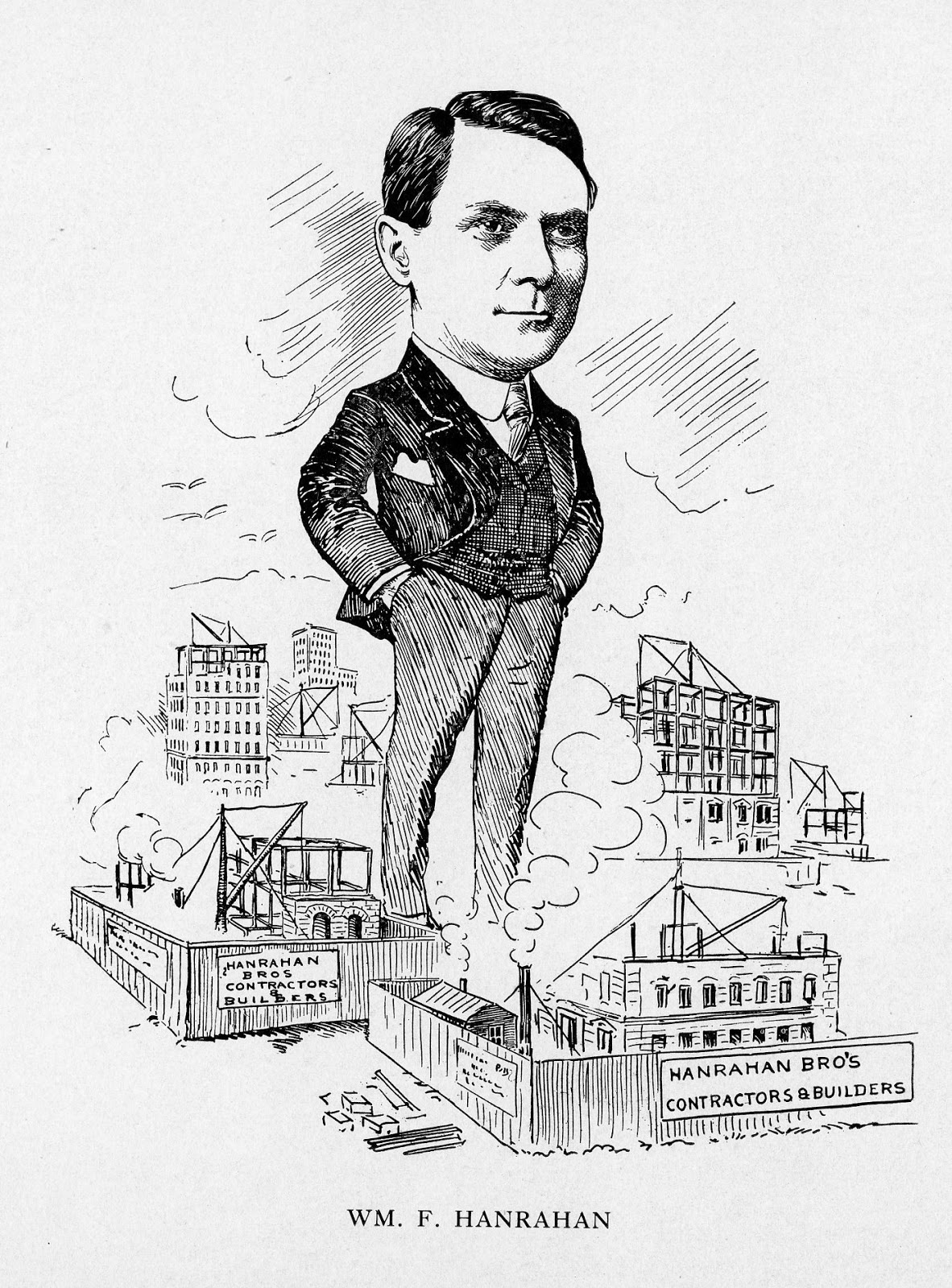
Some time around 1908 or 1909, a cartoonist created scores of caricatures of men prominent in the local community. Those depicted were businessmen and merchants, doctors and dentists, lawyers and judges, political figures, police officers and sheriffs, artists and musicians. The heads of the men are all rendered realistically, as in a photograph, while the men's bodies and surroundings are drawn in a more cartoonish style. The artist also inserted little jokes into the the drawings -- men's clothing store owner Henry Stern is shown being approached by a man wearing a barrel, the general manager of the Schenectady Railway Company skis along on trolleys, and the sun mutters "I am jealous of him" as as it shines behind L. O. Ripley, manager of the Schenectady Illuminating Company. Many of the men in the book are shown with symbols of their hobbies -- such as bowling, fishing, or singing -- in addition to symbols of their vocations. In the excitement of the early age of automobiles, the cars of a select few men are also depicted in loving detail.

The drawings were reproduced and printed in the format of a book, bound between leather covers embossed with the words "Just For Fun." The book's origins are somewhat mysterious. According to a 1953 Union-Star article, the men were all drawn by an itinerant caricaturist: "the name of the artist and his whereabouts are not known. In the book he bound nothing but the caricatures and the names of the men he drew." Although the drawings all appear to be in the same hand, in flipping through the book, we came across two drawings that appear to be signed. One bears the name "Berryman," while another is signed "Thomson." Given the approximate year and the focus on the professional, business, and civic leaders of the city, it's possible that the drawings could have been produced for the Schenectady's Board of Trade's week-long "Skedaddle to Schenectady" fair in 1909. Or perhaps it was indeed produced "just for fun." A few of the images from the book are included below.


Builder William F. Hanrahan overlooks his Schenectady building empire in Just For Fun. Hanrahan was one of many builders depicted in the books, as Schenectady grew in leaps and bounds during the era. From collections of Grems-Doolittle Library. 

Caricature of Dr. George W. Bates from Just For Fun. From collections of Grems-Doolittle Library. 

Alderman Harry G. Ellis outlines his plans for public baths in Just For Fun. From collections of Grems-Doolittle Library. 

Bad guys tremble before Sheriff William H. Hathaway in Just For Fun. From collections of Grems-Doolittle Library. 

George William Slaght, manager of the Saul Clothing Store in the Lorraine Building in Schenectady.  In addition to his work, Slaght also had music as a hobby. Many of the men in the book are shown with symbols of their hobbies in addition to symbols of their vocations. From collections of Grems-Doolittle Library. 


Thursday, May 23, 2013

Early Educational Television: The Role of the Schenectady City School District


Anne Slack, modern language coordinator for the Schenectady City School District and host of the educational television program "Fun With French," on set with students from Schenectady public schools in 1955. Photograph from Schenectady City School District Records. 

Schenectady has served as a site for innovation in television since the origins of the medium. The first ever successful television broadcast was made by Dr. Ernst Alexanderson to the homes of four General Electric executives in Schenectady in 1928, and Schenectady's WRGB is one of the oldest television stations in the country. As the popularity of television soared during the early 1950s, both nationally and locally, it seems natural that educators would be drawn to the possibilities of this medium.

The origins of educational television in Schenectady began during the 1952-1953 school year. Robert Hanna, manager of broadcasting for all GE projects, including WRGB, offered the city's school district one hour of TV time per week for educational programming. Regional interest was building in educational television. By May 1953, 120 organizations had organized the Mohawk-Hudson Council for Educational Television. The Schenectady City School District became a member. The Council employed a producer, Angela McDermott, to handle programming. By 1954, all Schenectady schools had television sets.

Third-graders at Lincoln School sit down for TV Schooltime. Photograph from Schenectady City School District Records. 

In the beginning, Mohawk-Hudson produced educational programs on WRGB, many under the series TV Schooltime. Several local schools and universities, libraries, museums, and other organizations created programming, and educational TV programs were shown in classrooms as part of the curriculum. Schenectady's schools didn't just receive educational TV programming in classrooms -- the district also had a hand in creating programming, and students from Schenectady schools often participated. The Schenectady City School District was responsible for a number of programs aimed at students, including "Science Adventures," "Conservation Road," "Our Friends," "Copy Desk," and "Teen Talk." The district also created programming aimed at adults, such as "It's Worth Knowing," a program aimed at homemakers, and "Let's Talk It Over," a program based on the discussion of public issues. After several years of broadcasting educational television on WRGB, the Mohawk-Hudson Council decided to form a non-commercial educational television station of its own. The station, WMHT, went on the air in 1962, becoming the second educational television station in New York State.

Alfred Hulstrunk during a taping of the educational TV program "Science Adventures." Hulstrunk served as coordinator of the Schenectady school district's elementary science resource program. In addition to his work on "Science Adventures," he worked with schools in the district to enrich their science curriculum, bringing animals such as iguanas, flying squirrels, and bats into the classroom for visits, and helping to set up science programming in elementary schools, and creating a weekly "Elementary Science Topics" bulletin. Photo from Schenectady City School District Records.    

The district's most successful program -- and the one that received the most media attention -- was "Fun With French." The TV program was the first in the United States to provide foreign language instruction to children. The series was hosted by Anne Slack, modern language coordinator for the Schenectady City School District. The program debuted in September 1953. The first studio class consisted of six third-graders from Euclid School and an estimated TV audience of 200,000, including students tuning in at 16 local elementary schools. After viewing "Fun With French," teachers carried on the information learned through activities and by using conversational French as part of the regular school-day routine. To facilitate this process, 32 elementary-school teachers in the district took night courses at Union College in French and in the teaching of foreign language. Teachers reported that the TV programming helped to engage the students, as it used a means of entertainment the students were all familiar with. The students themselves were also enthusiastic; 9-year-old Muriel Furbeck claimed that "Fun With French" was "much more fun than the cartoons on television." Some children carried the language experience out of the classroom, counting in French while playing hide-and-seek in their neighborhoods or wanting to speak the language at the dinner table.

Euclid School principal Virginia Day observes first-grade students participating in a French-language classroom activity after watching the educational TV program "Fun With French." Photo from Schenectady City School District Records. 

Slack's enthusiasm and gift for engaging students was an immediate hit. Voice of America, impressed by the quality of the program, requested transcripts of the program for overseas broadcasting. "Fun With French" was also featured in a 1956 issue of Parade magazine. Parade reported that Slack "squeeze[d] the agony" out of learning a foreign language, noting "students have no grammar drills, conjugate no verbs, practice pronunciation not letter by letter but only as they meet it in words . . . they do not see a French word until late in fourth grade, often not until fifth. By that time, French accent is embedded so deeply that few trip over English accents." Taking notice of the success of "Fun With French," the Massachusetts Modern Language Project recruited Slack to relocate to the Boston area to present and help to direct "Parlons Français," a new television program for Boston's WGBH-TV, in 1959. The program went national. Following her television work, Slack taught advanced French courses at Boston University and Harvard University, served as president of the American Association of Teachers of French, and presented workshops throughout the country.

Cover of "Television: An Instructional Tool," produced for teachers by the Schenectady City School District.  The guide discusses the benefits and limitations of TV instruction, and provides tips for teachers in using TV in the classroom, from readiness and follow-up activities to the physical arrangement in the room when showing a TV program in class. From Schenectady City School District Records. 

In addition to the educational television programming on WRGB, the district also experimented with closed-circuit television (CCTV). under a $10,000 Ford grant, the district experimented with closed-circuit television programs at Mont Pleasant High School in 1956. The pilot program was the first of its kind in New York State. The system used a communication system so that students in the remote classrooms could ask questions of the teacher in the "studio" classroom. "We have the students to teach - in science we need more of them," said teacher Joseph F. Collins. "Is it better to have inexperienced, perhaps uncertified teachers, or to accept CCTV problems and have an experienced teacher keep the students on their toes and really learning?" CCTV courses were offered in mathematics, science, English, and French. Non-certified teachers, such as college students pursuing degrees in education, could serve as proctors in the remote classrooms.


Friday, May 17, 2013

Three Decades of Niska-Day


A glimpse of Niska-Day activities at Craig Elementary School in 2009.
Photo from the Daily Gazette (www.dailygazette.com). 


This Saturday is the 32nd annual Niska-Day in Niskayuna. Organized by the Niskayuna Community Action Program (N-CAP), the event serves to celebrate and foster a feeling of community in the town.

In the fall of 1981, N-CAP began planning the first Niskayuna Community Day (the name was soon changed to Niska-Day), sending a letter encouraging community organizations, schools, businesses, churches, and neighborhood associations to participate. The first Niska-Day was held on May 29, 1982. Organizer J. Daniel Tearno said that "people were skeptical" about Niska-Day initially, since the "bedroom community" had never before demonstrated community pride. However, the first Niska-Day proved to be a success. Rainy weather did not keep crowds away from the day-long festivities, which included a parade, a magic show, a "celebrity softball" game of television station WTEN versus radio stations WTRY and WPYX, tug-of-war, musical performances, craft and game booths, an art show, chess competition, a fun run, a tennis tournament, soccer scrimmages, and a dance contest. More than 70 groups participated in the first parade.


The crowd at the first Niska-Day in 1982 gather around Niskayuna High School students in tug-of-war. From Niska-Day clipping file.  

Cover of program for the first Niska-Day. From Niska-Day clipping file. 


Many of the features of Niska-Day have remained the same over the past 32 years, such as the parade, musical performances, craft and game booths, fireworks display, etc. Each year's celebration has had a theme, ranging from education and volunteerism to Mardi Gras and "going country" (this year's glitzy Las Vegas theme even features an Elvis impersonator as grand marshal). Festivities were generally held on the grounds of Niskayuna High School. In 2008, due to construction at the high school, events were held at Craig Elementary School. The decision was made to continue festivities at Craig due to the proximity to the Niskayuna Soccer Club Fields for extra picnic and family space. In addition to the standard Niska-Day activities, there have been a few highlights that stand out over the years. In 1987, students at Niskayuna Middle School constructed a float that operated as a working kazoo. Billed as the "World's Largest Kazoo," it was over 8 feet long. A snare drum head served as its resonator. In 1990, the Hometown Sprits, a basketball team made up of local politicians, teachers, and coaches, played against the Harlem Wizards. Niska-Day featured a Civil War encampment in 1991 and a re-enactment in 2003. The 1991 Niska-Day was reported to have drawn more than 20,000 people -- more than the population of the entire town at that time. Estimates of attendance for other years during the 1990s tended to range around 7,000-10,000.


Refreshment booth at Niska-Day in 2010. Photo from http://www.niskaday.org/


Niska-Day has also faced some challenges through its history. The 1986 Niska-Day was thought at the time to be possibly the last, due to liability insurance costs. A few years later, in response to reported cases of measles at Rosendale Elementary School, organizers encouraged pupils from that school not to attend (those who did attend Niska-Day would be required to present proof of immunization). Niska-Day has often fallen on rainy days, but, as Niska-Day Committee Co-Chair Denise Leader said in 2008, "we've come to realize that if you put the tents up, they will come." Only one Niska-Day has been cancelled due to inclement weather -- a snowstorm in May 2002. Niska-Day could not be rescheduled, but organizers created a Niska-Night on the Green celebration in July of that year on the grounds of Niskayuna Town Hall.

The annual Niska-Day celebration is the largest of its kind in the region. "This kind of thing is really essential to a community," said Elizabeth Kiffney, Niska-Day chair, in 1987. "It's a day for families and neighbors to be friends and neighbors - together." Niska-Day Committee Co-Chair Bill Leader said in 2011, "This event has been going on for 30 years. Kids that grew up with Niska-Day are now parents bringing their kids."

For more information about this year's Niska-Day activities, visit http://www.niskaday.org.